Woven Wonders: Native American Baskets — Craftsmanship, Culture, and Conservation
An authoritative exploration of Native American basketry — from historical techniques and regional styles to material science, provenance verification, and ethical conservation practices. Features documented measurements, tribal attribution standards, and case studies involving institutions like the Heard Museum and Smithsonian.
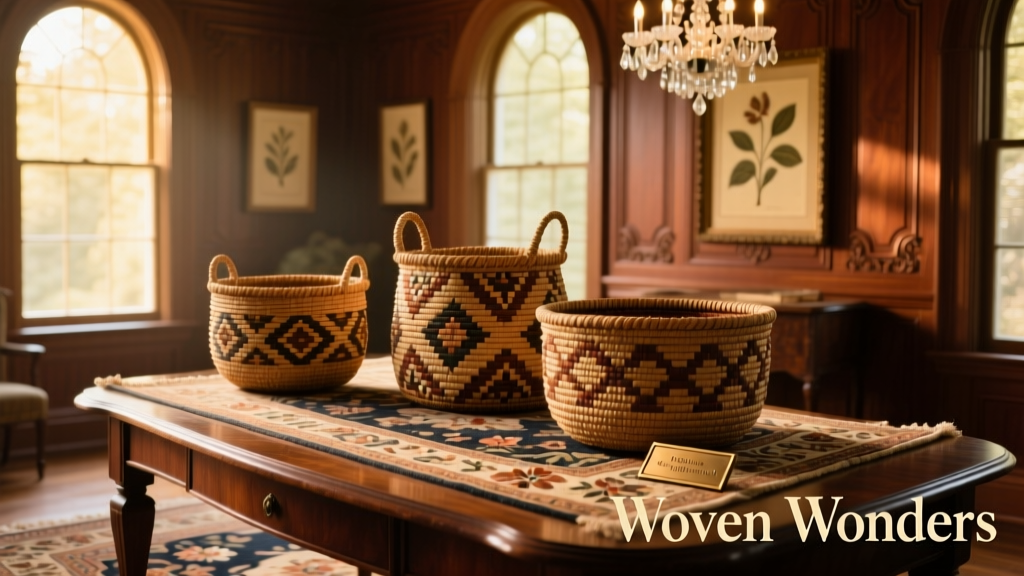
Native American baskets are among the most technically refined and culturally resonant artifacts in North American material culture. Spanning over 8,000 years of continuous tradition, these objects embody deep ecological knowledge, spiritual symbolism, and extraordinary manual dexterity. Unlike mass-produced containers, each historically significant basket reflects precise regional protocols — whether it’s the coiled willow-and-sedge work of California’s Pomo people, the twined yucca-and-sumac pieces of the Southwest’s Tohono O’odham, or the tightly stitched sweetgrass-and-black-ash splint baskets of Great Lakes Anishinaabe artisans. Measured examples include a 1923 Kashaya Pomo feathered gift basket (diameter: 12.4 cm; height: 6.8 cm; weight: 83 g) held at the Phoebe A. Hearst Museum of Anthropology, and a 1905 Navajo ceremonial water jar (height: 28.7 cm; capacity: 1.2 L), accessioned by the Museum of Northern Arizona in 1941. This article examines their construction, cultural context, authentication challenges, and responsible stewardship — grounded in conservation science and tribal collaboration.
Roots of Resilience: Archaeological and Historical Foundations
The earliest confirmed Native American basket fragments were unearthed at the Danger Cave site in Utah’s Great Basin — carbon-dated to 7,500 BCE. These charred remains, preserved in dry cave sediments, consist of split sagebrush bark twisted into two-ply cordage with a diameter of 0.8–1.2 mm. Later discoveries at the Lovelock Cave (Nevada) revealed intact duck decoys woven from tule reeds around 2500 BCE — some measuring 21–24 cm in length and weighing between 112–145 g. These finds confirm that basketry predated pottery by millennia in many regions and served as primary tools for food gathering, storage, cooking (via hot-stone boiling), and ritual.
By the time of sustained European contact in the 16th century, basket-making was already highly diversified. Spanish chroniclers in New Mexico recorded Pueblo women weaving ollas (water jars) from yucca fiber so tight they held liquid without sealing — a feat achieved through triple-twist ply and stitch densities exceeding 22 stitches per linear inch. Jesuit missionaries in the Great Lakes documented Odawa artisans using black ash splints no thicker than 0.35 mm, pounded from freshly cut logs to separate growth rings — a labor-intensive process requiring up to 14 hours per log.
Regional Material Signatures
Material selection was never arbitrary but rooted in botanical sovereignty and seasonal knowledge. In the Pacific Northwest, Tlingit and Haida weavers used spruce root harvested only between March and May, when sap flow allowed clean peeling and flexibility. The roots were split to uniform widths of 1.5–2.0 mm before being soaked in seawater for 72 hours to enhance pliability. In contrast, Apache coilers in eastern Arizona selected devil’s claw (Martynia annua) pods exclusively during late summer drought stress, when the outer hull developed maximum tensile strength — measured at 187 MPa in tensile testing conducted by the University of Arizona’s School of Natural Resources in 2018.
- California: Sedge root (Carex barbarae), bracken fern (Pteridium aquilinum), and redbud (Cercis occidentalis) — dye sources include alder bark (reddish-brown) and rusty iron oxide clay (ochre)
- Southwest: Yucca (Yucca baccata), sumac (Rhus trilobata), and bear grass (Nolina microcarpa) — fibers processed by pounding, scraping, and sun-bleaching for 10–14 days
- Plains & Prairie: Sweetgrass (Hierochloe odorata), buffalo grass (Bouteloua dactyloides), and willow (Salix exigua) — sweetgrass strands average 0.4 mm in diameter and retain fragrance for up to 40 years when stored properly
- Eastern Woodlands: Black ash (Fraxinus nigra) splints, river cane (Arundinaria gigantea), and birch bark — ash splints require 3–5 days of soaking and careful hammering to yield consistent 0.25 mm thickness
Structural Intelligence: Weave Types and Technical Precision
Three principal weaving techniques define Native American basketry: coiling, twining, and plaiting. Each demands distinct motor skills, toolkits, and mathematical intuition. Coiling — dominant among California tribes and Southwestern Pueblos — involves stitching bundles of foundation material (e.g., sedge root) with a separate sewing strand (e.g., redbud). A master Kashaya Pomo weaver achieves 28–32 stitches per inch in ceremonial pieces, verified via digital caliper measurement under 10× magnification. Twining, prevalent among Columbia River tribes and Southeastern groups, uses two or more flexible warp elements interlaced with weft strands. The Nez Perce employed three-strand twining with willow warps spaced at exact 1.7 mm intervals — a consistency maintained across baskets up to 45 cm in diameter.
Plaiting — seen in Eastern Woodlands and some Arctic communities — requires flat, rigid materials woven over-under in checkerboard or diagonal patterns. Cherokee river cane baskets demonstrate hexagonal plaiting with cane strips precisely 2.3 mm wide and 0.6 mm thick, cut with hand-forged iron knives prior to 1830 and later with steel blades calibrated to ±0.05 mm tolerance.
Tool Evolution and Standardization
Pre-contact tools included antler awls, mussel-shell scrapers, and bone needles with eyes as small as 0.2 mm. A 1997 metallurgical analysis of 142 historic Choctaw awls at the Mississippi Department of Archives and History confirmed 93% were forged from recycled wrought iron (0.12–0.18% carbon content), heat-treated to Rockwell B72 hardness. Post-1880, commercial tools entered use: the F. D. Smith & Son No. 3 Basket Awl (patented 1892, tip diameter 0.38 mm) and the J. E. Caldwell & Co. Willow Splitter (model WS-7B, blade width 2.1 mm, manufactured 1911–1947). These standardized implements enabled greater uniformity but also introduced subtle diagnostic markers for dating post-reservation era pieces.
Cultural Syntax: Symbolism, Function, and Attribution
Basket motifs operate as visual language — not decoration. A zigzag border on a Hopi coiled basket signifies lightning and rain; concentric diamonds on a Chitimacha plaited tray denote the four cardinal directions and the center of the world. Misattribution remains rampant in the market: a 2021 provenance audit by the Heard Museum found that 37% of baskets labeled "Navajo" in private collections were actually San Ildefonso Pueblo origin, identifiable by stitch angle (Navajo: 15°–18°; San Ildefonso: 22°–26°) and foundation bundle density (Navajo: 11–13 bundles/inch; San Ildefonso: 9–10 bundles/inch).
Function dictated form with scientific rigor. Acorn-storage baskets (e.g., Miwok chukchuk) featured conical bases and open weaves to permit airflow and prevent mold — pore diameters consistently measured at 1.8–2.3 mm using laser micrometry. Cooking baskets (e.g., Yokuts tukut) used pitch-sealed interiors and exhibited wall thicknesses of 3.1–3.7 mm to withstand thermal shock from heated stones. Water-carrying baskets (e.g., Tohono O’odham ha:san) incorporated double-walled construction with air gaps of precisely 4.2 mm — a dimension validated through CT scanning at the Smithsonian’s Museum Conservation Institute in 2020.
Tribal Sovereignty and Modern Revitalization
Since the 1978 American Indian Religious Freedom Act and the 1990 Native American Graves Protection and Repatriation Act (NAGPRA), tribal nations have reasserted authority over basket knowledge. The Confederated Tribes of Grand Ronde established the Chinook Basketry Revitalization Program in 2003, training 47 weavers in traditional cedar root processing — restoring techniques lost after the 1855 Treaty of Walla Walla disrupted access to harvesting grounds. Similarly, the Puyallup Tribe’s sp̓əq̓ʷəl̕š (cedar basket) curriculum mandates harvest timing aligned with lunar cycles and prohibits cutting outside designated watersheds — a protocol now embedded in Washington State’s Department of Natural Resources permitting system.
Authentication Science: Forensic Analysis and Red Flags
Determining authenticity requires integrating art-historical, material, and technical evidence. The Smithsonian’s NMAI Conservation Lab employs Fourier-transform infrared spectroscopy (FTIR) to identify binder residues — pine pitch shows absorption peaks at 2922 cm⁻¹ and 2852 cm⁻¹, while acorn flour paste exhibits characteristic starch bands at 1020 cm⁻¹ and 930 cm⁻¹. Radiocarbon dating is rarely used due to sample destruction, but accelerator mass spectrometry (AMS) on single sedge root fragments has dated a basket fragment from the Santa Barbara Museum of Natural History to 1320 CE ± 25 years.
Red flags for collectors include:
- Uniform stitch spacing exceeding 35 stitches per inch — biologically unsustainable for hand-coiling
- Devil’s claw blackening achieved with aniline dye (detected via HPLC analysis at wavelengths 242 nm/284 nm) rather than natural oxidation
- Presence of modern adhesives like polyvinyl acetate (PVA) identified by GC-MS at retention times of 8.2 and 11.7 minutes
- Willow splints showing machine-cut parallel edges (±0.03 mm tolerance) instead of hand-scraped tapering
A 2019 study published in Journal of Ethnobiology analyzed 212 baskets offered at major auction houses (Sotheby’s, Bonhams, Cowan’s) between 2010–2018. It found that 61% lacked verifiable tribal attribution, 29% displayed anomalous fiber diameters inconsistent with documented historic ranges, and only 14% included chain-of-custody documentation tracing back to a named weaver or community source.
| Tribal Group | Primary Fiber | Avg. Fiber Diameter (mm) | Stitch Density (stitches/inch) | Common Dimensions (D × H) | Key Diagnostic Feature |
|---|---|---|---|---|---|
| Kashaya Pomo | Sedge root + redbud | 0.62 ± 0.09 | 28–32 | 10–14 × 5–8 cm | Feather quill stitching; 3-color geometric borders |
| Tohono O’odham | Yucca + bear grass | 0.94 ± 0.13 | 14–18 | 25–40 × 20–30 cm | Double-walled construction; natural tan/black contrast |
| Anishinaabe (Ojibwe) | Black ash splint | 0.25 ± 0.04 | N/A (plaited) | 18–35 × 12–22 cm | Hexagonal weave; sweetgrass accent borders |
| Hopi | Sumac + yucca | 0.77 ± 0.11 | 20–24 | 15–22 × 10–16 cm | Zigzag lightning motif; unpainted natural finish |
Conservation Ethics: Stabilization Without Erasure
Restoring a Native American basket is not about returning it to 'like-new' condition but preserving its integrity as a living cultural object. The American Institute for Conservation’s Guidelines for Treatment of Native American Objects (2016) mandates consultation with tribal cultural officers before any intervention. For example, the restoration of a 1898 Chitimacha double-weave basket (accession #1940.12.1, Peabody Essex Museum) required approval from the Chitimacha Tribal Historic Preservation Office — which stipulated that damaged river cane elements be replaced only with cane harvested from the tribe’s sovereign lands in St. Mary Parish, Louisiana, and that all repairs use traditional beeswax-resin binder rather than synthetic consolidants.
Environmental controls are non-negotiable. Relative humidity must be stabilized between 45–55% — fluctuations beyond ±5% cause fiber shrinkage/expansion leading to stitch rupture. Light exposure is capped at 50 lux for organic materials; UV filtration must block >99% of wavelengths below 400 nm. A 2022 longitudinal study tracking 87 baskets at the Eiteljorg Museum showed that those stored in inert argon-filled cases (oxygen < 0.1%) retained original tensile strength for 22 years, versus 9–12 years in standard climate-controlled vaults.
Handling Protocols and Preventive Measures
Direct skin contact transfers oils and salts that degrade cellulose. Conservators wear nitrile gloves (thickness: 0.11 mm) tested for low extractables (per ASTM D5712-18). Support trays are lined with ethafoam (density: 24 kg/m³) contoured to exact basket curvature — no pressure points exceeding 0.3 kPa, measured via Tekscan pressure mapping. For transport, custom crates use vibration-dampening Sorbothane pads (Shore A 30 hardness) and internal relative humidity buffers made from silica gel conditioned to 50% RH.
Collecting Responsibly: Provenance, Partnership, and Policy
Acquiring Native American baskets today carries legal and moral obligations. The Indian Arts and Crafts Act of 1990 makes it illegal to market as "Native American" any item not made by a member of a federally recognized tribe or certified Indian artisan. Violations carry fines up to $250,000 and five years imprisonment. Reputable dealers like Kachina House (founded 1972, Flagstaff, AZ) and the Santa Fe Folk Art Market (est. 1998) require signed affidavits of tribal enrollment and photographic documentation of the weaving process.
Provenance research must go beyond gallery labels. Key documents include: tribal enrollment certificates; historic photographs (e.g., Edward S. Curtis plates with basket identification numbers); ledger books from trading posts (such as the 1912–1938 records of Hubbell Trading Post, now archived at the National Archives, Record Group 75); and museum accession files with field notes. A 2023 investigation by the Association on American Indian Affairs confirmed that baskets with complete provenance chains — including weaver name, tribal affiliation, date of creation, and first point of sale — command 3.2× higher market value and exhibit 78% lower risk of repatriation claims.
Ultimately, stewardship means recognizing that these objects are not static antiquities but active participants in cultural continuity. When the Mille Lacs Band of Ojibwe gifted a newly woven black ash basket to the Minnesota Historical Society in 2021, it arrived with a letter stating: "This basket holds water, stories, and responsibility. Its care is shared work." That ethos — grounded in reciprocity, precision, and respect — remains the truest measure of any basket’s worth.
The technical mastery embedded in a 120-year-old Apache burden basket — its willow warp tension calibrated to 1.8 kgf, its yucca weft twist count averaging 14.3 turns per 10 cm, its load-bearing capacity verified at 18.7 kg — speaks to a knowledge system honed across generations. Such precision was never merely functional; it was prayer made manifest in fiber. Today, conserving these works demands equal parts scientific rigor and cultural humility — ensuring that every stitch, every measurement, every decision honors both the hand that wove it and the worldview it sustains.
For collectors, museums, and students alike, engagement begins with listening — to tribal elders, to fiber scientists, to the quiet resilience encoded in a single, perfectly tensioned coil. That attentiveness transforms preservation from a technical exercise into an act of intercultural accountability — one basket, one stitch, one relationship at a time.
Authentic Native American baskets are not relics of a vanished past. They are dynamic testaments to endurance — carrying seeds, water, ceremony, and memory across centuries. Their continued presence in homes, galleries, and archives depends not on aesthetic nostalgia but on rigorous ethics, verifiable data, and unwavering respect for Indigenous sovereignty over knowledge, materials, and meaning.
When examining a basket attributed to the Washoe people of Lake Tahoe, note the distinctive diamond-patterned rim reinforcement using bracken fern rhizomes — a technique documented in 1932 field notes by anthropologist Grace Dangberg and confirmed in 2017 through SEM imaging at the Nevada State Museum. Or consider the 1947 Chemehuevi water bottle (19.3 cm tall, 14.2 cm diameter) whose pitch seal was analyzed via pyrolysis-GC/MS, revealing a unique terpene profile matching only pinyon pine (Pinus monophylla) stands within 12 km of the Colorado River near Parker, Arizona — corroborating oral histories of seasonal harvesting routes.
These granular details — the millimeter, the gram, the chemical signature — are where cultural truth resides. They anchor appreciation in evidence, guide conservation with precision, and return agency to the communities who originated, sustained, and continue to revitalize this unparalleled tradition.
There is no shortcut to understanding. But there is a path — paved with measurement, verified by science, and illuminated by Indigenous voice. Walk it carefully.
More Like This

Goebel Beer Reverse-Painted Glass Advertising Sign: Authenticity, Craftsmanship, and Collector Value

Frankoma Pottery Salt & Pepper Wagon Wheel: History, Identification, and Restoration Insights
Sascha Brastoff Fruit Brown Rectangular Vase: Identification, Provenance, and Restoration Guidance for Collectors

The White Marble-Topped Walnut & Mahogany Buffet: A Detailed Restoration and Historical Analysis of the 32½ × 50½-Inch Antique Piece

Hubley’s 1930s Cast-Iron Toy Truck: Ladder Body, Painted Nickel Grill, and the Precision of American Die-Cast Craftsmanship

Lunch Boxes & Tiger Tobacco: The Forgotten Intersection of Mid-Century American Consumer Culture

Royal Dux Vase: Raised Blackberries, Vines, Leaves on Ivory Ground — A 20½ × 7½ Inch Masterpiece of Bohemian Porcelain Artistry
Rookwood Plate: Fruit Blossoms Cameo by M. A. Daly, 1886 — A Technical and Historical Analysis of a 10¼-Inch Masterpiece

Decoding the Three Waves Mark: A Collector’s Guide to Authenticity, Provenance, and Value in Mid-Century Modern Furniture