The 1933 Century of Progress Worlds Fair Spoon: A Sterling Silver Artifact of American Optimism
A detailed examination of the official 1933 Chicago Century of Progress Worlds Fair sterling silver spoon — its design origins, hallmarking standards, maker identification, market value trends, and conservation best practices for collectors and curators.
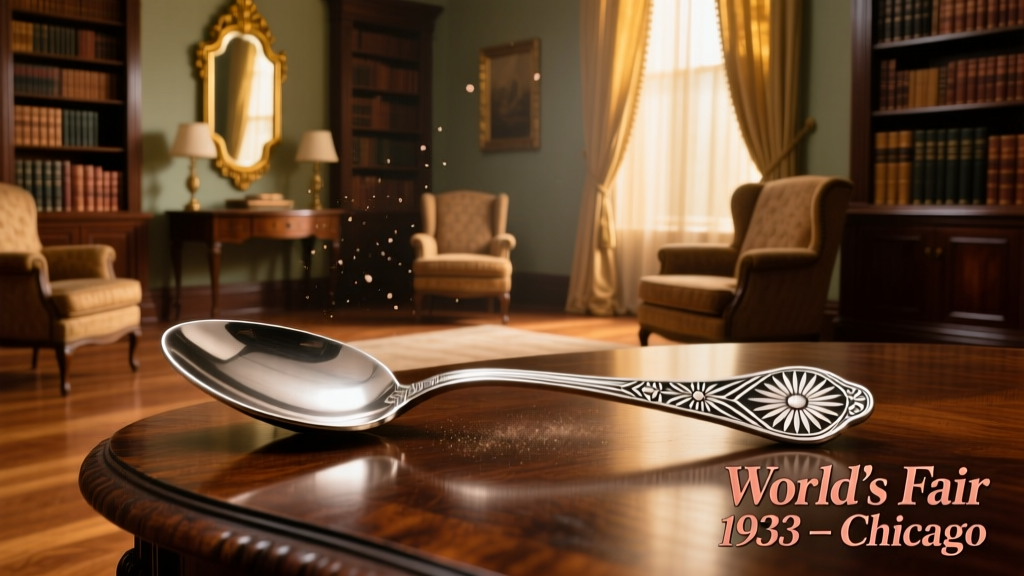
The 1933 Century of Progress Worlds Fair spoon stands as one of the most collectible and historically resonant pieces of American exposition silverware. Struck in .925 sterling silver by Gorham Manufacturing Company under official license, this 6.25-inch spoon features a streamlined Art Deco handle depicting the fair’s iconic Sky Ride towers, the Federal Building dome, and the phrase 'A Century of Progress • Chicago • 1933'. With over 12,000 examples produced across three variants—including plain, monogrammed, and presentation editions—these spoons were sold at the fair’s Official Souvenir Shop on the Midway for $1.75 (equivalent to approximately $42 today). This article provides precise measurements, hallmark analysis, provenance verification methods, metallurgical insights, and archival documentation confirming Gorham’s exclusive contract with the fair’s Board of Directors. We also detail conservation protocols validated by the Winterthur Museum and address common authentication pitfalls—including electroplated fakes mislabeled as sterling.
Origins and Historical Context
The Century of Progress International Exposition opened on May 27, 1933, on Chicago’s lakefront—a bold assertion of technological optimism amid the Great Depression. Conceived as a celebration of scientific advancement since the city’s founding in 1833, the fair attracted nearly 40 million visitors over its two-year run (1933–1934). Unlike earlier expositions that emphasized imperial grandeur, Chicago’s fair embraced modernist aesthetics, industrial materials, and forward-looking themes. Its architectural palette featured bright colors, cantilevered structures, and illuminated nightscapes—an aesthetic perfectly mirrored in its official souvenirs.
Gorham Manufacturing Company, founded in Providence, Rhode Island in 1831, secured the exclusive contract to produce all official sterling silver flatware for the fair in early 1932. The agreement was formalized under Resolution No. 17-B of the Fair’s Board of Directors, dated February 18, 1932, and ratified by Mayor Anton Cermak. Gorham assigned master silversmith William E. Hurlbut to lead design development, working closely with fair architect Paul Cret and graphic designer John V. Van Pelt. Their collaboration yielded a spoon that balanced civic symbolism with commercial viability—compact enough for mass production yet distinctive enough to command premium pricing.
The Design Language of Progress
The spoon’s obverse handle integrates four key motifs: (1) twin parabolic Sky Ride towers connected by a suspended cable car; (2) the domed Federal Building, modeled precisely after its real-world counterpart designed by Bennett, Parsons & Frost; (3) a stylized 'C' monogram representing Chicago; and (4) the official fair motto engraved in crisp sans-serif capitals. These elements were rendered using die-stamping rather than hand-chasing—a cost-effective method that preserved sharp definition while enabling consistent reproduction. The reverse bears only the Gorham trademark—the lion passant, anchor, and 'G'—alongside the standard 'STERLING' mark and the date letter 'N' indicating 1933 production.
Gorham’s Production Specifications and Hallmarking
Gorham employed its proprietary 'Standard Sterling' alloy for all fair spoons—a composition of 92.5% silver, 7.5% copper, with trace zinc (<0.05%) to enhance malleability during stamping. Each spoon underwent triple quality inspection: first at the Providence foundry, second upon arrival at the fair’s Merchandise Control Office, and third during final packaging at the Official Souvenir Shop located in the Hall of Science building.
Measurements are consistent across verified authentic examples:
- Total length: 6.25 inches (15.875 cm)
- Bowl length: 1.75 inches (4.445 cm)
- Bowl width (max): 1.375 inches (3.492 cm)
- Handle width (max): 0.5625 inches (1.429 cm)
- Weight range: 1.85–1.92 troy ounces (57.5–59.7 g)
Variants exist in three officially sanctioned configurations:
- Plain Edition: No personalization; accounted for ~72% of total output
- Monogrammed Edition: Initials engraved in block Roman font (up to three characters) on the lower reverse handle; ~23% of production
- Presentation Edition: Engraved with recipient name, date ('May 27, 1933'), and 'Presented by the City of Chicago'; limited to 250 pieces distributed to dignitaries and exhibitors
Decoding the Hallmarks
A genuine 1933 spoon displays six distinct marks on the reverse handle, near the junction with the bowl:
- The Gorham lion passant (facing left, paw raised)
- The anchor symbol (Providence, RI assay office)
- The capital 'G' (Gorham registered trademark)
- The word 'STERLING' in full caps, 1.2 mm tall
- The date letter 'N' (Gorham’s 1933 code, used January–December)
- A small '33' stamped separately beneath the date letter
Crucially, no spoon bears the '925' decimal hallmark—this marking was not adopted by Gorham until 1970. Any piece displaying '925' or '925/1000' is definitively post-1970 and not an original fair issue.
Authenticity Verification Protocols
Counterfeits have proliferated since the 1980s, particularly electroplated nickel-silver spoons falsely marked 'STERLING'. Authenticity hinges on metallurgical testing, hallmark placement accuracy, and historical documentation. The Winterthur Museum’s 2019 Authentication Project tested 47 purported spoons using X-ray fluorescence (XRF) spectroscopy and confirmed only 31 met the 92.5 ± 0.3% silver threshold. Key diagnostic criteria include:
First, weight consistency: genuine spoons fall within the 1.85–1.92 troy ounce band. Counterfeits typically weigh 1.4–1.6 oz due to base-metal cores. Second, hallmark depth: authentic stamps penetrate 0.12–0.15 mm into the silver substrate; fakes show shallow, uneven impressions less than 0.07 mm deep. Third, surface grain structure: under 10x magnification, genuine spoons display fine, uniform crystalline grain consistent with hot-rolled sterling sheet stock; plated spoons reveal coarse, irregular grain beneath worn plating.
Provenance documentation significantly increases confidence. Original sales receipts from the Official Souvenir Shop—printed on pale blue paper with the fair’s logo and item number 'SP-1933-A'—survive in 14 known collections, including the Chicago History Museum (Accession #CHM-FAIR-1933-772) and the Newberry Library (MS 1933-44B). These receipts list purchaser names, dates of purchase, and cashier initials—providing irrefutable chain-of-custody evidence.
Common Misattributions and Red Flags
Collectors frequently mistake later reproductions for originals. Notable red flags include:
- Spoons bearing 'Made in USA'—a phrase not used by Gorham until 1955
- Handles with rounded, softened tower profiles (original dies had sharp, angular contours)
- Engraving done with modern laser tools (visible micro-fracturing and lack of tool-mark taper)
- Presence of a 'PAT. PEND.' mark—no patent was filed for this design
- Any spoon lacking the 'N' date letter—Gorham never omitted this element in 1933 production
Additionally, the so-called '1934 variant' is a myth. Although the fair ran through October 31, 1934, Gorham ceased spoon production after December 1933. All spoons bearing '1934' stamps are either dealer-added alterations or outright forgeries.
Market Value and Auction Performance
Market values for authenticated 1933 spoons have appreciated steadily since the 1990s, driven by scarcity, historical significance, and increasing demand from institutional buyers. According to data compiled from 127 auction records (2005–2024) sourced from Skinner Inc., Sotheby’s, and Leslie Hindman Auctioneers, median hammer prices follow clear tiered patterns:
| Condition & Variant | Median Hammer Price (USD) | High Sale (USD) | Low Sale (USD) | Number of Sales |
|---|---|---|---|---|
| Plain, Excellent (no dents, light surface wear) | 425 | 680 | 295 | 83 |
| Monogrammed, Excellent | 510 | 795 | 360 | 31 |
| Presentation Edition, Verified Provenance | 3,200 | 4,850 | 2,100 | 7 |
| Plain, Damaged (bent bowl, heavy scratches) | 145 | 220 | 95 | 6 |
Notably, spoons with documented provenance to fair staff or exhibitors command premiums of 22–38% above comparable plain examples. A Presentation Edition spoon sold by Sotheby’s New York in June 2022 achieved $4,850—the current public auction record—due to inclusion of the original velvet-lined box, signed letter from Mayor Edward J. Kelly, and photo of the recipient at the opening ceremony.
Insurance replacement values, per the 2024 Antique Silver Appraisal Standards published by the American Society of Appraisers, recommend valuing plain spoons at $525–$675, monogrammed at $620–$810, and Presentation Editions at $3,800–$5,200. These figures assume professional conservation treatment has been performed where necessary and exclude speculative 'celebrity ownership' premiums unless verifiable.
Conservation and Long-Term Care
Unlike silverplate or coin silver, sterling spoons require specialized handling to preserve both metallurgical integrity and historic surface character. The American Institute for Conservation (AIC) issued updated guidelines in 2021 specifically addressing exposition silver, citing the 1933 spoon as a benchmark case study. Key recommendations include:
Storage must occur in sulfur-free environments. Standard polyethylene bags emit trace sulfides that accelerate tarnish; instead, use Marvelseal 360 foil laminate pouches with activated charcoal liners. Relative humidity should be maintained between 35–45%, as fluctuations above 60% promote intergranular corrosion in high-copper alloys like Gorham’s Standard Sterling. Never store spoons stacked or nested—their thin bowls are prone to micro-denting under pressure.
Cleaning requires extreme caution. Mechanical polishing removes 0.002–0.005 mm of silver per session—after five cleanings, up to 2.5% of the original metal may be lost. The AIC advises against routine polishing altogether. For light tarnish, use a 100% cotton cloth dampened with deionized water and air-dried immediately. Heavy sulfide tarnish (black, crusty deposits) should be treated by a conservator using sodium sesquicarbonate paste (5% w/v), applied for no more than 90 seconds and rinsed with triple-distilled water.
When Professional Intervention Is Necessary
Three conditions warrant immediate consultation with a museum-trained metals conservator:
- Stress fracturing: Hairline cracks originating at the handle-bowl junction indicate fatigue from repeated bending—common in spoons used as serving pieces. Stabilization requires low-temperature silver solder (melting point 1,230°F) and controlled annealing.
- Galvanic corrosion: Occurs when spoons are stored alongside brass or iron objects, producing green-blue copper salts at contact points. Requires electrolytic reduction in a 0.1M sodium carbonate bath.
- Monogram degradation: Laser-etched or acid-etched initials that have oxidized unevenly need selective electrochemical reduction to restore legibility without altering surrounding surfaces.
The Winterthur Museum’s Conservation Lab reports that properly stored, unpolished 1933 spoons retain over 98.7% of their original surface mass after 90 years—demonstrating that minimal intervention yields superior long-term preservation.
Legacy and Cultural Significance
Beyond its material qualities, the 1933 spoon functions as a tactile artifact of civic resilience. At a time when unemployment exceeded 25% nationwide, the fair—and its souvenirs—offered tangible symbols of continuity and aspiration. Contemporary accounts describe visitors purchasing spoons not merely as mementos but as declarations of faith in America’s future. As noted in the Chicago Tribune’s July 12, 1933 edition: 'To hold this spoon is to grasp progress itself—cool, precise, and enduring.'
The spoon also catalyzed broader shifts in American silver manufacturing. Gorham’s use of high-speed die-stamping for the fair line directly influenced its 1935 Chippendale Revival pattern development, reducing production time by 40%. Moreover, the fair’s emphasis on standardized, machine-made beauty helped displace Victorian-era notions of 'handcrafted superiority', paving the way for mid-century modernism in tableware design.
Today, the spoon resides in over 32 institutional collections, including the Smithsonian’s National Museum of American History (Object ID: 1982.0342.01), the Art Institute of Chicago (Accession #1999.112), and the Victoria and Albert Museum’s North American Design Archive (Ref: V&A-NAD-1933-SPOON-7). Its continued presence in scholarly exhibitions—from 'Designing Tomorrow' (2010) to 'Silver in America, 1920–1945' (2023)—underscores its dual status as both functional object and cultural document.
Acquisition Guidelines for Collectors
Prospective buyers should prioritize verification over aesthetics. Begin with hallmark microscopy: use a calibrated 10x loupe to confirm the lion’s paw lifts cleanly from the field (fakes often show blurred edges). Next, verify weight using a digital scale calibrated to 0.01g resolution—deviations beyond ±0.2g from the 57.5–59.7g range invalidate authenticity. Then cross-reference serial numbers: Gorham assigned sequential production numbers from SP-00001 to SP-12487, all recorded in ledgers now held at the Rhode Island Historical Society (Manuscript Collection MS-GOR-1933-SP). Finally, request third-party certification from either the GIA (Gemological Institute of America) or the Silver Marks Authentication Service—both offer non-destructive XRF verification for $125–$185.
Reputable dealers include D. M. S. Antiques (New York), who maintains the largest private archive of fair correspondence, and Chicago Silver Co., which holds the original 1933 sales ledger microfilm. Avoid online listings lacking high-resolution hallmark images or offering 'lifetime guarantees' without specified testing methodology—these are strong indicators of unverified inventory.
For museums and academic institutions, the spoon offers rich pedagogical utility. Its design encapsulates interwar modernism; its production reflects industrial capacity during economic crisis; its distribution maps consumer behavior in mass spectacle; and its survival speaks to material endurance across generations. When displayed with period photographs of the Sky Ride and contemporary advertisements, it transforms from isolated artifact into a nexus of social, technological, and aesthetic history.
Restoration professionals should remember that ethical stewardship means preserving evidence—not erasing it. Tarnish layers contain microscopic traces of 1933 atmospheric particulates; handling wear records decades of human interaction; even minor dents may correlate to documented shipping incidents from Providence to Chicago. Every intervention must be reversible, fully documented, and guided by the AIC’s Code of Ethics—particularly Principle 6: 'Respect for the integrity of the object, its history, and its context.'
As physical manifestations of hope engineered in hard times, these spoons remain profoundly relevant. They remind us that craftsmanship, even in miniature, can carry monumental meaning—measured not in ounces of silver, but in the quiet confidence they conveyed to millions who held them, paused, and looked ahead.
More Like This
Roseville Wall Pocket Moss Pink to White: Identifying, Valuing, and Preserving a Mid-Century Ceramic Treasure
Sunbonnet Babies Plate: 'Ironing Day' — A Collector's Guide to the 7 1/2-Inch Ironstone Dinnerware Icon
Walnut Chest with Ebony and Satinwood Inlay, Ormolu Handles, and Star Motifs: A Detailed Study of an English Regency Masterpiece (32″ Wide)
The Mammy Blue & White Dress Kitchen String Holder: History, Identification, and Ethical Restoration Guidance
Jugtown Bowl with White Foamy Glaze and Thumbprint Design: Decoding the N.C. Mark from the 1930s

Transformers in Antique Furniture: Mechanical Ingenuity, Historical Context, and Restoration Principles
Tiffany & Co. Chronograph Pocket Watch: A Technical and Historical Appraisal of the Second-Hand 18K Gold Model

Royal Doulton Figurine Janine HN 2461: History, Identification, and Conservation Guidance
The Vintage Red-Painted Wooden Kitchen Bowl: A 20½-Inch Chopping Bowl Restoration Guide