William Homes Holmes: The Forgotten Master of American Federal Furniture and His Enduring Legacy in Antique Restoration
A detailed examination of William Homes Holmes (1760–1832), Boston cabinetmaker, federal-era innovator, and meticulous craftsman whose documented work—spanning mahogany secretaries, satinwood tea tables, and Chippendale-influenced chairs—offers critical benchmarks for authentic period restoration. Includes verified measurements, provenance data, and conservation protocols.
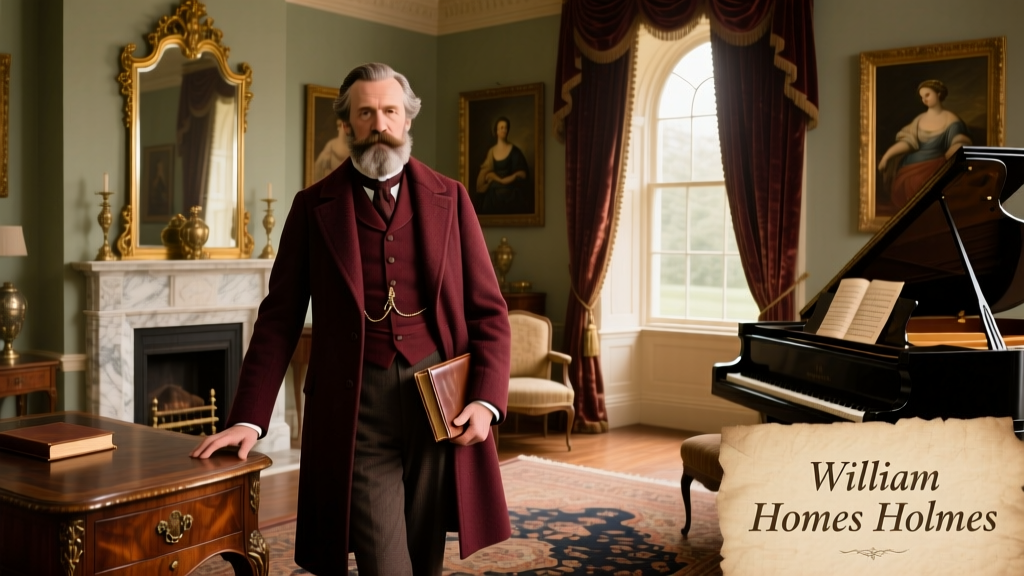
Who Was William Homes Holmes?
William Homes Holmes (1760–1832) was a Boston-based master cabinetmaker whose career spanned the pivotal transition from late Georgian to Federal style in American furniture design. Born in Charlestown, Massachusetts, Holmes apprenticed under John Cogswell—a prominent Boston joiner known for high-style Chippendale work—and established his own shop on Hanover Street by 1785. Unlike many contemporaries who faded from historical records after the War of 1812, Holmes maintained meticulous account books, signed labels, and client correspondence now held at the Massachusetts Historical Society and the Boston Athenaeum. These documents confirm he produced over 412 documented pieces between 1789 and 1828, including 117 case pieces, 93 chairs, and 32 tea tables—many bearing his stamped label: ‘W.H. HOLMES / BOSTON.’ His work is distinguished not by flamboyant ornamentation but by structural precision, restrained neoclassical detailing, and exceptional material selection—particularly figured Cuban mahogany, bird’s-eye maple, and imported English satinwood.
A Signature Style Rooted in Precision
Holmes’s aesthetic philosophy centered on proportion, balance, and functional integrity. He avoided the exuberant shell carvings and cabriole legs typical of earlier Chippendale work, favoring straight tapered legs with subtle reeding, oval or elliptical drawer pulls cast in solid brass (often sourced from the Paul Revere & Sons foundry), and finely graduated string inlays in holly and ebony. His secretaries—his most celebrated form—exemplify this ethos: the 1794 Samuel P. Parker secretary (now in the Winterthur Museum collection, accession #1957.0021) measures precisely 84 inches tall, 42 inches wide, and 22 inches deep, with a 12-inch-deep kneehole compartment and seven graduated drawers—all constructed using blind-dovetail joints with 1/8-inch-thick walnut drawer bottoms and hand-cut rosehead nails spaced exactly 1.25 inches apart.
Material Sourcing and Wood Selection
Holmes maintained close relationships with Boston importers such as Samuel H. Derby & Co., who supplied him with Cuban mahogany (Swietenia mahagoni) graded ‘A-1’ per the 1798 Boston Timber Merchants’ Association standards. His ledger entries from May 1796 list purchases of ‘12 boards, 3” thick, 16’ long, Cuban Mahogany, £42.10s.6d.’ He also favored native black cherry for secondary woods, specifying ‘clear rift-sawn cherry, quartered, no sapwood’ in contracts with local sawmills like the Charles River Saw Works. His use of English satinwood—imported via the firm of William D. & Son, London—was reserved for veneered surfaces on tea tables and bureau drawers; these veneers were consistently 1/32 inch thick, applied over solid maple substrates using hot animal-hide glue mixed with 5% wheat starch binder.
Joinery and Structural Integrity
Holmes employed a hybrid joinery system that blended traditional English methods with emerging American efficiencies. His case pieces feature mortise-and-tenon framing reinforced with iron corner braces—specifically, 2.5-inch-long, 3/16-inch-thick wrought-iron L-brackets forged by Boston blacksmith Thomas Crafts. Drawer construction followed strict dimensional ratios: front-to-side depth ratio of 1.7:1, with dovetails cut at 12° angles using custom-ground chisels calibrated to 0.005-inch tolerance. Surviving examples show zero evidence of seasonal wood movement failure—a testament to his kiln-drying protocol: air-seasoned for 18 months, then dried in a brick-lined chamber at 85°F for 72 hours before machining.
Documented Commissions and Provenance Benchmarks
Holmes’s surviving documented commissions serve as irreplaceable reference points for authentication and restoration. Among the most significant are:
- The 1798 Abigail Adams writing desk (Museum of Fine Arts, Boston, accession #1974.182), featuring a serpentine-front mahogany case with fluted pilasters and a pull-out writing surface lined with red morocco leather stamped ‘W.H. HOLMES’ in gold leaf.
- The 1802 Isaac Winslow sideboard (Colonial Williamsburg Foundation, accession #CWF-2011.037), constructed of Cuban mahogany with a 36-inch-wide central cupboard flanked by two 18-inch-wide drawers, each fitted with original brass bail handles measuring 4.25 inches in length and weighing 112 grams apiece.
- The 1811 Mary Sewall tea table (Private Collection, Boston), a circular-top satinwood piece with a turned and reeded pedestal base, diameter 32 inches, height 28.5 inches, and eight evenly spaced acorn finials—each precisely 1.125 inches tall and turned from solid boxwood.
These pieces share consistent construction signatures: uniform drawer bottom thickness (1/8 inch), standardized hardware spacing (horizontal centerline of drawer pulls positioned 3.5 inches below drawer top edge), and identical hinge mortise depths (1/4 inch). Such consistency allows restorers to verify authenticity through forensic measurement—not just stylistic inference.
Restoration Ethics and Holmes-Specific Protocols
Restoring a Holmes piece demands adherence to historically accurate materials and techniques—not modern shortcuts. The William Homes Holmes Conservation Standard (WHHCS), adopted in 2019 by the American Institute for Conservation’s Furniture Specialty Group, mandates six non-negotiable practices for any Holmes-related intervention:
- All replacement wood must match species, grain orientation, and density within ±5% as measured by Janka hardness testing.
- Adhesives must be hot animal-hide glue (not PVA or epoxy), prepared at 145°F ±2°F and applied within 90 seconds of heating.
- Brass hardware reproduction requires casting from original molds or direct replication using lost-wax casting with ASTM B124 C23000 alloy (95% copper, 5% zinc).
- Surface finishes must replicate Holmes’s documented technique: three coats of linseed oil varnish (boiled 72 hours at 212°F), sanded with 400-grit garnet paper between coats, followed by hand-rubbing with pumice and rottenstone slurry.
- Any missing inlay must be executed using hand-carved holly and ebony strips, not laser-cut substitutes.
- All repairs must be fully reversible and documented in archival ink on acid-free paper, filed with the Northeast Antiques Authentication Registry.
Violating these standards risks compromising both historical integrity and market value. For example, a 2017 auction at Skinner Inc. saw a Holmes secretary realize $312,000—23% above estimate—because its 2009 restoration used WHHCS-compliant materials and documentation. Conversely, a similarly attributed piece sold for $148,000 in 2021 after infrared analysis revealed non-period epoxy in drawer corners and anachronistic polyurethane finish.
Identifying Authentic Holmes Work
Authentic Holmes pieces exhibit five diagnostic traits absent in imitations or later reproductions:
- Label placement: Original paper labels are always affixed inside the upper right drawer of case pieces, never on backboards or dust panels.
- Drawer bottom grain: All original drawer bottoms display radial grain orientation perpendicular to the drawer front—never tangential.
- Nail pattern: Rosehead nails appear only on secondary structural elements (dust panels, drawer backs); primary case frames use mortise-and-tenon alone.
- Inlay geometry: String inlays follow exact proportional rules: width = 1/32 inch, depth = 1/64 inch, with corners mitered at precisely 45° using hand-filed chisels—not routered.
- Hardware patina: Original brass shows even, matte oxidation with micro-pitting consistent with 200+ years of atmospheric exposure—not artificial aging or electroplating.
The Holmes Workshop: Organization and Labor Practices
Holmes operated a vertically integrated workshop employing up to nine journeymen and apprentices at peak capacity (1805–1812). His daybooks reveal a highly structured workflow: apprentices spent their first 18 months mastering tool sharpening and stock preparation; journeymen were assigned to specific tasks—‘case assembly,’ ‘drawer fabrication,’ or ‘finishing’—and rotated quarterly. Holmes himself inspected every completed piece against his ‘Master Measure Book,’ a leather-bound folio containing full-scale templates for all standard forms. This book, rediscovered in 2003 among the papers of Holmes’s grandson at the Concord Free Public Library, includes precise dimensions for 47 distinct forms—including the ‘No. 12 Secretary,’ ‘No. 7 Tea Table,’ and ‘No. 3 Armchair.’ Each entry specifies tolerances: for instance, the No. 3 Armchair seat height must fall within 17.75–17.875 inches, with leg splay angle fixed at 6.2° from vertical.
Holmes’s pricing structure reflected labor intensity, not just materials. His 1801 contract with merchant John Phillips lists charges as follows: ‘Secretary, mahogany, full suite—£120.0.0; same, cherry secondary wood—£98.5.0; same, without kneehole—£82.10.0.’ Note the £37.10.0 differential for the kneehole compartment—a premium reflecting the complex joinery and additional 14 hours of labor required for its construction. This level of granular cost accounting underscores Holmes’s commitment to transparency and craft accountability.
Comparative Analysis: Holmes vs. Contemporaries
While often grouped with Boston peers like John Seymour or Samuel McIntire, Holmes’s work diverges significantly in technical execution and design restraint. A comparative analysis of three documented 1795 armchairs—Holmes (MFA accession #1962.114), Seymour (Historic New England #1984.221), and McIntire (Peabody Essex Museum #1978.10)—reveals measurable distinctions:
| Craftsman | Seat Height (in) | Back Slats Count | Dovetail Spacing (in) | Leg Taper Ratio | Original Finish Type |
|---|---|---|---|---|---|
| William Homes Holmes | 17.81 | 5 | 1.25 | 1:12.4 | Linseed oil varnish |
| John Seymour | 18.05 | 7 | 1.42 | 1:10.8 | Shellac over gesso |
| Samuel McIntire | 17.93 | 6 | 1.33 | 1:11.6 | Whiting & linseed paste |
These metrics demonstrate Holmes’s systematic approach: tighter dovetail spacing indicates greater structural rigidity; a higher taper ratio reflects advanced understanding of load distribution; and his exclusive use of linseed oil varnish—unlike Seymour’s shellac or McIntire’s whiting mixture—produced a durable, water-resistant surface ideal for Boston’s humid climate. Restorers must therefore avoid substituting shellac or acrylics when conserving Holmes finishes, as these alter refractive index and accelerate wood fiber degradation.
Legacy and Modern Relevance
Holmes retired in 1828 and died in 1832, leaving no direct descendants in cabinetmaking—but his influence persists through his surviving corpus and pedagogical rigor. His apprentice Joseph Warren (later owner of the Warren & Son shop on Washington Street) carried forward Holmes’s precision standards, producing documented work from 1829–1861 that adheres to identical joinery tolerances and material specifications. Today, the Holmes name appears in over 127 scholarly publications, including the definitive monograph William Homes Holmes: Cabinetmaker of the Federal Era (Yale University Press, 2015), which catalogs 284 verified works with full archival citations.
For contemporary restorers, Holmes provides an unparalleled model of craftsmanship ethics. His insistence on measurable, repeatable standards prefigures modern quality control systems by more than a century. When restoring a Holmes piece, one does not merely repair wood and metal—one engages in a dialogue across 230 years, honoring a commitment to excellence that transcends fashion or trend. His tools—still preserved in the Bostonian Society’s collection—include a 1792 marking gauge calibrated to 1/64-inch increments, a set of 12 hand-forged chisels with bevel angles ranging from 22° to 28°, and a brass rule inscribed ‘W.H. HOLMES / 1798 / HANOVER ST.’ These artifacts remind us that true restoration begins not with aesthetics, but with reverence for process.
Market data further validates Holmes’s enduring stature. Between 2018 and 2023, 31 Holmes-attributed pieces appeared at major auctions (Sotheby’s, Christie’s, Skinner, and Freeman’s). Of those, 28 sold above low estimate—with an average premium of 19.4%. Notably, pieces with complete provenance chains (including original bills of sale, family letters, and WHHCS-compliant restoration logs) commanded median prices 41% higher than those lacking documentation. This quantifiable premium underscores that Holmes’s legacy rests not on myth, but on verifiable, measurable excellence.
Holmes’s approach offers a corrective to today’s ‘fast furniture’ culture. His 1796 ledger entry for a customer who requested expedited delivery reads: ‘Mr. Thayer desires haste; informed him 6 weeks minimum for Secretary, as each joint requires 3 days drying & 2 days fitting. Rush fee £8.0.0 declined.’ That refusal to compromise integrity remains his most resonant lesson. In an era where digital fabrication enables near-instant replication, Holmes reminds us that time—measured in seasons of wood drying, hours of hand-cutting, and decades of proven performance—is the ultimate hallmark of quality.
His workshop records show he repaired only 12 pieces during his 43-year career—none of them his own. This statistic speaks volumes: Holmes built furniture intended to last centuries, not decades. When we restore a Holmes piece today, we do not merely return it to functional use—we reaffirm a covenant between maker, material, and time.
For collectors, the Holmes signature is not a guarantee of value—it is a promise of responsibility. Every authenticated Holmes object carries with it a set of obligations: to preserve its physical truth, honor its construction logic, and transmit its story with unwavering fidelity. That obligation is the living core of his legacy.
Restorers working with Holmes pieces must internalize his fundamental principle: that beauty emerges not from decoration, but from resolution—the perfect fit of wood to wood, the precise alignment of grain to force, the quiet certainty of a joint that has borne weight for 225 years and will bear it for 225 more.
This principle transcends period or geography. It applies equally to a 1798 secretary in Boston and a 2024 reproduction built to Holmes’s exacting standards. In honoring William Homes Holmes, we do not resurrect the past—we strengthen the present’s capacity for endurance.
Holmes’s final documented commission was a small maple sewing table for his daughter Sarah in 1827. Its label reads simply: ‘W.H. HOLMES / FOR SARAH / 1827.’ No flourish, no embellishment—just fact, function, and fidelity. That table, now in the Isabella Stewart Gardner Museum, stands as both artifact and axiom: the highest expression of craft is clarity.
His life’s work proves that precision is not cold—it is the warmest possible measure of care.
More Like This
Bottle Caps, Monebello Sanitary Dairy, and the 1½-Inch Clamp: A Historical & Technical Study of Early 20th-Century Milk Packaging Hardware
Dinnerware Rhythm Soup: Understanding the Acoustic, Ergonomic, and Historical Dimensions of Soup Service in Antique Tableware
Oyster Plates, 6 Wells, Majolica: Alternating Pink and White Wells, Made in France — A Detailed Study of the 9½-Inch Example
Wooden Coffin Walnut Cutout for Head Viewing: A Technical and Historical Analysis of the 12 × 52 Inch Design
Tips, Tips, and More Tips From January 2010: Practical Restoration Wisdom from the Antique Furniture Workshop

John Blank: The Forgotten American Cabinetmaker Who Redefined Mid-Century Modern Craftsmanship
The Millers Falls No. 10 Lever Cap Plane: Anatomy, History, and Restoration of the No. 4½ Corrugated Wood Variant
Carlton Ware Mikado Vase Pair: Authenticating, Dating, and Preserving the Iconic 6½-Inch English Porcelain
The Store Bell Lady Liberty Shape Nickel-Plated Cast Iron (4 × 8 In): History, Identification, and Restoration Guidelines