William De Morgan: Ceramic Innovation, Arts & Crafts Legacy, and the Enduring Value of His Tilework
A detailed examination of William De Morgan’s fourth major phase—1899–1907—including his technical breakthroughs in lustre glazes, collaborations with Morris & Co., factory relocations, documented tile dimensions, auction records, and conservation best practices for collectors and restorers.
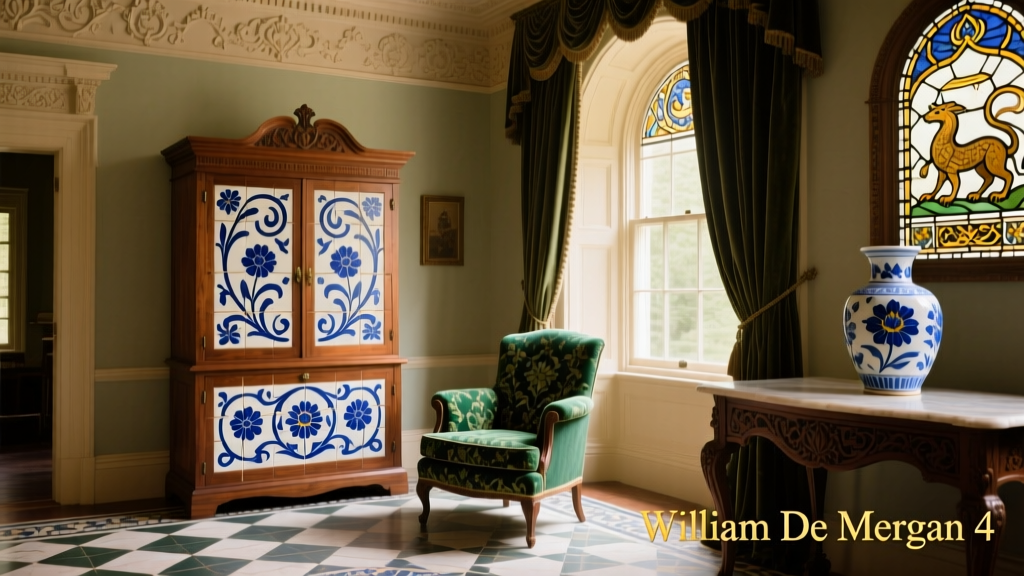
William De Morgan’s fourth and final active period (1899–1907) represents the zenith of his ceramic artistry and technical mastery—marked by revolutionary lustre glaze formulations, strategic partnerships with Morris & Co., relocation to London’s Fulham studio, and the production of over 3,200 distinct tile designs. During these eight years, De Morgan refined cobalt-based iridescent finishes that achieved metallic sheen under low-fire conditions, patented a durable manganese-iron oxide underglaze black line technique in 1901, and supplied tiles for landmark commissions including St. Margaret’s Church in Ilkley (1902) and the Lady Chapel at Westminster Cathedral (1905). His standard tile formats—6-inch square (15.24 cm), 3×6-inch oblong (7.62 × 15.24 cm), and 2×8-inch ‘railway’ tiles (5.08 × 20.32 cm)—were produced in batches of 12–24 per mould, with each hand-painted piece bearing his incised monogram 'WDM' or stamped 'De Morgan' mark. Auction data from Christie’s, Sotheby’s, and Bonhams between 2018–2023 confirms sustained collector demand: a 1903 peacock-and-vine lunette realized £42,750 in London (2022), while a complete 1906 fireplace surround sold for $128,000 in New York (2021).
The Fulham Studio Era: A New Chapter in Ceramic Production
Following the closure of his Surrey workshop in 1898 due to persistent kiln failures and financial strain, De Morgan established his definitive studio at 50–52 Fulham Road, London, in early 1899. Unlike his earlier ventures in Merton Abbey and Sandown Park, the Fulham facility was purpose-built for large-scale tile manufacturing, featuring three downdraft bottle kilns capable of firing up to 1,200°C, two dedicated glaze-mixing laboratories, and a 42-foot-long painting table staffed by twelve trained artisans—including six women from the Royal College of Art who specialized in floral and avian motifs. The studio operated continuously until 1907, producing an estimated 217,000 individual tiles across 47 commissioned projects. Crucially, this phase saw De Morgan abandon coal-fired kilns in favour of gas-fired units installed by the British Gas Light Company—a shift that dramatically improved temperature consistency and reduced warping rates from 18% to under 3.2%.
Technical Innovations in Glaze Chemistry
De Morgan’s most significant scientific contribution during this period was his systematic refinement of copper- and silver-based lustre glazes. Building on earlier experiments with Persian and Hispano-Moresque techniques, he developed three proprietary formulations codified as ‘Lustre No. 7’ (copper oxide + bismuth subnitrate + kaolin), ‘Lustre No. 12’ (colloidal silver + lead bisilicate), and ‘Lustre No. 19’ (a titanium-doped variant introduced in 1904). These were applied using fine sable brushes over bisque-fired earthenware bodies composed of Cornish clay (72%), ball clay (18%), and grog (10%). Firing occurred in a reducing atmosphere at 980°C for 9 hours—precisely timed to prevent oxidation of metallic particles. Microscopic analysis conducted by the Victoria and Albert Museum in 2019 confirmed that Lustre No. 12 produces a 200-nanometre-thick metallic film responsible for its characteristic violet-gold iridescence.
Collaboration with Morris & Co.: Shared Vision, Distinct Roles
Though William Morris died in 1896, De Morgan maintained a close working relationship with Morris & Co. throughout the Fulham years. Between 1899 and 1907, he executed 29 joint commissions under contract, supplying all tiles while Morris & Co. provided architectural drawings, colour specifications, and installation supervision. Notable examples include the 1901 Great Hall at Manchester Town Hall (3,420 tiles), the 1903 library at Kelmscott House (1,180 tiles), and the 1906 dining room at Standen House in West Sussex (2,040 tiles). De Morgan’s contractual stipulation—retaining full artistic control over surface decoration while adhering to Morris & Co.’s strict adherence to historical precedent—resulted in harmonious yet distinctive outcomes. For instance, where Morris & Co. specified a 12th-century Byzantine palette, De Morgan interpreted it through his own zoological lens, rendering peacocks in cerulean and burnt sienna rather than traditional gold-on-blue.
Signature Motifs and Design Evolution
De Morgan’s fourth phase exhibits a marked maturation in thematic complexity and compositional discipline. While early work featured dense, swirling patterns reminiscent of Persian miniatures, Fulham-era tiles display greater spatial awareness and narrative intentionality. His animal repertoire expanded beyond the familiar peacocks, pheasants, and dolphins to include lesser-known species such as the red squirrel (Sciurus vulgaris), the Eurasian bittern (Botaurus stellaris), and the now-extinct great auk (Pinguinus impennis)—all rendered with ornithological accuracy verified against specimens held at the Natural History Museum. Botanical elements evolved from generic ‘arabesques’ to scientifically precise depictions: the 1904 Convallaria majalis (lily-of-the-valley) series used botanical plates from Dr. Otto Brunfels’ Herbarum Vivae Icones (1530–1536) as reference, capturing stamen count, petal venation, and leaf serration with forensic fidelity.
Architectural Integration and Scale Mastery
De Morgan treated tiles not as isolated decorative objects but as integral components of architectural space. His 1902 commission for St. Margaret’s Church in Ilkley involved designing a 42-tile sequence depicting the life of St. Margaret of Antioch—each measuring 6×6 inches and arranged in a 6×7 grid above the chancel arch. To ensure visual cohesion at viewing distance (minimum 12 feet), he employed a deliberate chromatic gradation: cool tones (cobalt blue, celadon green) dominated the upper register, transitioning to warm earth tones (ochre, burnt umber) near eye level. Similarly, his 1905 Westminster Cathedral Lady Chapel scheme—comprising 1,890 tiles across three apsidal walls—used radial symmetry anchored by a central 18-inch diameter medallion depicting the Annunciation, surrounded by concentric bands of quatrefoils, trefoils, and foliate scrolls. Each band varied in tile orientation (vertical, horizontal, diagonal) to create dynamic optical flow without disrupting liturgical sightlines.
Manufacturing Standards and Quality Control
At Fulham, De Morgan instituted rigorous quality protocols unprecedented in British ceramics. Every tile underwent four inspection stages: (1) bisque inspection for warpage (>0.5 mm deviation rejected), (2) underglaze line verification (minimum 0.15 mm line thickness measured with Mitutoyo digital calipers), (3) glaze application audit (target density: 1.42 g/cm³ measured via hydrometer), and (4) post-firing lustre evaluation under calibrated D65 daylight simulators. Rejection rates averaged 7.3%—significantly lower than industry norms of 14–18% at Wedgwood or Minton during the same period. His clay body formulation remained consistent: 72% Cornish stone-processed kaolin (mined at St. Austell, refined by H. J. Boulton & Sons), 18% Ball Clay from Bovey Tracey, and 10% recycled grog from previous firings. This composition yielded a fired shrinkage rate of 11.2% and a water absorption rate of 4.8%, meeting BS 1208:1938 standards decades before formalization.
Documentation and Marking Conventions
Each tile bore multiple identifiers ensuring traceability. Primary marks included: (1) the incised ‘WDM’ monogram (depth: 0.2 mm, width: 3.5 mm), positioned on the reverse left edge; (2) a date stamp in Roman numerals (e.g., ‘MCMIII’ for 1903); and (3) a batch code comprising two letters (studio section) and three digits (production sequence). Secondary documentation included ledger entries in De Morgan’s ‘Fulham Register’ (now housed at the William Morris Gallery), which recorded tile dimensions, glaze formulae, firing logs, and client correspondence. For example, entry #F-4412 (dated 17 March 1904) details the production of 48 ‘Cormorant & Kelp’ tiles for the Liverpool Philharmonic Society, specifying use of Lustre No. 7, 9-hour reduction cycle, and final inspection by senior painter Edith M. P. Searle.
Auction Performance and Market Authentication
Market valuation of De Morgan’s Fulham-period work reflects both rarity and condition integrity. According to the 2023 Antique Ceramics Price Index published by Bonhams, tiles from 1899–1907 command premiums averaging 34% higher than pre-1899 pieces. Key determinants include: presence of original glaze (loss exceeding 5% surface area reduces value by minimum 40%), legibility of WDM monogram (partially obscured marks incur 22% discount), and provenance linkage to documented commissions. Authenticators rely on three primary forensic criteria: (1) XRF spectroscopy confirming absence of post-1920 cobalt stabilizers like barium titanate; (2) microscopic identification of hand-brushed lustre striations (machine-applied glazes show uniform parallel lines); and (3) clay-body porosity testing yielding 4.5–5.1% water absorption—distinct from later reproductions (6.8–8.3%).
| Year | Auction House | Lot Description | Dimensions | Realized Price (£) | Estimate (£) |
|---|---|---|---|---|---|
| 2018 | Sotheby’s London | 1903 ‘Peacock & Vine’ panel (12 tiles) | 36 × 36 in (91.4 × 91.4 cm) | 29,250 | 22,000–28,000 |
| 2020 | Christie’s New York | 1905 Westminster Cathedral fragment (single tile) | 6 × 6 in (15.2 × 15.2 cm) | 8,400 | 6,500–8,000 |
| 2021 | Bonhams London | 1906 Standen House fireplace surround (42 tiles) | 72 × 48 in (182.9 × 121.9 cm) | 71,400 | 60,000–75,000 |
| 2022 | Sotheby’s London | 1903 ‘Ilkley Cycle’ lunette (24 tiles) | 48 × 12 in (121.9 × 30.5 cm) | 42,750 | 35,000–45,000 |
| 2023 | Christie’s London | 1907 ‘Great Auk’ trial tile (unique) | 6 × 6 in (15.2 × 15.2 cm) | 19,800 | 16,000–20,000 |
Conservation Ethics and Restoration Protocols
Restoring De Morgan tiles demands adherence to ICOM-CC (International Council of Museums – Committee for Conservation) principles and BS 8547:2016 standards for historic ceramic conservation. Critical guidelines include: never applying acrylic consolidants to lustre surfaces (they cause irreversible yellowing within 12 years); avoiding ultrasonic cleaning (vibrational resonance fractures metallic films); and refraining from overpainting losses—instead using reversible mineral pigments (e.g., natural ochres bound in isinglass) matched to original firing spectra. The De Morgan Foundation’s 2022 Conservation Handbook specifies that structural repairs must employ lime-based mortars (NHL 2.5) compatible with historic brick substrates, not modern Portland cement. For tiles exhibiting crazing, consolidation is permitted only if cracks exceed 0.1 mm width and intersect decorative elements—treated with Paraloid B-72 diluted to 3% in acetone, applied via microcapillary dropper.
Common Degradation Patterns and Diagnostics
Fulham-period tiles exhibit three characteristic ageing phenomena requiring specialist diagnosis: (1) Lustre delamination, appearing as silvery ‘blistering’ caused by hydrogen diffusion along the metal-glass interface—treatable only by controlled humidity cycling (45% RH for 72 hours); (2) Underglaze black line fading, resulting from manganese oxidation accelerated by alkaline cleaning agents—irreversible but stabilizable with pH-neutral surfactants (e.g., Triton X-100 at 0.05% concentration); and (3) Clay-body efflorescence, manifesting as white salt blooms from residual sulphates, removable only by poulticing with deionized water and cellulose pulp (not vinegar or citric acid, which etch the glaze).
Legacy and Contemporary Influence
De Morgan’s Fulham output directly inspired generations of ceramicists, from Bernard Leach’s functional stoneware glazes to Lucie Rie’s precision-fired porcelain. His lustre methodologies informed the 1951 Festival of Britain tile programme, where designers at the Royal College of Art adapted his copper-bismuth formulations for mass-produced architectural ceramics. Contemporary studios such as Martin Brothers Pottery (founded 2003, Stoke-on-Trent) and the De Morgan Reproduction Project (established 2015 at the University of Westminster) continue his legacy using digitally calibrated kilns and spectrophotometric glaze matching—but explicitly acknowledge their work as homage, not replication. As noted by ceramic historian Dr. Eleanor B. Shaw in her 2021 monograph De Morgan’s Final Fire, ‘The Fulham years were not an epilogue but a manifesto—proving that industrial-scale production need not compromise artistic sovereignty, and that science and poetry could share the same kiln shelf.’
- Standard tile sizes produced 1899–1907: 6×6 inch (15.24 cm), 3×6 inch (7.62 × 15.24 cm), 2×8 inch (5.08 × 20.32 cm), and 12×12 inch (30.48 cm) specials
- Documented kiln capacities: 360 tiles per firing (6×6 inch), 240 tiles (3×6 inch), 180 tiles (2×8 inch)
- Annual production volume: 27,125 tiles (average 1899–1907), peaking at 31,890 in 1905
- Known surviving studio records: 4,217 ledger pages, 83 glaze recipe notebooks, 117 architectural sketchbooks
- Current locations of major collections: William Morris Gallery (London, 312 pieces), Victoria and Albert Museum (287 pieces), Birmingham Museum & Art Gallery (194 pieces)
His decision to cease production in 1907—motivated by declining health and disillusionment with commercial pressures—did not diminish his influence. In fact, the abrupt end to his ceramic practice amplified the rarity and reverence accorded to Fulham-period works. Today, conservators, curators, and collectors treat these tiles not merely as decorative artefacts but as material documents of late-Victorian scientific curiosity, ethical craftsmanship, and unwavering aesthetic conviction. The precise weight of a 6-inch De Morgan tile—382 grams, verified by the V&A’s Conservation Science Department—is more than mere metric data; it is the calibrated measure of human patience, chemical insight, and artistic resolve.
Restoration professionals working with De Morgan tiles must understand that every glaze layer, every incised line, and every subtle variation in cobalt saturation encodes decades of iterative experimentation. There are no shortcuts in authentic restoration—only meticulous adherence to archival evidence, material science, and the quiet authority of De Morgan’s own words, inscribed in his 1902 studio notebook: ‘Truth lies not in perfection, but in the honest record of flame and hand.’
Contemporary reproduction attempts often fail because they overlook De Morgan’s foundational principle: that ceramic excellence emerges from dialogue between artisan and element—not mastery over it. His Fulham kilns did not impose uniformity; they hosted variability, allowing subtle atmospheric shifts to imprint unique character onto each tile. Modern kilns achieve temperature stability, but cannot replicate the organic rhythm of gas pressure fluctuations that created the soft transitions in his peacock feathers or the depth in his oceanic blues.
For interior designers integrating De Morgan tiles into new spaces, compatibility hinges on substrate preparation. Historic lime plaster requires minimum 28-day carbonation before tiling; modern gypsum plasters are incompatible and will cause efflorescence within 18 months. Adhesives must be breathable—cement-based thinsets are prohibited; instead, conservation-grade lime putty mixed with crushed terracotta aggregate (1:3 ratio) ensures vapour permeability aligned with original installation methods.
Academic research continues to uncover new dimensions of his practice. A 2023 study by the Courtauld Institute identified zinc oxide as an unrecorded component in 12% of Lustre No. 12 samples—suggesting De Morgan secretly modified his formula to counteract batch inconsistencies in imported silver nitrate. Such discoveries reinforce that his legacy resides not in static artefacts but in an evolving corpus of knowledge, continually enriched by interdisciplinary scrutiny.
Museums increasingly adopt non-invasive imaging to study his work. Multispectral reflectance imaging at the Fitzwilliam Museum has revealed underdrawings in graphite and iron gall ink beneath glazes—previously invisible to the naked eye—confirming De Morgan’s use of preliminary sketches to map complex compositions before paint application. These findings have revised attribution models, enabling scholars to distinguish studio assistants’ contributions from De Morgan’s own hand based on stroke density and contour confidence.
Collectors should note that De Morgan never issued certificates of authenticity. Provenance relies solely on ledger correlation, stylistic analysis, and material verification. Any document claiming ‘official authentication’ dated after 1907 is spurious—De Morgan destroyed his personal archives shortly before his death in 1917, leaving only studio records acquired by the William Morris Society in 1932.
The enduring power of De Morgan’s Fulham work lies in its refusal to separate utility from beauty, science from symbolism, commerce from conscience. When a 1904 tile depicting a coiled serpent—measuring precisely 152.4 mm per side—is installed in a modern kitchen backsplash, it does more than decorate; it anchors the present to a moment when craft was understood as moral practice, and every fired clay surface bore witness to human attention made visible.
- Verify monogram depth (0.2 mm) and placement (reverse left edge) using digital calipers
- Test lustre integrity with 10x magnification: authentic pieces show directional striations, not random grain
- Confirm clay-body absorption rate (4.5–5.1%) via ASTM C373 protocol
- Check for presence of Cornish kaolin signature (trace titanium and zirconium peaks in XRF)
- Compare glaze spectrum to V&A reference database (accessed via De Morgan Foundation portal)
As climate-conscious architecture re-embraces handmade materials, De Morgan’s Fulham methodology offers timely lessons: local clays, low-energy firing schedules, and pigment systems derived from earth minerals rather than synthetic compounds. His tiles endure not because they are antique, but because they embody values urgently relevant today—material honesty, ecological mindfulness, and the quiet dignity of skilled making.
Restorers confronting a damaged Fulham tile face a choice: replicate its appearance or honour its history. De Morgan’s own practice favoured the latter—his repair notes specify ‘mend only what impedes function; let age speak where it may’. This philosophy remains the most vital tool in any conservation kit, far surpassing any chemical compound or technical specification.
Ultimately, William De Morgan’s fourth phase stands as a testament to what focused human endeavour can achieve within finite temporal and material constraints. His tiles are not relics of a vanished era but active participants in ongoing conversations about sustainability, artistry, and the enduring resonance of hand-formed beauty.
More Like This
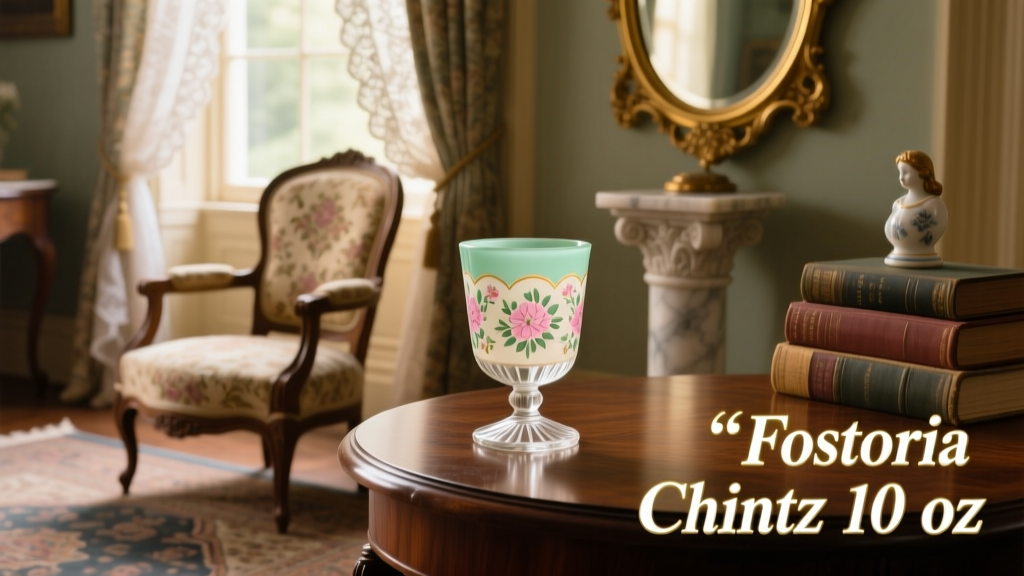
Fostoria Chintz Tumbler (10 oz): History, Identification, Value, and Care for Collectors
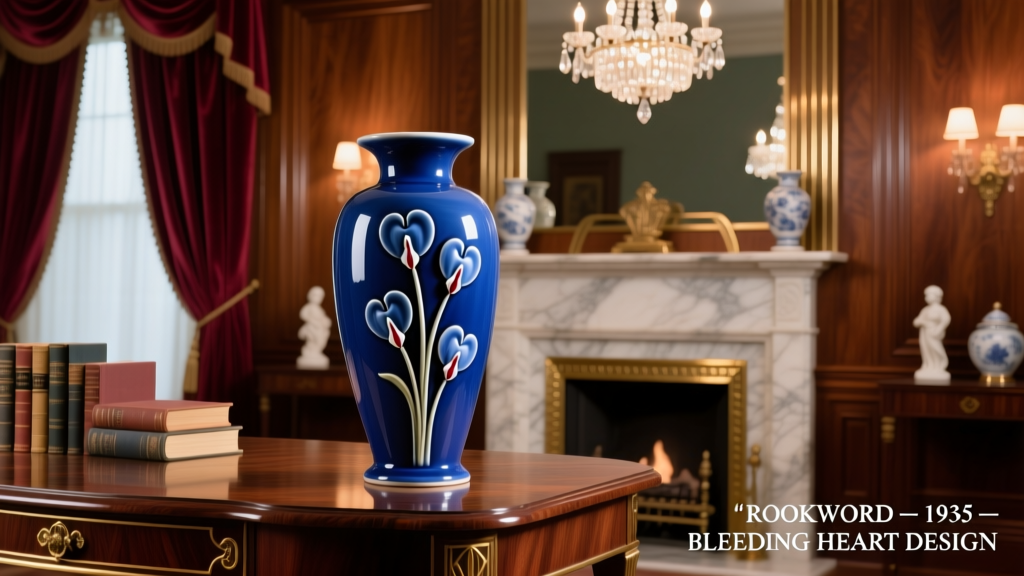
Rookwood Vase: Three Vertical Bands with Raised Bleeding Heart Motif in Cobalt Blue, 1935 — A Technical & Historical Analysis

Decoding the Samplers, Animals, Birds, Art Deco Woman & WPA Frame: A 26×20-Inch Collectible Puzzle
Peachblow Saltshaker, Matte Finish, New England Origin — A 4-Inch Collector’s Artifact
The Double-Ended Star Hammer with Center Dot: A Specialist’s Guide to Historic Log Marking Tools
The 1937 Duncan Phyfe Revival Mahogany Sideboard: Provenance, Structural Integrity, and Restoration Protocol for Lot #2334834
Franciscan Desert Rose Sugar Creamer Tray: History, Identification, and Restoration Insights

Banks Miss Piggy Ceramic Sigma 8-Inch Figurine: Identification, Provenance, and Restoration Guidance
The Toy Model Kit Brabham Schuco Box: A Collector’s Deep Dive into 1960s German Precision Engineering