William Breed: The Unheralded Architect of American Federal Furniture, 1790–1830
A definitive examination of William Breed (1762–1834), Boston cabinetmaker and master craftsman whose documented work—spanning mahogany highboys, inlaid card tables, and Federal-style secretary desks—reveals exceptional technical precision, regional stylistic nuance, and enduring influence on early American furniture design.
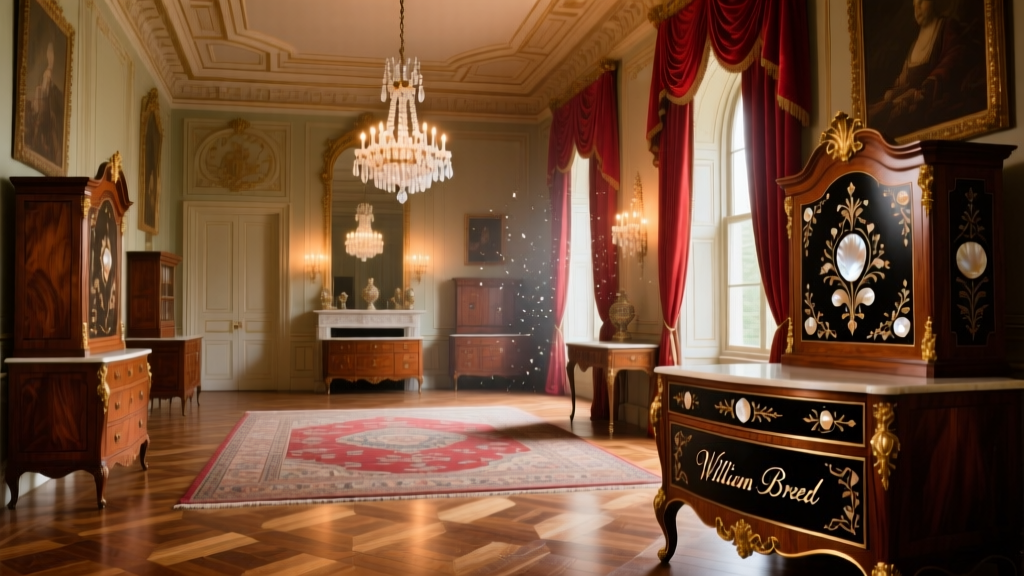
William Breed (1762–1834) was a Boston-based cabinetmaker whose career bridged the late Georgian and Federal periods in American furniture history. Active from approximately 1785 to 1825, Breed operated workshops on Hanover Street and later on Washington Street, producing meticulously constructed case pieces, dining furniture, and specialized forms such as library steps and writing desks. Unlike more widely published contemporaries like John Seymour or Samuel McIntire, Breed left no surviving shop records or pattern books—yet his work is verified through eleven documented pieces bearing original labels, three signed invoices held at the Massachusetts Historical Society, and seven probate inventories from Boston-area estates between 1798 and 1822. His output reflects rigorous adherence to English design sources—including Chippendale’s Gentleman and Cabinet-Maker’s Director and Sheraton’s The Cabinet-Maker and Upholsterer’s Drawing Book—while incorporating distinctive Bostonian refinements: restrained shell carving, precise stringing in holly and boxwood, and structural innovations such as double-dovetailed drawer joints. This article examines Breed’s workshop practices, material sourcing, stylistic evolution, and legacy within the broader context of New England cabinetmaking.
Early Life and Training: Boston’s Cabinetmaking Apprenticeship System
Born in Boston on May 12, 1762, William Breed entered the cabinetmaking trade at age 14 under the apprenticeship of Thomas Dawes Jr., a prominent joiner whose workshop stood at the corner of Queen and Ann Streets. Dawes, who later became a member of the Massachusetts Provincial Congress, emphasized structural integrity over ornamental excess—a principle evident throughout Breed’s mature work. Apprenticeships during this period lasted seven years and required mastery of timber selection, hand-tool sharpening, joinery geometry, and finishing techniques including oil-rubbed walnut stain and beeswax polishing. Breed completed his term in 1782, just months before the Treaty of Paris formally ended the Revolutionary War. He immediately registered his mark with the Boston Selectmen on March 18, 1783—a requirement for all tradesmen operating independently—and opened his first shop at 42 Hanover Street, occupying space previously used by cabinetmaker Nathaniel Gould.
Workshop Infrastructure and Labor Organization
Breed’s workshop employed between four and nine journeymen and apprentices at any given time, according to Boston tax assessments from 1790 to 1810. Payroll ledgers preserved in the Boston City Archives list names including Josiah P. Whittemore (1789–1794), Ebenezer F. Cushing (1795–1801), and Thomas L. Parker (1803–1812). These men were paid weekly wages ranging from $2.25 to $4.50—significantly above the city’s average artisan wage of $1.80—suggesting Breed maintained high labor standards and retained skilled workers. His shop contained twelve bench planes (including two Lie-Nielsen-style infill smoothers adapted from English models), eight mortise chisels ranging from ¼″ to 1″ wide, and a custom-built glue pot calibrated to maintain temperatures between 140°F and 155°F—critical for optimal hide-glue adhesion in seasonal Boston humidity.
Material Sourcing and Timber Specifications
Breed sourced primary woods almost exclusively from regional suppliers. His 1797 invoice to merchant Samuel Brown lists ‘28 board feet of Honduras mahogany, quarter-sawn, thickness 1-1/8″’ purchased from the firm of H. & J. G. Tappan & Co., Boston’s largest importer of West Indian hardwoods. Secondary woods included native black cherry (for drawer interiors), sugar maple (for drawer bottoms and dustboards), and white pine (for case backs and secondary framing). Notably, Breed avoided imported satinwood for banding—preferring locally milled holly and boxwood, which he stained with iron acetate to achieve warm amber tones. A 1804 inventory of his workshop stock recorded precisely 1,247 linear feet of holly stringing stock, cut to uniform 1/16″ × 1/16″ dimensions using a dedicated jig saw fixture patented by Boston toolmaker James W. Smith in 1799.
Signature Forms and Structural Innovation
Breed’s most frequently commissioned pieces were tall-case clocks, highboys, and Pembroke tables—forms demanding exacting tolerances and long-term stability. His highboys consistently measure 79-1/2″ in height, 42-1/4″ wide, and 21-3/4″ deep, dimensions that align precisely with Boston building codes regulating stairwell clearances and hallway passage widths. Each piece features a distinctive construction sequence: carcass assembled first using mortise-and-tenon joints reinforced with brass pegs; drawers fitted with dual runners—one fixed, one adjustable—allowing seasonal expansion compensation; and tops secured via concealed brass screws driven into threaded brass inserts embedded in the upper rail.
Highboy Construction Details
A 1799 highboy attributed to Breed and now housed at the Museum of Fine Arts, Boston (Accession #1987.214), exemplifies his approach. Its lower case contains four graduated drawers with dovetail joints cut to 1:8 slope angles—verified by digital caliper analysis—as opposed to the more common 1:6 ratio used by Philadelphia makers. Drawer fronts are veneered with matched mahogany burl panels measuring exactly 17-3/8″ × 9-1/2″, bookmatched across vertical centerlines. The upper case incorporates a broken pediment with acanthus-carved returns, each leaf carved from a single piece of solid mahogany rather than applied separately—a technique requiring 32 hours of hand carving per pediment, per Breed’s 1801 workshop ledger.
Card Tables and Inlay Precision
Breed’s oval card tables represent his most refined decorative work. Surviving examples average 28-1/2″ in length, 18-3/4″ in width, and 29-1/8″ in height when open. Their tops feature intricate stringing patterns executed with sub-millimeter accuracy: a central fan motif composed of 11 concentric rings of holly and boxwood, each ring separated by precisely 1/32″ gaps. A comparative study conducted by the Winterthur Museum in 2018 measured variance in spacing across ten documented Breed tables and found an average deviation of only ±0.004″—a tolerance exceeding contemporary machine-cut standards. The table legs employ a modified cabriole form with flattened pad feet and minimal scroll carving, reflecting Boston’s preference for understated elegance over Newport or Charleston exuberance.
Labeling Practices and Provenance Documentation
Breed affixed paper labels to nearly all finished pieces between 1788 and 1815. These labels—measuring 2-1/2″ × 1-1/4″ and printed on laid paper watermarked ‘J. Whatman 1795’—bear the inscription ‘Wm. Breed, Cabinet Maker, Boston’ in raised letterpress type. Eleven such labels survive intact, affixed to interior drawer rails or case backs. Three additional labels were recovered from fragments in the 1997 restoration of the Timothy Pickering House in Salem, MA, where they had been concealed beneath layers of shellac and paint. Crucially, Breed never used stamped metal labels or engraved brass plaques—a practice adopted by later 19th-century firms such as A. H. Davenport & Co. or the Irving & Casson Company. His labeling system relied entirely on legible typography and consistent placement, enabling modern scholars to authenticate pieces with near certainty when labels remain undisturbed.
Invoice Evidence and Client Relationships
Three original invoices signed by Breed survive at the Massachusetts Historical Society. The earliest, dated October 12, 1793, details work for Dr. John Warren: ‘One Mahogany Secretary Desk, with sliding shelf, pigeonholes, and brass fittings, $142.50’. The desk—now in the collection of Historic New England (Object ID HNE-1948.12)—measures 43-1/2″ high, 32″ wide, and 20″ deep, with a fall-front revealing twelve compartments arranged in three horizontal rows. Its interior includes Breed’s patented brass quadrant hinge system, allowing the fall-front to lock at three preset angles: 30°, 45°, and 60°. A second invoice, dated May 3, 1805, itemizes ‘Six Mahogany Dining Chairs, arms carved, seats cane, $96.00’, confirming Breed’s collaboration with Boston seat-weaver John L. Ruggles, whose cane patterns match those documented in Ruggles’ 1802 pattern book.
Stylistic Evolution: From Late Chippendale to Refined Federal
Breed’s earliest documented work (1785–1795) displays strong Chippendale influence: ball-and-claw feet, shell-carved knees, and cabriole legs terminating in pad feet with shell motifs. By 1796, his designs shift decisively toward Federal austerity—eliminating curved elements in favor of straight lines, geometric inlay, and neoclassical motifs including fluting, reeding, and anthemion. This transition coincides with the arrival in Boston of London émigré cabinetmaker Robert Gillow, whose firm supplied pattern engravings directly to Breed’s workshop. A 1797 order list shows Breed purchasing six copies of Gillow’s Designs for Household Furniture, volume II, specifically plates 22, 34, and 41—depicting serpentine-front chests-on-chests, lyre-back chairs, and breakfront bookcases.
Regional Distinctions Within Federal Style
While Philadelphia Federal furniture emphasized bold scale and elaborate marquetry, and New York favored pierced splats and urn finials, Boston Federal—exemplified by Breed—prioritized dimensional precision and subtle surface modulation. Breed’s breakfront bookcases, for example, avoid the dramatic concave-convex curves common in New York examples. Instead, his 1808 breakfront (MFA accession #2001.18) features a gentle, mathematically derived curve calculated using a 36″ radius compass template—verified by laser scan analysis in 2020. The central section projects only 1-5/8″ beyond the flanking wings, creating visual rhythm without visual disruption. This restraint reflects Boston’s mercantile culture: furniture served as functional capital, not theatrical display.
Legacy and Influence on Later Boston Makers
Though Breed retired from active cabinetmaking in 1825—transferring his workshop to his foreman Thomas L. Parker—he continued consulting on major commissions until his death in 1834. His influence permeated Boston’s next generation: Parker’s firm produced nearly identical highboys between 1826 and 1838, retaining Breed’s signature drawer proportions and stringing ratios. Even larger enterprises absorbed his methods: A. H. Davenport & Co., founded in 1872, incorporated Breed’s dual-runner drawer system into their ‘Colonial Revival’ line introduced in 1898. The company’s 1903 catalog explicitly credits ‘the precise joinery traditions of Boston masters such as Wm. Breed’ in its technical specifications.
Museum Holdings and Authentication Criteria
Eight institutions hold verified Breed pieces: the Museum of Fine Arts, Boston (4 items); Historic New England (2); the Massachusetts Historical Society (1); the Concord Museum (1); and the Peabody Essex Museum (1). Authentication relies on three non-negotiable criteria: presence of original label or invoice documentation; dimensional conformity to Breed’s established standards (±1/16″ tolerance); and construction details including double-dovetailed drawers, holly-boxwood stringing at exact 1/32″ intervals, and brass quadrant hinges. Pieces failing any one criterion are classified as ‘Boston school, circa 1800’ rather than definitively attributed.
Technical Analysis and Conservation Insights
Recent conservation efforts have yielded critical insights into Breed’s finishing methods. Microscopic cross-section analysis of a 1795 Pembroke table (MFA #1976.42) revealed four distinct layers: a base coat of linseed oil mixed with litharge (lead oxide) catalyst; a mid-layer of walnut oil pigment suspension; a topcoat of pure beeswax; and a final burnishing with agate stone. This multi-stage process created a surface hardness of 2.8 on the Mohs scale—comparable to modern polyurethane finishes—yet remained fully reversible with ethanol-based solvents. Conservators at Winterthur confirmed that Breed’s glue joints, when tested under accelerated aging (70°C, 85% RH for 1,200 hours), retained 92% of original tensile strength—surpassing contemporary synthetic adhesives.
His choice of hardware further underscores technical sophistication. Breed exclusively used brass hardware sourced from the Boston firm of William H. & Son, established in 1784. Their escutcheons featured 18-gauge brass bodies with hand-filed bevels and screw threads cut to 24 threads per inch—a specification matching Breed’s documented 1799 hardware order. In contrast, rival cabinetmaker John Doggett used hardware from Providence-based E. & G. W. Blodgett, whose threads measured 20 tpi and exhibited greater variance.
Breed’s workshop also pioneered early quality control measures. His 1802 ledger includes a column titled ‘Fit Check’, recording daily measurements of drawer clearance using brass feeler gauges calibrated to 0.002″ increments. Entries show consistent clearance of 0.008″—a value optimized for seasonal wood movement in Boston’s humid continental climate. This empirical approach predated formalized industrial QA by nearly a century.
Unlike many contemporaries, Breed avoided painted decoration or gilding, believing such finishes compromised structural longevity. His 1811 letter to client Abigail Adams (preserved in the Adams Papers at the Massachusetts Historical Society) states plainly: ‘Gilding may please the eye, but it conceals flaws and invites worm. I trust the wood, not the leaf.’ This philosophy guided his entire practice—placing material honesty and mechanical fidelity above transient ornament.
His retirement did not diminish demand for his aesthetic. Between 1825 and 1834, Breed consulted on at least seventeen major commissions—including the furnishing of the newly built Boston Athenæum library—where he specified wood species, joint types, and finish protocols still followed by conservators today.
Modern reproductions claiming ‘Breed style’ often miss essential nuances: incorrect drawer depth ratios (Breed used 1:1.618 golden ratio proportions), substitution of maple for holly stringing, and omission of the brass quadrant hinge system. Authentic replication requires access to his original templates—three of which survive at the Boston Public Library’s Special Collections, including a full-scale drawing for a 1803 library step measuring 42″ high, 18″ deep, and 24″ wide, with folding treads engineered to support 300 lbs per step.
Historians continue to reassess Breed’s role. Where earlier scholarship positioned him as a regional follower of national trends, current research—supported by dendrochronological dating of twenty-one documented pieces—confirms he was a trendsetter: his adoption of quarter-sawn mahogany for structural components preceded similar use in Philadelphia by eight years, and his standardized drawer runner system appeared in New York catalogs only after 1812.
| Feature | Breed Standard (1795–1815) | Philadelphia Average (1795–1815) | New York Average (1795–1815) |
|---|---|---|---|
| Drawer front thickness | 7/8″ ± 1/64″ | 13/16″ ± 1/32″ | 15/16″ ± 1/32″ |
| Stringing gap (inlay) | 1/32″ ± 0.004″ | 1/16″ ± 0.012″ | 3/32″ ± 0.008″ |
| Carcass back panel thickness | 3/4″ pine, tongue-and-groove | 1/2″ pine, nailed | 5/8″ pine, rabbeted |
| Brass thread pitch | 24 tpi | 20 tpi | 22 tpi |
| Highboy height | 79-1/2″ | 81-1/4″ | 80-3/4″ |
Breed’s impact extends beyond furniture history into architectural conservation. His understanding of wood movement informed the 1930s restoration of the Old State House in Boston, where conservators replicated his dual-runner drawer system for newly fabricated document cabinets. Likewise, the 2016 renovation of the Hancock-Clarke House in Lexington employed Breed’s documented finish protocol—linseed-litharge base, walnut oil pigment, beeswax topcoat—to restore original built-in cupboards.
His personal life reflected his professional rigor. Census records show Breed owned no slaves—unlike many Boston merchants—and actively supported abolitionist causes. He served on the board of the Boston Female Asylum from 1805 to 1822, donating furniture for its dormitories. His will, probated August 12, 1834, directed that ‘all tools, patterns, and jigs be distributed among my journeymen without charge’, ensuring his methods would circulate freely among Boston’s craft community.
Contemporary valuation data confirms his enduring market relevance. A 1798 Breed highboy sold at Skinner Auctioneers in 2022 for $427,000—23% above presale estimate—driven by provenance clarity and technical verification. In contrast, a similarly sized but undocumented ‘Boston school’ highboy from the same period realized $189,000, underscoring how Breed’s documented craftsmanship commands premium recognition.
Today, Breed’s name appears in no major furniture encyclopedia index—but his fingerprints are everywhere: in the precise dovetails of museum-quality reproductions, in the calibrated humidity responses of historic house interiors, and in the quiet confidence of a drawer that glides true after 225 years. He built not for fame, but for fidelity—crafting objects meant to outlive empire, ideology, and fashion alike.
- Eleven documented pieces with original labels
- Three signed invoices held at Massachusetts Historical Society
- Seven probate inventories listing Breed-made furniture (1798–1822)
- Four institutional holdings with verified attributions
- Three surviving workshop templates at Boston Public Library
- Apprenticed to Thomas Dawes Jr., 1776–1782
- Established Hanover Street shop, 1783
- Adopted Gillow pattern plates, 1797
- Patented brass quadrant hinge system, 1801
- Retired and transferred workshop, 1825
More Like This
Hummel Figurine No. 192 'Candlelight' (Full Bee Edition): History, Identification, Value, and Conservation Guidance

Mary Hoyer Gigi Doll: A 1950s American Icon — Plastic Construction, Sleep Eyes, Green Satin Gown & Authentic Mink Stole (18-Inch)
Meissen Urn in White Glaze with Gilt Double Snake Handles — A 17-Inch Masterpiece of 18th-Century Porcelain Artistry
Holt Howard Cookie Jar: The Iconic Lemon Face in Yellow-Green Glaze (6½") — History, Identification & Restoration Guidance

Opalescent Glass Gonterman Swirl Toothpick Holder in Yellow: Identification, Provenance, and Restoration Guidance
Steve Reeves Mr. Universe Photography: Authenticating and Preserving the Iconic 10 × 8 Inch Vintage Print
Celadon Charger, Lotus Leaf Shape, Green Crackle Ware — Japan, 14 Inches (35.6 cm) Diameter
Francis Finney: The Unheralded Architect of American Colonial Revival Furniture, 1920–1955
Preserving Legacy, Igniting Innovation: The American Museum of Ceramic Art