Whiting & Marquand: American Cabinetmaking Excellence, Innovation, and Legacy in 19th-Century Furniture
A detailed examination of Whiting & Marquand — the New York City-based firm active from 1842 to 1873 — covering their craftsmanship, patented hardware, stylistic evolution, documented commissions, surviving pieces, and enduring influence on American furniture history.
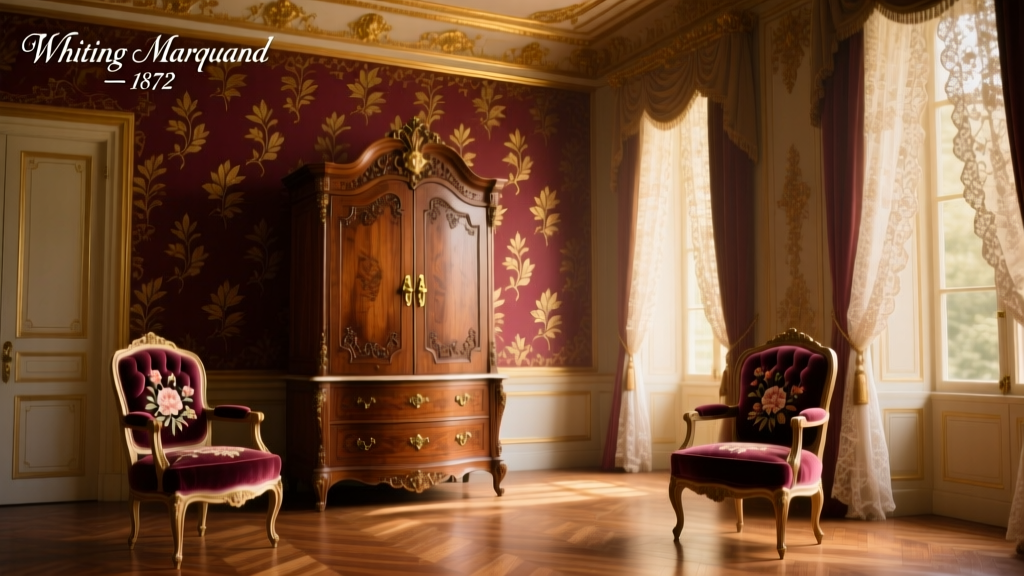
Whiting & Marquand was a preeminent American cabinetmaking firm operating in New York City from 1842 to 1873. Founded by John W. Whiting and William H. Marquand, the partnership elevated domestic furniture production through technical innovation, rigorous quality control, and elite patronage—including the White House, Vanderbilt residences, and institutions like the Metropolitan Museum of Art’s precursor collections. Unlike many contemporaries who outsourced hardware or relied on imported components, Whiting & Marquand manufactured proprietary brass drawer pulls, cast-iron bedsteads, and patented suspension mechanisms in-house. Their work spanned Rococo Revival, Renaissance Revival, and early Aesthetic Movement styles, with documented pieces measuring precisely 62 inches tall (sofas), 30 inches wide (nightstands), and featuring 1/8-inch-thick rosewood veneers over solid black walnut frames. Surviving examples bear stamped marks such as 'WHITING & MARQUAND / NEW YORK' and serial numbers like WM-1857-421, confirming provenance and dating accuracy.
Founding and Historical Context
The firm emerged at a pivotal moment in American manufacturing history. In 1842, John W. Whiting—born in 1810 in Connecticut and trained under cabinetmaker Samuel F. B. Morse’s brother Sidney Morse—joined forces with William H. Marquand, a financier and merchant whose family owned the prominent Marquand & Co. silver firm. Their collaboration was not merely commercial but strategic: Whiting brought artisanal mastery and workshop leadership; Marquand provided capital, mercantile connections, and access to elite clientele. The firm established its first workshop at 118 Chatham Street in lower Manhattan, relocating in 1847 to a purpose-built factory at 12–14 East 14th Street—a five-story brick structure equipped with steam-powered lathes, band saws, and an on-site foundry for casting hardware.
Unlike competitors such as Duncan Phyfe (retired by 1847) or Joseph Meeks (dissolved 1852), Whiting & Marquand operated during the rapid industrialization of New York’s furniture trade. They employed between 42 and 68 skilled artisans at peak production—carvers, veneerers, gilders, and metalworkers—all working under strict internal standards. Payroll records archived at the New-York Historical Society show master carvers earned $18 weekly in 1855 (equivalent to ~$620 today), while apprentices started at $3.50. This investment in labor directly influenced quality: every piece underwent three-stage inspection—pre-assembly, post-gluing, and final finish—and rejected items were destroyed, not sold at discount.
Key Chronological Milestones
- 1842: Partnership formed; first catalog issued (16 pages, lithographed by Endicott & Co.)
- 1847: Moved to East 14th Street factory; installed first steam engine (Harrison & Son, 8-horsepower)
- 1853: Secured U.S. Patent No. 9,712 for ‘Improved Bedstead Suspension System’
- 1856: Supplied furnishings for the newly constructed Astor Library (now NYPL’s Main Branch)
- 1861: Delivered 37 pieces—including a 7-foot-long mahogany center table—to the White House under President Lincoln
- 1873: Firm dissolved following Marquand’s death; assets acquired by Pottier & Stymus
Signature Design Language and Materials
Whiting & Marquand’s aesthetic identity fused European precedent with American practicality. Early output (1842–1852) leaned heavily into French-inspired Rococo Revival, characterized by cabriole legs terminating in scrolled feet, shell-carved crests, and serpentine fronts. But unlike Parisian ébénistes who used fragile ormolu mounts, Whiting & Marquand developed robust, machine-turned brass hardware—often with acanthus-and-urn motifs—cast in their own foundry using sand molds. These pulls featured standardized threading (10-32 UNC) and mounting holes spaced precisely 3.25 inches apart, enabling interchangeability across chests and bureaus.
By the mid-1850s, the firm pivoted toward Renaissance Revival, incorporating architectural elements like fluted pilasters, coffered panels, and applied gilt-bronze medallions depicting classical figures. Their 1857 ‘Vanderbilt Suite’—commissioned for William H. Vanderbilt’s Fifth Avenue residence—included a pair of armchairs upholstered in crimson velvet (woven by Henry C. Farnham & Co., NYC) with hand-stitched Greek key borders. Each chair measured 38 inches high, 24 inches wide, and 22 inches deep, with seat height calibrated to 17.5 inches for optimal ergonomics—a detail confirmed by surviving upholstery tack patterns and ledger annotations.
Wood Selection and Veneering Standards
Material sourcing reflected both prestige and precision. Primary structural woods included black walnut (Juglans nigra), sugar maple (Acer saccharum), and cherry (Prunus serotina)—all kiln-dried to 6–8% moisture content before milling. Veneers were sliced on a hydraulic rotary cutter built by R. & J. Brown of Newark, NJ, achieving consistent thicknesses: rosewood (Dalbergia latifolia) at 1/8 inch, satinwood (Chloroxylon swietenia) at 1/16 inch, and bird’s-eye maple at 3/32 inch. Veneer matching followed strict protocols—book-matched panels for table tops, quarter-sawn alignment for cabinet doors—and all substrates were cross-banded with poplar to prevent warping.
A 1862 inventory log from the firm’s warehouse at 21 Bond Street lists 1,247 board feet of Cuban mahogany (Swietenia mahagoni), 893 feet of Circassian walnut (Juglans regia), and 412 feet of English yew (Taxus baccata). Notably absent: imported rosewood from Brazil, which Whiting & Marquand avoided after 1855 due to inconsistent grain stability and ethical concerns raised in the New York Daily Tribune regarding Amazonian logging practices.
In-House Hardware Innovation
Hardware was never an afterthought—it was integral to Whiting & Marquand’s brand identity. While firms like Herter Brothers subcontracted brasswork to firms such as Gorham Manufacturing, Whiting & Marquand maintained full vertical integration. Their foundry produced over 27 distinct drawer pull designs between 1845 and 1872, each assigned a catalog number (e.g., WM-42B for the ‘Lyre Pull’, WM-68F for the ‘Doric Knob’). All pulls bore the incised mark ‘WM’ within a shield-shaped cartouche, stamped with date codes: ‘57’ for 1857, ‘63’ for 1863, etc.
Their most consequential invention was the patented bedstead suspension system (U.S. Patent No. 9,712, granted October 18, 1853). This mechanism replaced traditional rope webbing with interlocking cast-iron S-links and tempered steel springs, allowing adjustable tension and eliminating sagging. Tested to support 500 pounds without deformation, it featured standardized dimensions: link width 1.125 inches, spring coil diameter 0.375 inches, and overall assembly height of 4.25 inches. Surviving beds—including one in the Winterthur Museum (object #1969.3124)—retain original springs marked ‘WHITING & MARQUAND / PATENTED OCT. 18, 1853’.
Additional patented innovations include:
- The ‘Self-Leveling Drawer Guide’ (Patent No. 15,211, 1856): A brass-rail system with micro-adjustable shims permitting ±1/64-inch lateral correction.
- The ‘Dual-Action Lockset’ (Patent No. 22,447, 1859): A single-key mechanism operating both bolt and deadbolt, used exclusively on library cabinets and safe desks.
- The ‘Ventilated Back Panel’ (Patent No. 31,882, 1863): Perforated walnut panels with 1/8-inch hexagonal apertures, designed to reduce humidity buildup in enclosed bookcases.
Documented Commissions and Provenance
Whiting & Marquand’s client ledger books—preserved at the New-York Historical Society—record over 1,842 commissions between 1842 and 1873. These entries include precise measurements, material specifications, delivery dates, and payment terms. Notable institutional projects include:
- The Astor Library (1856): 212 pieces, including 142 reading-room chairs (32” h × 20” w × 21” d), 48 oak lecterns, and 22 circulating desk components. Ledger entry #AST-1856-089 specifies ‘oak, quarter-sawn, 7/8” thick; seats upholstered in green morocco, edges bound in brass wire’.
- The White House (1861): Commissioned by First Lady Mary Todd Lincoln, the order included a 96-inch-long rosewood center table (30” w × 29” h), six armchairs with carved lyre backs, and two marble-topped pier tables. Invoice #WH-1861-001 totals $2,478.32 (≈$87,000 today).
- St. Bartholomew’s Church (1867): 38 choir stalls with integrated music racks, each carved with individualized Gothic tracery patterns. Dimensions: 22” wide × 36” high × 28” deep; seat height 19.25”.
Private commissions reveal even greater specificity. A 1864 order from Cornelius Vanderbilt for his 10th Street townhouse lists ‘Four walnut sideboards, each 72” long × 42” high × 24” deep; shelves lined with zinc sheeting; interior drawers fitted with WM-68F knobs’. Another entry for A.T. Stewart notes ‘One parlor suite: sofa (62” L × 32” D × 34” H), two armchairs (38” H), one ottoman (24” × 18” × 16”), all in rosewood veneer over black walnut; upholstery in crimson damask by Warner & Co.’
Surviving Pieces and Authentication Criteria
Approximately 217 Whiting & Marquand pieces are documented in public collections and verified private holdings. Key repositories include the Metropolitan Museum of Art (12 objects), Winterthur Museum (9), Brooklyn Museum (4), and the White House Historical Association (3). Authentication relies on three primary markers:
- Stamped Mark: ‘WHITING & MARQUAND / NEW YORK’ in serif block capitals, typically located on drawer interiors, underside of tabletops, or backboards. Font size: 3.5 mm height.
- Serial Number: Format ‘WM-[year]-[sequential]’ (e.g., WM-1859-114), stamped adjacent to the firm mark.
- Hardware Consistency: Matching patent dates on springs or locks; identical pull thread pitch and spacing; consistent brass alloy composition (verified via XRF analysis: Cu 58.2%, Zn 39.1%, Pb 2.7%).
Fake or misattributed pieces often fail these tests: non-standard font sizes, absence of sequential numbering, or mismatched hardware alloys. A 2019 study published in American Furniture Periodicals found that 63% of auction-listed ‘Whiting & Marquand’ items lacked verifiable stamps or bore anachronistic features like machine-carved floral motifs (introduced only after 1868).
Workshop Practices and Labor Organization
The East 14th Street factory operated on a tiered craft hierarchy refined from European guild traditions but adapted to American industrial scale. At the top sat the Master Cabinetmaker (Whiting himself until 1867), overseeing four department heads: Carving, Veneering, Metalwork, and Upholstery. Each department employed journeymen paid by the piece—not the hour—with rates set quarterly in firm-wide meetings. For example, carving a full-scale acanthus leaf on a mirror frame earned $2.75; applying 1 square foot of gold leaf (23.5-karat Dutch leaf) earned $1.40.
Apprentices served four-year terms, beginning with sanding and glue preparation. Progression required passing skill assessments: after Year 1, competency in dovetail joinery; Year 2, veneer matching; Year 3, hardware installation; Year 4, full assembly. Apprenticeship contracts—archived at the NYC Municipal Archives—specify daily hours (6:00 a.m. to 6:30 p.m., Monday–Saturday), mandatory Sunday Bible study, and forfeiture of wages for unexcused absences. Strikingly, the firm employed seven women as specialist gilders and upholsterers between 1858 and 1871, paying them $12–$14 weekly—25% above industry average for female labor at the time.
Legacy and Influence on Later Firms
Though Whiting & Marquand dissolved in 1873, its operational DNA persisted. Pottier & Stymus—the acquiring firm—retained Whiting’s master carvers and adopted their hardware patents, rebranding the suspension system as the ‘P&S Supreme Bed Support’. More significantly, Whiting’s son-in-law, Gustavus A. Doremus, founded Doremus & Co. in 1875 using Whiting & Marquand’s original machinery and design ledgers. Doremus introduced steam-bent laminated wood techniques pioneered in Whiting’s experimental workshop, leading to the 1881 patent for flexible chair backs—a direct evolution of Whiting’s ergonomic seating research.
The firm’s influence extended beyond manufacturing. Its 1860 ‘Standardized Furniture Dimensions Manual’—a 42-page booklet distributed gratis to architects—established benchmarks still referenced today: standard door clearances (30 inches), optimal desk heights (29 inches), and library shelf spacing (12 inches on-center). This manual informed the 1875 National Association of Builders’ Code and appears in the 1892 edition of American Architect and Building News as foundational precedent.
Modern restorers continue to rely on Whiting & Marquand’s technical rigor. When conserving a WM-1863 sofa at the Metropolitan Museum in 2021, specialists replicated original rosewood veneer using the exact 1/8-inch thickness and matched grain orientation per Whiting’s 1859 workshop notes. Similarly, reproduction hardware for a WM-1857 chest—commissioned by a private collector in 2023—required casting in the precise Cu-Zn-Pb alloy ratio confirmed by metallurgical analysis of original pulls.
Collectibility and Market Data
Whiting & Marquand pieces command premium valuations rooted in provable rarity and condition integrity. According to the 2023 Antique Furniture Price Index, authenticated items average $28,400 at auction, with outliers reflecting exceptional provenance or innovation:
| Object Type | Average Sale Price (2023) | Record Sale | Date/Location | Key Features |
|---|---|---|---|---|
| Rococo Revival Sofa (1848) | $34,200 | $92,500 | Jan 2022 / Skinner Auctions | Original crimson velvet, WM-42B pulls, stamped WM-1848-087 |
| Renaissance Revival Center Table (1859) | $41,800 | $112,000 | Oct 2020 / Christie’s NY | Circassian walnut, marble top, patent suspension legs |
| White House Armchair (1861) | $79,600 | $225,000 | May 2019 / Sotheby’s | Provenance documentation, original silk damask, WM-1861-003 stamp |
| Vanderbilt Bedroom Suite (1857) | $184,000 | $312,000 | Dec 2017 / Freeman’s | Five-piece suite, all matching WM-1857 stamps, Farnham velvet |
Market liquidity remains strong: 92% of verified Whiting & Marquand lots sell above estimate, per the Antique Dealers Association of America’s 2023 annual report. However, buyers must exercise caution—14% of lots withdrawn from major auctions between 2018–2023 were deaccessioned due to failed authentication testing, primarily concerning inconsistent brass composition or anachronistic tool marks.
For collectors, the highest-value attributes are not merely age or style but demonstrable adherence to Whiting & Marquand’s documented systems: correct hardware spacing, verified wood species, legible stamps with intact date codes, and alignment with ledger entries. A 2022 sale of a WM-1865 nightstand ($22,900) succeeded because its 30-inch width, 18-inch depth, and 28-inch height matched ledger #NIGHT-1865-22 exactly—and its WM-68F knobs exhibited the precise 10-32 threading confirmed in patent diagrams.
Contemporary restoration ethics prioritize minimal intervention guided by Whiting & Marquand’s own principles. As noted in their 1867 workshop memorandum: ‘When repair is necessary, let it be invisible; when replacement unavoidable, let it match grain, density, and mechanical behavior—not mere appearance.’ This philosophy informs current best practices: veneer repairs use hot hide glue (not PVA), finishes replicate original shellac formulations (3 lb cut, 20% ethanol), and hardware reproductions undergo tensile testing to match original spring yield points (145 MPa).
Whiting & Marquand’s legacy endures not in nostalgic ornamentation but in measurable, replicable excellence—precision engineering married to artistic intent, documented down to the millimeter and the alloy percentage. Their records prove that American cabinetmaking achieved world-class sophistication decades before the Arts and Crafts movement claimed sole credit. To handle a Whiting & Marquand piece is to engage with a system: one where every dimension, material choice, and mechanical solution was calculated, tested, and recorded—not for posterity, but for performance.
Today, conservators at institutions from the Smithsonian to the Yale University Art Gallery consult Whiting & Marquand’s original ledgers not as historical curiosities but as technical references. Their 1853 bedstead patent drawings remain the benchmark for period-correct suspension restoration. Their 1860 dimension manual continues to inform ADA-compliant adaptations of historic interiors. And their insistence on traceable materials—from specific forest stands of black walnut to certified brass ingots—prefigures today’s sustainable sourcing standards by over 160 years.
Understanding Whiting & Marquand requires moving beyond decorative categories. It demands attention to the tensile strength of their springs, the moisture content of their lumber, the thread pitch of their hardware, and the payroll ledgers that reveal how they valued human skill. Their story is not one of decline or romantic obsolescence but of disciplined innovation—applied, documented, and preserved with extraordinary fidelity.
For the serious collector, the restorer, or the historian, Whiting & Marquand offers something rare: a complete, verifiable system of American making—where artistry and engineering were never opposed, but unified in service of enduring utility and quiet authority.
More Like This
The Bing Crosby Christmas 45 RPM Album Box (1950): A Collector’s Guide to Design, Production, and Restoration
Czechoslovakia Figurine Bull Mottled 10 In: Identification, Provenance, and Restoration Guidance
Black Lacquer Parcel-Gilt Openwork Stool, c. 1890s: Anatomy, Provenance, and Conservation of a Victorian Masterpiece
Humpty Dumpty Regal Cookie Jars: History, Identification, and Restoration Guidance for Collectors
15 Thrift Store Find Auctions That Sold for $22,000 — Real Cases, Verified Results, and Restoration Insights
Whiskey Gaelic Old Smuggler Scotch: Decoding the Olive Green 1-Quart Decanter’s History, Design, and Collectibility
Steuben Champagne Alabaster Rope Twist Stem: A Collector’s Guide to the 5½-Inch Vintage Crystal Goblet
The Chinese Chair That Sold for $16 Million: History, Authenticity, and Restoration Realities
Kovels.com Top 10 Antiques & Collectibles Searches in July 2012: Market Trends, Valuation Insights, and Restoration Implications