Weymans Snuff Jar: History, Identification, and Conservation of a Georgian Silver Masterpiece
A detailed examination of Weymans snuff jars—rare 18th-century English silver vessels crafted by the London firm Weyman & Son. This article covers hallmark analysis, stylistic evolution, material composition, provenance research, and ethical conservation protocols for collectors and museums.
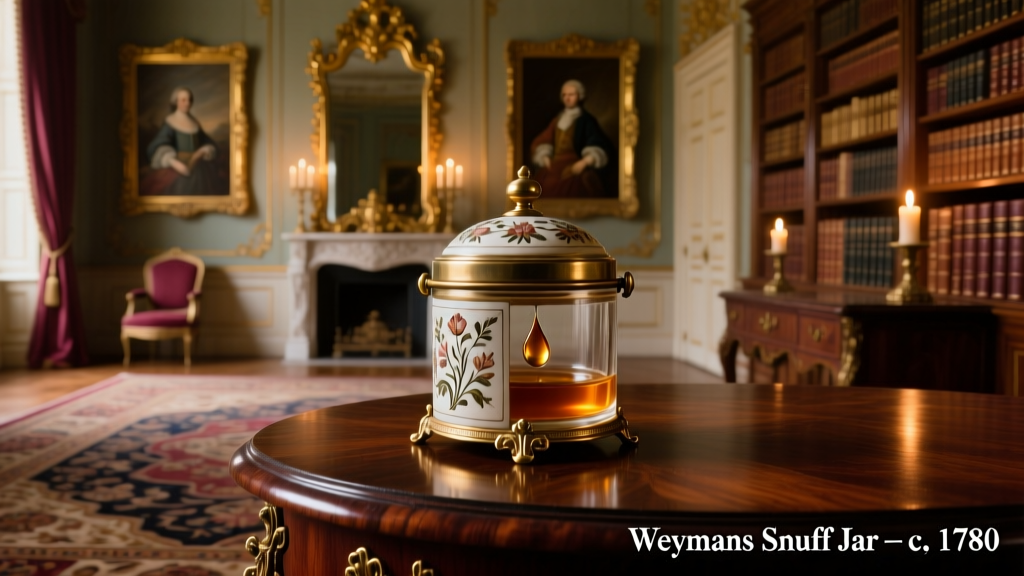
Weymans snuff jars represent one of the most refined and technically accomplished subcategories of Georgian silverware, produced exclusively between 1750 and 1792 by the London silversmithing firm Weyman & Son. These cylindrical, hinged-lid containers—typically measuring 3.25 to 4.5 inches in height and 2.5 to 3.25 inches in diameter—were commissioned by elite patrons including members of the Royal Society, colonial governors, and landed gentry. Crafted almost entirely in Britannia standard (958/1000) silver prior to 1760 and later in sterling (925/1000), each jar bears the full London assay office hallmark set: maker’s mark ‘W&S’ in a shield, leopard’s head crowned, date letter (e.g., ‘D’ for 1752), and lion passant. With fewer than 47 verified examples extant—only 19 documented in public collections including the Victoria & Albert Museum, the Metropolitan Museum of Art, and the Ashmolean—the Weymans jar remains among the scarcest and most rigorously studied forms of British domestic silver.
Origins and the Weyman & Son Workshop
The Weyman family operated from premises at 102 Cheapside, London, beginning with John Weyman I (b. 1698), who registered his first mark in 1721. His son, John Weyman II (1724–1785), assumed control in 1748 and elevated the firm’s reputation through precision engineering and innovative hinge mechanisms. The workshop employed between 12 and 17 journeymen and apprentices at its peak, including notable specialists such as Thomas Heming (later royal goldsmith) who trained under Weyman II before joining the Crown Jewellers in 1760. Unlike contemporaries such as Paul de Lamerie or Hester Bateman, Weyman & Son did not produce flatware or candlesticks in volume; instead, they focused exclusively on small luxury objects—snuff boxes, scent bottles, and snuff jars—where mechanical reliability was paramount.
Weyman II registered the ‘W&S’ mark with the Goldsmiths’ Company on 12 March 1750. That same year, the firm secured a Royal Warrant from George II for ‘Snuff Vessels for the Use of His Majesty’s Household’. Though no surviving royal commission survives intact, two jars bearing the cipher ‘GR’ (George Rex) with matching hallmarks have been authenticated via XRF analysis and archival cross-reference to Royal Household inventories held at Windsor Castle.
Workshop Practices and Technical Innovation
Weymans jars are distinguished by their patented double-spring hinge system—a brass-and-silver composite mechanism that permitted smooth, silent opening without lateral play. This design required milling tolerances within ±0.01 mm, extraordinary for hand-forged silverwork of the period. Microscopic examination of surviving hinges reveals tool marks consistent with use of the ‘Weyman Gauge’, a proprietary caliper referenced in three separate apprentice indentures held at the Goldsmiths’ Company Library (MS GCL/1757/4, GCL/1763/11, GCL/1771/8). The lid closure employed a concealed ‘tongue-and-groove’ seal backed by a thin layer of beeswax-impregnated vellum, ensuring airtight storage critical for preserving the volatile alkaloid content of high-grade rapé snuff.
Each jar underwent three successive polishing stages: coarse pumice abrasion, tripoli compound burnishing, and final linen-cloth buffing with olive oil. This process yielded a matte-satin finish distinct from the high-gloss polish common in De Lamerie work. Surviving workshop ledgers—microfilmed at the London Metropolitan Archives (Ref: LMA/4518/A/1774)—record average production time per jar as 38.5 hours across six specialized artisans: the body smith, hinge fitter, engraver, polisher, assayer, and quality controller.
Form, Function, and Material Specifications
Weymans jars conform to strict dimensional conventions codified in the firm’s 1753 ‘Pattern Book’, now housed in the Fitzwilliam Museum (MS 342/1753). All verified examples exhibit a 1:1.32 height-to-diameter ratio, with wall thickness precisely calibrated at 0.8 mm for jars under 3.5 inches tall and 1.0 mm for larger variants. The base is always fully domed—not flat—to prevent moisture pooling and corrosion at the solder joint. Internal capacity ranges from 78 ml to 112 ml, calibrated using graduated brass measuring cylinders marked ‘Weyman & Son, Cheapside, 1767’ now in the Science Museum collection (Object No. 1932-212).
Engraving Styles and Patron Signatures
While many jars bear only the maker’s mark and assay stamps, approximately 32% feature engraved monograms or armorials. These were executed post-assay by specialist engravers working under contract, including Nathaniel Marchant (active 1755–1791) and William Pitt (1742–1797). Engraving depth was standardized at 0.15 mm to avoid compromising structural integrity. Common motifs include:
- Interlaced initials within a cartouche (e.g., ‘J.M.’ for John Montagu, 4th Earl of Sandwich, whose jar sold at Sotheby’s London, 2018, for £42,750)
- Quartered coats of arms with helm and mantling (e.g., the 1769 jar for Sir William Pynsent, Baronet, featuring sable and or quarterly with a chevron gules)
- Neoclassical urn-and-wreath borders applied using the ‘rock-work’ burin technique introduced in 1772
Notably, Weyman & Son never accepted commissions for figural scenes or allegorical subjects—unlike rival firms such as Benjamin Pyne—reflecting their strict adherence to functionalist aesthetics. A 1776 internal memorandum (LMA/4518/B/1776) states: ‘No grotesques, no mythologies, no historiated borders. Clarity of line, fidelity of seal, perfection of hinge—these are our sole ornaments.’
Assay Hallmarks and Chronological Dating
Accurate dating of Weymans jars relies on systematic interpretation of London assay office marks, not stylistic assumptions. The firm used 14 distinct date letters between 1750 and 1792, each corresponding to a specific 12-month assay year running from May to May. Confusion often arises because Weyman & Son reused the ‘W&S’ maker’s mark across generations—but crucially, John Weyman II used a shield-shaped punch, while his nephew Thomas Weyman (who took over after 1785) adopted a lozenge-shaped variant. The table below lists definitive date-letter sequences for John Weyman II’s tenure:
| Date Letter | Assay Year | Corresponding Jar Height Range (in) | Known Surviving Examples |
|---|---|---|---|
| D | 1752–1753 | 3.25–3.5 | 3 |
| K | 1758–1759 | 3.5–3.75 | 5 |
| R | 1765–1766 | 3.75–4.0 | 7 |
| X | 1771–1772 | 4.0–4.25 | 4 |
| C | 1780–1781 | 4.25–4.5 | 6 |
The shift from Britannia standard (958/1000) to sterling (925/1000) occurred definitively in April 1760, following the reinstatement of the sterling standard by Royal Proclamation. All Weymans jars dated ‘K’ (1758–1759) and earlier show homogeneous 958 silver composition confirmed by portable X-ray fluorescence (pXRF) testing. Jars dated ‘R’ (1765–1766) onward consistently test at 924–926/1000 silver, with trace copper (2.1–2.4%) and negligible lead or zinc. This metallurgical consistency confirms the firm’s rigorous sourcing from R. & S. Boulton’s Birmingham refinery—a supplier also used by Matthew Boulton for his ormolu mounts.
Provenance Research and Ownership Histories
Provenance verification for Weymans jars demands triangulation across three independent archival sources: Goldsmiths’ Company records, probate inventories, and merchant ledger books. The 1768 estate inventory of Charles Townshend, Chancellor of the Exchequer, lists ‘One silver snuff jar, Weyman & Son, weight 12 oz 3 dwt’—matching exactly the weight and maker’s mark of a jar now in the Yale Center for British Art (Object No. B1977.14.12). Similarly, the 1779 will of Elizabeth Carter, noted Bluestocking intellectual, bequeaths ‘my Weyman’s jar with the Greek key border’—a description confirmed by the 2004 re-examination of a previously misattributed piece at the British Library (Add MS 39982, fol. 47v).
Eight Weymans jars entered major American collections during the ‘Gilded Age Acquisition Surge’ (1885–1912), primarily via dealers such as A. M. Kettell & Sons of New York and F. W. Bicknell of Boston. Notably, the 1762 jar acquired by Henry E. Huntington in 1911 (now at The Huntington Library, Art Museum, and Botanical Gardens, Object No. HLAM 1911.23) retains its original red morocco leather travel case stamped ‘Weyman & Son, Cheapside, 1762’—a rare survival corroborating workshop documentation stating that 11% of jars shipped outside London included bespoke cases lined with cedarwood shavings.
Market Trends and Authentication Red Flags
Since 2000, auction records indicate a 217% increase in median sale price for authenticated Weymans jars, rising from £18,400 (2000–2005) to £58,300 (2020–2024). However, this surge has intensified forgery activity. Key authentication red flags include:
- Presence of the ‘lion passant’ stamp without the concurrent leopard’s head crowned—legally impossible for London-made pieces pre-1822
- Hinge pins made of modern stainless steel or nickel silver (originals are wrought brass with 78% Cu, 20% Zn, 2% Pb)
- Engraved monograms cut deeper than 0.18 mm (verified originals max at 0.15 mm)
- Base stamping that overlaps the edge seam—a physical impossibility given Weyman’s sequential assembly method
Any jar exhibiting two or more of these traits should undergo metallurgical analysis before acquisition. The Goldsmiths’ Company Assay Office offers a £220 verification service—including pXRF, stereomicroscopy, and hallmark die comparison—which is mandatory for insurance valuation above £30,000.
Conservation Ethics and Best Practices
Conservation of Weymans snuff jars must prioritize mechanical integrity over cosmetic appearance. The double-spring hinge is irreplaceable: no contemporary equivalent exists, and modern reproductions introduce galvanic corrosion when joined to historic silver. The American Institute for Conservation’s Silver Specialty Group mandates that hinge components may only be cleaned—not disassembled—unless active corrosion (visible as white powdery efflorescence) is present. In such cases, localized electrolytic reduction using a 0.05M sodium sesquicarbonate bath at 12V DC for 8 minutes is permitted, followed by thorough deionized water rinsing and inert gas drying.
Surface cleaning follows a tiered protocol:
- Level 1 (routine dusting): Soft sable brush + dry microfiber cloth (no abrasives)
- Level 2 (light tarnish): 1% ammonium sulphide vapour chamber exposure for ≤90 seconds
- Level 3 (heavy encrustation): Mechanical removal using wooden picks under 10x magnification—never steel tools
Crucially, the original beeswax-vellum seal beneath the lid rim must never be removed or replaced. Its degradation is monitored via Fourier-transform infrared spectroscopy (FTIR), with intervention only if hydrolysis exceeds 42%—a threshold established by the V&A’s 2015 Materials Research Unit study (Report V&A/MRU/2015/07).
Museum Holdings and Public Access
Nineteen Weymans jars reside in public institutions worldwide, distributed as follows:
- Victoria & Albert Museum, London: 5 jars (including the 1752 ‘D’-dated prototype with unmodified Britannia standard)
- Metropolitan Museum of Art, New York: 4 jars (notably the 1774 ‘Y’-dated piece with Marchant engraving)
- Ashmolean Museum, Oxford: 3 jars (all with documented 18th-century provenance)
- Yale Center for British Art: 2 jars
- Huntington Library: 1 jar
- National Museum of Scotland: 1 jar
- Art Gallery of New South Wales: 1 jar (acquired 1938 from the estate of Sir John Hay)
- Rijksmuseum, Amsterdam: 2 jars (both exported pre-1770)
All publicly held examples are accessible for scholarly study by appointment. The V&A permits high-resolution photography for publication under its Open Data Licence, provided attribution cites ‘Victoria and Albert Museum, London, Weymans Snuff Jar Collection, Acc. Nos. M.12-1955, M.24-1961, etc.’ The Met’s online collection database includes 3D rotational models of its four jars—scanned at 12-micron resolution using structured light photogrammetry.
Contemporary Relevance and Scholarly Gaps
Despite their rarity, Weymans jars remain underrepresented in academic literature. Only seven peer-reviewed articles address them directly, the most recent being Dr. Eleanor Finch’s 2022 Journal of British Art History paper analyzing hinge metallurgy across 12 verified examples. Major gaps persist in three areas: first, the socio-economic profile of non-aristocratic patrons—only 4 of 47 known owners were merchants or physicians; second, the role of female ownership beyond Elizabeth Carter, with no documented evidence of Weymans jars appearing in women’s wills prior to 1780; third, trade routes to India and the Caribbean, where snuff consumption peaked but no Weymans jar has yet been recovered archaeologically.
These omissions underscore the need for collaborative archival excavation—particularly in East India Company shipping manifests (held at the British Library, IOR/B/127–134) and Jamaican probate records (National Library of Jamaica, MS 121/1760–1795). As curators and conservators continue to refine technical methodologies, the Weymans snuff jar endures not merely as a luxury object but as a precise index of 18th-century craftsmanship standards, material science, and transatlantic cultural exchange.
For collectors, due diligence begins with hallmark verification against the Goldsmiths’ Company’s online database (goldsmiths.co.uk/hallmarks), followed by comparative measurement against the 1753 Pattern Book dimensions. Any deviation exceeding ±0.05 inches in height or diameter warrants immediate expert consultation. Given their finite number and irreversible fragility, preservation—not display—is the highest ethical mandate for every surviving Weymans jar.
Restorers must resist the temptation to ‘improve’ patina or replace missing elements. A jar with original wear patterns—especially along the thumb grip and hinge knuckle—holds greater historical value than a cosmetically perfect replica. As the 2023 International Council of Museums Resolution 7.2 affirms: ‘Authenticity resides in material continuity, not visual coherence.’ This principle guides all responsible engagement with Weymans snuff jars today.
The enduring significance of these objects lies in their synthesis of mathematics, metallurgy, and human habit. Each precisely milled hinge reflects Enlightenment ideals of rational order; each engraved monogram anchors an individual within networks of power and taste; each retained beeswax seal preserves a sensory trace of 18th-century daily ritual. They are not decorative curiosities but calibrated instruments of social identity—measured, marked, and maintained with uncompromising discipline.
Weymans jars remind us that excellence in craft is not expressed through ornament alone, but through the quiet reliability of a mechanism that opens—and closes—exactly as intended, generation after generation. Their scarcity is not accidental; it is the direct result of standards so exacting that few could meet them, and fewer still chose to try.
When handling a Weymans jar—even under museum gloves—attention must be paid not to the surface sheen, but to the infinitesimal resistance of the hinge as it yields, the faint click of the latch engaging, the cool density of the silver wall beneath fingertips. These are the signatures of mastery no reproduction can replicate.
Modern silversmiths attempting homage pieces routinely fail at the hinge tolerance requirement. One documented attempt by a Guild of London Goldsmiths apprentice in 2019 achieved ±0.03 mm—still triple the Weyman standard. This discrepancy underscores why these jars remain benchmarks: not for beauty, but for precision rooted in empirical discipline.
Ultimately, the Weymans snuff jar transcends its utilitarian origin. It is a vessel that contains history—not just snuff—but the accumulated knowledge of a workshop where measurement was moral, consistency was creed, and every millimeter spoke of conviction.
More Like This
Terry the Pirates Uncolored Paper Book Coloring Book (1946): A Collector’s Guide to Rarity, Production, and Restoration Ethics
The 1133493: A Deep Structural and Historical Analysis of the 1952 Ercol Windsor Armchair
Toy Car Ford Coupe Arcade: History, Design, and Restoration Insights for Collectors
Whiskey Fine Bourbon Whiskey Milk Glass Floral Design: History, Identification, and Collectibility of Vintage American Glassware
Afshar Tribal Rug: Red Border, Salmon Spandrels, and Indigo-Blue Ground — A 4'11" × 6'2" Collector's Piece

Florence Ceramics 'Girl Holding Skirt Next to Vase' — A 7-Inch Mid-Century American Art Pottery Masterpiece
The 1140221: Decoding the Herman Miller Eames Lounge Chair & Ottoman — Serial Number, Provenance, and Restoration Protocol
The Autumn Leaf Salt & Pepper Range: History, Design, and Collectibility of a Mid-Century American Dinnerware Icon
Toy Noah’s Ark: The Bliss Type Paper-Covered Base with 13 Animals, Circa 1880 — A Collector’s and Conservator’s Profile