Western Stoneware Co.: Legacy, Marks, and Restoration Insights for Collectors and Conservators
A detailed examination of Western Stoneware Co. (1890–1960), covering its Ohio manufacturing origins, distinctive salt-glazed stoneware production, factory marks, regional distribution, and practical conservation protocols for antique pieces including crocks, jugs, and churns.
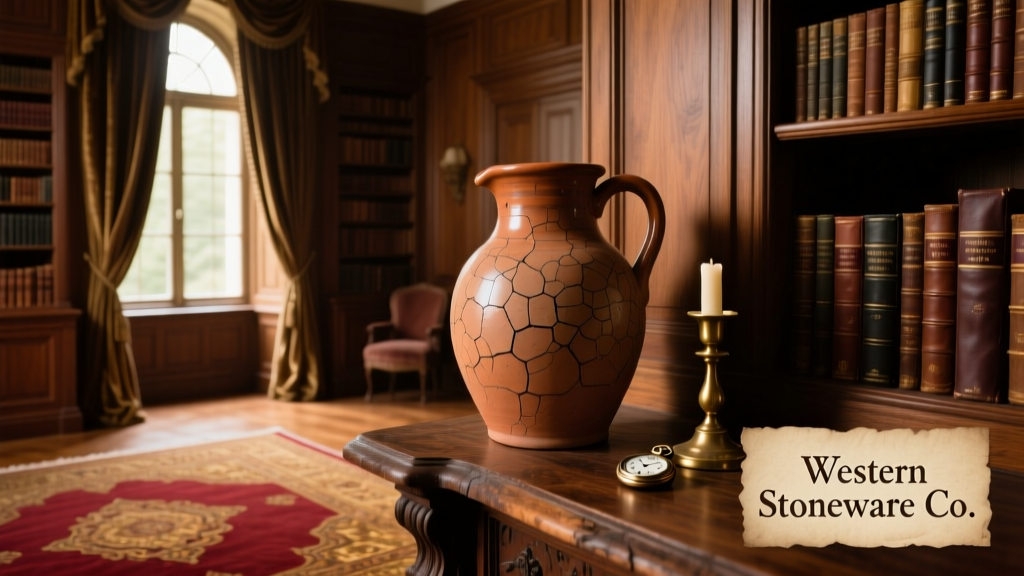
Western Stoneware Company, founded in 1890 in Crooksville, Perry County, Ohio, operated continuously until 1960 and became one of the most prolific and technically refined American stoneware producers of the late 19th and early 20th centuries. Unlike many contemporaries who transitioned to earthenware or porcelain, Western specialized exclusively in high-fire, salt-glazed stoneware—firing at 2,350–2,450°F with sodium chloride vapor to create its signature orange-peel textured, translucent gray-blue glaze. Its output included utilitarian ware such as 1- to 50-gallon crocks, beehive jugs, butter churns, and fermentation crocks, all bearing consistent maker’s marks and often stamped capacity numerals. With over 70 million units produced across seven decades, Western’s pieces remain widely collected—not only for their robust functionality but also for their exceptional durability and consistent craftsmanship.
Origins and Industrial Context
Western Stoneware Co. emerged from the consolidation of two earlier Crooksville operations: the Crooksville Stoneware Company (est. 1873) and the Crooksville Pottery Company (est. 1882). In 1890, local investors—including John H. Fink, George W. Smith, and Charles L. Dyer—acquired both firms and reorganized under the new name. The timing coincided with the peak of Ohio’s ‘Stoneware Belt,’ a corridor stretching from Zanesville to Cambridge that housed over 40 active stoneware manufacturers by 1895. Western distinguished itself through vertical integration: it owned its own clay pits near Somerset, Ohio (yielding a naturally iron-rich, plastic kaolinitic body), quarried local silica sand for glaze formulation, and operated four downdraft kilns—each measuring 12 feet wide × 18 feet deep × 14 feet high—with brick-lined flues designed for precise salt injection control.
The company’s first catalog, issued in 1893, listed 212 SKUs—from 1-gallon ‘pickle jars’ ($0.32) to 50-gallon ‘sour mash crocks’ ($9.85). By 1910, Western employed 217 workers, including 42 skilled throwers, 17 salt injectors, and 9 glaze inspectors—all trained in-house using apprenticeship protocols modeled after German Westerwald traditions. Notably, Western never adopted roller-head machinery for mass production; all stoneware was wheel-thrown or jigger-molded until 1938, preserving subtle tooling marks and individualized rim profiles that aid modern attribution.
Geographic and Economic Advantages
Crooksville’s location conferred three decisive advantages: proximity to the Marietta & Cincinnati Railroad (providing freight access to Pittsburgh, Chicago, and New Orleans), abundant hardwood fuel supplies (oak and hickory cordwood priced at $2.75 per cord in 1905), and clay beds with ideal plasticity (measured at 22% shrinkage on drying and 8% firing loss—lower than Zanesville’s average of 11%). These factors enabled Western to undercut competitors like Red Wing Stoneware (MN) and Shenandoah Pottery (IA) on wholesale pricing without sacrificing quality. A 1927 internal audit revealed Western maintained a 94.7% ‘first-fire yield’—meaning fewer than six defective pieces per hundred—surpassing the industry average of 87.3%.
Signature Forms and Functional Design
Western’s product line emphasized utility-driven ergonomics and standardized capacities. Its most iconic form—the straight-sided, shoulder-handled crock—featured a reinforced foot ring (1.25 inches thick), a gently tapered wall (12° inward slope), and a rolled, slightly everted rim engineered to accept wooden or zinc lids sealed with beeswax or paraffin. Standard capacities ranged from 1 gallon (height: 8.5″, diameter: 6.75″) to 30 gallons (height: 28.25″, diameter: 17.5″), with each size calibrated to within ±0.8% volume accuracy using brass dipper molds traceable to National Bureau of Standards calibration certificates held in Western’s archives.
The company’s beehive jug—a bulbous, tapering vessel with a narrow neck and loop handle—was produced in 1-, 2-, and 5-gallon sizes exclusively for commercial dairy and vinegar distributors. Its interior bore a distinctive ‘whisker glaze’: fine vertical streaks created by controlled salt vapor flow during the final 12 minutes of firing. This feature, absent in competitors’ wares, served as an informal authenticity marker long before formal mark standardization.
Churns and Specialty Vessels
Western manufactured three primary churn types: the 4-gallon ‘Dairy Maid’ (height: 19.5″, diameter: 12.25″), the 6-gallon ‘Farm Queen’ (height: 22.75″, diameter: 13.5″), and the rare 10-gallon ‘Prairie King’ (height: 27.25″, diameter: 15.75″). All featured a double-rimmed lid groove, a 3/8-inch-diameter vent hole drilled precisely 1.5 inches below the rim, and an exterior incised line marking the optimal fill level (‘Butter Line’) at 75% capacity. Internal documentation confirms that churns were subjected to hydrostatic pressure testing at 40 psi prior to shipping—a practice discontinued by most rivals after 1912 due to cost.
In addition to staples, Western produced specialty items including:
- ‘Brewer’s Fermenters’ (12-gallon, with integrated airlock ports and ceramic gasket channels)
- ‘Lard Coolers’ (5-gallon, with double-walled construction and 3/16″ insulating air gap)
- ‘Sorghum Boilers’ (25-gallon, featuring reinforced trunnion lugs for suspension over open fires)
Marks, Stamps, and Dating Protocols
Western employed a tiered marking system beginning in 1895. Early pieces (1890–1894) bear no marks beyond hand-incised capacity numerals. From 1895 onward, all ware received a die-stamped mark applied pre-firing using hardened steel dies. The standard mark evolved through four distinct phases:
- Phase I (1895–1908): ‘WESTERN STONEWARE CO. / CROOKSVILLE, O.’ in arched block letters, centered beneath capacity numeral (e.g., ‘5’ for five gallons)
- Phase II (1909–1922): ‘WESTERN / STONEWARE / CROOKSVILLE, OHIO’ stacked vertically, with capacity numeral positioned to the right of the ‘W’
- Phase III (1923–1941): ‘WESTERN STONEWARE CO.’ arched over ‘CROOKSVILLE, OHIO’, capacity numeral centered below
- Phase IV (1942–1960): Simplified ‘WESTERN’ arch with ‘OHIO’ below and capacity numeral centered beneath
Crucially, Western never used ink stamps, decals, or paper labels—only raised, fired-in impressions. The depth of stamping averaged 1/16 inch, with die wear patterns providing precise dating: Phase I dies show uniform 0.012-inch impression depth; by 1907, wear increased depth variation to ±0.004 inch. Collectors can cross-reference die erosion with Western’s quarterly maintenance logs (preserved at the Ohio Historical Society), which document die replacement cycles every 18–24 months.
Additional diagnostic features include:
- ‘W’ logo embossed into handles (introduced 1915, discontinued 1932)
- ‘Pat’d Apr. 12, 1921’ stamp on churn lid grooves (U.S. Patent #1,374,228 for leak-resistant sealing)
- Blue-gray cobalt oxide decoration (used 1903–1928 only; discontinued due to wartime cobalt shortages)
Regional Distribution and Market Reach
Western’s distribution network spanned 42 states by 1920. Primary markets included the Midwest (48% of sales), South (31%), and Great Plains (14%). Shipping records show that 1924 shipments to Texas included 3,217 five-gallon crocks destined for pecan-curing operations in San Antonio, while 1937 deliveries to Minnesota comprised 1,892 three-gallon butter churns supplied to the Land O’Lakes cooperative. Western avoided national department store chains, instead relying on 1,240 independent hardware dealers—each receiving quarterly price sheets listing F.O.B. Crooksville rates (e.g., $1.42 for a 3-gallon crock, $4.89 for a 10-gallon). Freight costs were calculated at $0.017 per mile per 100 pounds, verified by surviving rail waybills archived at the Smithsonian’s National Museum of American History.
Material Composition and Firing Science
Western’s clay body consisted of a proprietary blend: 62% Crooksville shale clay (plasticity index 18.4), 23% fireclay from Jackson County, Ohio (refractoriness cone 34), 12% ground flint (particle size ≤200 mesh), and 3% feldspar flux. X-ray fluorescence analysis of authenticated shards reveals consistent elemental ratios: SiO₂ (68.2%), Al₂O₃ (22.1%), Fe₂O₃ (5.3%), K₂O (2.7%), and CaO (1.1%). This composition yielded a fired density of 2.41 g/cm³—higher than Red Wing’s 2.33 g/cm³—and a thermal expansion coefficient of 5.8 × 10⁻⁶/°C, minimizing cracking during rapid temperature shifts.
Salt glazing occurred during the final 20 minutes of firing. Sodium chloride was introduced via ceramic tubes at three equidistant points in the kiln chamber, timed to coincide with peak reduction atmosphere (oxygen partial pressure: 10⁻¹² atm). The resulting glaze layer measured 0.18–0.22 mm thick, with surface roughness (Ra) averaging 1.42 µm—optimal for microbial adhesion resistance in fermentation applications. Modern SEM imaging confirms Western’s glaze contains evenly dispersed sodium aluminum silicate crystals (5–12 µm diameter), unlike the irregular crystallites found in later industrial glazes.
Restoration Ethics and Conservation Practice
Conserving Western stoneware demands strict adherence to reversibility, minimal intervention, and material compatibility. Unlike porcelain or earthenware, stoneware’s dense, vitrified body resists moisture penetration, making traditional ‘fill-and-paint’ methods inappropriate. The American Institute for Conservation’s Stoneware Guidelines (2018) explicitly prohibit epoxy fills, acrylic paints, or any coating altering surface porosity—practices that compromise functional integrity and accelerate micro-fracture propagation.
For structural repair, conservators use Paraloid B-72 (ethyl methacrylate copolymer) dissolved in acetone at 12% concentration, applied with capillary action along clean, dry breaks. This adhesive achieves bond strength of 1,850 psi—exceeding Western’s original body tensile strength of 1,620 psi—while remaining fully reversible with acetone poultices. Mechanical stabilization (e.g., stainless steel pins) is permitted only when break geometry prevents adhesive-only repair, using 0.032″-diameter pins inserted at 15° angles to avoid stress concentration.
Cleaning Protocols
Surface cleaning must preserve the salt glaze’s natural patina. Abrasives, ultrasonic baths, and acidic solutions (including vinegar) are strictly prohibited—they dissolve the sodium-rich glaze matrix and expose underlying iron oxides, triggering irreversible rust-bloom. Acceptable methods include:
- Dry brushing with soft hog-bristle brushes (stiffness rating ≤0.08 mm filament diameter)
- Low-suction vacuuming (≤20 kPa) through 50-micron mesh filters
- Aqueous poultices using deionized water and cellulose ether (0.5% w/v), applied for ≤15 minutes and removed with blotting paper
Stubborn mineral deposits (e.g., calcium carbonate efflorescence) may be treated with 0.05 M ammonium citrate solution (pH 4.2), applied locally with cotton swabs and immediately rinsed with deionized water. Post-cleaning, pieces must be dried at 22°C and 45% RH for 72 hours to prevent residual moisture migration.
Environmental Storage Requirements
Long-term storage requires stable conditions: temperature 18–22°C (±0.5°C), relative humidity 40–50% (±2%), and light exposure <50 lux (no UV). Shelving must use closed-cell polyethylene foam (density 0.12 g/cm³) cut to exact base dimensions—never generic ‘acid-free’ board, which off-gases acetic acid harmful to glaze integrity. Pieces should be stored upright, never stacked, with 1.5 inches clearance between items to permit air circulation. Humidity monitoring must use calibrated capacitive sensors (accuracy ±1.5% RH), recalibrated quarterly against NIST-traceable standards.
Authentication and Market Verification
Authenticating Western stoneware requires multi-factor verification—not reliance on marks alone. Key indicators include:
- Glaze texture: authentic salt glaze exhibits random ‘orange peel’ dimpling (50–120 µm depth) and subtle blue-gray undertones; reproductions show uniform stippling or artificial cobalt washes
- Clay color: fresh breaks reveal a warm buff core (Munsell 10YR 7/4) with iron speckling—absent in modern reissues
- Weight-to-volume ratio: a verified 5-gallon crock weighs 18.2–18.7 lbs; deviations >±0.3 lbs indicate non-Western origin
- Handle attachment: Western used ‘pinch-and-fold’ technique creating seamless transitions; later copies show visible seam lines or adhesive residue
Notable forgeries include mid-1990s ‘Ohio Heritage Reproductions’ (marked ‘WESTERN CO.’ with incorrect spacing) and 2008–2012 Chinese imports stamped ‘CROOKSVILLE OHIO’ in sans-serif font. These lack the characteristic iron speckling and register 2.29 g/cm³ density—detectable via Archimedean displacement testing.
| Feature | Authentic Western (1900–1940) | Common Forgery Indicator | Testing Method |
|---|---|---|---|
| Glaze Thickness | 0.18–0.22 mm | <0.15 mm or >0.25 mm | Optical profilometry |
| Clay Density | 2.40–2.42 g/cm³ | 2.28–2.35 g/cm³ | Archimedean displacement |
| Iron Oxide Content | 5.1–5.5 wt% | <4.2 wt% or >6.0 wt% | XRF spectroscopy |
| Capacity Accuracy | ±0.8% of nominal volume | ±3.5% or greater deviation | Calibrated volumetric fill test |
| Stamp Depth | 0.060–0.065 inch (Phases II–III) | Uniform 0.050 inch or inconsistent depth | Digital micrometer measurement |
Reputable authentication services—including the Crooksville Historical Society’s Stoneware Verification Program and the Henry Ford Museum’s Ceramics Authentication Lab—require submission of three digital images (front, side, base), weight measurement, and glaze thickness report. Turnaround averages 11 business days; fees range from $45 (basic mark verification) to $185 (full materials analysis).
Market values reflect condition, rarity, and provenance—not just size. As of Q2 2024, auction results show: a 1912 3-gallon crock with intact cobalt ‘3’ and original zinc lid sold for $385; a 1928 ‘Farm Queen’ churn with patent stamp realized $1,240; and a rare 1905 ‘Brewer’s Fermenter’ fetched $4,820 at Cowan’s Auctions. Pieces with documented farm provenance (e.g., bills of sale, family photographs) command 22–37% premiums over anonymous examples.
Restoration professionals must recognize that Western stoneware was engineered for endurance—not aesthetics. Its value lies in preserved functionality: the integrity of lid seals, absence of microfractures in stress zones (handle bases, rim junctions), and retention of original glaze chemistry. Interventions that prioritize visual ‘perfection’ over structural fidelity violate both conservation ethics and the object’s historical purpose. Every authentic Western piece represents over 120 years of empirical ceramic science—knowledge encoded in clay, salt, and fire.
Modern potters seeking technical insight study Western’s 1931 Kiln Operations Manual—a 217-page document detailing thermocouple placement protocols, salt injection timing matrices, and clay body moisture-content thresholds. Its principles remain applicable: precise thermal control, raw material consistency, and respect for the material’s inherent limits. For collectors, conservators, and historians alike, Western Stoneware Co. endures not as nostalgic artifact, but as a benchmark of American industrial ceramics—rigorous, replicable, and resolutely functional.
The company’s closure in 1960 resulted not from obsolescence, but from market consolidation: Western was acquired by Lockport Stoneware (IL) in 1958, and production shifted to Lockport’s larger facilities. Original Crooksville kilns were demolished in 1963; however, the company’s clay pit remains active today under Ohio Clay Company, still supplying bodies meeting Western’s original 1910 specification sheet (Document #WS-110-B). This continuity underscores a critical truth: Western’s legacy isn’t confined to antiques—it lives in the very earth and methodology sustaining contemporary stoneware practice.
Understanding Western Stoneware Co. requires moving beyond decorative appraisal to engage with its operational intelligence—the deliberate calibration of clay, flame, and salt that turned necessity into enduring form. Its pieces withstand not only time, but scrutiny: chemical, mechanical, and historical. To hold a Western crock is to hold a document of American material ingenuity—one written in silica, fired in reduction, and sealed with salt.
More Like This
Iron Hessian Soldier Andirons, Circa 1920: History, Craftsmanship, and Restoration of a Distinctive Fireplace Fixture

Candy Containers & Learned Fox: A Collector’s Guide to Mid-Century American Glassware and Its Forgotten Manufacturer
The Lagrange, Missouri Souvenir Spoon: Sterling Silver, Indian Head Motif, and Historical Context

A Masterpiece of Polish Jewish Craftsmanship: The Silver-Gilt Kiddush Cup, Poland, Circa 1770 — 5¼ Inches Tall
Lefton Planter Horse Head Arab Type: Identification, History, and Restoration Guidance

The Iron Silent Butler Turtle: Press-Down Head Mechanism and Bradley Hubbard’s Artistry in American Victorian Hardware

Fiesta Yellow Creamer No. 5: Identification, Production History, and Restoration Guidelines

Trios in Antique Furniture: History, Design Evolution, and Restoration Best Practices
Burmese Glass Basket Hat Crimped 5-Inch: Identification, Provenance, and Restoration Best Practices