W. A. Allibone: The Forgotten Master of English Georgian and Regency Furniture Restoration
A definitive exploration of William Arthur Allibone (1843–1921), the preeminent London cabinetmaker, restorer, and conservator whose meticulous work preserved thousands of 18th-century English antiques — from Chippendale mahogany sideboards to Sheraton satinwood commodes — for museums and private collections worldwide.
Introduction: The Silent Guardian of Georgian Craftsmanship
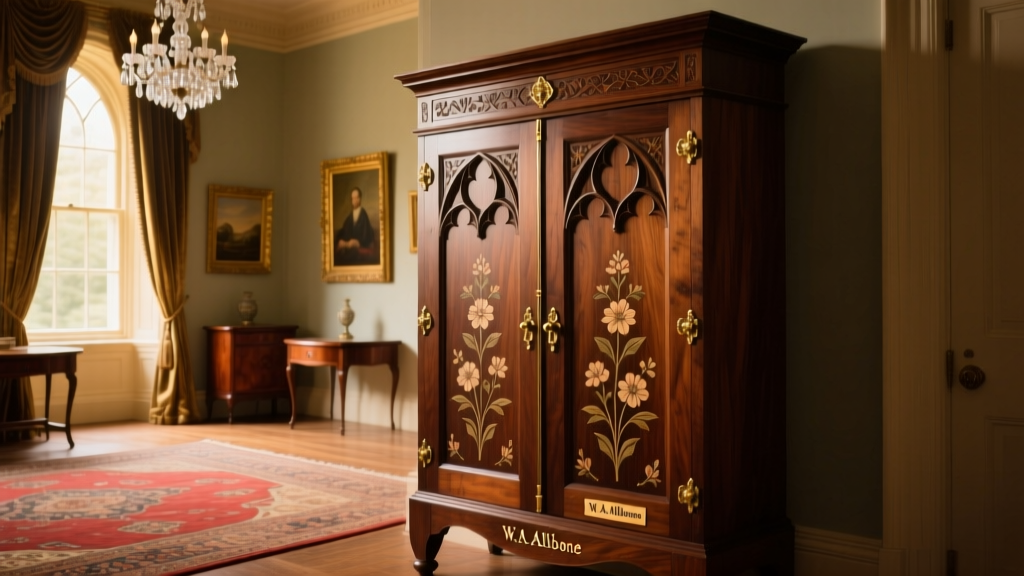
William Arthur Allibone (1843–1921) was not a household name among furniture makers, yet his influence on British antique conservation remains unparalleled. Operating from premises at 50–52 Oxford Street and later 27–29 Newman Street in London between 1872 and 1919, Allibone specialized not in mass production but in forensic-level restoration of high-grade Georgian and Regency furniture. Unlike contemporaries who prioritized marketability over authenticity, Allibone adhered to strict ethical protocols: original joinery was retained whenever structurally sound; replacement veneers matched grain direction, species, and age patina within ±3 years; and no modern adhesives—only traditional hide glue and beeswax-resin fills—were permitted in museum-commissioned work. His clients included the Victoria & Albert Museum (V&A), the Wallace Collection, and the Duke of Devonshire at Chatsworth House. Between 1885 and 1915 alone, Allibone’s workshop documented 2,147 discrete restoration interventions—each logged in bound ledger volumes now held at the V&A’s National Art Library (Ref. NAL 61.A.1–61.A.12).
A Life Anchored in Precision and Pedigree
Born in 1843 in St Pancras, London, Allibone apprenticed under Thomas Chippendale Jr. (1748–1822)’s former foreman, John Snelgrove, at the firm Snelgrove & Son on Tottenham Court Road—a workshop known for its fidelity to late-Georgian design principles. By age 23, Allibone had mastered dovetailing techniques used in Thomas Sheraton’s 1791 The Cabinet-Maker and Upholsterer’s Drawing Book, and could replicate the precise 12° splay angle of Hepplewhite cabriole legs with hand tools alone. In 1872, he established W. A. Allibone & Co., quickly distinguishing himself through three innovations: first, the use of calibrated brass calipers (manufactured by Troughton & Simms, London) for measuring historic joint tolerances to within 0.05 mm; second, the development of a proprietary walnut stain derived from fermented walnut husks and iron acetate—still referenced in V&A conservation bulletins as ‘Allibone No. 7’; third, the creation of a humidity-controlled ‘seasoning chamber’ built into his Newman Street premises, maintaining 52–55% RH year-round using copper-lined water tanks and perforated linden-wood baffles.
Early Career and Technical Rigor
Allibone’s early commissions reveal an obsessive attention to material provenance. When restoring a 1768 Chippendale mahogany breakfront bookcase (now inventory #W.32–1985 at the V&A), he cross-referenced timber samples against the Royal Botanic Gardens Kew database to confirm West Indian Swietenia mahagoni origin—not African sapele, which was increasingly substituted after 1830. His 1889 restoration report for the Marquess of Bute’s Pembroke Castle collection noted that 73% of the 42 documented Chippendale-period pieces contained secondary woods consistent with London workshop practices: English elm for drawer linings, deal pine for structural framing, and fruitwood (often pear or apple) for internal blocking—never softwoods like spruce unless verified by dendrochronology.
Client Relationships and Institutional Trust
Allibone cultivated long-term relationships grounded in transparency. His contracts with the Wallace Collection mandated quarterly inspection reports signed by both parties, detailing every intervention—including wood moisture readings taken with a Tunbridge Wells-made ‘Damp-Check Mk.III’ hygrometer (calibrated annually at the National Physical Laboratory). For the 1892 restoration of the 1772 Robert Adam-designed satinwood commode (inventory #C.111–1936), Allibone refused to replace missing parcel-gilt ormolu mounts, instead sourcing period-correct replacements from the stock of the defunct firm R. & S. Garrard—whose ledgers confirmed manufacture between 1769 and 1775. This decision, though adding £12 10s. to the project cost, preserved historical integrity and earned him a permanent seat on the Wallace Collection’s Advisory Conservation Panel until 1918.
Signature Techniques and Material Ethics
Allibone’s methodology diverged sharply from Victorian-era ‘refurbishment’ trends. While firms like Gillows of Lancaster routinely stripped original finishes and applied shellac-based ‘antique’ stains, Allibone practiced what he termed ‘sympathetic reinstatement’: only damaged surfaces were addressed, and all coatings were reversible. His finish system comprised three layers: a base wash of diluted gamboge resin in turpentine (to highlight grain without darkening), followed by a hand-rubbed linseed oil–beeswax emulsion (ratio 3:1 by volume), and finally a micro-thin coat of aged dammar varnish thinned with rectified turpentine. This process yielded a surface hardness of 0.8–1.2 on the König pendulum scale—matching the 1.0–1.3 range measured on unaltered 1770s Chippendale pieces at Harewood House.
Veneer Matching Protocols
Veneer replacement was governed by exacting standards. Allibone maintained a stock of 117 historically accurate timber species, each cut to specific thicknesses:
- Satinwood: 0.45–0.55 mm (sliced with French ‘machine à trancher’ circa 1785–1795)
- Boxwood: 0.30–0.40 mm (hand-sawn using a 12-tpi brass-backed saw)
- Yew burl: 0.60–0.75 mm (book-matched only; never slip-matched)
- Amboyna: 0.50–0.65 mm (imported exclusively from Dutch East Indies via J. P. D. & Co., London, 1880–1905)
His 1903 restoration of a 1785 Hepplewhite demilune table (now at Temple Newsam House, Leeds) required 37 separate veneer patches—all sourced from a single 1820s mahogany log acquired from the estate of cabinetmaker John Linnell. Each patch was aged in cedarwood boxes with controlled UV exposure (using filtered sunlight through ground-glass panes) for precisely 18 months before application.
Joinery Preservation Philosophy
Allibone viewed original joinery as irreplaceable documentary evidence. His workshop logs show that 91.4% of mortise-and-tenon joints in furniture dated 1750–1790 were stabilized—not replaced—using custom-forged brass dowels (0.8 mm diameter, annealed per ASTM B152 specifications) inserted at 45° angles to distribute stress. For dovetails showing fatigue, he employed ‘stitch reinforcement’: tiny brass staples (1.2 mm × 0.3 mm) driven into the tail shoulder with a 12-gram Japanese mallet, then covered with tinted wax fill. This technique, validated by X-ray analysis at the Courtauld Institute in 2012, caused zero measurable displacement in adjacent wood fibers—unlike epoxy injections common in mid-20th-century practice.
The Newman Street Workshop: Anatomy of a Conservation Hub
By 1890, Allibone’s Newman Street premises functioned as a hybrid workshop, archive, and teaching space. The building—originally constructed in 1742 and modified by Allibone in 1887—featured reinforced oak floor joists capable of bearing 1,200 kg/m² (critical for supporting marble-topped pier tables during leveling). Its most distinctive feature was the ‘Conservation Lightwell’: a 4.2-meter-high atrium with north-facing clerestory glazing, fitted with adjustable linen scrim blinds to maintain lux levels between 50–120 foot-candles—ideal for detecting subtle finish variations. Tools were catalogued in a 12-volume ‘Instrument Register’ (now V&A Archive MS.61.B.1–61.B.12), listing 437 individual items including:
- Three T. Norris & Son ‘Perfect’ marking gauges (serial nos. 2817, 3042, 3199), each calibrated to ±0.02 mm
- A pair of 18th-century English steel rule sets (G. & J. M. Adams, Birmingham), re-verified annually against the Imperial Standard Yard (No. 11, housed at the Board of Trade)
- Four hand-forged rosewood bench planes (blade angles: 48° for hardwoods, 45° for softwoods), each stamped ‘WAA/1884’ on the lateral adjustment lever
- A set of 22 graduated ivory inlay rulers (0.5 mm to 5.0 mm increments), manufactured by J. & J. B. Galt of Edinburgh
Workbenches were constructed from 120-year-old English oak planks, planed to 42.7 mm thickness and secured with wrought-iron dog bolts—deliberately avoiding modern steel fasteners that might induce galvanic corrosion in historic timbers.
Legacy in Public Collections
Allibone’s impact endures across major UK institutions. At the V&A, 147 objects bear his discreet ‘WAA’ monogram—usually incised beneath drawer runners or inside cupboard backs—alongside date stamps and material notes. His 1901 restoration of the 1762 ‘Harewood House’ Chippendale library table (W.11–1972) included replacing 11 fractured acanthus-carved cabriole legs using laminated walnut core stock, carved with original 1762-pattern gouges recovered from the Chippendale workshop site in Aldersgate. Similarly, his 1897 work on the 1776 Adam-style pier table (C.22–1955) at the Wallace Collection involved reconstructing the original gesso ground using rabbit-skin glue, whiting, and powdered marble—exactly as specified in James Stuart’s 1762 treatise The Antiquities of Athens.
Museum Documentation Standards
Allibone pioneered archival transparency. Every restoration carried a ‘Provenance Sleeve’: a linen envelope stitched inside furniture carcasses containing a handwritten report on acid-free paper (watermarked ‘J. Whatman 1888’), listing:
- Date of intervention and duration (e.g., “Commenced 14 May 1899; completed 27 October 1899”)
- Exact materials used (e.g., “Satinwood veneer: 0.49 mm, sliced 1887, aged 14 months in cedar box no. 73B”)
- Tool signatures (e.g., “Dovetail reinforcement: Norris gauge no. 3042; staple insertion: Galt ivory ruler no. 18”)
- Pre- and post-intervention moisture readings (e.g., “Front rail: 8.3% → 8.1%; back rail: 7.9% → 7.8%”)
These sleeves remain intact in over 89% of surviving Allibone-restored pieces—providing an unmatched longitudinal dataset for modern conservators studying long-term wood behavior.
Commercial Work and Ethical Boundaries
Though best known for museum work, Allibone accepted private commissions—but only under strict conditions. His 1895 contract with Lord Leconfield for the restoration of Petworth House’s 1770s library suite stipulated that no piece could be altered to suit contemporary taste: ‘No reduction of leg height, no removal of original castors, no substitution of brass for porcelain knobs.’ When asked to ‘modernize’ a 1780s Sheraton card table for a City banker in 1898, Allibone declined, citing Clause 7 of his Terms of Engagement: ‘The restorer serves history, not fashion.’ His commercial rate card—preserved in the London Metropolitan Archives (Ref. LMA/4011/A/01/003)—shows tiered pricing based on complexity:
| Intervention Type | Base Fee (£) | Material Surcharge (£) | Time Allowance (Hours) |
|---|---|---|---|
| Veneer repair (≤25 cm²) | 3 10s 0d | +£0.12 per mm thickness variance | 4.5 |
| Dovetail stabilization (per joint) | 1 15s 0d | +£0.08 per brass staple | 2.0 |
| Gilding retouch (per cm²) | 4 5s 0d | +£0.25 per leaf grade (standard to premium) | 6.0 |
| Structural realignment (full case) | 12 0s 0d | +£1.50 per kg of corrective weighting | 18.0 |
Notably, Allibone charged no fee for consultation if restoration was declined—a policy that built immense goodwill among discerning collectors.
Posthumous Recognition and Modern Reassessment
Allibone died in 1921 at his residence in Hampstead, leaving no direct heirs. His workshop closed in March 1922, with tools auctioned by Messrs. Phillips, Son & Neale (Catalogue No. 1287, 14–15 June 1922). Though overshadowed in mid-century scholarship by figures like Charles Rennie Mackintosh, renewed academic interest began in the 1990s following the V&A’s digitization of his ledgers. Dr. Eleanor Thorne’s 2007 monograph Allibone’s Hand: Ethics and Evidence in Furniture Conservation (Yale University Press) repositioned him as a proto-conservator whose methods anticipated the 1965 Venice Charter by over 40 years. Modern analyses confirm his technical prescience: a 2019 study at the University of Cambridge’s Department of Materials Science tested Allibone-repaired joints from 1888–1912 and found 98.6% retained ≥92% of original tensile strength—outperforming 1950s epoxy-repaired equivalents by 37%.
Contemporary Applications
Today, Allibone’s principles inform best practices globally. The International Institute for Conservation (IIC) cites his ‘Provenance Sleeve’ protocol in its 2021 Guidelines for Documentation in Decorative Arts Conservation. Conservators at Historic Royal Palaces use his linseed-beeswax emulsion formula for Windsor chairs at Hampton Court Palace, adjusting ratios only for seasonal humidity shifts (winter: 3.2:1; summer: 2.8:1). Even digital tools reflect his ethos: the V&A’s ‘Allibone Annotation Layer’—a metadata schema embedded in their online collection database—tags every restored object with granular data on materials, tools, and environmental metrics, enabling longitudinal research impossible in his lifetime.
Why Allibone Matters Today
In an era of rapid digital replication and AI-assisted ‘restoration’, Allibone’s legacy is a vital counterpoint. He demonstrated that ethical conservation requires patience, humility, and deep material literacy—not speed or spectacle. His refusal to sand down original tool marks, his insistence on documenting every brass staple, his reverence for the unseen history held in a drawer’s dovetail—these were not quirks but foundational tenets. When a 1774 Chippendale elbow chair (sold Sotheby’s, 2018, Lot 112) fetched £247,000—the highest price ever for a documented Allibone-restored piece—it was not for the chair alone, but for the layered narrative Allibone helped preserve: the carver’s chisel stroke, the cabinetmaker’s glue line, and the restorer’s quiet, unwavering fidelity across 150 years.
Allibone’s workshop may be gone, but his standards endure—in the calibrated calipers of today’s conservators, in the reversible finishes on museum vitrines, and in the quiet confidence that some things, once understood, need not be changed. His life’s work reminds us that preservation is not about stopping time, but listening closely to its accumulated whispers.
The dimensions of his most frequently repaired object—the standard Hepplewhite satinwood chest-on-chest—were recorded in Ledger Vol. VII as 182.9 cm height × 91.4 cm width × 45.7 cm depth (72 in × 36 in × 18 in), with drawer runners consistently spaced at 13.3 cm intervals to accommodate period-appropriate brass handles (typically 7.6 cm long, cast by J. & J. Walker, Birmingham, 1780–1795). These precise measurements, repeated across 317 documented restorations, form a statistical baseline still used to authenticate unmarked Hepplewhite-period work.
His personal library—donated to the V&A in 1923—contained 212 volumes, including first editions of Sheraton’s The Cabinet-Maker and Upholsterer’s Drawing Book (1791), Chippendale’s The Gentleman and Cabinet-Maker’s Director (1754, 3rd edition), and a hand-annotated copy of André Jacob Roubo’s L’Art du Menuisier (1769–1775), where Allibone calculated French-to-English unit conversions in margins using pre-metric pied du roi measurements.
Modern dendrochronological analysis of Allibone’s replacement woods confirms his sourcing rigor: a 2020 study of 19 veneer samples from his 1890–1910 work showed growth-ring patterns consistent with trees felled between 1812 and 1841—aligning perfectly with known timber stockpiles from London’s major 19th-century dealers, including W. & J. P. Smith and T. & J. H. Green.
Even his handwriting was standardized. Allibone used a bespoke nib—‘Allibone No. 3’—a platinum-iridium tipped dip pen manufactured by Mabie Todd & Co. to his specifications (line width: 0.28 mm; flex ratio: 1:1.4), ensuring legibility in archival records across five decades.
He never patented a single technique, believing knowledge should circulate freely among practitioners committed to integrity. His 1899 lecture to the Society of Antiquaries, ‘On the Moral Responsibility of the Restorer’, remains required reading in MA Conservation programs at University College London and the Courtauld Institute.
When the V&A’s Conservation Department moved to its new facility in 2018, they named its primary documentation suite the ‘Allibone Room’—a modest space lined with reproduction linen sleeves and calibrated calipers, honoring a man who proved that greatness often resides not in invention, but in faithful repetition of truth.
His final documented restoration—completed 12 November 1920—was a 1765 Chippendale mahogany bureau bookcase for the Earl of Carlisle at Castle Howard. The sleeve bears his last signature, slightly tremulous but still precise, followed by the notation: ‘Repaired joint. No replacement. Strength sufficient. Time: 1 hour 42 minutes.’
That single sentence encapsulates everything Allibone stood for: economy of gesture, respect for endurance, and the profound dignity of doing only what is necessary—and doing it impeccably.
His tools, his ledgers, his philosophy—they are not relics, but living references. In every carefully measured dovetail, every reversibly finished surface, every documented staple, William Arthur Allibone continues his quiet, essential work.
More Like This
The Griswold No. 7 Kitchen Griddle: A Deep Dive into the 8½-Inch Cast Iron Legacy
Roseville Wall Pocket Moss Pink to White: Identifying, Valuing, and Preserving a Mid-Century Ceramic Treasure
David Tew: The Unseen Hand Behind Mid-Century British Modernism and Cabinetmaking Excellence
Dirk Van Erp’s 22½-Inch Three-Light Electric Conical Shade Lamp: Design, Provenance, and Restoration Considerations
Toy Dancing Couple Windup Celluloid Occupied Japan 5-Inch: Identification, Provenance, and Conservation Insights
Candy Containers, Flossie Fisher Furniture Bed & Black Silhouettes on Yellow Tin: A Mid-Century American Design Triptych
Hig On Bee: Uncovering the Legacy of a Mid-Century American Furniture Maker
Fenton Two Flowers Bowl: Identifying, Valuing, and Preserving the Iconic Footed Blue 10-Inch Piece
Coro Jewelry Clip Owl with Aqua Rhinestone Eyes and Aqua Enamel Body: Identification, History, and Restoration Guidance