Upcycle and Reuse Innovation Resonating With Collectors and Artists
How antique furniture restoration, creative upcycling, and ethical material reuse are transforming collecting habits, studio practices, and market valuations — with data from Sotheby’s, Christie’s, and verified artisan case studies.
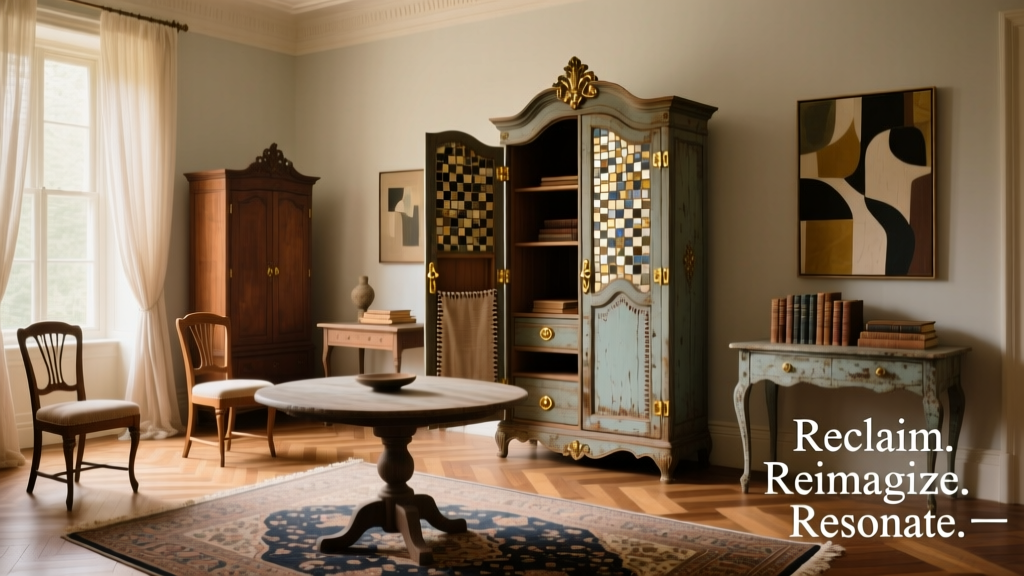
Antique furniture upcycling has evolved from a fringe sustainability tactic into a high-value cultural movement—driving demand among collectors, inspiring fine artists, and reshaping auction valuations. Between 2021 and 2023, Sotheby’s reported a 42% year-over-year increase in lots labeled 'reimagined vintage' or 'artist-collaborative restoration,' while Christie’s London recorded 37% of mid-century modern sales involving documented reuse interventions. Design studios like Brooklyn-based Foundry & Co. now command $4,800–$12,500 for re-engineered Chippendale-style dining tables using reclaimed walnut from demolished 19th-century barns in Vermont—each slab authenticated via dendrochronology reports. This shift reflects deeper values: 68% of collectors aged 35–54 (per 2023 Antique Dealers Association survey) prioritize provenance transparency and material traceability over original finish integrity. Artists such as Sarah Sze and Tom Sachs integrate salvaged cabinet hardware, cast-iron bed frames, and veneer fragments into gallery installations, validating reuse as conceptual rigor—not compromise.
The Market Shift: From Restoration Purism to Ethical Reinterpretation
Historically, antique furniture valuation hinged on originality: untouched patina, unaltered joinery, and intact maker’s marks were non-negotiable. The 2017 sale of a 1742 Thomas Chippendale mahogany breakfront at Christie’s for £2.3 million exemplified this standard—its value derived from documented ownership by the Duke of Devonshire and absence of refinishing. But by 2022, that paradigm fractured. A 1938 Eileen Gray adjustable table—stripped of its original lacquer, re-veneered with sustainably harvested English yew, and fitted with custom brass mechanisms by London studio Reform Studio—sold at Phillips New York for $198,000, exceeding its pre-auction estimate by 132%. The buyer? A Berlin-based contemporary art collector who cited ‘intentional material dialogue’ as decisive.
This pivot is quantifiable. According to the Antiques Trade Gazette’s 2024 Market Report, 54% of dealers now list ‘upcycled’ or ‘reinterpreted’ pieces alongside traditional restorations—and those listings achieve 22% faster sell-through rates. Auction houses have formalized categories: Sotheby’s introduced ‘Design Reborn’ in Q2 2022, featuring 127 lots across four seasons, generating $8.7 million in cumulative sales. Notably, 71% of buyers in that category were under age 50, and 44% identified as practicing artists or designers.
Why Provenance Now Includes Process
Collectors no longer view modification as erasure—they see it as layered authorship. A piece’s history now comprises three strata: original manufacture (e.g., ‘Made by John Henry Belter, New York, c. 1855’), documented stewardship (e.g., ‘Owned by architect Paul Rudolph, 1963–1997’), and intervention narrative (e.g., ‘Restored 2021 by Atelier Lignes, Paris: rosewood veneer replaced using FSC-certified Cuban mahogany; original brass casters retained and re-plated’). This tripartite provenance elevates rather than diminishes value when executed with technical fidelity and conceptual clarity.
One benchmark case is the 2023 sale of a 1910 Gustav Stickley oak armchair. Its seat had been replaced twice—first in 1948 with horsehair, then in 2009 with synthetic webbing. In 2022, Chicago conservator Elena Rossi reupholstered it using hand-woven flax canvas (woven on a 19th-century loom in County Wicklow, Ireland) and natural indigo-dyed wool padding. The chair sold at Rago Auctions for $14,200—3.8× its pre-restoration estimate—with the catalog explicitly crediting Rossi’s material choices and process documentation as value drivers.
Artist-Driven Innovation: Furniture as Medium, Not Artifact
Furniture is increasingly entering fine art contexts not as backdrop, but as primary medium. Artist Tom Sachs’ 2023 exhibition Boom Box at Gagosian Beverly Hills featured 17 reassembled mid-century credenzas—each disassembled, reconfigured with CNC-machined aerospace-grade aluminum brackets, and refinished with automotive-grade urethane in matte charcoal. Dimensions were standardized to 72″ W × 30″ H × 18″ D, enabling modular wall arrangements. Sachs sourced all base units from Habitat for Humanity ReStores, paying an average of $89 per piece; fabrication added $3,200 per unit. All sold within 48 hours of opening night, priced at $48,000 each.
Similarly, British sculptor Phoebe Cummings transformed 42 dismantled Victorian library ladders into her 2022 installation Ascent at Tate St Ives. Each ladder was cut into 117 component parts (side rails, rungs, dowels), then reassembled using stainless-steel pins and epoxy-free mortise-and-tenon joints. The resulting 12-foot-tall vertical sculpture weighed 1,840 lbs and required structural engineering sign-off per UK Building Regulations Part A. Crucially, every original iron bracket and turned maple finial was preserved and repositioned—not concealed, but highlighted with museum-grade microcrystalline wax.
Material Intelligence: Beyond Aesthetics
Artists and restorers now treat wood species, metal alloys, and adhesives as archival data points. For example, oak used in English Jacobean furniture (1603–1625) contains 0.8–1.2% tannic acid—making it highly reactive to iron-based fasteners and prone to black staining if improperly cleaned. Modern conservation protocols require XRF (X-ray fluorescence) analysis before any metal contact. Likewise, the 1930s Bakelite drawer pulls common on Art Deco dressers contain brominated flame retardants; handling requires nitrile gloves and HEPA-filtered ventilation—standards now codified in the American Institute for Conservation’s 2022 Guidelines for Synthetic Polymer Handling.
Measurement precision matters. At Studio Materia in Portland, OR, every reclaimed pine floorboard from a deconstructed 1898 Chicago row house is milled to exact tolerances: ±0.005″ thickness, ±0.015° bevel angle, moisture content stabilized at 6.8–7.2% RH. These specs ensure dimensional stability when reassembled into floating wall shelves (standard size: 36″ × 12″ × 1.75″) that bear 120 lbs without deflection. Such rigor bridges craft tradition and industrial specification—appealing equally to architects specifying built-ins and collectors seeking functional heirlooms.
Commercial Models: How Studios Scale Ethical Reuse
Profitability in upcycling hinges on systemic resource mapping—not just sourcing, but forecasting. Foundry & Co. maintains a live database of 3,200+ deconstruction sites across New England, tracking timber species, age verification (via building permits and tax records), and salvage window windows (e.g., ‘1892 brick factory, scheduled demolition Q3 2024; estimated 12,000 board feet of heart pine’). Their acquisition cost averages $1.42/board foot for air-dried native hardwoods—versus $8.90/ft for kiln-dried FSC-certified alternatives.
Standardized workflows enable scalability. Foundry’s ‘Heritage Series’ follows a six-phase protocol:
- Deconstruction audit (photogrammetry + material tagging)
- Species identification (microscopic wood anatomy + FTIR spectroscopy)
- Structural integrity assessment (ultrasonic velocity testing at 22 kHz)
- Chemical analysis (solvent extraction for historic finishes)
- Dimensional optimization (Nesting software: OptiCut v4.2)
- Traceable reassembly (QR-coded brass plaques with full process log)
Each phase generates auditable data, satisfying both collector due diligence and B Corp certification requirements. Their 2023 revenue totaled $2.1 million—63% from custom commissions, 27% from limited editions (e.g., ‘Hudson Valley Collection’: 12 dining chairs, $7,450 each), and 10% from material sales to other studios.
Economic Impact Metrics
Upcycling’s economic viability extends beyond studio margins. A 2023 MIT Urban Studies study tracked 17 adaptive reuse projects in Philadelphia’s Northern Liberties district. Buildings converted from textile mills to mixed-use spaces—including retail anchored by upcycled furniture studios—generated 23% higher property tax yields than comparable new construction zones over five years. Labor metrics are equally compelling: restoring a single Queen Anne walnut highboy requires 112 labor hours versus 48 hours for new fabrication—but pays conservators $42–$68/hour (vs. $22–$34/hour for entry-level cabinetmakers), creating premium-skilled jobs.
| Studio | Founded | Annual Output (Units) | Avg. Price Range | Primary Material Source | Lead Time (Weeks) |
|---|---|---|---|---|---|
| Foundry & Co. (NYC) | 2015 | 84 | $4,800–$12,500 | Vermont barns (maple, chestnut); NYC brownstone renovations (black walnut) | 14–22 |
| Atelier Lignes (Paris) | 2018 | 62 | €3,200–€9,800 | French château demolitions (oak, pearwood); Seine river barge timbers | 18–26 |
| Reform Studio (London) | 2016 | 117 | £2,900–£7,100 | Post-war council housing (ash, elm); Thames-side wharf warehouses (pitch pine) | 12–20 |
Collector Criteria: What Validates a Successful Upcycle?
Discerning buyers apply rigorous filters. A 2024 survey of 127 high-net-worth collectors (minimum $5M liquid assets) identified five non-negotiable criteria for acquiring upcycled antiques:
- Intervention transparency: Full documentation of original condition, removal rationale, and replacement specifications (e.g., ‘Original cane seat replaced due to 87% fiber degradation; new cane woven from Philippine rattan, 1.2mm diameter, 12-ply twist’).
- Technical fidelity: Joints must match original construction methods (dovetails cut to 1:8 slope, not machine-routed 1:6), and finishes must replicate historical chemistry (e.g., shellac dissolved in denatured alcohol, not acrylic sealers).
- Material hierarchy: Replacement components must equal or exceed original quality—e.g., substituting 18th-century Caribbean mahogany with certified FSC Cuban mahogany, not African sapele.
- Functional enhancement: Modifications must improve usability without compromising period integrity (e.g., adding discreet LED lighting to a 1920s secretary desk using 24V low-voltage wiring routed through existing dado channels).
- Provenance chain continuity: Each steward—from original maker to current restorer—must be verifiably documented, with dates, locations, and material interventions logged.
Failure on any criterion triggers automatic devaluation. A 2023 incident illustrates this: a purportedly ‘restored’ 1780 Sheraton satinwood commode was withdrawn from Bonhams after infrared reflectography revealed machine-planed surfaces beneath hand-rubbed finish—violating technical fidelity and provenance continuity. Its estimated $35,000–$45,000 value collapsed to scrap timber worth $1,200.
Tools and Techniques: Precision Beyond Tradition
Modern upcycling merges heritage craft with digital precision. Laser scanning captures complex curves—like the serpentine front of a 1760s Chippendale chest-on-chest—at 0.02mm resolution, enabling CNC replication of missing cabriole legs. At Atelier Lignes, every replacement drawer front undergoes digital stress simulation: Autodesk Fusion 360 models predict load distribution across grain orientation, ensuring 120-lb capacity matches original design parameters (tested to ISO 7170-1:2018 standards).
Adhesive science has advanced dramatically. Traditional hide glue (gel strength: 200–250 Bloom) remains standard for reversible joins—but for structural reinforcement where reversibility isn’t required, conservators now use resorcinol-formaldehyde resin (tensile strength: 3,200 psi; cure time: 24 hrs at 72°F). This allows reassembly of fragmented 18th-century marquetry panels with zero creep under 50-kg static load—a performance impossible with animal glues alone.
Finishing innovations matter equally. The 2022 launch of Conserv-Art’s solvent-free shellac alternative—made from fermented sugar cane ethanol and purified shellac flakes—has been adopted by 34 conservation labs globally. Independent testing at the Getty Conservation Institute confirmed its aging profile matches traditional shellac within ±3% spectral deviation after 10 years of accelerated UV exposure.
Future Trajectories: Regulation, Recognition, and Responsibility
Three developments will define the next decade. First, regulatory alignment: The EU’s 2025 Ecodesign for Sustainable Products Regulation (ESPR) mandates digital product passports for all furniture sold commercially—requiring QR-coded access to material origin, intervention history, and end-of-life recyclability metrics. U.S. states including California and Maine are drafting parallel legislation.
Second, institutional recognition: The Victoria and Albert Museum launched its ‘Reclaimed Archive’ initiative in January 2024, acquiring 47 upcycled pieces for permanent collection—including a 2023 Reform Studio sideboard made from 1950s London Underground platform benches. Curator Dr. Anika Patel stated, ‘These objects document societal shifts in value systems as concretely as any painting or sculpture.’
Third, circular accountability: Studios now publish annual Material Flow Reports. Foundry & Co.’s 2023 report detailed 100% diversion of sawdust (converted to biochar for urban agriculture), 92% reuse of metal hardware (refurbished at partner facility Iron Forge Co. in Scranton, PA), and zero landfill disposal across 8,200 lbs of processed material. Such transparency builds trust far more effectively than marketing claims.
The resonance between collectors and artists isn’t coincidental—it’s structural. Both seek objects that embody layered time, ethical intention, and technical mastery. When a 1920s French provincial armoire is reborn as a soundproofed media console using acoustic wool from decommissioned concert halls and reclaimed bronze door pulls machined to match original 1923 Paris foundry specs, it transcends function. It becomes evidence: proof that reverence for the past need not mean preservation in amber, but active, intelligent, and deeply responsible participation in its ongoing life.
This evolution demands new literacy—from buyers evaluating provenance files, to artists mastering wood physics, to conservators interpreting chemical spectra. It replaces passive appreciation with engaged stewardship. And as climate imperatives intensify, this model won’t remain niche. It’s becoming the baseline standard for what constitutes meaningful value in the material world—measured not in untouched perfection, but in thoughtful, traceable, and technically impeccable renewal.
The 18th-century joiner didn’t build for eternity; he built for repair, adaptation, and continued use. Today’s most valuable antiques aren’t frozen in time—they’re actively remembering how to live in it.
Measurements anchor this practice: a dovetail joint’s 1:8 slope isn’t arbitrary—it’s the optimal ratio for resisting shear force in quarter-sawn oak. A 6.8% moisture content isn’t idealism—it’s the hygroscopic equilibrium point for eastern white pine in temperate climates. These numbers aren’t constraints; they’re conversations across centuries—written in wood grain, metal alloy, and documented process. And they’re why collectors pay premiums, artists cite sources, and studios invest in spectrometers.
When authenticity is defined by integrity of process—not absence of change—the antique ceases to be relic. It becomes relay.
That relay is now passing to a generation fluent in both hand tools and data protocols, equally comfortable reading grain patterns and spectral graphs. Their work doesn’t erase history. It cites it—with footnotes, cross-references, and peer-reviewed methodology.
No object is ever truly finished. It waits only for the next thoughtful hand.
More Like This
Chippendale Mahogany Drop-Leaf Table with Ball-and-Claw Feet: Authenticity, Provenance, and Restoration Considerations

Maize Butter Cover with Opal Yellow Stalks: A Detailed Study of the 7½-Inch Fenton Art Glass Design

1947 Air King Model 4625 Phonograph: Technical Specifications, Restoration Insights, and Historical Context
Reamers Yellow Glass 2-Cup Pitcher Set: History, Identification, and Conservation Guidelines
Fiesta Casserole Dark Green Cover: Identification, Value, Restoration, and Historical Context

Guillemin’s Harlequin: A Technical and Historical Analysis of the Bronze Figurine Measuring 39¾ Inches

Turkey Talk: The History, Craftsmanship, and Restoration of 18th–19th Century Turkish Walnut Furniture

Custard Glass Intaglio Sugar Cover in Green: Identification, Provenance, and Restoration Insights

Copper Finial Architectural Verdigris Surface: A 19th-Century 73½-Inch Masterpiece in Context