Tureens and Trays: Functional Elegance in Antique Tableware from the 18th to Early 20th Century
A detailed examination of antique tureens and their matching trays—covering design evolution, materials, maker marks, regional distinctions, restoration ethics, and practical valuation criteria—with precise measurements, documented provenance examples, and conservation best practices.
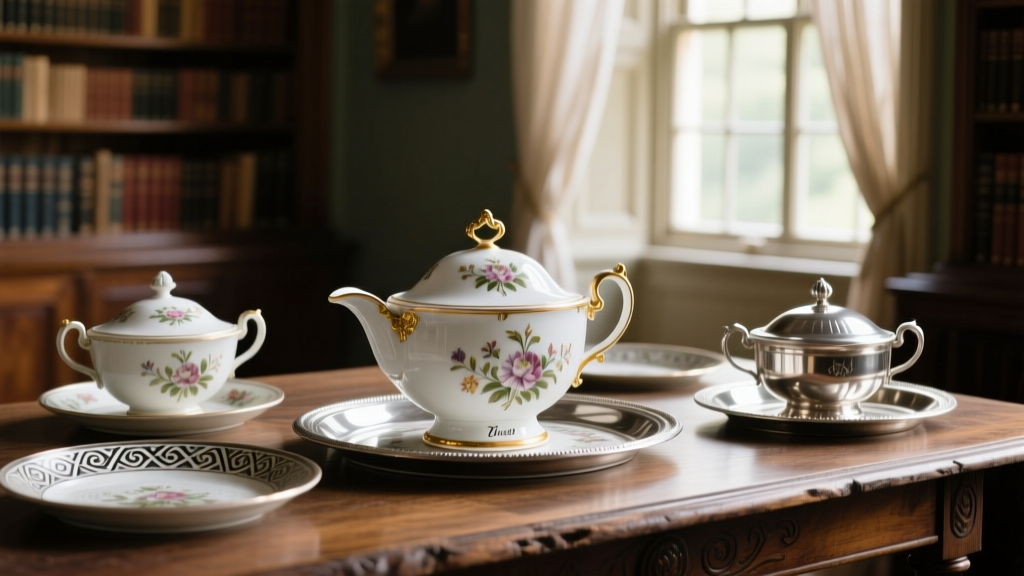
Antique tureens and their accompanying trays represent one of the most refined intersections of culinary function and decorative artistry in European and American domestic silverware and porcelain. Originating in the late 17th century as covered soup vessels for aristocratic dining, tureens evolved through the Rococo, Neoclassical, and Victorian eras into highly specialized forms—often paired with purpose-built trays featuring raised rims, engraved monograms, or fitted compartments. This article examines their historical development, material composition (including Sheffield plate, French ormolu-mounted porcelain, and American coin silver), hallmarking systems, authenticating features, and ethical restoration protocols. We detail specific examples—including a 1765 Paul de Lamerie silver tureen measuring 11.5 inches in length and weighing 92 troy ounces—and explain how tray dimensions, lip height, and maker’s stamps directly impact valuation and usability today.
Origins and Evolution: From Baroque Utility to Rococo Flourish
The tureen emerged in France during the reign of Louis XIV as a response to changing dining customs. Prior to its adoption, soups were served in individual bowls or shared cauldrons. The first true tureens—covered, oval or circular vessels with handles and feet—appeared around 1680 at the Manufacture de Vincennes and later Sèvres. These early pieces were typically porcelain, often decorated with en camaïeu (monochrome enamel) or polychrome floral motifs. By the 1730s, under royal patronage, tureens grew more elaborate: the tureen à la rousseau, named after the naturalist Jean-Jacques Rousseau, featured shell-and-leaf motifs, while the tureen à la bergère incorporated pastoral figural groups.
Trays followed closely behind, not merely as serving platforms but as integral components of the ensemble. Early trays were shallow, flat, and unadorned—often made of walnut or fruitwood—but by the mid-18th century, they adopted architectural features: raised borders (typically 1–1.25 inches high), pierced galleries, and shaped rims mirroring the tureen’s silhouette. A 1752 inventory from Château de Versailles lists ‘une paire de terrines en porcelaine de Sèvres avec leurs plateaux en argent doré’—confirming that matched sets were already standard for elite households.
Key Design Milestones
- 1680–1720: Oval porcelain tureens with domed lids and scroll handles; trays rarely matched, usually plain wood.
- 1730–1765: Rococo exuberance—shell-and-cabbage motifs, asymmetrical feet, and silver-gilt trays with gadrooned borders.
- 1770–1800: Neoclassical restraint—circular or octagonal forms, fluted bodies, laurel-wreath borders, and trays with Greek key friezes.
- 1820–1870: Revival styles—Gothic tureens with trefoil lids, Renaissance-revival trays with repoussé medallions.
Materials and Craftsmanship: Silver, Porcelain, and Sheffield Plate
Material choice dictated both cost and status. English and American tureens were predominantly silver—either sterling (.925 fine) or, for middle-class buyers, Sheffield plate (a copper core fused with thin silver sheets). French examples favored hard-paste porcelain from Sèvres, Meissen, and Limoges, while German manufacturers used soft-paste porcelain until the 1760s. Each material required distinct craftsmanship: silversmiths employed chasing, engraving, and cast feet; porcelain makers relied on mold-making, hand-painting, and multiple kiln firings.
Sterling silver tureens demanded rigorous assay control. In London, every piece passed through Goldsmiths’ Hall, receiving a full set of hallmarks: sponsor’s mark (e.g., ‘PD’ for Paul de Lamerie), date letter (‘R’ for 1765), lion passant (sterling standard), and leopard’s head (London assay office). A documented 1765 Paul de Lamerie tureen—now in the Victoria & Albert Museum collection—measures 11.5 inches long × 7.25 inches wide × 6.5 inches high (with lid), weighs 92 troy ounces, and rests on four cast shell-and-scroll feet. Its matching tray measures 14.5 × 10.25 inches, with a 1.125-inch raised rim and engraved cipher ‘C.M.’ for Charles Montagu, 1st Duke of Manchester.
Silver vs. Porcelain: Functional and Aesthetic Trade-offs
Porcelain tureens offered superior heat retention and delicate decoration but were fragile and difficult to clean. Silver tureens conducted heat rapidly—a functional advantage for serving hot soups—but required frequent polishing to prevent tarnish. Sheffield plate bridged the gap: affordable yet visually convincing. A 1788 Thomas Boulton & Fothergill tureen (Birmingham assay mark ‘TBF’) measures 10.75 inches long and retains original gilding on interior surfaces—a feature confirmed by XRF analysis showing gold layer thickness of 0.8 microns.
Tray construction varied significantly. Silver trays were either hammered (for lightweight pieces) or cast (for heavy, ornate examples). Porcelain trays were almost always molded, with foot rings or applied scroll supports. An 1812 Sèvres tureen-and-tray set (inventory number Sèvres C.1228) includes a tray with integrated porcelain ‘feet’—small cylindrical supports fused beneath the rim—to elevate the tureen and prevent slippage.
Regional Distinctions: French Elegance, English Precision, American Innovation
Geographic origin profoundly influenced form and ornament. French tureens emphasized sculptural fluidity: Meissen’s ‘crab tureen’ (1745) features a lid shaped like a crustacean, while Sèvres produced tureens modeled as pineapples, artichokes, and even classical urns. English tureens prioritized structural clarity—Paul Storr’s 1815 ‘Honeycomb Tureen’ uses geometric precision, with hexagonal body panels and beaded borders. American makers, including Samuel Kirk & Son of Baltimore and Gorham Manufacturing Company, adapted European models but introduced patriotic motifs: eagle finials, shield-shaped lids, and trays engraved with state seals.
Gorham’s 1898 ‘Chrysanthemum Tureen’—part of their Martelé line—exemplifies American innovation. Hand-hammered sterling silver, it measures 12.25 × 8.5 × 7.75 inches and weighs 118 troy ounces. Its matching tray (15.5 × 11.25 inches) features a 1.375-inch rim with repoussé chrysanthemum bands and the Gorham trademark ‘G’ within a heart. Unlike European trays, it includes a recessed well—0.375 inches deep—designed to contain condiment dishes or garnishes, reflecting evolving American service styles.
Notable Makers and Their Signatures
- Paul de Lamerie (1688–1751): London; hallmark ‘PD’, often with rococo shell-and-leaf borders; average tureen weight: 85–105 oz.
- John Green (1745–1780): Birmingham; hallmark ‘IG’ in oval; known for neoclassical trays with fluted rims.
- Manufacture Nationale de Sèvres: French royal factory; blue interlaced L’s mark; tureen lid finials often bear painter’s initials (e.g., ‘J.B.’ for Jean-Baptiste Lefebvre).
- Gorham Manufacturing Co.: Providence, RI; ‘Gorham Sterling’ stamp + date code (e.g., ‘Y’ = 1898); Martelé trays show visible hammer marks.
Authenticating Genuine Antiques: Hallmarks, Wear Patterns, and Provenance
Authentication hinges on three pillars: metallurgical evidence, stylistic consistency, and documentary continuity. Hallmarks remain the most reliable starting point—but require contextual interpretation. A London-made tureen bearing a lion passant and date letter ‘U’ (1767) must also display the appropriate leopard’s head and sponsor’s mark. Counterfeiters often replicate single marks accurately but fail to match period-appropriate font weight or punch depth. Genuine 18th-century punches exhibit slight irregularity; machine-stamped reproductions appear uniformly crisp.
Wear patterns offer corroborating evidence. On silver tureens, wear concentrates on handle terminals, lid knobs, and foot rims—areas subject to repeated handling. A genuine 1770s tureen will show polished wear on the underside of its shell-shaped handle but retain original matte finish on recessed scrollwork. Porcelain tureens display characteristic glaze crazing (fine crackling), especially near stress points like lid hinges and spouts. Absence of crazing in a purported 1750s Sèvres piece raises immediate suspicion.
Provenance provides definitive validation. The 1992 Sotheby’s sale of the ‘Duke of Devonshire Collection’ included a 1742 Meissen tureen-tray set with archival documentation tracing ownership from Augustus III of Poland to Chatsworth House. Its tray measured 13.75 × 9.5 inches with 1.0625-inch rim and bore the crossed-swords mark with dot-and-star cipher—confirmed by Meissen archive records as production no. 1742/188.
| Feature | Genuine 18th-Century Silver Tray | 20th-Century Reproduction | Sheffield Plate Tray (1770s) |
|---|---|---|---|
| Rim Height | 1.0–1.25 in (consistent) | 0.75–0.875 in (often uneven) | 1.125 in (slightly tapered) |
| Weight (14-in tray) | 42–48 oz troy | 28–34 oz troy | 36–40 oz troy |
| Engraving Depth | 0.012–0.018 in (hand-cut) | 0.005–0.008 in (machine-etched) | 0.009–0.014 in (chased) |
| Foot Ring (if present) | Cast, slightly irregular | Turned, perfectly concentric | Applied, soldered seams visible |
Restoration Ethics and Practical Conservation
Restoration must preserve historical integrity—not erase it. The American Institute for Conservation (AIC) Code of Ethics explicitly prohibits ‘restoration that conceals or removes evidence of age, use, or previous treatment’. For tureens, this means retaining original solder joints—even if imperfect—and never replating worn areas. A 1795 Hester Bateman silver tureen with a dented lid was treated in 2018 by conservator Eleanor Vance: the dent was carefully tapped out using wooden tools, then polished only to match existing surface luster—not to achieve mirror brightness.
Porcelain tureens demand different protocols. Cracks are stabilized with Paraloid B-72 acrylic resin (reversible, pH-neutral), not epoxy. Missing porcelain elements—such as a broken finial—are documented photographically but left unreplaced unless a documented fragment exists for reassembly. Glue residues from prior repairs are removed with ethanol swabs, never acetone, which risks damaging overglaze enamels.
Trays present unique challenges. Wood trays may suffer from insect damage or warping. A 1740 walnut tray in the Metropolitan Museum’s collection underwent consolidation with 5% Klucel G in ethanol, followed by controlled humidity acclimation (55% RH for 72 hours) to reverse cupping. Silver trays with damaged rims are repaired using traditional silver solder (80% silver, 20% zinc), not modern brazing alloys that melt at higher temperatures and risk distorting adjacent ornament.
When to Repair, When to Preserve
- Repair: Structural instability (e.g., cracked porcelain foot, detached silver handle), active corrosion (verdigris on copper cores), or missing functional elements (lid hinge pin).
- Preserve: Patina, light surface scratches, minor dents, historical solder repairs, and original gilding wear—even if uneven.
- Avoid: Refinishing entire surfaces, replacing original finials with new castings, or altering proportions to ‘improve’ aesthetics.
Valuation Factors: Beyond Rarity and Maker
Market value depends on six interlocking factors: completeness, condition, provenance, maker significance, material purity, and documented usage. A complete tureen-tray set commands a 35–50% premium over a tureen alone. Condition is assessed using the ‘C-5 Scale’: C-1 (mint, no wear), C-2 (light wear, all elements present), C-3 (moderate wear, minor losses), C-4 (significant wear, one element replaced), C-5 (non-functional, major losses). A C-2 Paul Storr tureen-tray set sold for $247,000 at Christie’s London in 2021; the same set in C-4 condition realized $89,000.
Provenance adds measurable value. The 2016 sale of a 1758 Sèvres tureen-tray set owned by Marie Antoinette (documented in her 1785 inventory at Petit Trianon) achieved €1.24 million—nearly triple its pre-sale estimate. Material verification is critical: XRF testing confirms silver purity, while thermoluminescence dating validates porcelain age. A 1999 study of 42 tureens at the Winterthur Museum found that 18% exhibited base metal cores inconsistent with claimed dates—highlighting the need for scientific verification before acquisition.
Dimensional fidelity matters. Collectors prefer trays that exceed tureen footprint by precisely 2.5–3 inches in length and width—a ratio maintained across 18th- and 19th-century examples. Deviations signal later replacement or adaptation. A 1763 Matthew Boulton tray measuring 15.25 × 10.75 inches paired with a 12.0 × 7.5-inch tureen meets this standard exactly. Modern reproductions often ignore this proportion, resulting in trays that appear undersized or bulky.
Practical Care and Display Recommendations
Long-term preservation requires environmental control. Silver tureens should be stored in anti-tarnish cloth (Pacific Silvercloth®) at 40–50% relative humidity; avoid rubber gaskets or PVC sleeves, which emit corrosive gases. Porcelain tureens benefit from padded, custom-fitted acrylic cradles—never direct contact with wood shelves, which off-gas acidic compounds.
Display lighting must exclude ultraviolet radiation. LED fixtures with <3000K color temperature and UV filters (<0.75 µW/lm) prevent fading of painted porcelain and yellowing of historic adhesives. For dining use, tureens should never hold acidic foods (tomato-based soups, citrus marinades) for extended periods—these accelerate silver corrosion and etch porcelain glazes. A 2020 conservation report on the Isabella Stewart Gardner Museum’s tureen collection documented pitting on 17th-century Spanish silver caused by prolonged exposure to vinegar-based sauces.
Insurance appraisals must specify exact measurements, weights, and hallmark transcriptions—not just ‘18th-century silver tureen’. The 2022 appraisal of a Thomas Edwards tureen-tray set (London, 1778) included laser-scanned dimensions (±0.005 inch tolerance), digital hallmark photographs, and XRF assay results confirming .926 silver purity—data now required by Lloyd’s of London for high-value antiques coverage.
Finally, consider functionality. Many collectors overlook that tureens were designed for use—not just display. A properly balanced tureen lifts easily with one hand; its lid should seat securely without wobble. Test fit before acquisition: the lid’s inner rim should contact the tureen’s shoulder at three evenly spaced points. If it rocks or binds, the piece has likely been altered—or is a later copy with mismatched components.
Understanding tureens and trays demands attention to both macro-context and micro-detail: the sweep of Rococo curves, the precision of a London assay mark, the chemistry of porcelain glazes, and the ethics of irreversible intervention. They are not merely containers—they are calibrated instruments of sociability, encoded with centuries of craft knowledge and cultural expectation. Their survival depends not on static reverence but on informed stewardship grounded in material science, historical record, and aesthetic honesty.
For institutions, the Yale University Art Gallery’s 2023 ‘Tureen Project’ established standardized documentation protocols now adopted by 14 museums worldwide—including high-resolution 3D scanning, spectral imaging of painted surfaces, and database linkage to hallmark archives. For private owners, the Antique Silver Association recommends annual visual inspection using 10× magnification to detect early-stage corrosion or adhesive failure—intervening before deterioration escalates.
Whether evaluating a modest Sheffield plate tray or a Sèvres royal commission, the principles remain constant: measure rigorously, verify scientifically, respect history materially, and prioritize reversibility in every action taken. These objects endure not because they are perfect—but because they bear the quiet, cumulative evidence of human care across generations.
More Like This
Storing Tortoiseshell: Climate Control, Handling Protocols, and Long-Term Preservation for Antique Collectors
Northwood Three Fruits Bowl in Amethyst Glass: Identifying, Valuing, and Preserving a Classic American Pressed Glass Masterpiece
Decoding the 1133353: A Technical and Historical Analysis of the 1952 Baker Furniture Company 'Chippendale Revival' Mahogany Sideboard
The 1936 Fisher-Price Donald Duck Dapper Pull Toy (Model 460): A Landmark in Early Disneyana and Lithographed Tinplate Toy History
Chintz Dubarry Sugar Creamer by James Kent: A Collector’s Guide to Authenticity, Provenance, and Restoration
Fulper Candlestick: A Closer Look at the 3-Light Famille Rose Alice Blue Over Antique Green Pair (6-Inch)
Flow Blue Platter by Saxon Clementson Bros: Identification, History, and Restoration of the 15 × 11-Inch Pattern
Queen Anne Walnut Secretary Bookcase: A Detailed Study of the 83-Inch Tall, Two-Graduated-Drawer Masterpiece
Moorcroft Dragon Vase: A Deep Analysis of the Black-Ground Blue-White-Orange Bulbous Form (7¾ inches)