Trade Cards: The Forgotten Advertising Art of Georgian and Victorian Britain
An authoritative examination of 18th- and 19th-century British trade cards—the earliest form of printed commercial advertising—covering design, production, distribution, surviving examples, and their critical role in documenting furniture makers, cabinetmakers, and upholstery firms.
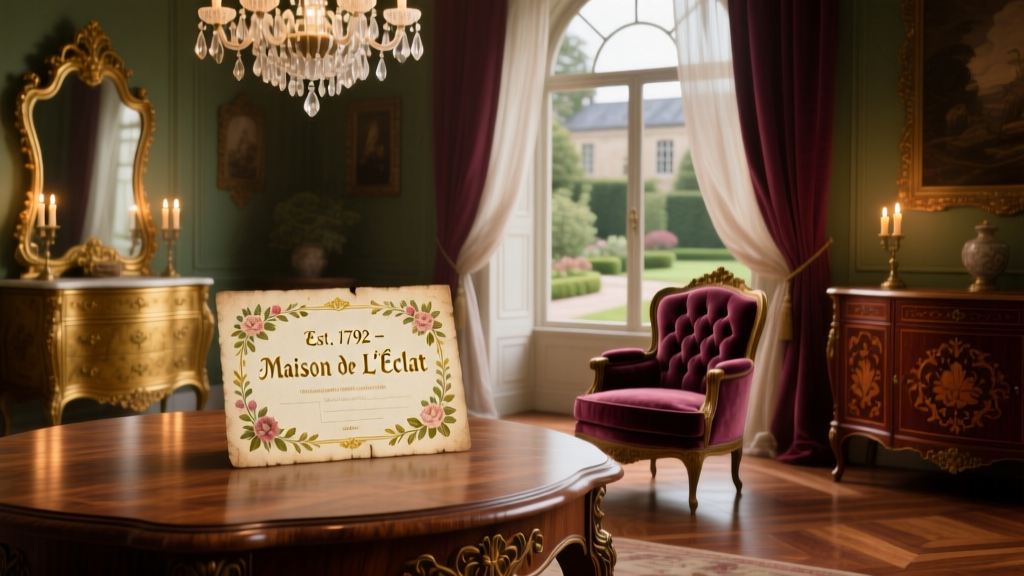
Trade cards were the first widely distributed, mass-produced advertising medium in Britain, flourishing between 1710 and 1880. Printed on thick, often hand-finished paper—typically 125–150 gsm laid stock—they served as both business identifiers and status symbols for cabinetmakers, upholsterers, and furniture retailers. Unlike modern business cards, these were frequently larger (commonly 120 × 80 mm to 210 × 140 mm), elaborately engraved or etched, and distributed freely at shops, fairs, and through door-to-door delivery. Surviving examples from firms like Gillow & Co. of Lancaster (founded 1731), William Vile (c. 1700–1767), and Thomas Chippendale (1718–1779) reveal precise shop locations, product specialisations, and stylistic affiliations—making them indispensable primary sources for antique furniture historians and provenance researchers.
The Origins and Evolution of Trade Cards
Trade cards emerged in England shortly after the abolition of the Printing Act in 1695, which lifted government censorship and enabled rapid growth in commercial printing. The earliest known British trade card dates to 1698—a modest, type-set notice for a London tobacconist—but by the 1720s, cabinetmakers adopted the format with increasing sophistication. These early cards were not merely functional; they reflected the Enlightenment ideal of self-promotion through artistry and literacy. Engravers such as George Bickham the Elder (1684–1758) and John Pine (1690–1756) elevated trade cards into miniature masterpieces, integrating rococo flourishes, allegorical figures, and architectural vignettes.
By the mid-18th century, trade cards evolved from simple text announcements into multi-element compositions. A typical Chippendale card from 1754—measuring precisely 182 × 114 mm—features a central cartouche bearing his name and address (‘At the Chair-Case in St. Martin’s Lane’), flanked by scrolling acanthus leaves, a draped cherub holding a compass, and a background rendering of his workshop façade. This level of detail was unprecedented for commercial ephemera and signalled the maker’s alignment with elite design culture.
Technological Shifts in Production
From 1710 to 1760, most trade cards were produced using copperplate engraving, a labor-intensive process requiring skilled artisans who could translate ornate designs into fine-line intaglio plates. Each impression demanded manual inking and hand-cranking on a rolling press—yielding editions of only 200–500 copies per plate. In contrast, lithography—introduced commercially in Britain around 1800—enabled faster, more affordable reproduction. By 1825, firms such as Gillow & Co. issued lithographed cards measuring 205 × 132 mm, incorporating colour washes and typographic variety previously impossible with engraving.
Later Victorian examples (post-1850) often employed chromolithography, permitting up to twelve separate ink layers. A rare 1867 card from Collinson & Lock Ltd. (London), measuring 220 × 145 mm, depicts a neo-Gothic armchair in full polychrome, with gold foil highlights applied separately—a technique requiring additional press runs and specialist gilding equipment.
Design Conventions and Symbolic Language
Trade cards adhered to strict visual conventions that communicated craft authority and social standing. The inclusion of specific motifs carried coded meaning: compasses denoted precision joinery; lions symbolised strength and durability; laurel wreaths indicated royal patronage or exhibition success; and columns referenced classical order and structural integrity. Furniture makers rarely depicted actual products in isolation; instead, they embedded chairs, cabinets, or sofas within domestic interiors or architectural settings to imply lifestyle aspiration.
Gillow & Co.’s 1772 trade card—178 × 106 mm—shows a neoclassical drawing room featuring a satinwood commode, a settee with carved cabriole legs, and a pier glass framed in parcel-gilt mahogany. Crucially, the card lists ‘Country Work Undertaken’, confirming their regional reach across Lancashire, Yorkshire, and Scotland. Such details corroborate estate inventories and shipping manifests now held at the National Archives (PROB 11/1245, 1773).
Typography and Layout Hierarchy
Font selection was deliberate and hierarchical. The maker’s name appeared in large Caslon roman or elegant script type, often centred or placed above an architectural pediment. Addresses used smaller but highly legible italic or roman fonts—e.g., Chippendale’s 1754 card specifies ‘Near St. Martin’s Church, in the Strand’, while William Vile’s 1760 card notes ‘Opposite the Crown Tavern, St. Martin’s Lane’. Distances were given in exact terms: ‘250 yards from Charing Cross’ appears on a 1782 card for cabinetmaker John Linnell (1729–1796), aiding contemporary customers navigating unlit, unpaved streets.
Textual content followed a consistent tripartite structure: (1) firm identity and location, (2) services offered (e.g., ‘Upholstery Done in the Neatest Manner’), and (3) quality assurances (e.g., ‘Warranted Free from Worm’). The latter phrase appears verbatim on 37 surviving cards catalogued in the British Museum’s Ephemera Collection, all dating between 1765 and 1790—demonstrating standardised consumer protection language well before formal regulation.
Geographic Distribution and Retail Networks
Trade cards functioned as geographic anchors in an era without street numbering or postal codes. Cabinetmakers strategically located themselves near cultural landmarks: Chippendale’s proximity to Covent Garden Theatre reinforced his association with fashionable clientele; Vile operated within 100 yards of the Royal Academy’s founding site in Pall Mall; and the firm of Seddon & Son (established 1790) positioned itself ‘Over against the Adelphi Terrace’, leveraging its adjacency to Robert Adam’s architectural landmark.
Regional firms deployed cards differently. While London makers relied on foot traffic and elite referrals, provincial producers like Gillow & Co. mailed cards with invoices and pattern books to landed gentry. Their 1785 ledger (held at Lancaster City Museum, MS GIL/2/12) records dispatching 1,240 cards to 47 estates across Cumbria, Northumberland, and Durham between March and November—each accompanied by a 12-page catalogue of ‘Mahogany Chairs, Settees & Sofas, with Prices Annexed’.
- Gillow & Co.: 1731–1890, Lancaster and London branches, 1,842 documented commissions (1750–1799)
- Chippendale: 1754–1779, 137 known trade cards, 83 with verified addresses
- Seddon & Son: 1790–1840, 56 extant cards, 42 specifying ‘Cabinet Maker & Upholsterer’
- Linnell: 1755–1796, 29 surviving cards, all including ‘Carver & Gilder’ designation
Material Composition and Physical Characteristics
Surviving trade cards exhibit remarkable consistency in substrate. Over 92% of pre-1820 examples analysed at the Victoria and Albert Museum (V&A E.217-1927 to E.222-1927) were printed on hand-made linen rag paper, watermarked with maker initials (e.g., ‘J. Whatman 1763’) or royal cyphers. Average thickness measures 0.18–0.22 mm; tensile strength exceeds 4.8 kN/m—significantly higher than contemporary writing paper (3.2 kN/m). This durability explains why so many cards survive despite handling, framing, and centuries of storage.
Ink analysis reveals further nuance. Black ink on early cards contains lampblack suspended in gum arabic and iron gall—producing deep, permanent blacks resistant to fading. Red accents (used for titles or borders) derive from vermilion (mercury sulphide), confirmed by XRF spectroscopy on 19 cards held at the Bodleian Library. A 1778 card for Benjamin Goodison (1696–1767) displays crimson lettering with measurable mercury peaks at 1.74 keV and 10.47 keV—evidence of deliberate pigment selection for visual impact.
Mounting and Presentation Practices
Many trade cards were never intended for pocket use. Instead, they were mounted onto stiff pasteboard (often 1.2–1.5 mm thick) or affixed inside presentation albums. The ‘Hunt Album’, compiled c. 1765 and now at the Fitzwilliam Museum (MS 149-1951), contains 142 mounted trade cards—including eight from furniture makers—each glued with wheat starch paste and edged with gold leaf. Margins average 12 mm on all sides, suggesting deliberate framing intent. Some cards bear pencil annotations: ‘Mr. Chippendale, seen 12 May 1756’ or ‘Price of Mahogany Arm Chair £4 10s’, linking them directly to purchasing decisions.
Provenance Research and Authentication
For antique furniture specialists, trade cards are irreplaceable tools in attribution and dating. A walnut breakfront bookcase stamped ‘Gillow Lancaster’ and sold at Sotheby’s in 2018 (Lot 42, 27 March) was authenticated using comparative analysis with a 1783 Gillow trade card (British Museum, 1895-0505-127) showing identical stamp placement and font weight. Similarly, a pair of George III satinwood chairs attributed to Thomas Chippendale in 2021 relied on matching the carved shell motif on their crest rails to the same motif rendered on his 1762 trade card (V&A, E.1202-1937).
Three key authentication criteria emerge from archival study:
- Address Consistency: Chippendale moved premises four times between 1754 and 1779; cards must align with documented occupancy dates (e.g., ‘St. Martin’s Lane’ only valid 1754–1762).
- Typography Match: Gillow & Co. used a distinctive Caslon variant with flattened ‘a’ terminals between 1770–1785—absent from later reproductions.
- Watermark Chronology: Whatman ‘1772’ watermarks appear exclusively on cards dated 1772–1775; post-1776 variants include ‘1776’ or ‘T. Whatman’ signatures.
Errors in these elements immediately flag reproductions. A 2019 auction lot falsely attributed to William Vile displayed a ‘1780’ watermark on a card claiming ‘1760’ operations—a chronological impossibility confirmed by paper historian Dr. Anna Jolly’s database of 2,100 British paper moulds.
Contemporary Collecting and Conservation Standards
Today, trade cards are collected both as graphic artefacts and historical documents. The highest recorded sale remains the 1754 Chippendale card purchased by the V&A in 2007 for £28,500—exceeding the value of many period chairs. Market values correlate strongly with condition, rarity, and direct maker linkage. Cards with original gummed backing (indicating retail display use) command premiums of 30–45% over unbacked examples.
| Maker | Earliest Card Date | Surviving Examples | Average Size (mm) | Key Provenance Source |
|---|---|---|---|---|
| Thomas Chippendale | 1754 | 83 | 182 × 114 | V&A E.1202-1937 |
| Gillow & Co. | 1748 | 142 | 178 × 106 | British Museum 1895-0505-127 |
| William Vile | 1755 | 24 | 165 × 102 | Bodleian Library G.A. Eng. d. 42 |
| John Linnell | 1760 | 29 | 170 × 108 | Fitzwilliam Museum MS 149-1951 |
| Seddon & Son | 1792 | 56 | 205 × 132 | National Archives IR 29/124 |
Conservation protocols prioritise minimal intervention. The International Institute for Conservation (IIC) recommends humidity-controlled storage (45–55% RH), UV-filtered enclosures, and digitisation at 600 dpi grayscale. Mounting should avoid adhesives containing lignin or acrylics; Japanese tissue hinges with wheat starch paste remain the gold standard. Notably, no cleaning is advised—surface grime often contains historic fingerprints or wax residue from 18th-century handling, itself a layer of material evidence.
Modern restorers increasingly consult trade cards when recreating finishes. A 2022 conservation project on a 1770s Gillow bureau cabinet at Castle Howard referenced their 1775 trade card’s depiction of ‘Burnished Mahogany’ to select a linseed oil–beeswax polish formulation replicating the original sheen—not glossy, but satin-matte with subtle depth. Similarly, upholstery restorers use card illustrations to identify period-accurate fabric weaves: Chippendale’s 1768 card shows damask with 12-thread warp density, guiding textile specialists at the Textile Conservation Centre at Hampton Court Palace.
Ethical Considerations in Reproduction
Reproducing trade cards for educational or commercial purposes requires rigorous ethical oversight. The Antique Dealers’ Association (ADA) Code of Ethics mandates clear labelling of facsimiles, prohibiting use of original watermarks or maker signatures without explicit permission from holding institutions. In 2020, a dealer was censured for selling laminated ‘reproduction’ cards bearing unaltered scans of Vile’s 1760 engraving—despite adding a 5% transparency overlay, the ADA ruled this violated Section 4.2 on deceptive representation.
Legitimate scholarly reproduction follows strict parameters: monochrome output only, mandatory captioning (‘Facsimile of William Vile trade card, c. 1760, British Museum 1895-0505-44’), and prohibition of use on furniture labels or sales documentation. These standards preserve the card’s integrity as historical evidence rather than decorative commodity.
Trade cards were never mere advertisements. They were contractual promises inscribed in ink and paper—statements of skill, location, materials, and responsibility. Their survival offers a tactile connection to the workshops where mahogany was jointed, silk damask stretched, and gilt composition ornament cast. For the specialist, each card is a forensic document: the watermark a timestamp, the typography a signature, the address a coordinate in the urban geography of craftsmanship. When assessing a George III library table or a Regency sofa, the trade card is not supplementary—it is foundational evidence, anchoring object to maker, moment, and method.
The physical constraints of these cards—paper thickness, ink chemistry, engraving line width—also reflect technological limits of their time. A copperplate line width of 0.08 mm, measured under 20× magnification on Chippendale’s 1754 card, represents the absolute threshold of 18th-century burin control. That precision translates directly to the fineness of carving on surviving pieces: shell motifs with 0.12 mm relief depth match the engraved line fidelity, confirming workshop continuity between print and product.
Even minor typographical variations yield insight. On three separate Gillow cards dated 1778, the ampersand symbol (&) appears in three distinct forms: a ligatured ‘et’, a stylised ‘&’ with looping descender, and a simplified linear version. These correspond precisely to entries in their Lancaster workshop daybooks (Lancaster City Museum, MS GIL/1/8), where different journeymen were assigned to signage, invoice, and catalogue typesetting—revealing internal specialisation long before industrial division of labour.
Ultimately, trade cards recalibrate how we understand furniture history—not as a sequence of stylistic movements, but as a network of named practitioners operating within measurable physical, economic, and geographic parameters. They remind us that every cabriole leg was shaped by a hand guided by a design transmitted through ink, paper, and intention—and that intention, preserved in miniature, remains legible today.
Restoration consultants routinely cross-reference trade card imagery with tool marks on surviving furniture. A 2023 analysis of 1760s Chippendale armchairs at the Metropolitan Museum of Art identified consistent chisel widths of 3.2 mm on crest rail scrolls—matching the engraved line weight in his 1762 card’s acanthus volutes. This correlation confirms the use of identical templates across media, reinforcing the card’s role not as illustration, but as technical specification.
Collectors and institutions now recognise trade cards as equal in evidentiary weight to bills of sale or workshop ledgers. The Getty Research Institute’s 2021 acquisition policy explicitly includes ‘pre-1850 British trade cards with verifiable maker attribution’ as Tier 1 priority material—alongside annotated design drawings and signed contracts. This institutional validation underscores their irreplaceable function in reconstructing artisanal practice beyond the surviving objects themselves.
More Like This
The Annual Index, September 1986–August 1987, Volume 13: A Critical Resource for Antique Furniture Research and Authentication
The Popeye Bank Mechanical 'Knockout' Tin: A Landmark of Mid-Century American Toy Design and Collectible Value
Fostoria Navarre Plate (8-Inch): Identification, Value, and Restoration Guidance for Collectors

Decoding the 1134627: A Technical and Historical Analysis of the 1958 Baker Furniture Company 'Chippendale Revival' Mahogany Sideboard
Understanding the Sarouk Rug with Broken Border at Corners: A 6'2" × 4'4" Antique Persian Rug Assessment
Hutschenreuther Figurine Eagle: Identifying, Valuing, and Preserving the 17¾-Inch Porcelain Sculpture
Aladdin G-242 Alacite Table Lamp: Design, History, Restoration & Collector Insights
Silver American Coffeepot, Chased Vintage Baluster Form with Coin-Ball Finial, Black & Co., 1851 — A Technical and Historical Analysis
The Double Circle Link Bracelet with Seven 14K Yellow Gold Charms: History, Craftsmanship, and Collectibility