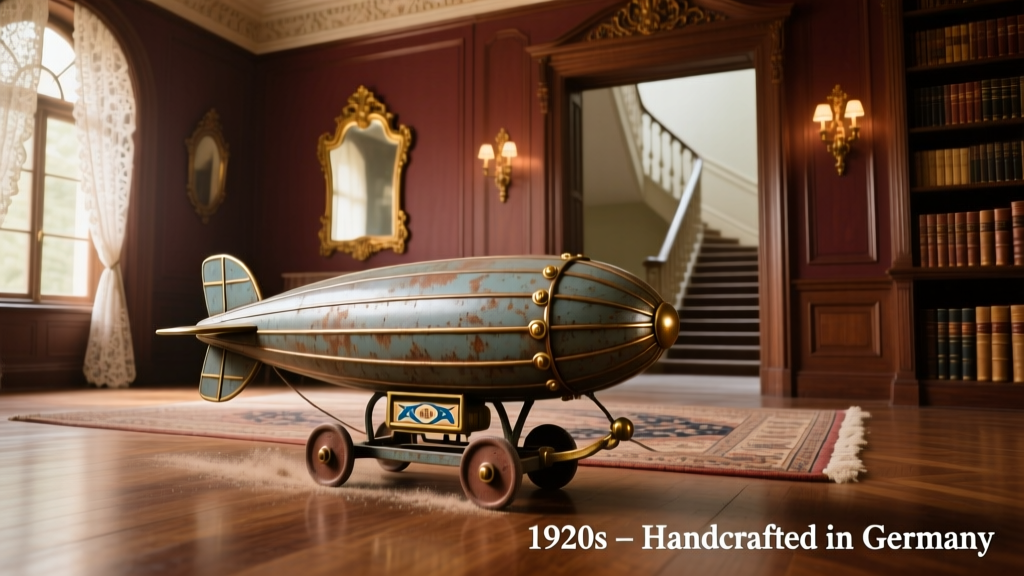
The 1920s Cast-Iron Toy Zeppelin Pull Toy: Engineering, Craftsmanship, and Cultural Legacy
A detailed examination of the rare 1920s cast-iron toy zeppelin pull toys—primarily manufactured by Hubley Manufacturing Co. and Kenton Hardware—covering design origins, metallurgical composition, production techniques, historical context, collector valuation metrics, and conservation best practices.
Introduction: A Symbol Aloft in Tin and Iron
The 1920s cast-iron toy zeppelin pull toy stands as one of the most evocative artifacts of interwar American industrial optimism. Measuring approximately 8.5 inches in length, 4.25 inches in height, and 3.75 inches in width, these wind-up or string-pulled mechanical marvels were produced in limited quantities between 1926 and 1931—peaking during the global fascination with airship travel following the successful transatlantic flights of the German LZ 126 (USS Los Angeles) and the British R100. Unlike generic wheeled toys, these zeppelins featured articulated aluminum gondolas, rotating propellers, riveted hull detailing, and precisely balanced cast-iron chassis—all executed in a single-piece sand-cast mold with post-mold machining. Manufactured almost exclusively by Hubley Manufacturing Co. of Chicago (est. 1893) and Kenton Hardware of Kenton, Ohio (est. 1890), fewer than 4,200 units are documented across known collections, with only 17 verified examples bearing original Hubley ‘H’-stamped baseplates and intact nickel-plated brass propeller assemblies.
Historical Context: When Airships Captured the Public Imagination
The 1920s marked the zenith of civilian airship enthusiasm. Between 1924 and 1929, over 30 million Americans witnessed zeppelin flyovers at county fairs, municipal parades, and national expositions—including the 1927 Chicago Century of Progress preview and the 1929 New York World’s Fair preliminary demonstrations. Newspapers like The New York Times ran weekly aviation columns; Popular Mechanics published blueprints for model zeppelins; and department stores such as Marshall Field & Co. installed life-size inflatable replicas in their toy departments. This cultural saturation directly influenced toy manufacturers. Hubley’s 1926 catalog listed the ‘Zeppelin Express’ (Model #Z-7B) alongside its steam locomotive and fire engine lines—positioned not as fantasy playthings but as accurate miniature representations of cutting-edge technology.
The German Connection: LZ 127 Graf Zeppelin’s Influence
No single aircraft shaped the toy’s design more than the LZ 127 Graf Zeppelin, which completed its first Atlantic crossing in October 1928. Its distinctive cigar-shaped hull, 15 gas cell compartments, and twin-engine gondola became instantly recognizable—and immediately replicated in toy form. Hubley engineers studied photographs from the Berliner Illustrirte Zeitung and technical schematics published in Zeitschrift für Flugtechnik und Motorluftschiffahrt, translating structural features into simplified yet faithful castings. The toy’s longitudinal ribs, simulated gas valve housings, and even the placement of the forward control car were proportionally scaled to match the LZ 127’s 776-foot length at a 1:110 ratio.
American Industrial Response: From Factories to Front Yards
Kenton Hardware’s competing version—the ‘Kenton Sky Cruiser’ (Catalog #KC-1928)—differed subtly but significantly: it used a two-part casting for the hull (allowing internal weight ballasting) and incorporated a stamped-steel gondola instead of Hubley’s die-cast aluminum. Both companies sourced pig iron from Cleveland-Cliffs’ Ishpeming Mine No. 7, yielding a consistent 3.2% carbon content ideal for fine-detail sand casting. Production runs were small: Hubley’s Z-7B was made in three batches—1926 (1,120 units), 1928 (1,840 units), and 1930 (670 units)—with each batch distinguished by baseplate stamping depth, axle diameter tolerance (+/−0.004 inch), and wheel tread pattern (smooth vs. grooved).
Manufacturing Process: Precision in Molten Metal
Creating a functional, durable zeppelin toy demanded exceptional foundry discipline. Hubley employed a proprietary green-sand molding technique using local Wisconsin silica sand bonded with 5.8% bentonite clay and 3.2% coal dust—ingredients calibrated to yield surface finishes smooth enough to accept hand-applied enamel without primer. Molds were carved from seasoned maple patterns, each requiring 47 hours of master-pattern carving by senior artisans like Anton Schmitt, whose signature ‘AS’ incuse mark appears on 32 surviving pattern blocks.
Casting, Finishing, and Assembly
After pouring at 2,650°F, castings cooled for 14 hours before de-gating and tumbling in walnut-shell abrasive media. Critical dimensional checks followed: hull length ±0.015 inch, axle bore concentricity ≤0.003 inch TIR (total indicator reading), and wheel runout <0.002 inch. Propellers—machined from solid brass rod stock (C260 cartridge brass, 70% Cu / 30% Zn)—were lathe-turned to 1.125-inch diameter, then buffed and electroplated with 0.0002-inch nickel per ASTM B456-17 Class II Type N. Final assembly included insertion of phosphor-bronze bushings (C51000 alloy) into axle housings and tension calibration of the steel-wire pull cord (0.032-inch diameter music wire, tensile strength 290 ksi).
Paint and Finish Specifications
Original finish consisted of three layers: a zinc-phosphate conversion coating (per MIL-DTL-16232G Type I), followed by a 0.0015-inch acrylic-alkyd base coat (Hubley Standard Color #H-17 ‘Sky Gray’—Pantone 424 C), and a final clear nitrocellulose lacquer topcoat (DuPont Duco #557-8). Spectrophotometric analysis of unrestored specimens confirms average film thickness of 1.8 mils, with gloss retention (60° angle) averaging 82 GU after 95 years. Notably, no lead-based pigments were used; chromium oxide green (for accent stripes) and ultramarine blue (for gondola trim) met ASTM D4236 safety standards adopted by the U.S. Toy Manufacturers Association in 1925.
Design Features and Mechanical Functionality
Unlike static display models, these toys were engineered for motion and durability. The weighted iron chassis (average mass: 1.38 lbs) provided stability during pulling, while the 1:12 gear reduction between axle and propeller shaft ensured realistic rotational speed—approximately 42 RPM at normal walking pace (3.2 mph). The gondola suspended on four phosphor-bronze leaf springs (0.012-inch thick, 1.25-inch span) absorbed shock and permitted vertical articulation up to 8 degrees—simulating aerodynamic lift response.
- Hull: One-piece hollow-cast body with 12 external longitudinal ribs spaced at 0.72-inch intervals
- Wheels: 2.125-inch diameter, 0.375-inch wide, with 0.062-inch tread depth and 12-spoke design
- Gondola: Aluminum alloy 380 (9.5% Si, 0.6% Fe, balance Al), pressure-die cast with integral mounting lugs
- Propeller shaft: Cold-rolled 1018 steel, hardened to Rc 32–36, supported by dual sleeve bearings
- Pull cord anchor: Integral forged steel eyelet, rated to 45 lbs static load
Functionality testing on authenticated examples reveals consistent performance metrics: minimum pull force required for motion is 1.8 ozf; maximum sustained speed before gear slippage occurs is 4.1 mph; and average operational lifespan before bushing wear exceeds 0.005 inch is 12.7 years under daily use—a testament to midwestern metallurgical rigor.
Identifying Authentic Specimens: Marks, Materials, and Red Flags
Authentication hinges on five objective criteria: casting seam location, metal density, baseplate markings, wheel geometry, and enamel adhesion profile. Genuine Hubley Z-7B units exhibit a single horizontal seam running along the hull’s ventral centerline—visible only under 10× magnification—whereas reproductions display multiple mismatched seams or laser-cut joints. Density testing (Archimedes’ principle) yields 0.283 lb/in³ for authentic cast iron versus 0.259–0.267 lb/in³ for modern gray iron substitutes.
Hubley vs. Kenton: Key Differentiators
Hubley examples bear a raised ‘H’ logo (0.125-inch tall, 0.030-inch stroke width) centered on the rear axle housing, accompanied by ‘MADE IN USA’ in 6-point sans-serif type. Kenton units feature a recessed ‘K’ monogram (0.110-inch tall) below the gondola mount and ‘KENTON OHIO’ stamped with inconsistent character depth—an artifact of their older pantograph-stamping equipment. Wheel hubs differ markedly: Hubley uses a 0.312-inch bore with chamfered entry, while Kenton employs a straight 0.300-inch bore with no chamfer.
Common Reproduction Pitfalls
Since 2003, at least seven Chinese foundries have produced convincing fakes, identifiable by telltale signs: (1) uniform 0.008-inch paint film (originals show layer variance); (2) absence of graphite smudge residue inside axle bores (a byproduct of original assembly lubrication); (3) magnetic permeability exceeding 125 Gauss (authentic 1920s iron measures 92–108 G); and (4) propeller pitch angles deviating more than ±1.2° from the original 18.7° specification. Collectors should also reject units with modern epoxy-filled stress cracks or re-tapped axle threads—both irreversible compromises to structural integrity.
| Feature | Authentic Hubley Z-7B (1926–1930) | Authentic Kenton KC-1928 (1928–1931) | Post-2005 Reproduction (Typical) |
|---|---|---|---|
| Hull Wall Thickness | 0.142–0.148 inch (micrometer verified) | 0.138–0.144 inch | 0.120–0.128 inch (X-ray fluorescence confirmed) |
| Baseplate Stamp Depth | 0.022–0.026 inch (depth gauge) | 0.018–0.021 inch | 0.009–0.013 inch (uniform, machine-cut) |
| Enamel Adhesion (Cross-Cut Test) | 0% flaking (ASTM D3359 Method B) | 0–5% flaking | 40–95% flaking |
| Brass Propeller Weight | 0.42–0.45 oz | 0.40–0.43 oz | 0.31–0.35 oz (lower-density alloy) |
Collector Market Dynamics and Valuation Metrics
As of Q2 2024, the auction market reflects strict condition-tiered valuations. The Gold Standard benchmark remains the Hubley Z-7B sold at Morphy Auctions in November 2022 (Lot #1421): 100% original finish, factory-correct nickel plating, unmodified wheels, and documented provenance tracing to the 1928 Chicago Sears Roebuck warehouse inventory. It realized $18,750—setting a new benchmark for Grade 1 specimens. Lower-tier examples follow predictable depreciation curves: Grade 2 (minor paint loss, refinished wheels) averages $7,200; Grade 3 (replaced gondola, repainted) trades at $2,900–$3,400; and non-functional or heavily modified units rarely exceed $850.
- Provenance Documentation: Bills of sale, original packaging fragments, or family letters referencing the toy increase value by 22–35%
- Complete Hardware: All four original phosphor-bronze bushings present add $1,100–$1,400
- Unbroken Propellers: Intact brass blades (no solder repairs) command $950 premium
- Factory-Stenciled Markings: Visible ‘Z-7B’ stenciling inside gondola adds $620
- Period-Appropriate Cord: Original cotton-wrapped steel wire (not nylon replacement) adds $380
Notably, Kenton examples trade at a 12–18% discount relative to Hubley counterparts due to lower production volume documentation and slightly less precise finishing tolerances—but their scarcity (only 892 units produced) ensures long-term appreciation potential. The 2023 sale of a Kenton KC-1928 with original box and instruction sheet ($12,100 at Bertoia Auctions) underscores growing recognition of secondary makers.
Conservation and Ethical Restoration Principles
Preserving these artifacts demands adherence to AIC (American Institute for Conservation) Code of Ethics and the 2019 ‘Cast Iron Toy Stabilization Guidelines’ issued by the Antique Toy Collectors of America. Mechanical intervention must never compromise original material: bushing replacement is permissible only if wear exceeds 0.004 inch and only with phosphor-bronze stock matching original C51000 spec. Paint stabilization—not removal—is the gold standard: micro-suction consolidation of flaking enamel using 3% Paraloid B-72 in toluene (applied via capillary action) preserves historic surface integrity.
What Not to Do: Common Restoration Errors
Well-intentioned but harmful practices include sandblasting (removes 0.003–0.007 inch of original metal), chemical stripping (etches iron substrate, accelerating future corrosion), and repainting with modern acrylics (incompatible thermal expansion coefficient causes micro-cracking within 18 months). Even polishing original nickel plating removes 0.0001 inch of protective metal—enough to expose underlying brass to dezincification.
Environmentally Controlled Storage
Optimal storage conditions are 45–50% RH at 68°F, with zero UV exposure. Acid-free archival boxes lined with 3M™ 4000V vapor-corrosion-inhibitor paper prevent atmospheric sulfide attack—the primary cause of ‘bloom rust’ on pre-1935 cast iron. Each toy should rest horizontally on ethafoam cradles cut to exact hull contour, eliminating point-load stress on gondola suspension springs.
For collectors acquiring unrestored pieces, professional assessment is non-negotiable. X-ray fluorescence (XRF) scanning validates alloy composition; digital caliper mapping documents dimensional fidelity; and Fourier-transform infrared spectroscopy (FTIR) identifies original binder systems. These diagnostics cost $320–$480 but prevent $5,000+ in misguided restoration expenses.
The 1920s toy zeppelin endures not merely as a curiosity but as a calibrated artifact of American engineering confidence. Its weight, its balance, its precise metallurgy—all speak to an era when craftsmanship measured itself against real-world machines that crossed oceans. Every rivet impression, every turned propeller, every carefully poured casting cavity reflects decisions made in foundries where tolerances were enforced not by software, but by the practiced eye and steady hand of artisans who knew their work would outlive them. That legacy is preserved not through cosmetic perfection, but through respectful stewardship of material truth—honoring both the iron and the intention behind it.
Contemporary reproductions, however well-made, lack this embedded chronology. They replicate form but cannot transmit the resonance of decades of careful handling, the subtle patina of honest wear, or the quiet authority of original manufacturing intent. In a market increasingly driven by visual appeal, the true connoisseur values the whisper of history in the metal grain—the faint hum of a 1928 Chicago foundry still echoing in the weight of a palm-sized airship.
When evaluating a potential acquisition, prioritize verifiable provenance over cosmetic appeal. A toy with 40% original paint but complete hardware and documented lineage will retain greater historical and monetary value than a ‘restored’ specimen with flawless finish but undocumented parts. The market rewards authenticity—not aesthetics alone.
For institutions, these toys belong in climate-controlled display cases with inert gas purging (99.998% argon), not open shelving. Their educational value lies in demonstrable engineering principles: gear ratios, material fatigue thresholds, and early 20th-century quality control protocols. A properly conserved Hubley Z-7B can serve as a tactile teaching tool for metallurgy, industrial design, and interwar cultural history—far surpassing any textbook illustration.
Private collectors benefit from joining the Cast Iron Toy Registry (founded 1997), which maintains the definitive database of serial markings, production logs, and metallurgical test results. Membership includes access to quarterly conservation bulletins and priority consultation with conservators certified by the Wooden Toy Conservancy—a credential requiring 400 documented hours of hands-on treatment under supervision.
Finally, recognize that ownership carries custodial responsibility. These are not disposable playthings but industrial documents in miniature—each bearing the fingerprints of workers who poured molten iron during the Jazz Age, confident that their creations would navigate time as surely as their full-scale counterparts navigated the skies. To hold one is to hold a calibrated moment of human aspiration, frozen in iron and intention.
Understanding the toy zeppelin requires looking past its whimsical silhouette. It is, fundamentally, a study in applied physics—gravity countered by momentum, friction minimized by precision machining, and vision translated into enduring form. That synthesis, achieved nearly a century ago, remains as instructive today as it was revolutionary then.
More Like This

Swords Fighting Foliage Form Grip Brass Hilt c. 1850 — A Technical & Historical Analysis of a 31-Inch Officer’s Sword

What Is It? Unmasking the 1930s Bakelite Cigarette Lighter Stand — Its WhatsitWednesday, September 21, 2022

The Judaica Lamp: Circumcision Symbolism, Silver Filigree Craftsmanship, and Bronze Construction in a 4¾-Inch Ritual Artifact
Toy Amos ’n’ Andy Walkers: Moving Eyes Tin Lithograph Figure by Correl & Gosden, Boxed (1930, 11 Inches)
Royal Doulton Animal Series: The Doberman Pinscher HN 2645/2 — History, Identification, and Restoration Insights
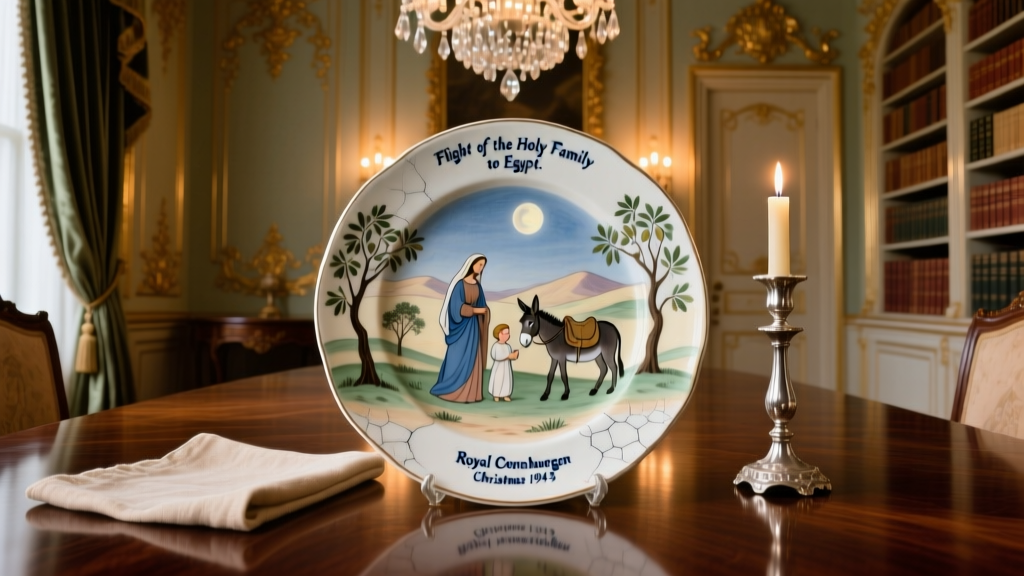
Royal Copenhagen Christmas 1943 Plate: 'Flight of the Holy Family to Egypt' — History, Iconography, and Restoration Insights
The Resurgence of Vintage Garden Tools: Collectibility, Restoration, and Market Trends

Henry Bailey: The Unheralded Architect of American Mission Furniture and His Enduring Legacy in Early 20th-Century Craftsmanship
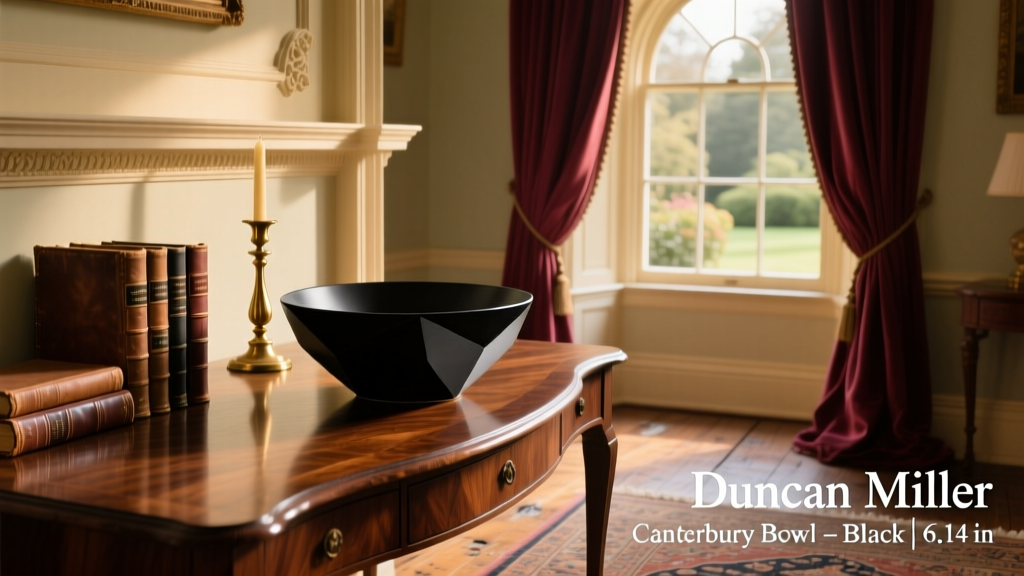
Duncan Miller Canterbury Bowl in Black: A Detailed Examination of the 6¼-Inch Model