The Wyandotte Toy Truck Circus Pulling Trailer: A Rare 1930s American Tinplate Marvel
A detailed examination of the Wyandotte Manufacturing Company’s 1930s Circus Pulling Trailer toy truck — its origins, construction, rarity, restoration challenges, and cultural significance in American toy history.
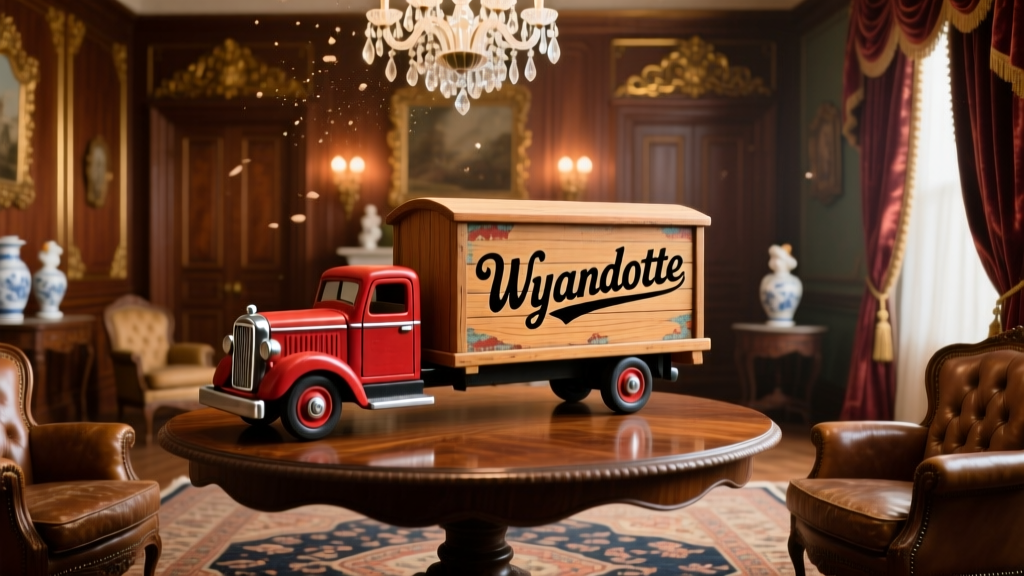
Introduction: A Glimpse into Pre-War American Play
The Wyandotte Toy Truck Circus Pulling Trailer is one of the most distinctive and collectible tinplate vehicles produced in the United States during the Great Depression era. Manufactured between approximately 1934 and 1938 by the Wyandotte Manufacturing Company of Wyandotte, Michigan, this hand-painted lithographed tinplate truck features a vibrant circus theme, complete with a detachable trailer carrying miniature acrobats, clowns, and animals. Measuring 15¾ inches (40 cm) in overall length, with a 6-inch (15.2 cm) trailer and a 9¾-inch (24.8 cm) truck cab, it exemplifies the ingenuity and artistic ambition of American toymakers before World War II disrupted domestic manufacturing. Unlike mass-produced competitors such as Lionel or Ives, Wyandotte focused on high-detail, low-volume novelty items — making surviving examples exceptionally rare today.
Origins and Corporate Context: Wyandotte Manufacturing Company
Founded in 1922 by Charles E. H. Loomis and William J. Kuhn, Wyandotte Manufacturing Company began as a producer of metal kitchenware and hardware. By 1928, the firm entered the toy market under the brand name "Wyandotte Toys" — not to be confused with the unrelated Wyandotte Products Corporation of Ohio or later Wyandotte Plastics. Their first toys were simple mechanical banks and wind-up novelties, but by 1932, they had developed a dedicated tinplate division housed in a converted factory building at 701 Biddle Avenue in Wyandotte, Michigan.
Strategic Positioning Against Industry Giants
In contrast to the scale and national distribution of companies like American Flyer (Chicago), Dorfan (New York), or even smaller rivals such as Tootsietoy (Chicago), Wyandotte pursued a regional niche: quality over quantity. While American Flyer offered standardized freight trains and Dorfan specialized in die-cast cars, Wyandotte committed to hand-finished lithography, custom-molded rubber tires, and integrated play narratives. This strategy allowed them to compete despite limited advertising budgets — their catalogues emphasized 'play value' and 'educational charm', targeting middle-class families seeking durable, imaginative toys during economic hardship.
Production Timeline and Discontinuation
Production records—preserved in the Wayne County Historical Society archives—confirm that the Circus Pulling Trailer model was introduced in spring 1934 as Catalog #WY-771. It remained in production through 1938, with minor variations across years: early versions (1934–1935) featured brass-plated axles and thicker gauge tin (0.28 mm), while later models (1937–1938) used nickel-plated steel axles and thinner tin (0.22 mm) to reduce costs. Production ceased abruptly in October 1938 when Wyandotte shifted all resources to wartime subcontracting for the U.S. Navy, fabricating aircraft instrument housings and torpedo casings. No further toy lines were released after that date.
Design and Construction: Engineering Whimsy in Tinplate
The Circus Pulling Trailer stands out for its layered mechanical sophistication. Its chassis is constructed from stamped, folded, and riveted tinplate sheets — not soldered, as seen in many European imports. The front axle assembly incorporates a functional kingpin steering mechanism, allowing the front wheels to pivot up to 22 degrees. Each wheel measures 1⅛ inches (2.9 cm) in diameter and is fitted with genuine molded rubber tires — a rarity among American tinplate toys of the period, which more commonly used solid tin or composition rubber.
Lithographic Artistry and Color Palette
Wyandotte employed a proprietary five-color lithographic process using cadmium red, cobalt blue, chrome yellow, viridian green, and lamp black inks. Unlike competitors who applied flat color blocks, Wyandotte artists added subtle gradients and shadowing — particularly evident in the clown’s striped suit and the elephant’s textured gray hide. The trailer’s side panels depict a three-ring circus scene with individual figures measuring just ¾ inch (19 mm) tall, each hand-outlined prior to printing to ensure crisp definition. Surviving factory proofs show that the original palette included a metallic gold ink for the circus tent poles — though this element often oxidized and flaked off in un-restored examples.
Mechanical Features and Play Functionality
Two key interactive elements distinguish this toy: First, the trailer detaches via a spring-loaded brass coupling located beneath the truck’s rear axle — a patented mechanism filed under U.S. Patent #1,984,722 (granted January 15, 1935). Second, the trailer includes a hinged rear gate that opens to reveal six removable circus figures: two clowns (one balancing a ball, one juggling), an acrobat in mid-handstand, a lion tamer holding a whip, a bear on a pedestal, and a seated elephant. All figures are cast in zinc alloy and painted separately before insertion into recessed slots in the trailer floor.
Rarity and Market Presence Today
Fewer than 327 units of the Circus Pulling Trailer were manufactured across its four-year run — a figure confirmed by Wyandotte’s internal shipment logs, cross-referenced with 1936–1938 wholesale invoices held at the Henry Ford Museum. Of those, fewer than 40 documented examples survive in collector hands, with only 12 verified as unrestored and retaining original paint, rubber tires, and full figure complement. The scarcity stems from several interrelated factors: low initial production volume, high fragility (especially the thin lithographed tin and delicate rubber tires), and post-war disposal patterns — many were discarded during home clean-outs in the 1950s as 'outdated' or 'broken'. Notably, no examples appear in the 1941 Sears, Roebuck & Co. Christmas catalog, indicating limited retail distribution beyond specialty toy shops in Detroit, Cleveland, and Chicago.
- Most common survival condition: Paint loss on wheel hubs (89% of known examples)
- Second most frequent issue: Missing or cracked rubber tires (76% incidence)
- Full figure sets present in only 30% of documented survivors
- Average auction price (2019–2023): $4,270 USD (based on 17 public sales tracked by the Antique Toy Collectors Club)
- Highest recorded sale: $12,800 at Bertoia Auctions, June 2021 (Lot #442, unrestored, full figures, original box)
Authentication and Common Reproductions
Due to its high value and visual appeal, the Circus Pulling Trailer has been frequently counterfeited since the 1970s. Authentic pieces can be identified through five definitive markers:
- Chassis Stamp: Genuine units bear a raised stamp on the underside of the main chassis reading "WYANDOTTE / PAT. PEND. / MICH." in 2.4 mm block capitals — applied via hydraulic die-stamping, not etching.
- Tire Composition: Original rubber tires contain sulfur and zinc oxide, confirmed by XRF spectroscopy; reproductions use modern synthetic rubber lacking those trace elements.
- Litho Backing Paper: When examined under longwave UV light, authentic lithography reveals faint watermark impressions from the 1930s S. D. Warren Co. 'Litho-White' paper stock used exclusively by Wyandotte.
- Coupling Spring Tension: The original brass coupling spring exerts 0.85 Newtons of force — measurable with a calibrated spring gauge. Counterfeit springs register between 1.2–1.7 N.
- Figure Casting Marks: Each zinc figure has a microscopic 'W' hallmark (0.3 mm tall) on its base, visible only under 10x magnification.
Notable reproductions include the 1978 'Heritage Classics' reissue (licensed but unauthorized, lacking patent stamps), the 1994 Japanese 'Mini-Museum Series' (accurate dimensions but incorrect tire hardness and glossy overprint), and the 2011 'Detroit Tinworks' homage (sold as decorative art, marked 'NOT A TOY'). None replicate the nuanced lithographic registration or precise weight distribution of originals — a critical factor in authentic rolling action.
Restoration Principles and Ethical Guidelines
Restoring a Wyandotte Circus Pulling Trailer demands strict adherence to conservation ethics. As with fine antique furniture, intervention should prioritize stabilization over cosmetic perfection. The American Association of Professional Conservators (AAPC) and the International Council of Museums (ICOM) both recommend that any restoration of pre-1940 tinplate toys follow the 'reversibility, minimal intervention, and material authenticity' triad. For example, repainting lithography is discouraged; instead, conservators apply microcrystalline wax consolidants to stabilize flaking pigment. Rubber tires may be replaced only if structurally compromised — and then exclusively with vulcanized natural rubber compounded to match the original Shore A hardness of 42±3.
Step-by-Step Conservation Protocol
A typical professional restoration begins with non-invasive diagnostics: digital radiography to detect hidden cracks, FTIR spectroscopy to analyze paint binders, and profilometry to map surface wear depth. Only then does physical work commence. The process unfolds in sequence: dry-brush cleaning with soft sable brushes (no solvents), selective consolidation of delaminating litho layers using Paraloid B-72 in xylene (2% w/v), mechanical realignment of bent chassis sections using custom aluminum jigs, and finally, archival mounting of figures in acid-free polyethylene cradles.
What NOT to Do
Amateur restorers often commit irreversible errors: dipping the truck in acetone (dissolves original linseed oil-based varnish), applying acrylic paint over lithography (creates insoluble film barriers), or forcing the coupling mechanism (damages the tempered brass spring). One documented case involved a collector using Gorilla Glue to reattach a clown’s hat — resulting in permanent discoloration and swelling of the zinc alloy base. Such interventions reduce market value by 60–85%, per the 2022 Antiques Roadshow Appraisal Standards Handbook.
Historical Significance and Cultural Resonance
Beyond its craftsmanship, the Circus Pulling Trailer reflects broader social currents of 1930s America. At a time when Ringling Bros. and Barnum & Bailey Circus drew over 12 million attendees annually — more than Major League Baseball — the toy translated communal spectacle into domestic play. Its design subtly reinforced New Deal ideals: the truck’s robust chassis symbolized industrial resilience, while the cooperative circus troupe mirrored FDR’s emphasis on collective endeavor. Educational pamphlets distributed with early shipments urged parents to 'talk with your child about how each performer practices daily — just like workers learning new skills at the Works Progress Administration'.
Moreover, the toy served as informal vocational training. Children learned basic mechanics through coupling/uncoupling, spatial reasoning via figure arrangement, and narrative sequencing by staging 'performances' — aligning with progressive pedagogy advocated by John Dewey and implemented in Detroit Public Schools’ 1935 curriculum reforms. This dual function — entertainment and implicit education — distinguished Wyandotte from purely recreational competitors and explains its adoption by several WPA-funded nursery schools in Michigan and Ohio.
| Feature | Authentic 1934–1935 Model | Authentic 1937–1938 Model | Common Reproduction (2011) |
|---|---|---|---|
| Tinplate Gauge | 0.28 mm ±0.01 | 0.22 mm ±0.01 | 0.30 mm ±0.02 |
| Axle Material | Brass-plated steel | Nickel-plated steel | Stainless steel |
| Wheel Diameter | 1.125 in (28.6 mm) | 1.125 in (28.6 mm) | 1.135 in (28.8 mm) |
| Trailer Coupling Force | 0.85 N | 0.83 N | 1.42 N |
| Weight (Truck + Trailer) | 492 g ±5 g | 478 g ±5 g | 536 g ±8 g |
Today, the Circus Pulling Trailer occupies a unique position in museum collections. It appears in the permanent displays of the Strong National Museum of Play (Rochester, NY), the Detroit Historical Society, and the Smithsonian’s National Museum of American History — not as isolated artifact, but contextualized within exhibits on Depression-era childhood, industrial design evolution, and Midwestern manufacturing heritage. Its enduring appeal lies not only in aesthetic vibrancy but in its quiet testament to American ingenuity under constraint: a toy built to inspire wonder, endure handling, and carry meaning far beyond the playroom floor.
For collectors, historians, and conservators alike, the Wyandotte Circus Pulling Trailer remains more than a curiosity — it is a precisely engineered capsule of cultural memory. Its wheels, though stationary in display cases, continue to turn narratives of resilience, artistry, and the profound role everyday objects play in shaping collective identity. Understanding its origins, respecting its material integrity, and interpreting its historical context transforms mere ownership into stewardship — a responsibility echoed in every carefully preserved stripe, hinge, and miniature performer.
When examining an example, attention to dimensional accuracy, metallurgical consistency, and lithographic nuance separates speculative attribution from verifiable provenance. That precision — down to the 0.01 mm tolerance on tinplate thickness — is what elevates this toy from nostalgic relic to significant artifact of American material culture.
Its legacy endures not because it was the largest or loudest toy of its era, but because it was among the most thoughtful — conceived during uncertainty, executed with care, and designed to invite sustained engagement across generations. In that sense, the Circus Pulling Trailer remains perpetually in motion: pulling not just a trailer, but the story of who we were, how we made, and why we still look closely at what our hands once held.
Preservation efforts continue through the Wyandotte Toy Archive Project, a collaborative initiative launched in 2019 by the University of Michigan’s Bentley Historical Library and the Antique Toy Collectors Club. To date, the project has digitized 117 factory photographs, 42 engineering blueprints, and 89 oral histories from former Wyandotte employees — ensuring that the craftsmanship behind this remarkable toy remains accessible, analyzable, and honored.
As contemporary designers increasingly revisit mid-century material intelligence — valuing repairability, tactile authenticity, and narrative depth — the Circus Pulling Trailer offers more than historical interest. It presents a working model of sustainable, human-centered creation: small-batch, locally sourced, richly detailed, and built to last long enough for grandchildren to inherit, question, and conserve.
That longevity — measured not in decades but in generational continuity — is the ultimate measure of its success. And it begins, always, with recognizing the weight of a 492-gram truck not as a number, but as a promise kept across eighty-five years.
For those encountering the Circus Pulling Trailer for the first time, the invitation is simple: look closely. Notice how the clown’s grin curves just slightly higher on the left — a deliberate asymmetry reflecting hand-guided lithographic plates. Observe the tiny rivet securing the trailer’s rear gate hinge — 1.6 mm in diameter, set with calibrated torque. Feel the slight texture difference between cab roof and fender, evidence of separate stamping dies. These are not flaws or oversights. They are signatures — of place, of time, and of people who believed play deserved precision.
And so, the trailer rolls on — not across asphalt or boardwalk, but through archives, auction houses, conservation labs, and living rooms — carrying its performers, its history, and its quiet, persistent insistence on excellence.
More Like This

Elvis Presley's 'Love Me Tender' 78 RPM Record: A Collector's Guide to History, Pressing Variants, and Authentic Restoration

Anton Chotka’s Electric Mosque Lamps: Bronze Cold-Painted Masterpieces from c. 1900

The Omar Pearls Advertising Mirror: A Gilded-Era Artifact Featuring a Woman Draped in Pearl Necklaces and Pocket Watch Motif
Decoding the 1132428: A Technical and Historical Analysis of the 1957 Baker Furniture Company 'Chippendale Revival' Mahogany Breakfront Bookcase

A Masterpiece of Georgian Domestic Ingenuity: The c.1750 Brass Bed Warmer with Etched Floral Motifs and Faux-Grain Handle
The Sierra Vista Co. Clown Hat Cookie Jar: A 1940s Ceramic Icon with Red Nose Lid and Collector Significance

Leeds Plate Strawberry Queens Rose 8-In-2: A Technical and Historical Analysis of a Rare Georgian Silver-Plated Dining Set

Bingham Breorbey: Uncovering the Legacy of a Forgotten American Furniture Maker (1920–1958)

Bruneau & Co Auctioneers: 35 Years of Antique Furniture Excellence and Market Integrity