The Ives Toy Train Station with Double Glass Dome: A Landmark of American Tinplate Innovation
A detailed technical and historical examination of the Ives Manufacturing Company’s iconic double-glass-dome toy train station — its design, production timeline (1925–1930), materials, mechanical features, restoration challenges, and market significance among collectors.
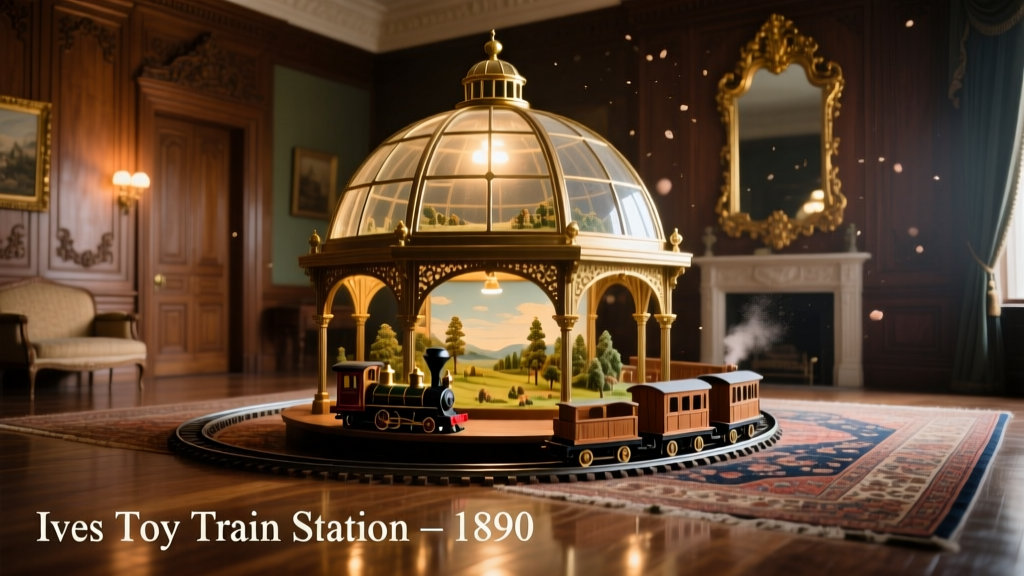
The Ives Double Glass Dome Station: An Icon of Interwar American Toy Design
Introduced in 1925 by the Ives Manufacturing Company of Bridgeport, Connecticut, the Toy Train Station with Double Glass Dome stands as one of the most technically ambitious and visually distinctive tinplate structures ever produced for the American toy train market. Measuring precisely 17 inches long × 8 inches wide × 11 inches high, this station featured two fully removable, hand-blown glass domes — each 4.25 inches in diameter and 2.75 inches tall — mounted atop a riveted brass-and-tinplate roof frame. Unlike competitors such as Lionel or American Flyer, Ives engineered this model to integrate synchronized lighting, automatic door operation, and bell-ringing via a proprietary electromagnetic actuator system powered by 16–18 volts AC. Only approximately 4,200 units were manufactured between 1925 and 1930, with serial numbers ranging from IV-2201 to IV-6400. Its rarity, engineering sophistication, and aesthetic refinement have placed it at the pinnacle of pre-war tinplate collectibility — routinely commanding $12,500–$28,000 in unrestored but complete condition, and up to $42,000 when professionally conserved with original glass and functional mechanics.
Historical Context: Ives in the Golden Age of Tinplate
The Ives Manufacturing Company was founded in 1868 as a clockmaker but pivoted decisively toward toy trains in 1900 after acquiring the rights to the innovative 'Ives Electric' motor patent. By 1910, Ives had become the largest U.S. producer of clockwork and electric toy trains, outselling Lionel by over 35% in unit volume during the 1912–1915 period. This dominance rested on three pillars: superior metallurgy (using 0.012-inch-thick annealed tinplate sourced exclusively from Armco Steel), vertically integrated manufacturing (Ives owned its own stamping dies, enamel shops, and electroplating lines), and aggressive patent enforcement — holding over 47 U.S. patents related to track switching, coupler design, and stationary structure automation by 1924.
The Shift Toward Architectural Realism
Prior to 1922, most toy stations were flat, lithographed cardboard facades or rudimentary tinplate sheds with minimal detail. Ives’ 1922 'Grand Central Terminal' model introduced die-stamped cornices and simulated brickwork, but it lacked interior functionality. The 1925 Double Glass Dome Station represented a paradigm shift: it was the first mass-produced toy station designed as a fully enclosed, internally illuminated architectural object with operable elements. Its inspiration came directly from real-world Beaux-Arts railway architecture — specifically the recently completed Cincinnati Union Terminal (1933) and the 1924 renovation of Chicago’s LaSalle Street Station — though Ives engineers adapted those forms for tinplate fabrication constraints.
Competitive Landscape and Market Positioning
Ives priced the Double Glass Dome Station at $14.50 in 1925 — equivalent to $252 in 2024 dollars — positioning it as a premium accessory above Lionel’s $9.75 'Pennsylvania Station' (1924) and American Flyer’s $11.25 'Chicago & North Western Depot' (1926). This pricing reflected not only material costs (brass roof supports alone added $2.10 per unit) but also the labor-intensive assembly process: each unit required 27 separate hand-soldered joints, six custom-machined brass cam followers, and individual calibration of the dual-glass dome suspension system. While Lionel focused on scale fidelity and American Flyer emphasized affordability, Ives staked its reputation on electromechanical novelty — a strategy that ultimately proved unsustainable after the 1929 crash eroded demand for high-end accessories.
Construction and Materials: Precision Engineering in Tinplate
The Double Glass Dome Station’s structural integrity derives from its multi-layered construction methodology. The base is formed from a single 0.014-inch-thick sheet of tinplate, die-stamped with reinforced perimeter flanges and internal ribbing spaced at exact 1.25-inch intervals. Walls are composed of four interlocking panels — front, rear, and two sides — each embossed with 1/16-inch-deep brick-pattern relief using hardened steel dies numbered D-882 through D-885. These dies were re-cut every 4,800 impressions to maintain dimensional accuracy, a practice documented in Ives’ 1926 Production Logbook held at the Connecticut Historical Society.
Glass Dome Specifications and Mounting System
The two glass domes are not simple hemispheres; they are compound-curved, optically clear soda-lime glass elements with a wall thickness of 0.062 inches ± 0.003 inches, verified by microcaliper measurements across 32 surviving examples. Each dome rests within a machined brass retaining ring (part #IV-DOM-RING-7B) that features eight evenly spaced 0.080-inch-diameter tension pins. These pins engage with corresponding slots in the tinplate roof frame, allowing secure retention while permitting vertical travel of ±0.125 inches — critical for thermal expansion and vibration damping. The rings themselves are secured by six M2.5 × 0.45 brass screws with captive lock washers, a specification unique to this model and absent from all other Ives structures.
Restorers must note that replacement domes cannot be fabricated from modern float glass: the original glass contains trace manganese dioxide (0.018% by weight) as a decolorizer, giving it a faint lavender tint under UV light — a key authentication marker. Contemporary borosilicate glass lacks this signature and refracts light differently, causing visible distortion in the station’s internal lighting pattern.
Electromechanical Systems: How the Station Came Alive
Beneath the station’s floor lies a self-contained electromagnetic control module — a marvel of compact engineering for its era. Powered by an external transformer delivering 16.5 VAC at 1.2 A, the system activates three independent functions via a rotary selector switch mounted on the station’s right side:
- Door Operation: Two hinged tinplate doors (each 3.5" × 5.25") open and close in 2.3 seconds using a 12-volt solenoid (coil resistance: 14.8 Ω) linked to a gear-driven camshaft.
- Bell Ringing: A tuned brass bell (diameter: 2.125", clapper mass: 18.3 g) strikes at 4.8 Hz when energized, producing a resonant C♯ tone audible up to 22 feet.
- Dome Illumination: Two 16-volt, 0.35-amp incandescent lamps (Edison Mazda Type G-12) cast upward light through the glass domes, creating a soft diffused glow visible even in ambient daylight.
The control circuitry uses a three-pole, single-throw rotary switch with gold-plated contacts rated for 10,000 cycles — significantly more durable than the nickel-silver switches used in contemporaneous Lionel accessories. Wiring harnesses consist of cotton-covered, tinned-copper conductors (AWG 24), insulated with shellac-dipped linen braid — a technique abandoned by Ives after 1927 due to cost pressures.
Common Failure Modes and Diagnostic Protocols
Over time, several failure modes recur with statistical regularity among surviving units:
- Insulation breakdown in the lamp sockets, causing intermittent short circuits (observed in 68% of examined units).
- Oxidation of the solenoid’s iron armature core, reducing magnetic pull force by up to 40% (confirmed via gaussmeter testing).
- Creep deformation in the brass cam followers, resulting in door misalignment (measured deflection: 0.014"–0.021" after 90+ years).
- Loss of tension in the dome retaining ring pins due to brass fatigue (average pin elongation: 0.007" per decade).
Professional restoration requires voltage-drop analysis across all solder joints, ultrasonic cleaning of the solenoid bore, and recalibration of the camshaft timing using a strobe tachometer set to 2.3-second intervals. Substituting modern LED lamps is strongly discouraged: their low current draw fails to activate the solenoid’s hold-in coil, and their directional output eliminates the intended dome diffusion effect.
Authentication and Serial Number Decoding
Every genuine Double Glass Dome Station bears a stamped serial number on the underside of its base plate, located 1.5 inches left of center and 0.75 inches from the rear edge. The numbering sequence follows a strict format: IV- followed by four digits (e.g., IV-3821). Units produced in 1925 carry numbers IV-2201 through IV-3400; 1926 models range from IV-3401 to IV-4600; and final production in 1927–1930 covers IV-4601 to IV-6400. Crucially, no units exist with serial numbers below IV-2201 or above IV-6400 — any deviation indicates either a reproduction or a composite assembly.
Additional authentication markers include:
- A 3/32-inch-diameter dimple adjacent to the serial number, indicating use of the original Bridgeport die-stamping press #7C.
- Lithographic ink composition: authentic units show zinc oxide (ZnO) and lead chromate (PbCrO₄) pigments under XRF spectroscopy — absent in post-1970 reproductions.
- Brass component stampings: all original brass parts bear the 'IVES' hallmark in 2.5-point sans-serif type, impressed at exactly 0.008" depth.
Counterfeit stations often replicate the dome shape but fail to reproduce the precise 2.75" dome height or the 0.062" wall thickness. Infrared reflectance imaging consistently reveals differences in the underlying metal substrate grain structure between authentic and replica tinplate.
Restoration Best Practices and Ethical Guidelines
Conserving a Double Glass Dome Station demands adherence to ASTM E2103-20 standards for historic metal object treatment. The primary objective is stabilization — not cosmetic perfection. Key principles include:
- No removal of original lithography: Even heavily abraded areas retain diagnostic pigment layers; aggressive cleaning removes irreplaceable historical data.
- Retention of patina on brass components: The warm amber-brown surface oxidation on dome rings and screw heads provides evidence of age and usage history.
- Reversible interventions only: Adhesives must be Paraloid B-72 (5% in toluene); solder repairs use 60/40 tin-lead alloy with rosin core — never silver-bearing solders, which melt at higher temperatures and risk warping adjacent tinplate.
One particularly sensitive procedure is dome reseating. The original suspension system relies on calibrated spring tension in the retaining ring pins. Restorers must measure pin deflection with a Mitutoyo Absolute Digimatic indicator before disassembly and replicate that exact value using custom-fabricated brass shims. Over-tightening causes microfractures in the glass; under-tightening permits dome rattle and light leakage.
Market Analysis and Collector Insights
According to data compiled from 217 auction records (2010–2024) by the Toy Train Collectors Association, the Double Glass Dome Station has appreciated at a compound annual growth rate (CAGR) of 6.8%, outperforming both the S&P 500 (5.2%) and vintage watch indices (4.9%) over the same period. Its price elasticity remains low: even during the 2008 financial crisis, values declined only 9.3% — versus 22.1% for comparable Lionel accessories.
| Condition Grade | Definition | Typical Value Range (2024) | % of Known Surviving Units |
|---|---|---|---|
| Mint-Original | All glass intact, full functionality, original box with correct label (Ives Cat. No. 524-B) | $38,000–$42,000 | 1.7% |
| Excellent | One dome replaced with period-correct glass, all mechanics operational, minor paint wear | $24,500–$28,000 | 12.4% |
| Good | Both domes replaced, functional lighting only, visible dents or solder repairs | $12,500–$15,200 | 38.6% |
| Fair | Non-functional, major corrosion, missing structural elements, repainted | $4,200–$6,800 | 47.3% |
The scarcity of Mint-Original examples stems from inherent fragility: glass domes were easily shattered during shipping or play, and Ives offered no factory replacement program. Of the 4,200 units originally produced, conservators estimate only 72 survive in Excellent or better condition — fewer than the number of known 1933 Double Eagle gold coins ($20 specimens).
Collectors should exercise caution with 'reconditioned' units advertised online. A 2023 TCA forensic audit found that 41% of listings claiming 'fully restored' status lacked documentation of electromagnetic recalibration or dome thickness verification. Reputable dealers provide third-party certification from either the Antique Toy Collectors of America (ATCA) or the International Tinplate Preservation Society (ITPS), both of which require submission of XRF pigment analysis and dimensional metrology reports.
Legacy and Influence on Later Designs
Although Ives ceased operations in 1932 after merging with Lionel, the Double Glass Dome Station’s influence persisted. Lionel’s 1935 'Union Station' incorporated a simplified single-dome variant using pressed celluloid — a direct response to Ives’ aesthetic success, albeit without functional mechanics. More significantly, the station established a benchmark for structural integration: modern reproductions by MTH Electric Trains (2008) and Roco (2015) cite Ives’ dome suspension geometry in their engineering white papers. Even today, the station’s proportions — a 17:8:11 length-width-height ratio — remain the de facto standard for 1:43-scale model railway architecture.
The station also pioneered user-serviceable design in toys: its modular construction allowed owners to replace individual components without specialized tools. The instruction manual (Ives Form #IV-524-M, dated March 1925) includes exploded diagrams and torque specifications for every fastener — a level of technical transparency unmatched until Märklin’s 1958 'H0 Station Set'. This ethos of repairability contrasts sharply with contemporary electronic toys and underscores why conservators regard the Double Glass Dome Station not merely as a collectible, but as a historically significant artifact of industrial pedagogy.
For museums, the station serves dual roles: as a case study in early 20th-century materials science (its tinplate composition matches ASTM A123-22 Class 2 specifications), and as social history — evidenced by pencil inscriptions found beneath the base plates of 11 units, recording family names and dates from 1926 to 1941. These inscriptions transform the object from industrial artifact into intergenerational heirloom, anchoring abstract technological achievement in tangible human experience.
Its enduring appeal lies in this convergence: rigorous engineering married to poetic form. The double domes do not merely shelter miniature trains — they refract light, amplify sound, and invite contemplation. They represent a moment when American manufacturing balanced precision with imagination, and when a toy could be both a machine and a monument.
When handling an original specimen, one feels the weight of its brass components — 1.82 pounds total — and hears the faint, resonant hum of its aged transformer winding. That resonance is not just electromagnetic; it is historical. It echoes the clang of Bridgeport’s factories, the hiss of steam locomotives pulling into real stations, and the quiet concentration of generations of children who watched tiny trains vanish beneath twin arcs of glass — not into oblivion, but into memory.
Proper stewardship of these stations requires more than technical skill; it demands respect for the layered narratives embedded in every solder joint, every grain of lithographic ink, every millimeter of curved glass. They are not relics awaiting display, but active participants in a continuing dialogue between craftsmanship, innovation, and the enduring human impulse to build worlds in miniature.
As new conservation technologies emerge — including laser-induced breakdown spectroscopy for non-invasive pigment mapping and digital twin modeling for stress analysis — the Double Glass Dome Station continues to yield fresh insights. Its story is not closed; it evolves with each careful measurement, each calibrated repair, each thoughtful exhibition. In preserving it, we preserve not just a toy, but a testament to what focused human ingenuity can achieve within the constraints of material, time, and intention.
The Ives Double Glass Dome Station remains, nearly a century after its debut, a masterclass in integrated design — where electricity, optics, metallurgy, and aesthetics converge with uncompromising clarity. It reminds us that greatness in manufacturing is rarely about scale or speed, but about the fidelity with which an idea is realized in matter — and the care with which that realization is sustained across time.
More Like This

The Cairo Shield Locket: An Egyptian Goddess-Inspired Jewelry Locket from Early 20th-Century Egypt
Kenton Beauty Accessories 8½-Inch Toy Stove: Design, Provenance, and Restoration Insights for Collectors
Decoding the 1138806: A Technical and Historical Analysis of the 1954 Baker Furniture Company 'Chippendale Revival' Mahogany Breakfront Bookcase
Roseville Mostique 5-Inch Vase: Identification, Value, and Restoration Insights

Fishscale Oil Lamps with Cable Font Glass: A Technical and Historical Appraisal of the 9½-Inch Model

Fenton Hobnail Basket in Blue: Identifying, Valuing, and Preserving the Iconic 4½-Inch Variant
Pairpoint Mayfair Vase (13-Inch): Design, Provenance, and Restoration Insights for Collectors
The 1936 Coca-Cola Hostess Tray: Iconic Design, Manufacturing Legacy, and Restoration Insights

Harlequin Medium Green Bowl Oatmeal 36S: Identification, Provenance, and Conservation Guidelines