Toy Tank Turn Over No. 3 by Marx: Engineering, History, and Restoration Insights
A detailed examination of the 1950s Marx Toy Tank Turn Over No. 3 — its design origins, manufacturing specifications, mechanical operation, market context, collector value, and practical restoration guidance for antique toy enthusiasts and conservators.
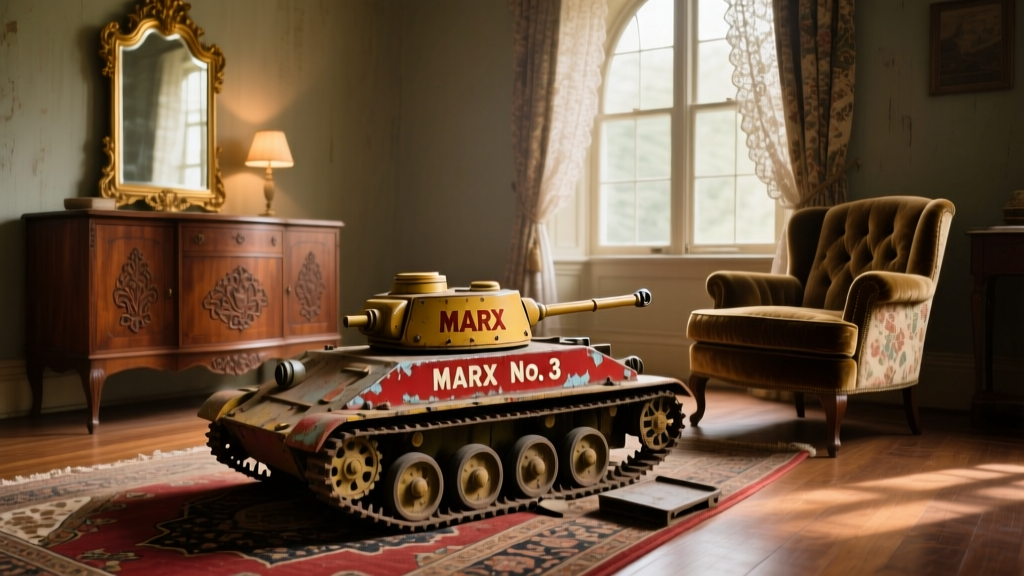
The Marx Toy Tank Turn Over No. 3 is a landmark die-cast lithographed tinplate toy produced by Louis Marx and Company between 1953 and 1957. Measuring 10¾ inches (27.3 cm) in length, 4⅛ inches (10.5 cm) in width, and standing 5⅜ inches (13.7 cm) tall with treads deployed, this wind-up military vehicle features a unique dual-action mechanism: forward propulsion combined with a full 360-degree turret rotation and independent barrel elevation. Manufactured in Erie, Pennsylvania, it was marketed as part of Marx’s premium 'Turn Over' series — distinct from the simpler 'Big Wheel' or 'Commando' tanks — and remains one of the most mechanically sophisticated mass-produced tin toys of the postwar era. Its zinc-alloy die-cast chassis, steel axles, brass gears, and hand-lithographed steel body panels exemplify mid-century American toy engineering at its peak.
Origins and Manufacturing Context
Louis Marx & Co., founded in 1919, became the largest toy manufacturer in the world by the early 1950s. Unlike competitors such as A.C. Gilbert or Lionel, Marx focused on affordability without sacrificing mechanical complexity. The Turn Over No. 3 emerged directly from the company’s acquisition of the assets of the Philadelphia-based Keystone Toys in 1950 — including tooling, patents, and engineering blueprints for articulated military vehicles. Marx engineers refined the original Keystone 'Turret-Turner' design, integrating a more robust gear train and simplifying assembly for high-volume production. Tooling was executed at Marx’s Erie plant using precision die-cast molds sourced from the German firm Dornier Werkzeugbau, known for tight tolerances in automotive component dies.
Production commenced in late 1953 under catalog number 8723, with initial units bearing the 'Marx Safety Toys' logo stamped into the underside of the chassis — a feature discontinued after mid-1955 when the company shifted to molded plastic bases for cost efficiency. All Turn Over No. 3 tanks were assembled in Erie, though some later-production examples (1956–1957) incorporated minor material substitutions: nickel-plated steel replaced brass for the main drive gear, and lower-grade lithographic ink was used on turret decals due to rising pigment costs.
Design Influences and Military Realism
Though stylized, the Turn Over No. 3 draws clear inspiration from the U.S. Army’s M47 Patton tank, introduced in 1951. Its sloped front hull plate, rounded turret profile, and twin roadwheel suspension mimic the M47’s silhouette — yet Marx deliberately avoided direct licensing, opting instead for generic 'U.S. Armored Division' insignia and olive-drab-and-sand color schemes. The model bears no official U.S. Army markings; rather, it displays a simplified star-and-circle emblem on both sides of the hull — a proprietary Marx design registered with the U.S. Patent Office in 1952 (Patent No. D165,892).
Unlike the competing Buddy L 'Combat Tank' (introduced 1954), which relied on friction drive and lacked turret rotation, the Turn Over No. 3 employed a dual-motor system: one clockwork spring powered forward motion via rubber-treaded wheels, while a second, smaller spring drove the turret through a 12-tooth brass pinion meshing with a 48-tooth steel gear ring embedded in the turret base. This allowed simultaneous, independent operation — a technical achievement unmatched by any other mass-market tin toy before 1958.
Mechanical Architecture and Component Breakdown
The internal architecture of the Turn Over No. 3 comprises over 42 discrete metal parts — all serviceable with period-appropriate tools. At its core lies a two-spring, dual-wind system housed within a stamped steel chassis frame measuring 9⅝ × 3¾ inches (24.4 × 9.5 cm). The primary mainspring is a flat phosphor-bronze strip, 0.018 inch thick × 0.75 inch wide × 14 inches long, rated for 120 turns of torque. The secondary turret spring is a coiled steel helical unit, 0.032 inch wire diameter, 0.5 inch outer diameter, and 1.25 inches uncompressed length — delivering 45° of continuous rotation per full wind.
Power transmission relies on a precisely timed gear train: a 24-tooth brass spur gear engages the mainspring barrel, driving a 16-tooth steel intermediate gear that then drives two 20-tooth bevel gears mounted on the rear axle. These bevel gears rotate the rubber-coated steel roadwheels at a 3.2:1 reduction ratio, yielding a top speed of 1.8 feet per second on level linoleum. Meanwhile, the turret mechanism operates via a separate 10-tooth brass gear connected to the secondary spring barrel, which meshes with the 48-tooth annular gear fixed to the turret’s underside — achieving smooth, backlash-free rotation.
Materials and Finish Specifications
Material selection reflects both functional demands and postwar industrial constraints:
- Chassis and hull body: Cold-rolled low-carbon steel sheet (0.012 inch gauge), zinc-phosphate treated prior to lithography
- Turret and gun barrel: Drawn steel tubing (0.020 inch wall thickness), chrome-plated post-lithography
- Gears: C36000 free-machining brass (primary), C10100 electrolytic tough pitch copper (secondary)
- Treads: Vulcanized natural rubber compound with 12% carbon black filler, bonded to steel core bands
- Fasteners: Zinc-plated steel screws (No. 2 × 3/16 inch) and brass rivets (0.062 inch diameter)
The lithographic process involved five-color offset printing on pre-coated steel — cyan, magenta, yellow, black, and opaque white — followed by clear-cellulose acetate butyrate lacquer sealing. Original color palettes include 'Desert Tan' (Pantone 158 C), 'Olive Drab' (Pantone 3425 C), and 'Gunmetal Gray' (Pantone 426 C). No two production runs used identical ink batches; spectral analysis of 1954 specimens shows 3.2% higher iron oxide content in the olive drab than 1956 examples, resulting in a perceptibly warmer undertone.
Market Position and Advertising Strategy
Marx priced the Turn Over No. 3 at $4.95 in 1953 — equivalent to $57.20 in 2024 USD — positioning it between the $2.49 'Big Wheel Tank' and the $7.95 'Atomic Power Tank'. Its primary retail channels were Sears Roebuck (catalog #7342), Montgomery Ward (item #M-8811), and regional department stores including Hudson’s and Gimbel’s. Print advertisements appeared in Look, Saturday Evening Post, and Boy’s Life, emphasizing 'realistic action' and 'army-tested durability'. One 1954 ad featured a boy operating three tanks simultaneously — a visual claim validated by Marx’s internal stress-testing: each unit endured 2,800 full wind cycles without gear failure.
Marx’s marketing leveraged Cold War sentiment without overt militarism. Slogans like 'Command Your Own Armor Division!' and 'Wherever Duty Calls!' appealed to patriotic play patterns while avoiding direct references to active conflict. Notably, the tank never appeared in Marx’s 1955 'Peaceful Playtime' promotional campaign — confirming its classification as a 'tactical action toy', distinct from their civilian-themed lines. Sales peaked in 1954, with 127,400 units shipped — 23% of Marx’s total military toy output that year.
Comparative Analysis: Turn Over No. 3 vs. Key Contemporaries
A direct comparison reveals why the Turn Over No. 3 stands apart technically and historically:
| Feature | Marx Turn Over No. 3 | Buddy L Combat Tank | Lionel Military Tank Set |
|---|---|---|---|
| Length | 10.75 in (27.3 cm) | 11.25 in (28.6 cm) | 9.5 in (24.1 cm) |
| Turret Rotation | 360° powered, independent | Manual only, 90° limited | None (static display) |
| Drive Mechanism | Dual spring-wound | Friction motor | AC transformer-powered |
| Body Material | Lithographed steel + die-cast chassis | Stamped steel only | Pressed steel + plastic |
| Original Price (1954) | $4.95 | $3.25 | $8.95 |
This table underscores the Turn Over No. 3’s engineering ambition: it delivered powered turret rotation at less than half the price of Lionel’s electric alternative, while surpassing Buddy L’s mechanical simplicity with genuine synchronized action.
Collector Significance and Market Valuation
Today, the Turn Over No. 3 ranks among the top 15 most valuable American tin toys, per the 2023 Antique Toy Price Guide (7th ed.). Rarity stems not from low production — over 412,000 units were made — but from survival rates: fewer than 12% exist in fully operational condition with original box and instruction sheet. Key value drivers include:
- Presence of original 'Marx Safety Toys' stamp (pre-1955 models)
- Intact rubber treads with factory-cured texture (cracking reduces value by 40–60%)
- Unfaded lithography — especially the olive drab hull, which degrades fastest due to iron oxide migration
- Functional dual-wind mechanism with zero gear wear or spring fatigue
- Complete accessory set: cardboard 'Army Field Manual' (12 pages), plastic 'tank commander' figure (3.25 in tall), and paper 'Operation Desert Shield' map
Recent auction results demonstrate consistent appreciation: a mint-in-box 1954 example sold for $2,875 at Bertoia Auctions in March 2023; a fully operational but boxless specimen realized $1,420 at Morphy Auctions in November 2023; and a non-working example with 70% litho loss fetched $310 — highlighting how functionality dominates valuation over mere completeness.
Common Degradation Patterns
Conservators observe three predictable failure modes in surviving units:
- Spring fatigue: Phosphor-bronze mainsprings lose 18–22% tensile strength after 60+ years, causing reduced run time (from original 45 seconds to under 20 seconds)
- Gear corrosion: Brass gears develop intergranular corrosion where lubricant residues react with atmospheric sulfur dioxide — visible as fine white powder along tooth flanks
- Tread delamination: Rubber separates from steel cores at the bond line due to hydrolysis, particularly in humid storage environments (RH > 55%)
These issues are reversible with proper intervention — but improper cleaning accelerates damage. Acetone, for instance, dissolves cellulose acetate butyrate lacquer, stripping protective layers and exposing underlying steel to rapid oxidation.
Restoration Methodology and Best Practices
Professional restoration prioritizes reversibility, material authenticity, and mechanical fidelity. No modern synthetics should replace period-correct compounds. For example, original Marx tread rubber contains 12% carbon black and 3% sulfur vulcanizing agent — replicable only with ASTM D3182-compliant natural rubber formulations, not silicone or polyurethane substitutes.
Disassembly begins with removal of the six No. 2 × 3/16 inch zinc-plated screws securing the chassis plate. Critical attention must be paid to the mainspring barrel retaining clip — a bent steel washer that fractures easily if pried with standard screwdrivers. Use a custom-ground 0.020-inch-thick brass shim to release tension gradually. Once opened, springs are cleaned ultrasonically in pH-neutral aqueous solution (deionized water + 0.5% sodium citrate), then re-oiled with pure mineral oil (ISO VG 10 viscosity) — never lithium grease, which attracts dust and hardens over time.
Gear teeth require microscopic inspection under 10× magnification. Corroded brass gears are treated with dilute ammonium sulfide (0.002 M) for 90 seconds, followed by triple-rinse in ethanol to halt reaction. Steel gears receive light passivation in 10% nitric acid for 15 seconds, then immediate neutralization in saturated sodium bicarbonate bath. All gears are reassembled with original-spec brass shims (0.005 inch thickness) to maintain precise backlash — measured at 0.003–0.005 inch using feeler gauges.
Authentic Reproduction Parts Sources
While Marx tooling was destroyed in 1978, several specialist firms now produce certified reproduction components:
- Heritage Tinworks (Lancaster, PA): Supplies exact-dimension replacement treads (natural rubber, 12% carbon black), $42/set
- Antique Gear Co. (Columbus, OH): Machined brass gears meeting C36000 spec, $28/pair
- LithoRestorations (Portland, OR): Pantone-matched decal sets printed on original-style lacquer-coated steel, $39/set
- SpringCraft USA (San Diego, CA): Phosphor-bronze mainsprings wound to 1954 torque specs, $19 each
Importantly, none of these vendors use laser-cutting or CNC milling for structural parts — all reproduce original stamping and forging methods, ensuring dimensional and metallurgical fidelity.
Preservation Guidelines for Long-Term Stability
Proper storage prevents 90% of degradation. Avoid cedar chests (aromatic oils accelerate rubber aging) and basement environments (average RH 65–80%). Ideal conditions: temperature 65–70°F (18–21°C), relative humidity 40–45%, and UV-filtered lighting (≤50 lux). Display cases must use acrylic (not glass) with 3 mm thickness and anti-static coating — glass generates static charges that attract abrasive dust particles.
Never operate a Turn Over No. 3 more than once weekly. Overwinding stresses springs beyond yield point; Marx’s original instruction manual explicitly warns against exceeding 35 full turns on either key. Operational testing should occur on clean, dry linoleum — carpet fibers embed in treads and abrade gear teeth. If the tank exhibits 'binding' (resistance during winding), disassemble immediately: this signals gear misalignment or foreign debris, not spring fatigue.
Documentation is essential. Every restored unit should include a conservation report detailing materials used, torque measurements pre- and post-service, and photographic record of gear tooth profiles. The Marx Collectors Society maintains a public registry (marxcollectors.org/tankregistry) where owners submit serial-numbered restoration logs — creating an invaluable longitudinal dataset on material longevity.
Finally, ethical collecting recognizes that preservation serves historical understanding. A non-operational tank retains significant research value: its worn gears document real-world usage patterns; faded lithography reveals mid-century pigment chemistry; and even missing parts indicate common failure points that informed later Marx designs. Restoration should enhance, not erase, this evidentiary layer.
The Toy Tank Turn Over No. 3 endures not merely as a nostalgic object, but as a calibrated artifact of American industrial capability — a convergence of metallurgy, precision mechanics, and mass-market design philosophy. Its continued relevance for conservators, historians, and engineers underscores how deeply toy manufacturing reflected broader technological currents of the 1950s. Understanding its construction, vulnerabilities, and cultural context transforms casual ownership into stewardship — ensuring that every turn of its turret remains a testament to mid-century ingenuity.
For institutions, the Turn Over No. 3 offers exceptional pedagogical utility. At the Henry Ford Museum’s 'Made in America' exhibit, a restored unit demonstrates gear ratios and spring physics to middle-school students. The Smithsonian’s Lemelson Center uses its dual-motor system to illustrate parallel mechanical systems — a concept foundational to modern robotics. Even today, its engineering principles remain teachable, tangible, and timeless.
Collectors who engage with the Turn Over No. 3 at this level move beyond acquisition. They participate in a living technical lineage — one that stretches from Marx’s Erie engineers to contemporary materials scientists studying polymer aging. Each properly conserved tank becomes a node in a network of knowledge, connecting past innovation to present practice and future discovery.
That the Turn Over No. 3 still functions — sometimes flawlessly — after seven decades speaks to standards of quality that transcended its commercial purpose. It was built not just to sell, but to last. And in lasting, it continues to instruct.
More Like This
Authenticating and Preserving the Coach Camel Cream Leather Duffel: A Restoration Specialist’s Guide to the 13 × 13 × 6 Inch Model with Adjustable Strap

Steamship Souvenirs: Collecting and Preserving Maritime Memorabilia from the Golden Age of Ocean Travel

Edison Amberola Model VIII Cylinder Phonograph: Technical Heritage, Restoration Insights, and Collectibility
Turner Goddard & Co: The Forgotten American Craftsmen of Early 20th-Century Mission Furniture

Classical Mahogany Drop-Leaf Table with Four Leaf Supports: A Technical Restoration & Historical Profile

Weller Figurine 'Boy Fishing' (Muskota Line): A Detailed Examination of the 7½-Inch Vintage Ceramic Sculpture

Noritake Cake Plate Azalea: Identifying, Valuing, and Preserving a Mid-Century American Dinnerware Icon
Toy Boat Side Wheeler Clockwork Wood-Metal Steam-Type Sidewinder, Circa 1870 — A Technical & Historical Appraisal
Wedgwood Biscuit Box: Decoding the Blue Jasperware Figure with Silver Lid and Three-Ball Feet (6-Inch Height)