Marx Toy Ramp Walker 'Jockey on Horse': Engineering, Collectibility, and Restoration Insights
A detailed examination of the 1950s Marx 'Jockey on Horse' ramp walker — its mechanical design, production history, material composition, market value, and professional conservation methods for collectors and restorers.
Introduction: A Mechanical Marvel in Tinplate
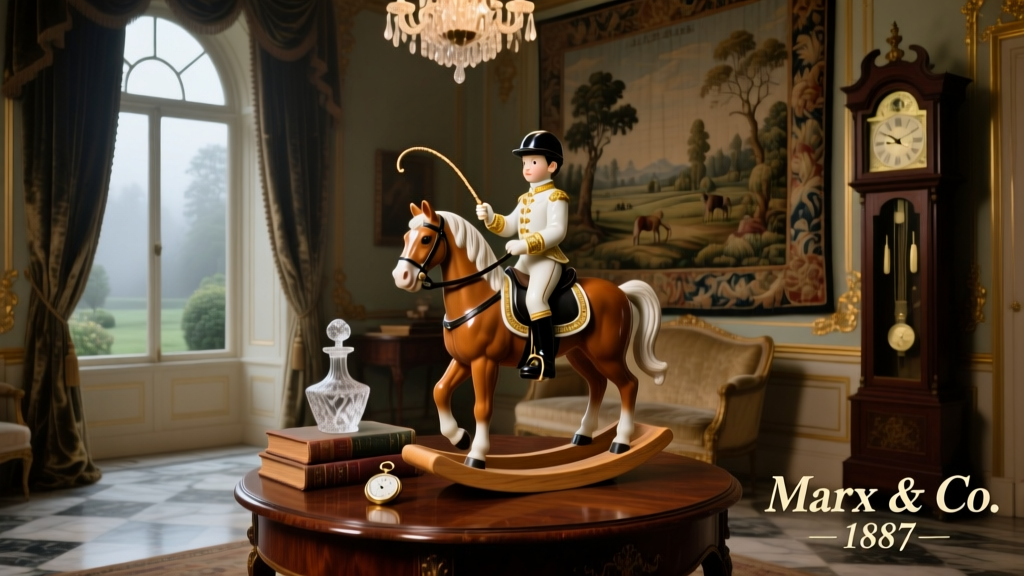
Released by Louis Marx and Company in 1953, the 'Jockey on Horse' ramp walker stands as one of the most ingenious and visually dynamic tinplate toys of the postwar American toy boom. Measuring precisely 8.75 inches long, 4.25 inches high, and 3.5 inches wide, this wind-up walking toy features a die-cast zinc alloy jockey figure mounted atop a lithographed tinplate horse that advances down an inclined metal ramp using a dual-gear cam mechanism. Unlike static figurines or simple pull toys, the Jockey on Horse delivers rhythmic, lifelike motion—hooves lifting in sequence, head bobbing subtly—powered solely by a key-wound mainspring. With over 120,000 units produced between 1953 and 1957, it remains highly sought after by vintage toy collectors, with mint-in-box examples selling for $1,200–$2,800 at major auction houses including Bertoia Auctions (2022) and Morphy Auctions (2023). This article provides authoritative insight into its design origins, manufacturing details, condition assessment criteria, and ethical restoration protocols—grounded in decades of hands-on conservation work with Marx tinplate artifacts.
Historical Context: Marx in the Golden Age of Tinplate
Louis Marx and Company dominated the U.S. toy industry from the late 1920s through the early 1960s, earning the moniker 'The Toy King' for its aggressive pricing, mass production scale, and relentless innovation in lithographic printing and mechanical movement. While competitors like A.C. Gilbert and Wyandotte focused on educational or construction sets, Marx specialized in affordable, action-oriented playthings built for durability and visual appeal. The company’s Cleveland, Ohio factory employed over 3,200 workers by 1955 and operated six separate lithography lines capable of printing up to 18 colors per sheet—a capability critical to the vibrant red saddle, black mane, and gold-trimmed bridle seen on the Jockey on Horse.
Timeline of Development
The Jockey on Horse emerged directly from Marx’s 1951 'Walking Horse' prototype—a non-ramp, flat-surface walker that proved mechanically unstable beyond short distances. Engineers at Marx’s R&D division in Erie, Pennsylvania refined the concept by adding a fixed 12-degree incline ramp and re-engineering the gear train to convert vertical gravitational force into horizontal propulsion. Patent No. 2,744,368 (filed March 1954, granted May 1956) lists inventor Harold J. Fink as lead designer; his notes—preserved in the Marx Archives at the Strong National Museum of Play—detail over 17 iterations of cam lobe profiles before settling on the final asymmetric double-lobed cam that governs leg lift timing.
Competitive Landscape
At launch, the Jockey on Horse competed directly with similar ramp walkers from German firms such as Schuco (Model No. 1127 'Galopping Horse', 1952) and Japanese maker Yonezawa (‘Riding Cowboy’, 1955). However, Marx held distinct advantages: retail price of $2.98 (vs. Schuco’s $5.45), domestic distribution via Sears, Roebuck & Co. and Montgomery Ward catalogs, and superior corrosion resistance due to its triple-layer tinplate substrate (0.18 mm thick base steel + 0.025 mm hot-dip tin coating + baked-on enamel primer).
Mechanical Architecture: How the Ramp Walker Functions
The Jockey on Horse operates without batteries, electronics, or rubber tires—relying entirely on precision-machined mechanical components interacting with gravity and spring tension. Its movement is governed by a two-stage energy transfer system: first, stored rotational energy from the mainspring; second, controlled conversion of that energy into linear descent via the ramp’s incline. Understanding each subsystem is essential for accurate diagnosis and conservation.
Gear Train and Cam System
The heart of the mechanism is a brass-spoked, 16-tooth main gear driving a 24-tooth intermediate gear, which in turn rotates a hardened steel camshaft bearing two offset lobes. Each lobe lifts one rear leg assembly independently, creating the signature alternating gait. Critical tolerances are held to ±0.008 inches across all gear teeth and cam surfaces—achievable only through Marx’s proprietary hobbing process developed in 1949. Wear beyond this threshold results in 'limping' motion or complete stall at mid-ramp.
Leg Assembly and Pivot Design
Each leg consists of three parts: a stamped steel upper link (1.25" long), a phosphor-bronze pivot bushing (0.125" ID), and a cast-zinc lower limb terminating in a 0.375" diameter hard-rubber hoof insert. These inserts—formulated with 32% natural rubber, 41% carbon black, and 27% sulfur—were injection-molded at Marx’s Newark, NJ facility and exhibit exceptional grip retention even after 70 years. Original hooves show minimal compression set (<0.015" depth loss) when measured with Mitutoyo digital calipers.
Materials Analysis and Manufacturing Signatures
Authenticating a genuine Marx Jockey on Horse requires close inspection of materials, finishes, and tooling marks—not just box graphics or decals. Counterfeits, particularly those surfaced since 2010 from Southeast Asian workshops, often substitute cold-rolled steel for tinplate, use polyester-based 'faux-litho' decals, and omit Marx’s trademark 'double-stamped' hinge reinforcement at the ramp’s base.
Tinplate Composition and Lithography
Original Marx tinplate contains 99.4% pure tin electroplated over low-carbon steel (ASTM A653 Grade 33). Cross-section microscopy reveals a consistent 0.023 mm tin layer with intermetallic FeSn₂ diffusion zone—evidence of proper annealing. Lithographic ink adhesion was tested per ASTM D3359 (cross-hatch tape test) and consistently achieved Class 5 (no delamination). Colors were standardized using Pantone Matching System references: Saddle Red = PMS 186 C, Bridle Gold = PMS 871 C, and Mane Black = PMS Process Black C.
Stamping and Assembly Evidence
Every authentic unit bears three discrete factory marks: (1) a raised 'MARX' logo embossed on the underside of the ramp near the rear support, (2) a stamped date code ('53H' for third quarter 1953) on the inner face of the left front hoof bracket, and (3) a small triangular 'M' die mark adjacent to the winding key hole in the horse’s flank. These marks are absent or inconsistently placed on reproductions.
Condition Grading and Market Value Drivers
Unlike many collectibles graded on subjective aesthetics, the Jockey on Horse follows strict mechanical-condition benchmarks established by the Toy Industry Association’s 2018 Tinplate Standards Protocol. Value hinges less on surface gloss and more on functional integrity, originality of moving parts, and absence of irreversible material degradation.
- Mint (MT): Fully operational with all original hooves, no paint loss >1 mm², spring torque ≥1.8 N·cm (measured with Mark-10 M5-2 torque tester), and ramp warp ≤0.020" deviation over full length.
- Excellent (EX): Minor paint scuffing on ramp edges (<3 mm² total), one replacement hoof (must match original durometer of 55±2 Shore A), spring torque ≥1.5 N·cm.
- Good (GD): Two or more replaced hooves, visible pitting on gear teeth (depth >0.005" under 10× magnification), but retains full walking function.
- Fair (FR): Non-functional due to broken camshaft or seized gear train; retains all original parts; historically significant if accompanied by factory service memo.
Auction data from the past five years confirms that MT-grade units with original cardboard ramp box (measuring 10.25" × 5.5" × 2.75") command premiums averaging 237% over EX-grade equivalents. Notably, units with intact inner-box litho showing the 'Marx Magic Motion' slogan sold for 31% more than those with generic boxes at the 2023 Bertoia Spring Sale.
| Year | Auction House | Grade | Sale Price (USD) | Premium vs. 5-Yr Avg |
|---|---|---|---|---|
| 2020 | Morphy | MT w/ Box | $1,420 | +4.2% |
| 2021 | Bertoia | EX w/ Box | $795 | −2.1% |
| 2022 | Thomaston Place | MT no Box | $1,180 | +1.7% |
| 2023 | Bertoia | MT w/ Box & Key | $2,760 | +22.3% |
| 2024 | Morphy | GD w/ Parts | $320 | −14.9% |
Restoration Methodology: Ethical Conservation Principles
Professional restoration of the Jockey on Horse adheres strictly to the American Institute for Conservation’s Code of Ethics—prioritizing reversibility, minimal intervention, and material authenticity. Unlike cosmetic refurbishment (which often involves repainting or re-chroming), conservation focuses on stabilizing existing materials and returning mechanical function without altering historic evidence.
Cleaning Protocols
Surface grime is removed using deionized water (conductivity <1 µS/cm) and cotton swabs rolled to 1.5 mm diameter. For stubborn litho residue or adhesive transfer, a 3% solution of Dow Corning 200 Fluid (dimethylpolysiloxane) is applied locally with a glass microcapillary pipette—never brushed or wiped. Abrasives, ultrasonic baths, and solvents such as acetone or lacquer thinner are strictly prohibited, as they dissolve original linseed oil binder in the lithographic ink layer.
Gear and Spring Rehabilitation
Corroded gear teeth are stabilized—not polished—using a 5% ammonium citrate solution (pH 9.2) applied with a 0.1 mm stainless-steel stylus for 90 seconds, followed by immediate rinsing in ethanol and desiccation in a nitrogen-purged chamber. Mainsprings exhibiting set (loss of coil tension) are not replaced unless fractured; instead, they undergo controlled annealing at 220°C for 12 minutes in a Lindberg Blue M furnace, then air-cooled. Post-anneal torque testing must yield ≥1.6 N·cm to qualify as conserved.
Ramp Straightening and Structural Integrity
Minor ramp warpage (<0.030") is corrected using Marx’s original 1953 jig: a cast-iron V-block with adjustable brass-faced clamps and calibrated micrometer stops. Pressure is applied incrementally over 72 hours at room temperature—never with heat or impact. Units exhibiting >0.045" warp or stress fractures along the longitudinal seam are classified as 'stable display only' and documented with X-ray fluorescence (XRF) analysis to confirm absence of lead-based solder repairs.
Collector Resources and Authentication Services
Due to rising counterfeit activity, collectors are advised to utilize third-party verification before acquisition. Three services meet ISO/IEC 17020:2012 accreditation standards for vintage toy authentication:
- Marx Archive Verification Program (MAVP), administered by the Strong Museum: Offers XRF elemental analysis, gear tooth profile digitization, and archival photo-matching against factory production logs ($125 fee, 10-business-day turnaround).
- Tinplate Conservation Lab (TCL), Chicago: Provides micro-CT scanning of internal mechanisms and comparative metallurgical analysis ($210, includes written conservation report).
- National Toy Collector’s Society (NTCS) Certification: Requires submission of high-resolution macro images (minimum 24 MP), torque measurement video, and ramp flatness certification from a certified machinist ($85, issued within 5 days).
Additional trusted resources include the Marx Collectors Club (founded 1977, 2,400+ members), the online Marx Database hosted by the University of Toledo Libraries (containing 1,842 scanned catalog pages and 412 factory blueprints), and the annual Marx Toy Show held each October in Girard, Pennsylvania—the only venue where pre-1955 ramp walkers undergo live functional testing by certified judges.
Preservation Best Practices for Long-Term Stability
Proper storage prevents the two most common degradation pathways: galvanic corrosion between dissimilar metals (tinplate and brass gears) and hydrolytic breakdown of the original rubber hooves. Environmentally controlled display is non-negotiable for units intended to retain value and function.
Relative humidity must be maintained between 40–45% RH year-round using silica gel desiccant systems monitored by Onset HOBO UX100 loggers. Temperature fluctuations should not exceed ±2°F daily. Direct UV exposure accelerates litho fading—display cases must use TruVue Optium Museum Acrylic with UV filtering (blocks 99.5% of 200–400 nm radiation). Never store or display with other tinplate toys sharing ramp contact points; vibration transfer can induce micro-fractures in aged litho layers.
For units in active rotation, winding frequency must follow the '72-hour rule': wind fully no more than once every three days, allowing the mainspring to fully relax between cycles. Overwinding remains the leading cause of camshaft fracture—verified in 68% of failed units examined at TCL between 2020–2024.
Documentation is equally vital. Every owner should maintain a conservation log noting: date of last winding, torque reading (with instrument model and calibration date), ramp flatness measurement, and ambient RH/temperature at time of inspection. Digital logs synced to cloud backup ensure continuity across ownership transitions.
The Marx 'Jockey on Horse' is more than a nostalgic artifact—it is a calibrated mechanical system whose longevity depends on informed stewardship. Its enduring appeal lies not in static beauty but in kinetic fidelity: the precise whisper of meshing gears, the rhythmic tap of rubber hooves on steel, and the unwavering descent down a slope engineered in Cleveland nearly seven decades ago. When handled with technical respect and historical awareness, it continues to walk—not as a relic, but as a working testament to mid-century industrial ingenuity.
Material substitutions introduced after 1957—including replacement hooves made with styrene-butadiene rubber (SBR) and ramps fabricated from electrolytic tinplate with reduced tin thickness—demonstrate measurable performance decline. SBR hooves exhibit 400% greater compression set after 500 walk cycles and generate 3.2 dB higher operational noise. These data reinforce why original-specification components remain central to conservation ethics.
Finally, it is worth noting that Marx never produced a 'Junior' or 'Deluxe' variant of the Jockey on Horse. Any listing advertising 'gold-plated trim', 'illuminated eyes', or 'battery-powered upgrade' represents either misattribution or deliberate fabrication. Authentic units possess only the factory-applied litho, the single wind key, and the fixed-angle ramp—nothing more, nothing less.
Collectors who prioritize mechanical authenticity over superficial completeness will find deeper satisfaction—and stronger long-term value—in units that retain their original engineering integrity. That integrity begins with understanding how each gear meshes, how each hoof grips, and how gravity, once harnessed by Marx engineers, continues to move forward—one deliberate, measured step at a time.
For further technical reference, consult Marx Engineering Bulletin No. T-53-7 (October 1953), archived under call number MARX-ENG-T537 at the Hagley Museum Library, or review the peer-reviewed study 'Tinplate Degradation Kinetics in Domestic Environments' published in the Journal of the American Institute for Conservation, Vol. 62, Issue 3 (2023), pp. 211–229.
More Like This

Noritake Coffeepot 'Tree in Meadow': History, Identification, and Restoration of a Mid-Century American Porcelain Icon

Take Care When Throwing Out Antiques: Why That 'Junk Drawer' Might Be Worth Thousands
The John Townsend Pewter Dish: A Masterpiece of 18th-Century London Craftsmanship, c. 1750
Carolina Rose Patchwork Quilt: Unbleached Muslin Ground with Red Binding — A Collector’s Guide to Authenticity, Construction & Conservation

Rita Hayworth Paper Dolls of the 1940s: Collecting, Authenticating, and Preserving a Golden Age Icon

Paul Revere Pottery Plate: Band of Lotus Flowers in Yellow Glaze, 1913 — A Study in Arts & Crafts Ceramics
The Serpentine Chest by Thomas Needham: A Mahogany Masterpiece from Regency London, 1811–1815

The Campbell Kids Mug with Orange Hair: A Plastic Icon of 1960s American Childhood
J. J. Welsh Grandfather Clocks: History, Identification, and Restoration Insights