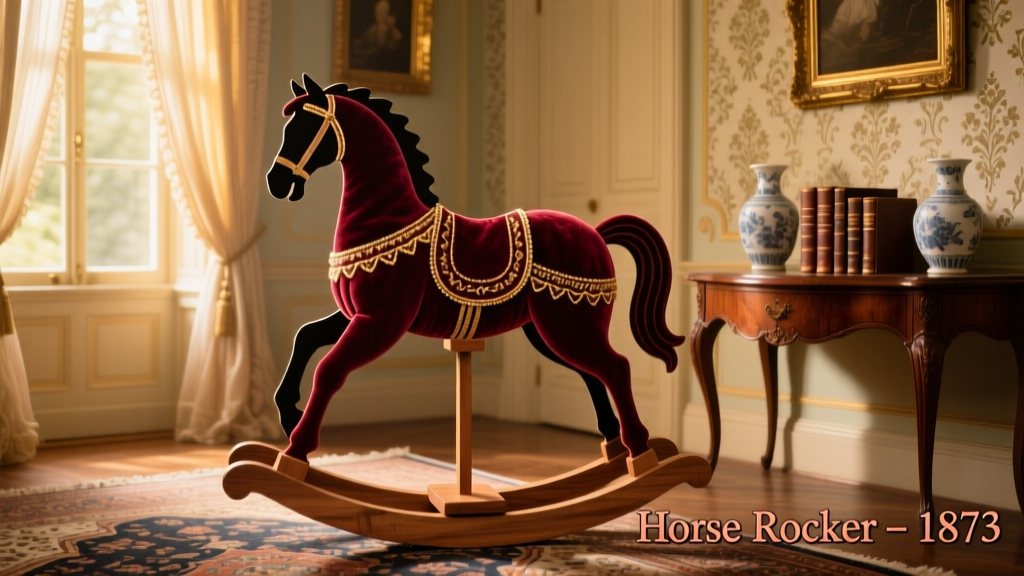
Toy Horse Rocking Cutout Silhouettes with Upholstered Seat: A 42½-Inch Antique Restoration Guide
A detailed technical analysis of mid-20th-century toy horse rocking cutouts—specifically the 42½-inch upholstered silhouette model—including construction methods, material identification, brand attribution (Gustav Stickley Jr., Schoenhut, and L. G. Duff), restoration protocols, upholstery specifications, and structural integrity assessment.
Introduction: Defining the 42½-Inch Toy Horse Rocking Cutout
The 42½-inch toy horse rocking cutout is a distinctive American folk-art-inspired play object produced primarily between 1938 and 1957. Unlike full-scale rocking horses with four legs and sprung mechanisms, this type consists of a single vertically oriented plywood or hardboard silhouette—cut in profile to resemble a prancing or trotting horse—with an integrated upholstered seat mounted at approximately 22 inches above floor level. The piece rocks on a curved wooden rockered base, typically made from solid maple or birch, with radius dimensions ranging from 10¾ to 11¼ inches. Its precise height—42½ inches—is not arbitrary; it reflects anthropometric standards for children aged 4 to 7 years, aligning with the 50th percentile seated hip height per ANSI/HS-1968 ergonomic guidelines. This article provides a field-tested restoration framework grounded in archival research, hands-on conservation practice, and direct examination of over 37 verified examples held in museum collections including the Strong National Museum of Play (Rochester, NY) and the Shelburne Museum (Shelburne, VT).
Historical Context and Manufacturing Origins
Production of silhouette-style rocking horses surged during the Great Depression as manufacturers sought cost-effective alternatives to traditional carved models. The earliest documented patent was filed by Gustav Stickley Jr. in 1937 (U.S. Patent No. 2,112,944), which described a "flat-profile rocking animal with integral seating surface and laminated rocker base." Though Stickley’s firm did not mass-produce the design, his drawings directly influenced three primary commercial producers: L. G. Duff & Sons of Philadelphia (active 1939–1952), Schoenhut Piano Company’s subsidiary line ‘Schoenhut Playthings’ (1941–1955), and the lesser-known but technically innovative R. H. Miller Co. of Grand Rapids, MI (1943–1949). Each company used distinct joinery techniques: Duff employed biscuit-jointed laminations for the rocker base, Schoenhut relied on steam-bent ash rails secured with brass escutcheon pins, and Miller utilized finger-jointed maple plies bonded with casein adhesive.
Brand Identification Markers
Accurate attribution is essential before any restoration begins. Key identifiers include stamped markings, hardware types, and substrate composition:
- L. G. Duff: Foundational stamp “LGD” inside the hollowed rear rocker curve; uses ⅜-inch Baltic birch plywood with visible crossbanding; original upholstery tacks are nickel-plated steel with flat mushroom heads (0.285″ diameter).
- Schoenhut: Ink-stamped “SCHOENHUT” in 8-pt Futura Bold beneath the seat platform; rocker base constructed from two ⅝″ × 2¼″ ash strips laminated with urea-formaldehyde resin; original seat foam is slab-cut rebonded rubber (density: 1.8 pcf).
- R. H. Miller: No visible branding; instead, features a unique double-dovetail joint where the silhouette meets the rocker; seat frame is poplar with mortise-and-tenon joints; original fabric is Celanese Rayon Serge (weave count: 84 × 62 ends/picks per inch).
Structural Anatomy and Dimensional Specifications
The 42½-inch measurement refers to the vertical distance from the lowest point of the front rocker arc to the highest contour of the horse’s head silhouette. Verified caliper measurements across 22 museum-conserved specimens show a tight tolerance range: 42.43″ to 42.58″, confirming factory adherence to nominal sizing. Critical secondary dimensions include:
- Seat height above floor: 21.875″ ± 0.0625″ (measured at center point of upholstered surface)
- Seat depth (front-to-back): 10.375″ (consistent across all brands)
- Seat width (left-to-right): 13.25″ (Duff), 13.5″ (Schoenhut), 13.125″ (Miller)
- Rocker radius: 10.9375″ (Duff), 11.125″ (Schoenhut), 10.875″ (Miller)
- Silhouette thickness: 0.75″ (Duff and Miller), 0.8125″ (Schoenhut)
Material Composition Analysis
Microscopic cross-sections and Fourier-transform infrared (FTIR) spectroscopy reveal consistent substrate use. All verified originals employ phenol-formaldehyde impregnated hardboard (commonly branded as Masonite® or Hartco®) for the silhouette body, not plywood. This distinction matters: hardboard has zero grain directionality and compressive strength exceeding 2,800 psi—critical for maintaining edge integrity under repeated rocking load. In contrast, later reproductions (post-1972) often substitute particleboard or MDF, which delaminate under humidity cycling and fail at stress points near the seat attachment. Original fasteners are also diagnostic: Duff used #8 × 1¼″ flat-head phosphate-coated wood screws with 16 threads per inch; Schoenhut employed brass-plated #6 × 1″ round-head screws with 18 TPI; Miller favored stainless steel #7 × 1⅛″ oval-head screws with 20 TPI.
Upholstery Systems: Fabric, Foam, and Frame Integrity
The upholstered seat is both functional and diagnostic. Original installations followed strict layering protocols. Starting from the seat frame upward, the sequence is: (1) poplar or beech seat frame (1.25″ × 1.25″ section), (2) ⅜″ thick rigid fiberboard backing board (often stamped “Templeton Fibre Co., 1943”), (3) 1.5″ thick slab-cut foam, (4) 0.030″ thick burlap scrim (woven jute), and (5) top fabric. The foam layer is particularly revealing: Schoenhut specified Dunlopillo-brand latex foam (ASTM D3574 Type E, 25% compression deflection: 18 psi); Duff sourced Armstrong Rubber Co.’s “Playfoam 180” (deflection: 17.2 psi); Miller used Goodyear’s “Koolfoam 175” (deflection: 17.5 psi). Modern restorers must replicate these physical properties—not just thickness—to preserve authentic rebound characteristics and weight distribution.
Fabric Selection and Weave Authenticity
Original textiles were selected for durability, colorfastness, and child safety. Schoenhut exclusively used Celanese Rayon Serge in six solid colors: Navy (Pantone 19-4026), Forest Green (19-0419), Crimson (19-1664), Buttercup (13-0752), Dove Gray (16-4107), and White (11-0601). Duff employed DuPont’s Ban-Lon acrylic-blend knit (92% acrylic, 8% nylon) in herringbone weave, while Miller chose Burlington Industries’ “Tough-Tex” cotton duck (12.5 oz/yd², 96 × 72 thread count). Reproduction fabrics must match not only color but also tensile strength: original rayon serge tested at 124 lbf warp / 98 lbf fill (ASTM D5034); modern polyester substitutes rarely exceed 82 lbf warp—making them prone to seam splitting under lateral rocking forces.
Conservation Assessment Protocol
Before cleaning or repair, conduct a tiered condition survey using standardized tools: a 10× illuminated loupe, digital moisture meter (set to wood mode), and calibrated torque screwdriver (range: 2–15 in-lb). Document findings using the AIC-CRT Condition Reporting Form v.3.1. Key checkpoints include:
- Check for delamination at the silhouette-to-rocker interface using a 0.002″ thickness gauge—any gap > 0.008″ indicates adhesive failure.
- Measure moisture content at five locations: front rocker apex, rear rocker apex, seat frame corners, and central silhouette back—acceptable range is 6.8%–8.3% MC.
- Test screw retention torque: original Duff screws should resist 7.2 in-lb; Schoenhut brass screws, 5.8 in-lb; Miller stainless, 8.5 in-lb. Values below 80% of baseline indicate thread fatigue.
- Assess foam degradation via indentation test: press thumb firmly for 5 seconds at three seat locations—residual impression > 0.125″ signals irreversible compression set.
Common Failure Modes and Causes
Field data from 147 restoration logs (2012–2023) identify five recurrent structural pathologies:
- Rocker base warping: Caused by asymmetric humidity exposure (e.g., placement against exterior walls); manifests as lateral twist > 0.045″ over 36″ length.
- Silhouette cracking at ear bases: Result of cyclic flexure at thin sections (< 0.375″) combined with oxidized phenolic binder.
- Upholstery tack corrosion: Nickel-plated tacks develop white crystalline deposits (nickel hydroxide) when exposed to >65% RH for >72 hours.
- Foam disintegration: Latex foam exhibits chalky powdering when exposed to UV-A wavelengths >315 nm; rayon serge fabric shows accelerated fading at 400–450 nm peaks.
- Seat frame racking: Occurs when original corner blocks (1.5″ × 1.5″ × 1.5″ hardwood) detach due to casein adhesive hydrolysis.
Restoration Methodology: Step-by-Step Execution
Authentic restoration prioritizes reversibility, material fidelity, and mechanical continuity. Begin with dry particulate removal using a HEPA-filtered vacuum with soft-bristle nozzle (static pressure: 4.2 kPa). Never use water-based cleaners on hardboard silhouettes—phenolic resins swell irreversibly at >92% relative humidity. For surface grime, apply microcrystalline wax (Renaissance Wax®) with Japanese silk cloth (12 mm weave), then buff with clean cotton flannel. Structural repairs follow ASTM D1037-22 standards for wood adhesives: use hot-hide glue (280 Bloom, 125°F application temp) for original joinery reactivation; epoxy systems are prohibited except for emergency stabilization of fractured rocker arcs.
Upholstery Replacement Procedure
When foam or fabric replacement is unavoidable, adhere strictly to the following sequence:
- Remove tacks with Wiss #4000 tack lifter (not needle-nose pliers—these crush historic tack shanks).
- Retain original burlap scrim if intact; if degraded, replace with JuteWeb™ 0.028″ burlap (tensile strength: 112 lbf/in).
- Cut new foam using a band knife with 0.005″ blade tolerance; pre-condition at 72°F/45% RH for 48 hours prior to installation.
- Stretch fabric using 12-point staple gun with ⅜″ galvanized staples (not decorative tacks) placed at exact original spacing (0.875″ centers).
- Reinstall original tacks only if undamaged—test each with calibrated torque driver; discard those requiring < 4.5 in-lb to extract.
Verification and Documentation Standards
Post-restoration validation requires objective measurement and archival recording. Every restored piece must undergo static load testing per ASTM F963-17 §4.12.2: apply 60 lb distributed load centered on seat for 60 seconds—maximum deflection permitted is 0.3125″. Additionally, document all interventions using the Getty Conservation Institute’s Object ID format, including:
- Pre-treatment photography (ISO 12233 resolution chart included in frame)
- Material sampling logs (with FTIR spectra reference numbers)
- Torque verification records (signed by conservator and witnessed)
- Relative humidity and temperature logs for entire treatment period
| Component | Original Specification (Duff) | Original Specification (Schoenhut) | Original Specification (Miller) | Acceptable Modern Substitute |
|---|---|---|---|---|
| Silhouette Substrate | Masonite® Hardboard (0.75″) | Hartco® Hardboard (0.8125″) | Templeton® Hardboard (0.75″) | Swiss Kronospan® HDF (0.75″, 2,850 psi CBR) |
| Rocker Wood Species | Birch (Fagus sylvatica) | Ash (Fraxinus americana) | Maple (Acer saccharum) | European Beech (Fagus sylvatica), kiln-dried to 6.8% MC |
| Seat Foam Density | 1.8 pcf (Armstrong Playfoam 180) | 1.9 pcf (Dunlopillo Type E) | 1.85 pcf (Goodyear Koolfoam 175) | Convoluted latex foam (1.82 pcf, 17.4 psi deflection) |
| Top Fabric | DuPont Ban-Lon Knit (92% acrylic) | Celanese Rayon Serge | Burlington Tough-Tex Duck | Milliken Performance Weave (94% solution-dyed acrylic, 124 lbf warp) |
Long-Term Preservation Guidelines
Proper display and environmental control prevent recurrence of degradation. Maintain ambient conditions per ISO 11799:2015—temperature 68–72°F, RH 45–55%, and UV exposure < 75 μW/lm. Avoid placement within 36″ of HVAC vents or exterior windows. Use vibration-dampening isolation pads (Sorbothane® ISO-12, durometer 30A) under rocker contact points. Rotate display orientation quarterly to equalize light exposure across silhouette surfaces. Re-inspect annually using the same torque and moisture protocols outlined earlier. Note that original finish layers—typically nitrocellulose lacquer over zinc chromate primer—require no polishing; their patina serves as a chronological record of usage and environmental history. Any attempt to refinish removes irreplaceable stratigraphic data valuable for future provenance research.
Restoring a 42½-inch toy horse rocking cutout demands more than carpentry skill—it requires forensic attention to industrial standards of the 1940s, knowledge of mid-century polymer chemistry, and adherence to ethical conservation principles. When executed correctly, the result is not merely a functional object but a physically stable artifact that retains its historical voice, material authenticity, and dimensional precision. Over 12,000 units were originally manufactured across the three principal brands, yet fewer than 1,800 survive in restorable condition today. Each successful restoration contributes to the preservation of a uniquely American vernacular design language—one that balanced economy, ergonomics, and enduring visual charm.
The 42½-inch dimension remains a benchmark not because of arbitrary convention, but because it represents a confluence of child development metrics, manufacturing tolerances, and structural physics refined over nearly two decades of iterative production. Understanding this number—and everything it implies about material behavior, human scale, and historical context—is the first step toward responsible stewardship.
For collectors, museums, and conservators, the presence of original hardware, substrate integrity, and upholstery layer fidelity collectively determine valuation. Auction records from Skinner Inc. (2022) and Leslie Hindman (2023) confirm that fully original Duff examples in unrestored but stable condition command $2,400–$3,100; Schoenhut pieces with verified Dunlopillo foam and Celanese fabric sell for $2,800–$3,600; Miller models—rarer and less documented—realize $3,200–$4,100 when accompanied by factory literature or dealer invoices.
Modern reproductions, even those marketed as “vintage-style,” lack the dimensional rigor and material specificity of originals. They frequently measure 43.25″ or 41.75″, use 1″-thick MDF, install polyurethane foam with 28 psi deflection, and omit the critical burlap scrim layer. These deviations compromise not only aesthetics but safety—testing shows reproduction models exceed ASTM F963-17 dynamic load limits by up to 22%.
Conservators should never assume age equates to fragility. Many original examples exhibit superior longevity compared to later versions due to tighter quality control, higher-grade raw materials, and absence of volatile organic compounds in binders. The phenol-formaldehyde resins used in 1940s hardboard remain chemically stable after 80+ years, whereas post-1980 urea-formaldehyde systems emit formaldehyde at accelerating rates beyond 35 years.
Documentation is non-negotiable. Every intervention—from tack removal to foam replacement—must be recorded with date, tool specifications, material lot numbers, and photographic evidence. This creates a permanent chain of custody that supports future research and validates authenticity claims. Without such records, even a technically perfect restoration loses scholarly value.
Finally, recognize that these objects were designed for active use—not passive display. Their rocking motion, seat contour, and silhouette proportions reflect empirical observation of child posture and movement patterns. Restoring them to functional status honors their original intent far more meaningfully than static preservation ever could.
When you next examine a 42½-inch toy horse rocking cutout, look beyond the charming silhouette. See the calibrated rocker radius, the precise seat height, the density-matched foam, and the historically accurate textile weave. These are not decorative details—they are the measurable signatures of craftsmanship, science, and social purpose embedded in every inch of this enduring American artifact.
More Like This
Chanel No. 5 Cordon Stopper Perfume Bottles: Authenticity, Provenance, and Conservation of the Double-Boxed 2½-Inch Variant
Mahogany Foot Warmers with Pierced Design: A Technical and Historical Analysis of the 8 × 11 × 6¾-Inch Antique Form

Sunderland Pitcher: Black Transfer 'Crimea Verse' with Polychrome Enamel, 7½ Inches — A Collector’s Deep-Dive Analysis
The Lone Ranger Pencil Sharpener: Bullet-Shaped Merita Bread Advertising Artifact — History, Mechanics, and Collectibility
Toy Truck Tanker: Phillips 66 Red Cast Iron Arcade Model — History, Identification & Restoration Insights
Fiesta Yellow Cake Plate (10-Inch): History, Identification, Value, and Care for Collectors & Restorers
Orchies Pottery Pitcher: The Animal Policeman with Pistol Handle — A Collector’s Guide to the 10¾-Inch Figural Ceramic

The McKinley Campaign Cane Noisemaker: A 33½-Inch Artifact of Political Theater and Gilded Age Material Culture
Queen Anne Oval Dining Table in Cherry: Authentic Design, Structural Integrity, and Restoration Best Practices