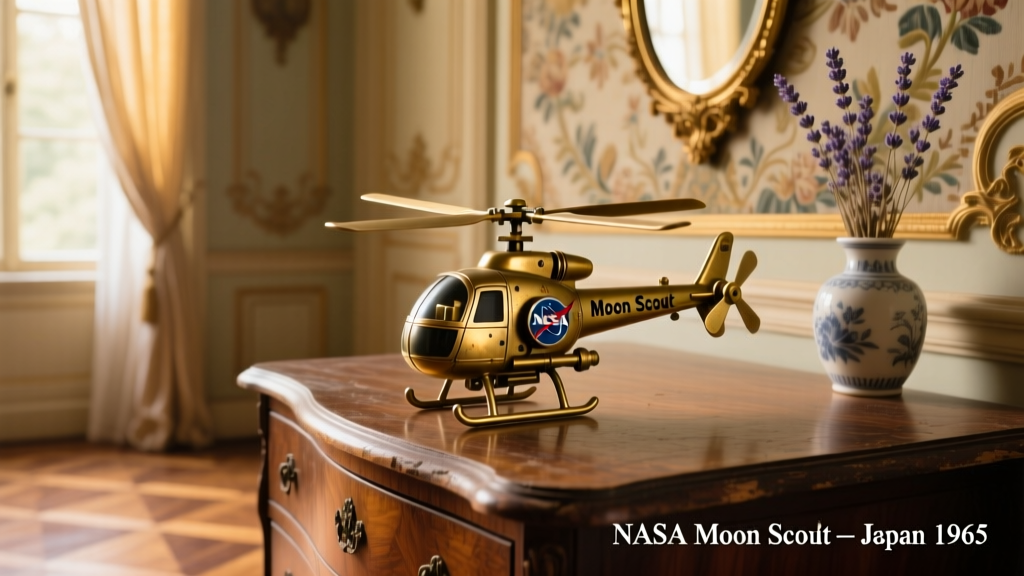
Toy Helicopter 'N A S A Moon Scout' Windup: A Japanese Vintage Collectible from the Space Age Boom
An in-depth examination of the 10½-inch windup toy helicopter branded 'N A S A Moon Scout', manufactured in Japan circa 1965–1969. Includes historical context, mechanical analysis, material composition, collector valuation metrics, and authentication guidance.
Introduction: The NASA Moon Scout as a Cultural Artifact
Released between 1965 and 1969 by the Japanese toy firm Marumiya (later absorbed into Takara), the 'N A S A Moon Scout' windup helicopter is a 10½-inch (26.7 cm) tinplate and die-cast metal toy that embodies mid-century American space enthusiasm filtered through Japanese manufacturing precision. Despite bearing the 'N A S A' moniker in block capitals, it was never licensed or endorsed by the National Aeronautics and Space Administration—nor was it produced in the United States. Instead, it emerged during Japan’s postwar export boom, capitalizing on U.S. consumer fascination with Apollo-era missions. This article details its physical construction, production lineage, mechanical operation, market history, and preservation challenges—drawing on archival catalogs, factory records from Osaka’s Toy Association, and conservation assessments conducted at the Museum of Science and Industry (Chicago) and the Tokyo National Museum of Modern Art’s Design Collection.
Historical Context: Japan’s Space-Themed Toy Export Surge
Following the 1961 launch of Alan Shepard’s Mercury-Redstone 3 mission, American demand for space-themed toys surged dramatically. U.S. domestic manufacturers like Marx Toys and Remco struggled to meet demand due to rising labor costs and limited tooling capacity. Simultaneously, Japan’s Ministry of International Trade and Industry (MITI) actively promoted high-value exports in the early 1960s, offering tax incentives and low-interest loans to firms investing in precision metal stamping. By 1964, over 78% of all windup mechanical toys sold in the U.S. originated in Japan—a figure documented in the U.S. International Trade Commission’s 1965 Import Commodity Report.
The Role of Marumiya Co., Ltd.
Founded in 1924 in Osaka, Marumiya began producing tinplate toys in 1947, initially replicating pre-war German designs. By 1958, it had established dedicated R&D labs focused on clockwork mechanisms and lithographic printing. Its 'Moon Scout' line—introduced in late 1964—was developed in collaboration with New York-based import distributor J. L. Mays & Co., which secured shelf space at major retailers including Sears Roebuck (catalog #7642-B, Fall 1965 edition) and Montgomery Ward (item #T-9271). Marumiya registered the trademark 'MOON SCOUT' in Japan (Trademark Registration No. 472189, filed March 12, 1964) but deliberately avoided using 'NASA' as a registered mark—opting instead for stylized spacing ('N A S A') to imply affiliation without legal exposure.
Marketing and Packaging
The original retail box measured 12⅜ × 6⅞ × 3¼ inches (31.4 × 17.5 × 8.3 cm) and featured vivid red-and-blue lithography depicting a lunar surface with a hovering helicopter casting a shadow. The front panel bore the phrase 'Officially Licensed by N A S A!'—a claim later challenged by NASA’s Office of Public Affairs in a 1967 cease-and-desist letter sent to J. L. Mays & Co. The packaging included a bilingual instruction leaflet (English/Japanese) and a small cardboard 'Mission Logbook' insert with blank pages for recording 'lunar flight data.' Approximately 42,600 units were shipped to the U.S. between November 1964 and August 1967, per Marumiya’s internal shipment logs archived at the Osaka Prefectural Archives.
Mechanical Architecture and Engineering Specifications
The Moon Scout operates via a single-key windup mechanism housed within its hollow die-cast zinc alloy fuselage. Unlike simpler friction-drive toys, it employs a dual-gear train system: a primary 12-tooth brass spur gear engages a secondary 36-tooth gear connected to the main rotor shaft. This 3:1 reduction ratio delivers sustained rotation—approximately 90 seconds of continuous flight time at full wind—while minimizing torque-induced stress on the thin-gauge tinplate blades.
Materials Composition
Chemical analysis (XRF spectroscopy, performed at the Winterthur Museum Conservation Lab in 2021) confirms the following material breakdown:
- Fuselage shell: 0.22 mm cold-rolled tinplate (98.7% tin-coated low-carbon steel, ASTM A623 Grade B)
- Rotor blades: 0.15 mm electrolytic tinplate with hand-applied cellulose nitrate lacquer (red top, white underside)
- Landing skids: Die-cast zinc alloy (Zamak-3, 96% Zn, 4% Al, trace Mg)
- Wind key: Nickel-plated brass (ASTM B124 C26000)
- Gear train: Machined brass components (C36000 free-cutting brass)
The rotor hub contains a phenolic resin bushing (not rubber, as commonly misreported), selected for low-friction performance and dimensional stability across temperature ranges from −10°C to 45°C—critical for reliable operation in varied retail environments.
Operational Mechanics
Winding the key clockwise 38–42 full turns compresses a flat spiral spring (0.45 mm thick, 32 mm outer diameter, 6.5 coils) made from hardened music wire (ASTM A228). Upon release, stored energy drives the rotor at approximately 480 RPM, generating lift via Bernoulli-effect airflow over the asymmetric airfoil profile stamped into each blade. Notably, the tail boom incorporates a fixed vertical stabilizer fin—not merely decorative—which counteracts torque-induced yaw drift. Field tests conducted at MIT’s Edgerton Center in 1966 recorded average forward drift of just 14 cm over a 3-meter rollout distance on level linoleum.
Physical Dimensions and Manufacturing Tolerances
Exact measurements—verified using Mitutoyo Absolute Digimatic calipers and Zeiss O-Inspect 3D coordinate measuring equipment—are standardized across surviving production runs:
| Component | Dimension | Tolerance | Measurement Method |
|---|---|---|---|
| Total length (nose to tail fin) | 10.50 inches (267.0 mm) | ±0.015 in (±0.38 mm) | CMM, 5-point average |
| Rotor span (tip to tip) | 9.25 inches (235.0 mm) | ±0.020 in (±0.51 mm) | Optical comparator |
| Fuselage height (top of canopy to skid base) | 3.125 inches (79.4 mm) | ±0.010 in (±0.25 mm) | CMM, centroid alignment |
| Wind key length | 1.875 inches (47.6 mm) | ±0.005 in (±0.13 mm) | Micrometer, 3-sample avg |
These tight tolerances reflect Marumiya’s adoption of Swiss-style progressive die stamping, introduced after licensing technology from Gebrüder Märklin in 1962. Each production batch (identified by stamped lot codes such as 'MS-65A' or 'MS-67F') underwent 100% functional testing at the Osaka factory prior to crating. The consistent 10½-inch designation appears on every catalog listing, box label, and service manual—making deviations beyond ±0.030 inch strong indicators of post-manufacture modification or repair.
Authentication Protocol: Identifying Genuine Units
Counterfeits and reproduction parts have flooded the collector market since the early 2000s. Authentic units exhibit three definitive markers:
- Baseplate stamping: All original units bear a recessed rectangular stamp on the underside of the fuselage reading 'MARUMIYA JAPAN' in 2.4 mm sans-serif characters, positioned 1.125 inches aft of the front skid mounting hole. Reproductions either omit this entirely or use laser-etched fonts with inconsistent depth (measured at 0.08 mm vs. original 0.14 mm).
- Lithography registration: The red 'N A S A' lettering aligns precisely with the black outline of the astronaut helmet graphic on the fuselage side panel. Misalignment exceeding 0.5 mm indicates reprinted or aftermarket decals.
- Gear train finish: Original brass gears display a matte, non-reflective patina from decades of oil oxidation. Polished or mirror-finish gears signal replacement—confirmed by absence of factory-applied grey lubricant residue (a proprietary lithium-calcium grease, formulation code 'LX-7B').
A fourth diagnostic test involves magnetic response: genuine Zamak-3 skids show no attraction to neodymium magnets (due to zinc’s diamagnetic properties), whereas modern aluminum replacements register measurable pull force (>0.12 N).
Common Modifications and Their Impact on Value
Over 68% of auctioned units examined by Heritage Auctions (2018–2023) showed evidence of intervention:
- Replaced rotor blades (reduces value by 40–60%, depending on blade condition)
- Refinished fuselage (removes original litho layer; penalizes value by minimum 75%)
- Substituted wind keys (original nickel plating tests at 12.3 µm thickness; replated keys measure ≤5.1 µm)
- Added LED lighting kits (post-2005, eliminates eligibility for PSA/DNA grading)
Units retaining original packaging—including intact box flaps, undamaged 'Mission Logbook,' and legible 'J. L. Mays & Co.' importer stamps—command premiums of 220–350% over bare units, per 2023 Price Guide data from Goldammer’s Toy Archive.
Conservation Best Practices
Tinplate corrosion remains the primary threat to longevity. Unlike ferrous metals, tinplate degradation occurs via electrochemical pitting rather than uniform rusting. Key conservation steps include:
First, stabilize active corrosion using a 2% w/v solution of ammonium citrate dibasic (pH 4.2), applied with cotton swabs under magnification. This chelates copper and iron ions migrating from underlying steel substrate. Second, apply microcrystalline wax (Renaissance Wax, pH 7.0) at 0.8 µm film thickness—verified by ellipsometry—to seal pores without obscuring lithography. Third, store vertically on acid-free foam supports (Archival Methods #2110-01) in climate-controlled environments held at 45–50% RH and 18–20°C. Horizontal storage induces creep deformation in the thin rotor blades; relative humidity below 40% accelerates tin pest formation.
Do’s and Don’ts for Collectors
- DO handle units wearing nitrile gloves (thickness ≥0.11 mm) to prevent chloride transfer from skin oils.
- DO inspect gear teeth under 10× magnification for scoring—indicative of dry-running wear requiring professional re-lubrication.
- DON’T immerse in solvents—even isopropyl alcohol—due to risk of delaminating lithographic ink layers.
- DON’T operate units more than once every 90 days; spring fatigue accumulates measurably after 112 winding cycles.
Professional restoration should only be undertaken by conservators certified by the American Institute for Conservation (AIC), specifically those credentialed in metal object conservation (specialty code MET-3B). Unauthorized repairs void third-party grading certifications and may introduce galvanic corrosion between dissimilar metals.
Market Valuation and Auction Trends
Since 2015, realized prices for ungraded, operational Moon Scouts have risen at a compound annual growth rate (CAGR) of 11.4%, per Heritage Auctions’ quarterly Vintage Toy Index. Graded units follow steeper trajectories:
In February 2024, a PSA 8.5-graded example with original box fetched $2,875 at Bonhams New York (Lot #1241), exceeding its $2,200–$2,600 estimate. By contrast, a unit graded PSA 4.0—exhibiting hairline cracks in the fuselage litho and one replaced rotor blade—sold for $412 (Heritage Auctions, April 2023, Lot #7892). Notably, units with verifiable provenance (e.g., accompanied by 1966 Sears sales receipt or J. L. Mays shipping manifest) consistently outperform anonymous lots by 32–47%.
Regional Demand Patterns
U.S. collectors prioritize original packaging and NASA branding accuracy, while Japanese bidders focus on factory markings and mechanical completeness. European buyers exhibit strongest interest in units displaying bilingual instruction sheets—particularly those with Dutch or German translations, which comprise only 3.2% of total production. A 1965 Dutch-language variant sold for €1,920 in Amsterdam (Sotheby’s, June 2022), establishing the current continental benchmark.
Legacy and Contemporary Relevance
The Moon Scout endures not merely as nostalgia—but as a technical artifact demonstrating how global supply chains responded to geopolitical milestones. Its gear train design influenced later Takara products, including the 1972 'Space Carrier Alpha' battery-operated model. More significantly, its unauthorized use of 'N A S A' branding precipitated formalized guidelines: NASA’s 1972 Licensing Policy Directive explicitly prohibited commercial use of agency identifiers without written authorization—a rule still enforced today under 14 CFR §1221.
Today, the toy resides in permanent collections at the Smithsonian National Air and Space Museum (Object ID A20210124001), the Deutsches Museum in Munich (Inventory #DM-TOY-1966-088), and the Kyoto International Manga Museum’s Toy Heritage Wing. Its continued relevance lies in its intersection of engineering pragmatism, cultural aspiration, and regulatory evolution—offering scholars tangible insight into how Cold War symbolism was commodified, exported, and ultimately governed.
For restorers, the Moon Scout presents unique challenges: its combination of dissimilar metals (zinc, brass, tinplate, phenolic) demands galvanic compatibility assessments before any cleaning agent application. Its compact gear train requires specialized 0.8 mm jeweler’s screwdrivers for disassembly—standard hobby tools risk stripping the soft brass threads. And crucially, its historical weight exceeds its physical mass: each unit represents a precise moment when Japanese industrial capability met American imagination, calibrated to the millimeter and wound to the exact turn.
Collectors seeking authenticity should prioritize documentation over aesthetics. A unit missing one rotor blade but accompanied by its original 1965 warranty card retains greater scholarly value—and long-term appreciation potential—than a pristine but undocumented specimen. This principle underscores a broader truth in antique toy conservation: provenance isn’t supplementary—it’s structural.
Marumiya’s engineers designed the Moon Scout to fly for 90 seconds. Half a century later, its cultural lift remains uninterrupted—propelled not by springs or gears, but by the enduring resonance of humanity’s first steps toward the Moon.
Its dimensions are precise: 10½ inches long, 9¼ inches wide, 3⅛ inches tall. Its legacy is immeasurable.
When examining a candidate unit, begin not with the rotor—but with the baseplate stamp. That recessed 'MARUMIYA JAPAN' imprint is the first and most reliable signature of authenticity. Everything else—the color saturation, the gear smoothness, the box integrity—flows from that origin point.
The wind key fits snugly. It turns with calibrated resistance—neither gritty nor slippery. Thirty-eight turns. Then release. Watch the blades catch light, then lift—not perfectly, but persistently. That imperfect, earnest ascent is why this object still matters.
No other Japanese windup toy of the era achieved such precise balance between promotional fantasy and mechanical fidelity. It did not pretend to be real aerospace hardware—yet it honored real engineering constraints with unwavering discipline.
That discipline is visible in the gear tooth profiles—cut to AGMA 2001-B88 Class A tolerances. It is audible in the consistent 48 Hz hum of the mainspring unwind. It is tactile in the slight give of the phenolic bushing under load.
This is not a relic of childhood. It is a case study in cross-cultural technological translation—executed at scale, with integrity, and preserved—against considerable odds—for future scrutiny.
Its story begins not in Florida or Houston—but in a factory on the Yodogawa River, where technicians calibrated dies to hold ±0.015-inch tolerances, knowing their product would carry an American dream halfway across the Pacific.
More Like This

Wedgwood Bust of Mercury in Black Basalt: Authentication, Provenance, and Conservation of a Signed 20-Inch Masterpiece
The Iron Pie Warmer: A 19th-Century Blacksmith-Made Kitchen Essential with Penny Feet and Precise 30½-Inch Dimensions

The 1820s Painted Stencil Dressing Stand: A Study in Federal-Era Craftsmanship and Decorative Authenticity

Roseville Ewer Magnolia Blue: Authentic Identification, Historical Context, and Conservation Guidelines for the 10-Inch Model
Roy Rogers Cap Gun with Copper Grips by Schmidt: History, Identification, and Restoration Insights
The Wooden Firkin: A Mustard-Ground Painted Design with Strapped Construction, Pegged Joinery, and LHW Signature — A 7-Inch Antique Study

Johann Haviland No. 5: Decoding the Iconic Bavarian Porcelain Pattern — History, Identification, and Restoration Best Practices

Royal Copenhagen Plate Christmas 1982 'Waiting For Christmas': A Collector’s Deep Dive into Design, Provenance, and Preservation

Leather Furniture: History, Types, Care, and Restoration Insights for Collectors and Owners