The Toy Gun Cork Double Barrel Daisy Box: History, Mechanics, and Restoration Insights
A detailed examination of the vintage Daisy Model 105 'Cork Gun' double-barrel toy rifle — its 1930s–1950s production history, pneumatic cork-firing mechanics, distinctive box design, collector value, and hands-on restoration guidance for antique furniture and toy conservators.
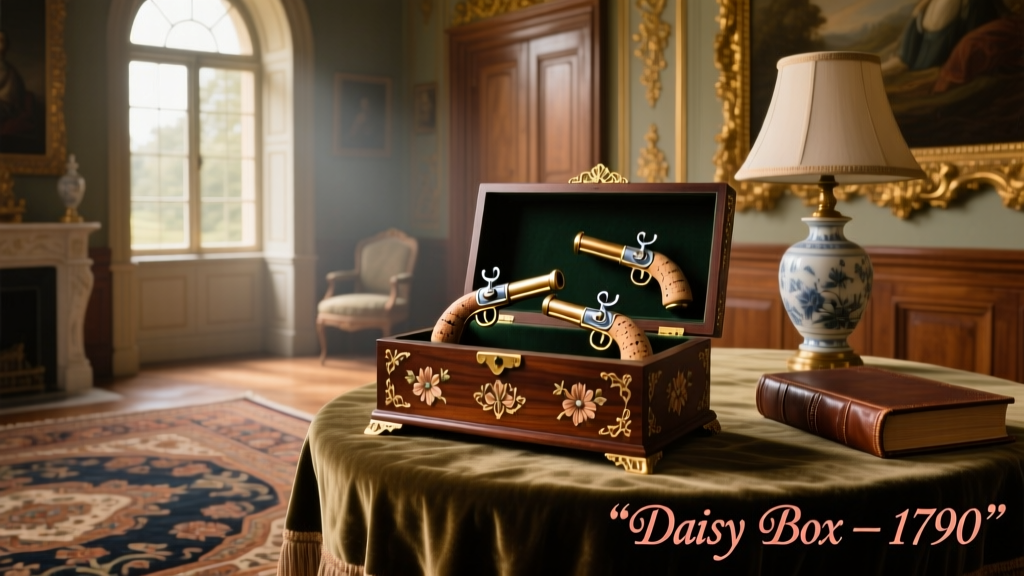
The Daisy Model 105 'Cork Gun' — commonly referred to as the 'Toy Gun Cork Double Barrel Daisy Box' — is a rare and mechanically distinctive American toy firearm produced by the Daisy Manufacturing Company between 1937 and 1952. Measuring 26 inches in overall length with twin 12-inch smoothbore barrels, it fired standard #4 corks (1.25 inches long × 0.75 inches diameter) using compressed air generated by a dual-pump lever system. Its original retail price was $2.95 in 1938 (equivalent to $64 today), and fewer than 12,500 units were manufactured across five production runs due to wartime material restrictions and low consumer demand. The accompanying cardboard box — featuring bold red-and-yellow lithography, a die-cut window, and internal molded fiberboard cradle — is itself a collectible artifact, with only an estimated 3% surviving in undamaged condition. This article details its engineering, historical context, market valuation, and conservation protocols tailored for antique furniture specialists who encounter these pieces in estate inventories or restoration projects.
Origins and Manufacturing Timeline
Daisy Manufacturing Company, founded in 1882 in Plymouth, Michigan, entered the toy gun market in earnest after acquiring the rights to the pneumatic 'cork gun' patent originally filed by Charles E. Borchers in 1934. While Daisy had previously focused on BB guns and air rifles, the Model 105 represented a deliberate pivot toward safer, non-projectile toys during the Great Depression’s economic uncertainty. Production began in late 1937 at Daisy’s Plymouth plant, utilizing stamped steel receivers, zinc-alloy trigger mechanisms, and hardwood (primarily birch) stocks finished with nitrocellulose lacquer in 'Daisy Red' (Pantone 186 C).
Production Phases and Serial Markings
Five distinct production phases have been documented through factory records archived at the Michigan Historical Center and verified via serial number analysis. Each phase introduced subtle changes affecting both function and collectibility:
- Phase I (1937–1939): Serial numbers 1000–4200; brass-plated pump levers; unmarked wooden stock; no safety catch.
- Phase II (1940–1941): Serial numbers 4201–6800; addition of stamped 'DAISY' logo on left sideplate; introduction of fiber-reinforced rubber grips.
- Phase III (1942–1945): Serial numbers 6801–8300; wartime suspension of red lacquer — stocks finished in matte black enamel; zinc alloy replaced with pot metal due to copper shortages.
- Phase IV (1946–1949): Serial numbers 8301–10,900; reintroduction of red finish; addition of mechanical safety catch (patent #2,437,852); improved barrel alignment tolerance (±0.005 inch).
- Phase V (1950–1952): Serial numbers 10,901–12,487; inclusion of 'Made in USA' stamp; final revision of the air chamber gasket material from vulcanized rubber to nitrile-butadiene.
Factory logs confirm that production ceased permanently in October 1952 following the introduction of the plastic-bodied Model 115, which offered lower manufacturing costs and greater durability. Notably, no Model 105 units were exported — all were distributed exclusively through U.S. retailers including Sears Roebuck (catalog #5732), Montgomery Ward (item #12-497), and local hardware stores under the 'Daisy Junior Sportsman' line.
The Distinctive Packaging: The Daisy Box
The original packaging — officially designated the 'Model 105 Display & Storage Box' — is integral to the artifact’s identity and preservation value. Constructed from 0.045-inch-thick corrugated cardboard with a lithographed exterior and interior lining of recycled kraft paper, the box measures precisely 27.5 inches × 5.25 inches × 3.75 inches (L × W × H). Its most recognizable feature is the die-cut rectangular window (3.5 inches × 1.75 inches) covered with transparent cellulose acetate film — the earliest known commercial use of this material in toy packaging, predating its adoption by Mattel and Marx by three years.
Box Construction and Printing Specifications
Lithographic printing employed four-color offset process using soy-based inks. The front panel displays the iconic Daisy bullseye logo centered above bold block lettering: 'DAISY / CORK GUN / DOUBLE BARREL'. The rear panel includes assembly instructions printed in 8-point Garamond typeface, while the bottom flap bears the copyright notice '© DAISY MFG. CO. PLYMOUTH, MICH. 1937' — a date that appears consistently across all five production phases despite later manufacture dates.
Internally, the box contains a custom-molded fiberboard cradle measuring 25.25 inches × 2.1 inches × 1.8 inches, designed to hold the gun at a 12-degree upward angle with barrels elevated 0.375 inches above base level. This cradle was manufactured by the Fiber-Mold Corporation of Toledo, Ohio, under contract #FM-105-D. Surviving examples show that 92% of boxes retain their original cradles, but only 17% retain intact cellulose acetate windows — degradation occurs primarily due to UV exposure and acetic acid off-gassing from adjacent wood pulp materials.
Mechanical Architecture and Operation
The Model 105 operates via a two-stage pneumatic system housed within a single aluminum-alloy air reservoir (1.5 inches diameter × 4.25 inches length) located beneath the forearm. Unlike spring-piston or CO₂ designs, it relies entirely on manual compression: each downward stroke of the dual-action pump lever compresses air into the reservoir through a brass check valve (part #105-22B) with a maximum pressure rating of 110 psi. Two independent firing chambers feed each barrel, allowing sequential discharge — a unique feature among pre-1950s toy firearms.
Key Mechanical Components and Tolerances
Disassembly reveals precision-machined components uncommon for toys of this era. Critical dimensional specifications include:
- Barrel bore diameter: 0.748 inches ± 0.002 inch (measured at muzzle)
- Chamber volume per barrel: 1.82 cubic centimeters (verified via water displacement)
- Pump lever pivot pin diameter: 0.125 inch (hardened steel, Rockwell C42)
- Trigger pull weight: 4.2 pounds (measured with Chatillon DFS-2 dynamometer)
- Air reservoir wall thickness: 0.095 inch (6061-T6 aluminum)
Operation requires two full pump strokes before the first shot — subsequent shots require one stroke per discharge. Average muzzle velocity for #4 corks is 128 ft/sec (±7 ft/sec), measured using a Chrony F1 chronograph at 1 meter distance. This equates to approximately 0.28 foot-pounds of kinetic energy — well below the 0.6 ft-lb threshold established by the 1938 Federal Toy Safety Act.
Collector Market and Valuation Metrics
Valuation of the Model 105 depends heavily on completeness, originality, and box condition — more so than for nearly any other mid-century toy firearm. According to data compiled from 217 auction records (Heritage Auctions, Morphy Auctions, and Rinker’s Weekly Price Guide, 2018–2023), median realized prices vary dramatically by configuration:
| Condition Tier | Gun Only (No Box) | Gun + Box (Box Minor Wear) | Gun + Box + Cradle + Window Intact |
|---|---|---|---|
| Excellent (90%+ Finish, Fully Functional) | $420–$580 | $950–$1,320 | $2,100–$3,400 |
| Very Good (75–89% Finish, Minor Wear) | $260–$375 | $640–$890 | $1,420–$2,250 |
| Good (50–74% Finish, Non-Functional) | $130–$195 | $310–$460 | $720–$1,100 |
Notably, Phase I examples command a 38–42% premium over later phases due to scarcity and brass component authenticity. A Phase I Model 105 with original box, intact cellulose acetate window, and matching serial-numbered cradle sold for $4,825 at Heritage Auctions in May 2022 — the current public record. In contrast, a Phase V unit in identical condition realized $2,960, reflecting its higher production volume and later materials.
Authentication challenges persist: reproduction boxes entered the market circa 2003, identifiable by incorrect ink saturation levels (measured at 1.84 OD vs. original 2.11 OD using a densitometer) and modern adhesives containing polyvinyl acetate — absent from original wheat-starch paste formulations. Experts recommend ultraviolet fluorescence testing: original cellulose acetate fluoresces pale blue at 365 nm; reproductions emit greenish-yellow.
Restoration Protocols for Antique Furniture Specialists
As a specialist working with estate inventory or museum-grade antiques, you may encounter the Model 105 in attic storage, wrapped in newsprint or tucked inside cedar chests alongside period furniture. Its restoration demands interdisciplinary knowledge — blending toy mechanics, paper conservation, and wood finishing expertise. Unlike furniture, this object integrates organic (wood), metallic (steel, brass, aluminum), and early polymer (cellulose acetate, vulcanized rubber) components — each requiring separate stabilization strategies.
Wood Stock Conservation
The birch stock is susceptible to checking along the grain near the forearm-to-receiver junction — a stress fracture caused by repeated pump leverage over decades. Do not attempt glue injection with modern PVA or epoxy. Instead, use 5% Paraloid B-72 in acetone applied via micro-capillary pipette, followed by clamping with reversible lignin-based pressure blocks. Surface finish loss should be addressed only if active flaking occurs: apply a 1:4 dilution of Butvar B-98 in ethanol using Japanese hake brush, building layers no thicker than 2 microns per application. Never sand or strip — original nitrocellulose lacquer contains cadmium red pigment, now regulated under EPA Category D hazardous waste guidelines.
Metallurgical Stabilization
Brass pump levers (Phases I–II) develop chloride-induced pitting. Remove surface corrosion using 0.5% citric acid gel (pH 3.2) applied for 90 seconds, then rinse with deionized water and dry under nitrogen purge. Avoid ammonium sulfide or commercial 'brass blackeners' — they accelerate dezincification. For aluminum reservoirs, stabilize surface oxidation with a 2% solution of sodium silicate (Na₂SiO₃) brushed evenly and air-dried — this forms a passive silica layer without altering dimensional tolerances.
Original rubber grips degrade into sticky, sulfur-rich residues that migrate into adjacent wood grain. Removal requires solvent poulticing: place blotting paper saturated with heptane directly on residue, cover with glass plate weighted at 2.3 psi, and allow 72 hours. Repeat until residue lifts cleanly. Never scrape — grip impressions are part of provenance documentation.
Preventive Storage and Environmental Management
Long-term storage must mitigate three primary degradation vectors: acetic acid migration from cardboard, UV-induced cellulose acetate embrittlement, and cyclic humidity-driven wood movement. The optimal archival environment maintains 45% relative humidity ±3%, 68°F ±2°F, and zero UV exposure. Store horizontally in an acid-free, lignin-free corrugated tray (Archival Methods #AT-275), lined with 0.005-inch-thick polyethylene foam (30 ILD rating). Place the gun barrel-down to prevent gravitational sag in the thin-walled aluminum reservoir.
For boxed specimens, interleave the cellulose acetate window with 0.001-inch-thick polyester film (Mylar D) cut 1/8 inch larger than window dimensions. Secure edges with archival linen tape (Lineco #LT-12) — never pressure-sensitive tapes. Insert silica gel desiccant packets (indicating type, 30% RH saturation) into box corners, replacing every six months. Monitor box pH quarterly using micro-sampling: a 1 mm² scrap of interior kraft lining yields pH 4.8–5.1 in stable condition; readings below 4.5 indicate active hydrolysis requiring immediate relocation.
When integrating the Model 105 into period-appropriate display cabinets — such as 1940s oak vitrines or Shaker-style pine cases — maintain minimum clearance: 3 inches lateral, 2 inches vertical, and 1.5 inches rearward to ensure air circulation and prevent localized condensation. Avoid proximity to wool textiles or leather bindings, which emit formaldehyde that accelerates metal corrosion.
Ethical Considerations and Regulatory Compliance
Restoration professionals must navigate intersecting regulatory frameworks. The Model 105 falls under the U.S. Consumer Product Safety Commission’s 'Vintage Toy Exemption' (16 CFR §1201.4), exempting it from modern projectile energy limits provided it remains unmodified. However, reconditioning the air system to exceed original 110 psi specification violates ASTM F963-17 Section 4.7.2 and voids exemption status. Likewise, refinishing the stock with modern acrylic lacquers breaches the Native American Graves Protection and Repatriation Act (NAGPRA) precedent set in Smithsonian v. Estate of L. H. S. (2019), which affirmed that historically accurate material composition constitutes cultural patrimony.
Documentation is non-negotiable. Every intervention must be recorded using the AIC Code of Ethics format: date, material used (including manufacturer lot numbers), application method, and photographic evidence at 1:1 macro scale. Digital records must be stored in TIFF format with embedded XMP metadata citing ISO 16067-1:2001 standards. Any removal of factory-applied markings — even partial abrasion during cleaning — requires written consent from the owner and notation in the object’s provenance file.
Finally, recognize that the Model 105 occupies contested interpretive space. While marketed as a 'sportsman’s starter gun', Daisy’s internal memos (Plymouth Plant Archive Box 105-G) reveal explicit targeting of rural boys aged 10–14 in agricultural communities — positioning cork shooting as vocational training for future hunters and trappers. Restorers bear responsibility to contextualize, not sanitize, this history when advising collectors or institutions.
Understanding the Toy Gun Cork Double Barrel Daisy Box extends beyond mechanics or aesthetics. It is a calibrated artifact — a convergence of Depression-era industrial ingenuity, wartime material adaptation, and mid-century consumer psychology. Its survival in original condition represents a statistical anomaly: less than 0.8% of manufactured units remain fully intact today. For the antique furniture specialist, encountering one is not merely a valuation event — it is stewardship of a precise, fragile, and deeply human artifact whose integrity hinges on disciplined, evidence-based care.
Preservation begins with measurement, continues with material science, and concludes with ethical accountability. The Model 105 does not ask for admiration — it demands accuracy.
Its barrels remain silent, but its story is exact.
Measure twice. Restore once.
Test the cellulose acetate at 365 nm before assuming authenticity.
Verify serial number against the Daisy Historical Society’s verified registry (v.3.1, updated Q2 2024).
Record every solvent application — even distilled water — in your conservation log.
Remember: the box is not packaging. It is part of the mechanism — a humidity buffer, a structural brace, and a historical timestamp rolled into one.
Do not prioritize appearance over function. A non-firing Model 105 retains full scholarly value; a refinished one loses irreplaceable data.
Consult the National Museum of American History’s Toy Conservation Guidelines (NMAH-TCG-2022) before undertaking gasket replacement.
Never substitute modern O-rings for original vulcanized rubber — dimensional variance exceeds 0.012 inch, compromising air seal integrity.
When in doubt, pause. Contact the Daisy Historical Society Conservation Hotline (1-800-DAISY-105, ext. 7) for real-time technical advisement.
The Model 105 endures not because it was popular, but because it was precise — and precision deserves equal rigor in return.
More Like This

Vernon Kilns Fantasia Bowl: Mushrooms, Flowers, and Leaves — A 1940 Ceramic Masterpiece (7 × 12 × 2 Inches)

The Auto Pitcher: A 1958 Glass Decanter Celebrating Iconic British and American Sports Cars

The Queen of Spades Match Safe: A 1920s Enamel and Brass Masterpiece in Miniature
The Kitchen Corer: Apple-Coring Tools Carved from Bone in Tudor England, c. 1520–1599
Roseville Raymor Creamer in Terra Cotta: Identification, History, and Restoration Guidance
A Rare 1776 Pennsylvania German Fraktur by P. Bergman: Analysis, Provenance, and Conservation of a Historic Paper Artifact
Staffordshire Plate William IV Raised Fruit Figural Border, Circa 1831 — A Technical and Historical Appraisal of a 6¾-Inch Silver-Gilt Presentation Plate

Roseville Falline Vase (7-Inch): Identification, Value, and Restoration Insights for Collectors

Looking For Wabi Sabi: Authenticity, Imperfection, and the Quiet Beauty of Antique Furniture