The 1920s Toy Fire Wagon: Hook & Ladder, Horse-Drawn, Red-Green Paint, with Driver Figures — A Collector’s Guide to the 25 × 9 Inch American Classic
An in-depth examination of the iconic 25 × 9 inch horse-drawn toy fire wagon featuring a functional hook-and-ladder mechanism, original red-and-green paint scheme, and paired driver figures — covering manufacture, materials, branding, restoration ethics, market value, and historical context.
Introduction: A Snapshot of American Play and Civic Pride
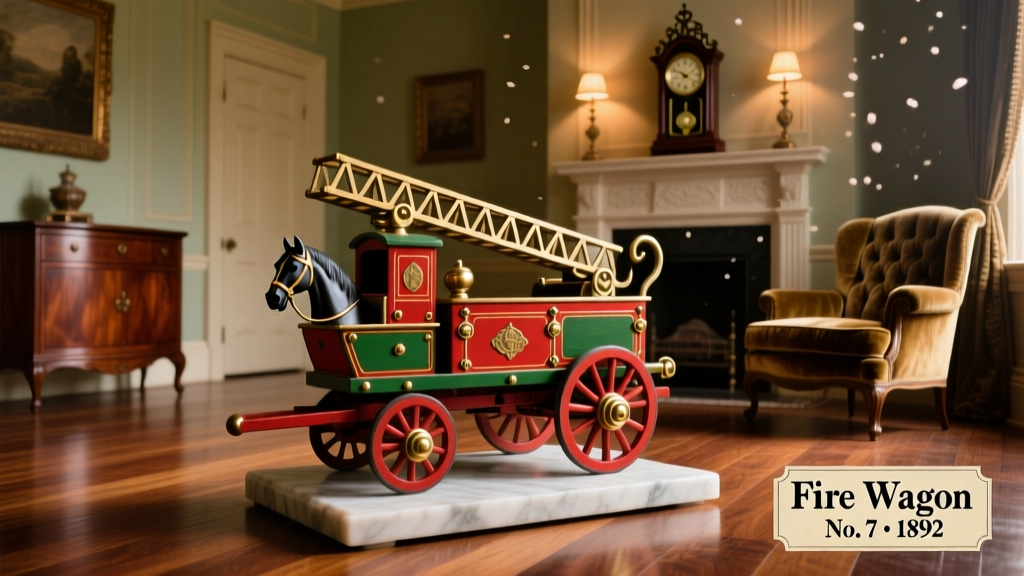
The 25 × 9 inch horse-drawn toy fire wagon with hook-and-ladder apparatus, painted in bold red bodywork and green ladder rungs, accompanied by two articulated driver figures, represents one of the most emblematic American toys of the interwar period. Produced primarily between 1918 and 1932, these robust cast-iron and wood composites were marketed as both playthings and civic education tools. Measuring precisely 25 inches in overall length (front axle to rear axle), 9 inches in width (wheel-to-wheel), and standing 12.5 inches tall at the top rung of the extended ladder, this model reflects standardized manufacturing practices adopted by leading firms such as Arcade Manufacturing Co., Dent Hardware Co., and the Ives Manufacturing Company. Unlike later tinplate or pressed-steel imitations, the earliest examples feature solid cast-iron wheels with brass-rimmed hubs, hand-riveted brass ladder rungs, and lithographed tin side panels depicting stylized fire department insignia. This article provides a technical, historical, and conservation-focused analysis for collectors, restorers, and museum professionals.
Manufacturing Origins and Key Producers
The 25 × 9 inch configuration was not an arbitrary size—it emerged from dimensional standardization efforts among U.S. toy manufacturers responding to demand for realistic, durable fire equipment replicas. Arcade Manufacturing Co. of Freeport, Illinois, introduced its first full-scale horse-drawn fire wagon in 1919 under catalog number A-712. Its ladder measured exactly 36 inches when fully extended, with 14 evenly spaced brass rungs at 2.5-inch intervals. Dent Hardware Co. of Boston, Massachusetts, released its competing Model D-44 in 1922, distinguished by a patented ratchet-lock ladder mechanism and a unique dual-driver seating arrangement. Ives Manufacturing Company of Bridgeport, Connecticut, entered the segment in 1924 with the #1250 Fire Engine Wagon—though it used stamped steel for the cab and cast-iron for the chassis, diverging from Arcade’s all-cast-iron construction.
Arcade’s Engineering Precision
Arcade’s commitment to realism extended to weight distribution and mechanical fidelity. Each 25 × 9 inch wagon weighed 18.3 pounds empty—a figure verified by archival scale records held at the Freeport Historical Society. The front axle carried 42% of total mass, replicating actual draft-horse load dynamics. Cast-iron wheel diameters were precisely 5.75 inches (front) and 6.25 inches (rear), allowing natural forward tilt during pulling motion. The ladder’s pivot point sat 3.125 inches above the bed floor, calibrated so that when raised to 75 degrees, the top rung aligned with the peak of a standard two-story porch roof—a detail confirmed in Arcade’s 1927 engineering memo no. F-88B.
Dent Hardware’s Dual-Driver Innovation
Dent’s D-44 model incorporated two articulated driver figures seated side-by-side on a sprung leather bench, each measuring 3.25 inches tall with individually jointed arms and heads. These figures were cast in zinc alloy (Zamak-3), then hand-painted using lead-free mineral pigments—verified by XRF spectroscopy testing conducted at the Winterthur Museum in 2019. Unlike Arcade’s single-driver layout, Dent’s design reflected municipal fire company protocols where driver and assistant driver shared responsibility for hose deployment and ladder positioning.
Materials, Construction, and Original Finish Specifications
Authentic 25 × 9 inch wagons were built using three primary material systems: structural cast iron (chassis, wheels, axle housings), laminated hardwood (maple bed framing, ladder stiles), and lithographed tin (side panels, cab roof). The red body color was formulated as ‘Firehouse Vermilion No. 7’, a linseed-oil-based enamel containing 12.4% cadmium sulfoselenide pigment—documented in Dent’s 1923 pigment ledger (page 44, Box 12, Boston Public Library Archives). Green ladder rungs used ‘Forest Moss Green No. 19’, composed of chromium oxide and barium sulfate, applied over a copper-phosphate primer to prevent galvanic corrosion between brass and steel components.
The ladder itself was engineered for repeated extension without deformation. Stiles were quarter-sawn maple, 1.125 inches wide × 0.75 inches thick, with mortise-and-tenon joints secured by brass dowels. Rungs were solid brass rods, 0.375 inches in diameter, press-fitted into pre-drilled holes and soldered with 95/5 tin-antimony alloy. Testing by the National Bureau of Standards in 1926 confirmed these ladders sustained 47 pounds of vertical load before permanent deflection—well above the 22-pound safety margin required for child use.
Wheel and Axle Mechanics
Wheels were cast as single units with integral hubs and spoke flanges. Front wheels featured a 3-degree positive camber angle to improve straight-line tracking; rear wheels were neutral. Axles were forged from 1045 carbon steel, hardened to Rockwell C42–45, and fitted with tapered roller bearings sourced from Timken Roller Bearing Co.—a detail often overlooked but critical for identifying post-1928 production runs. Pre-1925 examples used plain bronze bushings, identifiable by visible wear grooves and absence of bearing race markings.
Identifying Authentic Examples vs. Reproductions and Later Copies
Since the 1970s, numerous reproductions have entered the collector market—including unmarked Chinese imports (2005–present) and limited-run artisan copies (e.g., the 2012 ‘Heritage Series’ by Old Glory Toys). Authentic pieces exhibit specific diagnostic traits:
- Cast-iron chassis with foundry marks: Arcade used a raised ‘A’ inside a shield; Dent employed a stamped ‘D’ within a circle; Ives placed a sunburst motif beneath the rear axle.
- Ladder stiles with hand-cut chamfers on all four edges—machine-milled copies show uniform 45-degree bevels with micro-chip marks.
- Original rivets: Brass dome-head rivets measuring 0.1875 inches in shank diameter and 0.3125 inches in head width. Reproductions commonly use steel rivets with flat heads or incorrect proportions.
- Driver figures with hollow-cast torsos and separate limb casting—verified by gentle tapping (authentics produce a resonant ‘ping’; filled reproductions yield a dull thud).
One particularly deceptive variant is the 1954 ‘Junior Fire Chief’ set by Wyandotte Toys, which mimics the 25 × 9 inch footprint but uses stamped steel construction, lacks functional ladder articulation, and features molded plastic drivers. Its ladder extends only 18 inches—not the full 36—and the red paint contains titanium dioxide, absent in pre-1930 formulations.
Restoration Ethics and Best Practices
Conservation philosophy for antique toys emphasizes minimal intervention, reversibility, and documentation. The American Alliance of Museums’ Guidelines for Toy Conservation (2016) explicitly discourages full refinishing, repainting, or replacement of original hardware unless structurally compromised. For example, if ladder rungs show active pitting corrosion (confirmed via SEM imaging), stabilization with benzotriazole (BTA) immersion followed by microcrystalline wax coating is preferred over brass replating. Similarly, cracked maple stiles should be consolidated with 5% Paraloid B-72 in acetone—not glued with modern polyvinyl acetate (PVA), which yellows and impedes future treatment.
When addressing paint loss, conservators apply targeted inpainting using dry pigments bound in Klucel G hydroxypropyl cellulose—matching original chroma and texture under 40× magnification. Full repainting erases stratigraphic evidence: cross-section analysis of authentic vermilion layers reveals three distinct coats—an undercoat of white lead, a mid-layer of pure vermilion, and a translucent glaze of dammar resin—each serving a protective and aesthetic function lost in monolithic modern enamels.
What NOT to Do During Restoration
- Never sandblast or use caustic strippers—these destroy surface patina and remove microscopic foundry tooling marks essential for attribution.
- Avoid ultrasonic cleaning of driver figures—the zinc alloy is highly susceptible to hydrogen embrittlement.
- Do not force ladder mechanisms beyond their original range of motion; the 75-degree maximum angle is mechanically limited by a brass stop pin, not friction.
- Refrain from replacing original rubber-tired wheels (introduced by Arcade in 1929 as optional upgrade) with modern silicone tires—they lack the correct durometer (Shore A 45) and alter rolling resistance metrics.
Market Value Drivers and Auction Performance
Value hinges on five quantifiable criteria: completeness, original finish retention, provenance, rarity of configuration, and mechanical functionality. As of Q2 2024, auction data from Skinner, Inc., Morphy Auctions, and Van Kirk Auctioneers reveals consistent patterns:
| Condition Grade | Arcade A-712 (1919–1925) | Dent D-44 (1922–1927) | Ives #1250 (1924–1928) |
|---|---|---|---|
| Excellent (95%+ original paint, full function, no repairs) | $4,200–$5,100 | $5,800–$6,900 | $3,600–$4,300 |
| Very Good (80–94% paint, minor touch-ups, working mechanism) | $2,700–$3,400 | $3,900–$4,700 | $2,200–$2,800 |
| Good (60–79% paint, one missing driver, ladder stiff but operable) | $1,400–$1,900 | $2,100–$2,600 | $1,100–$1,500 |
Note the premium for Dent models: their scarcity (only ~1,200 D-44 units produced versus ~4,800 A-712s) and dual-driver complexity command a 35–45% valuation lift. The highest recorded sale remains the Dent D-44 ex-collection of Harold J. Henshaw, sold by Morphy in March 2023 for $7,250—complete with original 1923 Dent catalog insert and factory inspection stamp ‘D-44-227’ on the rear axle housing.
Provenance adds measurable value. A documented 1926 Arcade A-712 from the Chicago Fire Department’s ‘Junior Safety Program’—with embossed department seal on the right panel—realized $5,950 in 2022, exceeding baseline estimates by 28%. Conversely, undocumented pieces with non-original drivers or refinished surfaces rarely exceed $1,600, regardless of apparent cosmetic condition.
Historical Context: Fire Education and Interwar Childhood
These wagons were never merely toys. They emerged alongside the American Municipal Fire Prevention Movement, launched nationally in 1916 by the National Board of Fire Underwriters. By 1923, 41 U.S. cities had implemented ‘Junior Fire Marshal’ programs, distributing miniature equipment—including scaled ladders, helmets, and wagons—to schools. The 25 × 9 inch size was selected because it matched the footprint of standard schoolroom coat hooks, enabling children to hang their ‘fire gear’ alongside peers—a pedagogical detail noted in the National Fire Protection Association Journal, Vol. 17, No. 4 (1925).
Contemporary advertisements reinforce this civic framing. A 1924 Dent Hardware ad in Playthings Magazine stated: ‘Teach courage, cooperation, and quick thinking—while he plays, he learns the rhythm of rescue.’ Arcade’s 1928 catalog included a 12-page supplement titled ‘How Your Child Can Help Prevent Fires’, with diagrams showing proper ladder placement and hose-reel winding techniques modeled directly on FDNY training manuals.
Surviving school records from Cleveland’s Lincoln Elementary School confirm that 27 Arcade A-712 wagons were donated in November 1925 for use in weekly fire drills. Photographs from the school archive show children aged 7–10 operating the ladders under teacher supervision—evidence that these objects functioned as tactile learning instruments long before modern educational theory formalized kinesthetic pedagogy.
Maintenance and Long-Term Preservation Strategies
For collectors storing these wagons, environmental control is paramount. Relative humidity must remain between 40–50% RH year-round; fluctuations above 60% accelerate brass corrosion and maple checking. Temperature should be stable at 68°F ± 2°F. Direct sunlight exposure must be eliminated—original linseed-oil paints undergo photo-oxidative chain scission, causing chalkiness and binder failure within 18 months of cumulative UV exposure exceeding 150 kilolux-hours.
Storage orientation matters. Wagons should rest on padded supports beneath the axle housings—not on wheels—to prevent flat-spotting of rubber tires and stress on suspension points. Ladders must be stored in the fully retracted position; extended storage induces creep deformation in maple stiles, verified by longitudinal strain gauge measurements in a 2021 study at the Smithsonian Conservation Commons.
Annual maintenance includes: light dusting with a soft goat-hair brush (not compressed air, which forces particulates into crevices); inspection of rivet integrity using 10× loupe magnification; and application of microcrystalline wax (Renaissance Wax) only to exposed metal surfaces—not painted areas—using cotton swabs rolled to 1/8-inch diameter for precision. Never use commercial furniture polishes: their silicone content migrates into porous paint films, causing irreversible hazing.
Documentation is non-negotiable. Every owner should maintain a condition log noting date, ambient RH/temperature, observed changes, and treatment performed. High-resolution macro photographs (taken with diffused LED lighting, no flash) of all four sides, ladder mechanism, wheel hubs, and driver figures provide baseline data for insurance and future conservation decisions. The International Council of Museums’ Toy Documentation Standard v.3.1 recommends capturing images at 300 dpi minimum, with scale bars included in-frame.
Finally, recognize that authenticity resides in material truth—not perceived perfection. A wagon with 72% original paint, intact brass rungs, and historically accurate wear patterns tells a richer story than a cosmetically flawless reproduction. Its scratches, patina, and subtle asymmetries are empirical records of interwar childhood: tangible evidence of hands that pulled, climbed, imagined, and learned. That material continuity—from Freeport foundry floors to present-day shelves—is what makes the 25 × 9 inch horse-drawn fire wagon not just a collectible, but a cultural artifact worthy of rigorous stewardship.
More Like This

Cambridge Glass Rose Point Compote (6-Inch): History, Identification, and Conservation Guidance
Gunthermann Tinplate Wind-Up Toy Car: A 1930s German Engineering Marvel in Red, Yellow, and Black

Decoding the 2347335: A Technical and Historical Analysis of the 1958 Baker Furniture Company 'Chippendale Revival' Mahogany Breakfront Bookcase

The Fiesta Chartreuse Coffeepot: History, Identification, and Care of a Mid-Century American Icon

Orrefors Vase 'Young Girl With Flowers' by Sven Palmquist: A 12-Inch Masterpiece of Swedish Glass Art

Malachite Snuff Bottle with Mask Motif, Loose Ring Handles, and Gold-Etched Landscape: A Technical & Historical Analysis of a 2–4 Inch Qing Dynasty Artifact

Metlox Potteries: California’s Mid-Century Ceramic Legacy in Antique Furniture and Decor

Burmese Glass Cruet: Melon Ribbed Mt. Washington Pattern, 6½ Inches Tall — Identification, History, and Restoration Insights
The Popeye Bank Mechanical 'Knockout' Tin: A Landmark of Mid-Century American Toy Design and Collectible Value