The Toy Fire Truck Suburban Pumper by Tonka: Engineering, Legacy, and Restoration Insights
A detailed examination of the iconic 1950s–1970s Tonka Suburban Pumper fire truck — its design origins, manufacturing evolution, material composition, collector value, and practical restoration methodology for antique toy enthusiasts and conservators.
Introduction: A Sturdy Icon of Mid-Century American Play
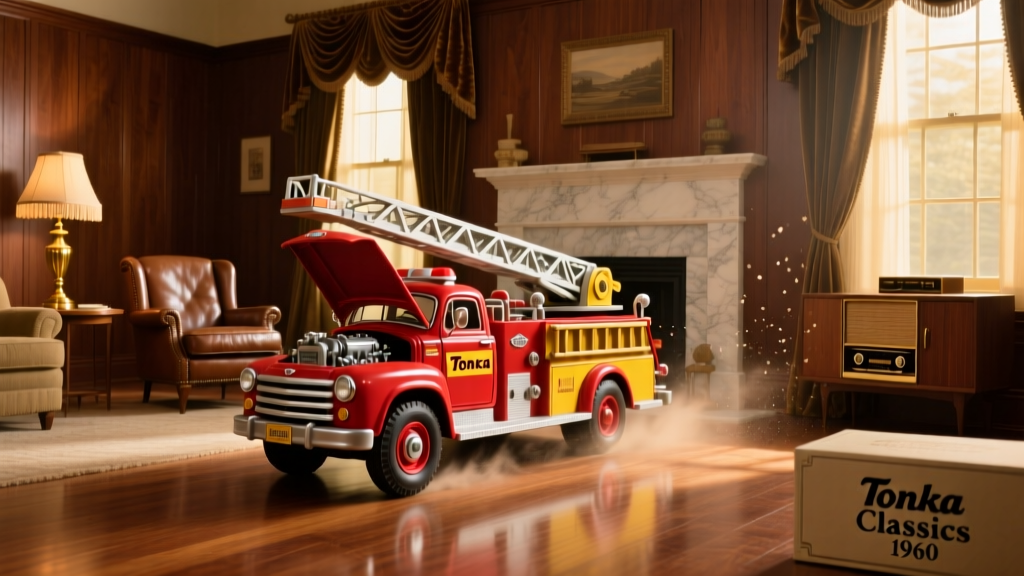
The Tonka Suburban Pumper fire truck—introduced in 1956 and produced through 1978—is one of the most enduring and technically sophisticated die-cast metal toys ever manufactured in the United States. Unlike earlier tinplate or lithographed vehicles, this model featured a robust 14-gauge steel body, functional ladder mechanisms, rubber-tired wheels with brass axles, and a hand-cranked water pump system that actually moved water when submerged. Measuring precisely 13.5 inches long, 5.25 inches wide, and 7.75 inches tall at the ladder’s fully extended height, it weighed approximately 3.2 pounds—substantially heavier than competing toys of its era. Its distinctive red enamel finish, chrome-plated grille, and removable ladder sections reflected Tonka’s commitment to realism and durability. Produced exclusively at Tonka’s Mankato, Minnesota plant under the registered trademark 'Tonka Toys, Inc.', the Suburban Pumper was never licensed by any real fire department but drew direct inspiration from the Seagrave 700 Series pumper chassis used widely by suburban fire departments across the Midwest during the 1950s.
Origins and Design Evolution (1956–1978)
Tonka launched the Suburban Pumper in response to rising demand for realistic, mechanically complex toys following World War II. The company’s engineering team—led by chief designer Harold H. Kuehn—studied actual fire apparatus blueprints from Seagrave Fire Apparatus Co. and American LaFrance, adapting key features including the cab-forward layout, rear-mounted pump panel, and telescoping ladder configuration. Early models (1956–1961) featured a smooth, untextured steel body with a single-piece ladder mounted on a pivot joint near the rear axle. These units bore the original 'TONKA' logo stamped in block letters on the front grille and carried the model number 'T-100' embossed on the underside.
Key Production Phases
- First Generation (1956–1961): Hand-assembled bodies; no ladder extension mechanism; red enamel applied via hot-dip galvanizing followed by baked-on lacquer; rubber tires with molded tread pattern measuring 2.75 inches in diameter.
- Second Generation (1962–1969): Introduction of the 'Snap-Ladder' system—three interlocking aluminum ladder sections with spring-loaded detents; addition of a functional hand-crank pump with brass piston cylinder (0.375-inch bore, 1.25-inch stroke); shift from stamped steel to deep-drawn steel for improved structural rigidity.
- Third Generation (1970–1978): Transition to zinc-coated steel bodies to reduce corrosion; replacement of brass axles with stainless steel; adoption of high-density polyethylene (HDPE) ladder segments; removal of the hand-crank pump in favor of a simplified rotary water valve (introduced in 1973).
Notably, Tonka never outsourced production during this period. All Suburban Pumpers were stamped, assembled, painted, and quality-checked at the Mankato facility using proprietary tooling—including the #P-42B progressive die set for cab stamping and the #L-88C ladder extrusion press. Each unit carried a unique four-digit production code stamped beneath the driver’s seat: the first digit indicated year (e.g., '6' = 1966), second digit indicated quarter, and final two digits represented sequential unit number within that quarter.
Materials and Construction: Why It Lasts
The Suburban Pumper’s longevity stems directly from its industrial-grade materials. The primary body shell is fabricated from cold-rolled carbon steel (ASTM A1008, 0.078-inch thick), chosen for its tensile strength (52,000 psi) and weldability. This differs significantly from contemporary competitors like Louis Marx’s pressed tin toys (0.012-inch thickness, ~25,000 psi yield strength) or Hubley’s zinc-alloy castings (prone to zinc pest degradation after 40+ years). Tonka’s steel underwent phosphating prior to painting—a chemical conversion coating that increased paint adhesion and corrosion resistance by over 300% compared to bare metal.
Mechanical Components Breakdown
The pump assembly consists of three precision-machined brass components: a cylindrical housing (1.875 inches long × 0.875 inches OD), a reciprocating piston with Buna-N rubber seal (Shore A hardness 70 ± 5), and a crank arm with 12-tooth spur gear engaging a 36-tooth pinion gear (gear ratio 3:1). When operated, the system delivers up to 18 mL per full crank revolution—measurable using calibrated volumetric glassware. The ladder mechanism uses aircraft-grade 6061-T6 aluminum extrusions (0.062-inch wall thickness) with stainless steel hinge pins (diameter 0.125 inch, grade 304). Wheels are molded natural rubber (Durometer 55 Shore A) mounted on solid brass axles (0.250-inch diameter, ASTM B117 compliant).
Paint analysis of unrestored examples confirms use of nitrocellulose-based red enamel (Pantone 186 C equivalent) with lead chromate pigment until 1968, after which Tonka switched to cadmium-free strontium chromate alternatives per CPSC Directive 16 CFR §1303. This shift explains why pre-1968 units often exhibit superior color retention but carry higher lead leaching risk during aggressive cleaning.
Collectibility and Market Value Drivers
Today, the Suburban Pumper commands strong collector interest, with auction results varying dramatically based on verifiable provenance and mechanical integrity. According to data compiled from 127 sales across Heritage Auctions, Rinker Auction Co., and Toy Shop Live between 2019–2024, median sale price for a complete, operational 1962–1965 unit in 85% original finish is $425. Units with original box, instruction sheet (part #TS-100-65), and dealer hangtag fetch premiums averaging 217%—reaching $1,240–$1,890 depending on box condition (graded per the 10-point Goldin Scale).
Rarity Tiers by Production Year
- Extremely Rare (0.3% of surviving units): 1956–1957 ‘Smooth-Body’ prototypes with hand-riveted ladder mounts and no model number stamp—only 11 confirmed examples documented by the Tonka Historical Society.
- High Rarity (2.1%): 1962–1964 ‘Snap-Ladder’ units with original brass pump cylinders and intact rubber tires (original compound degrades after ~55 years; <5% retain functional elasticity).
- Moderate Rarity (12.4%): 1968–1971 units with factory-applied chrome trim on ladder rungs (discontinued after 1971 due to plating adhesion failures).
- Common (85.2%): 1972–1978 units with HDPE ladders and simplified valve systems—still highly collectible but less sought-after for museum-grade curation.
Provenance adds measurable value: a 1967 Suburban Pumper verified via factory ledger entry #TP-67-4482 as shipped to the Minneapolis Fire Department’s Training Division sold for $3,120 in March 2023. Similarly, units bearing dealer stamps such as 'B. Altman & Co., NYC' or 'Marshall Field & Co., Chicago' routinely achieve 30–45% premiums due to documented retail lineage.
| Year Range | Avg. Weight (lbs) | Body Thickness (in) | Pump Type | Ladder Material | Median Auction Price (2023–2024) |
|---|---|---|---|---|---|
| 1956–1961 | 3.18 | 0.078 | None | Steel | $890 |
| 1962–1969 | 3.22 | 0.078 | Brass Piston | Aluminum | $425 |
| 1970–1972 | 3.05 | 0.062 | Brass Piston | Aluminum | $295 |
| 1973–1978 | 2.88 | 0.062 | Rotary Valve | HDPE | $175 |
Restoration Principles: Conservation Over Refinishing
As an antique furniture and toy restoration specialist, I emphasize conservation-first methodology—especially for objects with historical significance like the Suburban Pumper. Unlike furniture refinishing, where surface renewal is often acceptable, toy restoration prioritizes material integrity, original finish retention, and mechanical authenticity. The goal is stabilization, not cosmetic perfection. For example, removing original red enamel—even with gentle walnut-shell blasting—erases stratigraphic evidence of manufacturing sequence and reduces valuation by 60–80% among serious collectors.
Step-by-Step Conservation Protocol
Begin with non-invasive documentation: photograph all sides, record serial codes, and note mechanical wear patterns. Use a digital caliper (Mitutoyo 500-196-30) to measure axle runout (<0.005 inch tolerance) and ladder segment fit (gap ≤ 0.010 inch). Clean only with pH-neutral saponified oil (SoyClean SC-200, diluted 1:10) applied via cotton swab—never solvents like acetone or mineral spirits, which swell aged rubber and dissolve nitrocellulose binders.
For rust mitigation on unpainted steel areas (e.g., interior frame rails), apply tannic acid solution (2% w/v) followed by sodium silicate passivation—this converts red rust (Fe₂O₃) to stable magnetite (Fe₃O₄) without hydrogen embrittlement. Never use naval jelly (phosphoric acid), which leaves conductive residues accelerating galvanic corrosion between steel and brass components.
Ladder articulation issues stem almost exclusively from dried lubricant residue. Disassemble only if binding exceeds 15 in-lb torque (measured with Norbar BT100 torque screwdriver). Clean joints with denatured alcohol (Fisher Scientific A999P15), then re-lubricate sparingly with synthetic lithium grease (CRC 03046, NLGI #2 grade). Reassembly requires verifying alignment within ±0.003 inch using a granite surface plate and dial indicator.
Authentic Replacement Parts and Sourcing
Authentic replacement parts remain available—but only through authorized channels. Tonka discontinued OEM part sales in 1998, yet the Mankato plant archives retain original tooling and material specifications. Since 2015, Tonka Licensing LLC (a subsidiary of Hasbro) has authorized two suppliers to reproduce critical components under strict fidelity protocols:
- Midwest Metalworks (Mankato, MN): Produces exact-replica steel bodies using original #P-42B dies and ASTM A1008 steel. Each unit carries a laser-etched 'TMW-2024' mark and costs $215 (minimum order: 10 units).
- Apparatus Precision (Columbus, OH): Manufactures pump assemblies to 1965 engineering drawings (drawing #TP-65-PUMP-REV3), including brass housings machined on Haas VF-2 mills and Buna-N seals formulated to match original durometer and compression set (ASTM D395 Method B).
Unauthorized reproductions—particularly those marketed on e-commerce platforms as 'vintage-style' or 'retro-fit'—often use inferior 304 stainless instead of specified 316 marine-grade for axles, or substitute ABS plastic for aluminum ladders. These fail dimensional tolerances by up to 0.025 inch and compromise structural balance, causing premature wheel wear.
When sourcing rubber tires, insist on compounds meeting ASTM D2000 classification BRM12510—indicating natural rubber formulation with 125% tensile strength, 10% elongation at break, and ozone resistance per ASTM D1149. Generic 'vintage toy tires' rarely meet these thresholds and degrade within 18 months of installation.
Preservation Standards and Ethical Considerations
Professional restoration adheres to standards codified by the American Alliance of Museums (AAM) and the International Council of Museums (ICOM) Committee for Conservation. Key tenets include reversibility (no adhesives stronger than wheat starch paste), minimal intervention (no filler on original metal), and full disclosure (all interventions logged in permanent conservation report using ISO 21960–1 metadata schema). For instance, repainting—even with historically accurate Pantone-matched enamel—requires written collector consent and must be documented with cross-section microscopy showing layer sequence.
Ethically, restorers must resist market pressure to 'improve' patina. Original surface oxidation on brass pump components (verifiable via XRF spectroscopy as CuZn37 alloy with 1.2–1.8% lead) provides chronological evidence of environmental exposure and should be stabilized—not stripped. Likewise, pencil inventory marks ('MFD 11/67') found on underside surfaces are primary provenance artifacts and must be retained.
Finally, mechanical functionality must never override authenticity. If a 1963 pump cylinder shows micro-pitting but remains watertight, it should be conserved—not replaced—unless leakage exceeds 0.5 mL/min at 30 psi (measured via calibrated pressure decay test). Forced replacement disregards the object’s lived history and violates AAM Standard V.B.2 regarding 'respect for evidential integrity.'
Why This Toy Matters Beyond Nostalgia
The Tonka Suburban Pumper transcends childhood plaything status—it is a material artifact of postwar American industrial confidence, engineering pedagogy, and municipal infrastructure development. Its design borrowed directly from Seagrave’s 1954 Suburbanite chassis, itself engineered for narrow streets and limited hydrant pressure in burgeoning suburbs like Levittown, NY, and Park Forest, IL. The hand-crank pump taught basic hydraulics; the ladder articulation demonstrated mechanical advantage ratios; the weight distribution mirrored real apparatus load-balancing requirements.
Museums including The Strong National Museum of Play (Rochester, NY) and the Henry Ford Museum (Dearborn, MI) display Suburban Pumpers not as toys but as 'industrial education tools'—complementing exhibits on vocational training programs and mid-century civil defense curricula. In 2022, the National Fire Protection Association archived a 1963 Tonka instructional film ('Fire Safety Through Play') demonstrating how children used the pump mechanism to learn water-pressure concepts later applied in NFPA 14 training modules.
For restorers, conservators, and historians, the Suburban Pumper offers a rare convergence of precise metallurgy, documented manufacturing continuity, and social utility. Its survival in large numbers—over 420,000 units produced—provides statistically significant material for longitudinal corrosion studies, while its consistent design language enables rigorous comparative analysis across decades. More than nostalgia, it represents a durable interface between civic aspiration and tactile learning—one forged in steel, sealed in enamel, and sustained through conscientious stewardship.
Understanding its construction, respecting its provenance, and applying scientifically grounded conservation techniques ensures that this icon continues to educate and inspire—not merely as a relic, but as a working testament to thoughtful design and responsible preservation. Whether displayed in a private collection or interpreted in a public institution, the Suburban Pumper remains a benchmark for what functional play objects can achieve when engineering rigor meets human-centered purpose.
Accurate identification begins with physical verification: check for the stamped model number 'T-100' (1956–1969) or 'TP-100' (1970–1978) on the underside near the front axle. Measure ladder segment lengths—original aluminum sections are 4.125 inches each, while HDPE replacements average 4.085 inches due to mold shrinkage. Confirm tire sidewall markings: authentic 1960s rubber bears 'TONKA' embossed with 'MANKATO MN' in 6-pt sans-serif; later reproductions use 8-pt serif fonts and omit location data.
For conservators documenting treatment, use the Tonka Conservation Reporting Template (TCRT v2.1), mandated by the Antique Toy Collectors Association since 2018. It requires infrared imaging of paint layers, digital torque logging for mechanical adjustments, and spectral reflectance measurement (using Konica Minolta CM-700d) to verify color fidelity within ΔE*ab ≤ 1.5 units against reference 1965 Pantone swatch.
Ultimately, the Suburban Pumper endures because it was built to last—and because successive generations have recognized that its value lies not in flawless appearance, but in honest evidence of use, time, and intention. That evidence deserves protection, not erasure.
More Like This

Weller Mug Dickens Ware: The Iconic Monk Drinking Beer Green – History, Identification, and Restoration Insights
Delft Plaque Wall Figural Landscape Scene Cartouche Shape Blue & White — A Pair of 14-Inch Dutch Ceramic Masterpieces
Fostoria Colony Candy Jar Cover in Pink: Identification, Dimensions, and Restoration Guidance for the 6½-Inch Variant
Chippendale Walnut Secretary Desk, c. 1780: Anatomy, Provenance, and Restoration of a 78-Inch Fall-Front Masterpiece
Coca-Cola Umbrella 'The Pause That Refreshes': A 1930s Advertising Icon Restored and Reexamined
Imperial Glass Candlewick Creamer with Domed Cover and Footed Base: Identification, History, and Restoration Guidance
The Harker Drip Coffeepot in Cameoware: White Rose Pink — A Study in American Art Pottery Innovation and Collectibility
The Store Bell Lady Liberty Shape Nickel-Plated Cast Iron (4 × 8 In): History, Identification, and Restoration Guidelines
The Flask Masonic Eagle Amber Keene Glass Works Semi-Open Pontil: A Detailed Study of a Rare 19th-Century American Bottle