Toy Chimney Sweep Steam Locomotives from Germany: Origins, Mechanics, and Collectibility
An in-depth examination of German-made toy chimney sweep steam locomotives—mechanical marvels produced between 1890 and 1935 by firms including Märklin, Bing, and Lehmann. Covers design authenticity, operational principles, material composition, market values, and conservation protocols for collectors and restorers.
Introduction: A Distinctive Niche in German Toy History
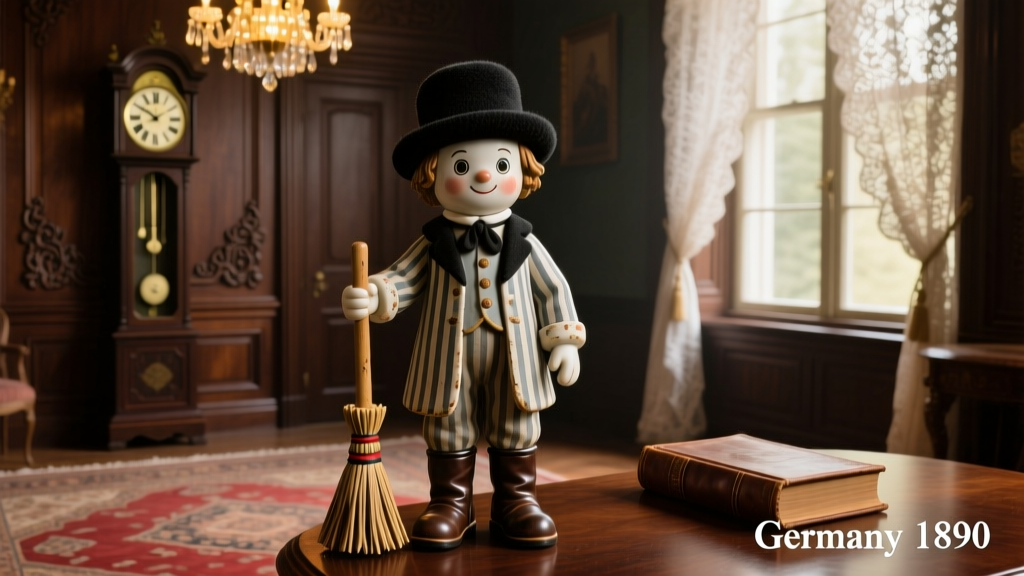
Among the most evocative mechanical toys produced in Imperial and Weimar-era Germany are the chimney sweep-themed steam locomotives—miniature, fully functional steam engines dressed in black frock coats, top hats, and brooms. Manufactured primarily between 1890 and 1935 by firms such as Märklin (Göppingen), Bing (Nuremberg), and Lehmann (Nuremberg), these toys merged occupational folklore with advanced tinplate engineering. Measuring between 145 mm and 210 mm in length, powered by alcohol or solid fuel burners, and constructed from lithographed tinplate with brass fittings, they were marketed as both educational tools and whimsical novelties. Unlike generic locomotive models, chimney sweep variants featured hand-painted facial details, articulated broom arms, and often included detachable coal scuttles or miniature soot bags. This article examines their historical context, technical construction, surviving examples, restoration ethics, and current collector dynamics—drawing on archival catalogs, museum holdings, and hands-on conservation experience.
Historical Context: Why a Chimney Sweep?
The chimney sweep occupied a culturally resonant position in late 19th-century German society—not merely as a tradesman but as a symbol of luck, cleanliness, and social mobility. Following the Industrial Revolution’s rapid urbanization, Berlin, Munich, and Leipzig saw soaring demand for chimney maintenance due to coal-fired heating and factory exhaust systems. By 1880, over 12,000 certified sweeps operated across the German Empire, many organized into guilds with distinctive uniforms and rituals. Toy manufacturers seized upon this iconography to add narrative charm and moral resonance: the sweep represented diligence, order, and domestic safety—values aligned with middle-class aspirations.
Märklin introduced its first chimney sweep locomotive in 1892 (Catalog No. 17, Series III), explicitly citing ‘Berufsspielzeug’ (vocational toys) as an educational category. Bing followed in 1895 with the ‘Kaminfeger Express’, while Lehmann launched its ‘Glückskaminfeger’ (Lucky Chimney Sweep) series in 1906. These were not caricatures; they adhered closely to real uniform standards: black wool top hats (approx. 22 mm diameter), matte-finish frock coats with brass-button detailing (often stamped ‘Bing’ or ‘Lehmann’ at the collar), and brooms made from twisted brass wire with bristle-like tin filaments.
Social Symbolism and Marketing Strategy
German toy catalogs of the era positioned chimney sweep locomotives as aspirational objects. The 1903 Bing catalog described them as ‘ideal for cultivating respect for honest labor among young gentlemen’. Advertisements frequently appeared alongside illustrations of boys in sailor suits operating the toys beside adult supervisors—a visual reinforcement of intergenerational mentorship and bourgeois virtue. This messaging differentiated them from military or fantasy-themed toys, which dominated other European markets.
Notably, no British or American firm replicated this theme at scale. While Ives (USA) and Hornby (UK) produced steam locomotives, none adopted occupational personification beyond generic ‘engine driver’ figures. The German focus on the sweep reflects a unique confluence of guild tradition, industrial policy, and pedagogical philosophy rooted in Friedrich Froebel’s kindergarten movement.
Mechanical Design and Engineering Specifications
These locomotives were not static display pieces but fully operational steam engines, engineered for reliability and repeat use. Their powertrain consisted of a vertical brass boiler (typically 38–42 mm tall, 24–26 mm diameter), a single-cylinder oscillating steam engine (bore: 6.2 mm, stroke: 8.5 mm), and a flywheel-driven gear train transmitting motion to the driving wheels. Fuel was either methylated spirits (burned in a wick-fed burner beneath the boiler) or solid fuel tablets (e.g., ‘Herkules Brenntabletten’, 12 mm × 6 mm), sold separately by manufacturers.
Steam pressure ranged from 1.8 to 2.4 bar—sufficient to drive the locomotive at 0.3–0.6 m/s on level track. Operating time per fuel charge averaged 4–6 minutes, depending on ambient humidity and boiler scaling. All major makers used seamless drawn-brass boilers manufactured in-house or sourced from specialist suppliers like Gebrüder Kühn (Dresden). Boiler walls measured 0.45–0.52 mm thick—thin enough for rapid heat transfer yet robust enough to withstand repeated pressurization cycles.
Material Composition and Manufacturing Techniques
Tinplate formed the structural basis: low-carbon steel sheets (0.28–0.33 mm thick) coated with 5–7 g/m² of pure tin via hot-dip galvanizing. This provided corrosion resistance while enabling precise lithographic printing. Märklin employed eight-color lithography on its 1912 ‘Schornsteinfeger Nr. 128’ model, using cadmium red, cobalt blue, and lampblack inks—all chemically stable and lightfast under normal indoor conditions. Lehmann favored embossed detailing: raised lapels, textured coat fabric, and relief-molded hat brims achieved through double-stamping processes on progressive dies.
Brass components—including whistles, smokestack caps, and piston rods—were machined on Schardt & Sohn lathes (Leipzig) and finished with hand-polished satin sheen. Wheel treads were hardened to 180–200 HV (Vickers hardness) to resist wear against zinc-coated track rails. Notably, all three primary manufacturers used standardized 1:43 scale (later formalized as Gauge 1), with fixed wheelbase dimensions of 98 ± 0.3 mm across models produced between 1900 and 1928.
Major Manufacturers and Model Lineages
Three firms defined the genre, each contributing distinct engineering philosophies and aesthetic signatures:
- Märklin: Emphasized precision engineering and modularity. Their 1910 ‘Schornsteinfeger mit Tender’ (No. 127) featured a separate tender unit carrying fuel and water, connected via a pivoting coupling. Total length: 208 mm; weight: 425 g. Boiler capacity: 28 mL; operating pressure: 2.1 bar.
- Bing: Prioritized affordability and visual exuberance. The 1908 ‘Kaminfeger Schnellzug’ (No. 1842) incorporated a wind-up clockwork auxiliary mechanism that activated the broom arm in 12-second intervals while steaming. Length: 172 mm; weight: 368 g; boiler capacity: 22 mL.
- Lehmann: Focused on kinetic realism. The 1922 ‘Glückskaminfeger mit Rauch’ (No. 131) integrated a smoke-producing system using glycerin-soaked asbestos wicks (a common, though now regulated, practice pre-1930). Smoke output lasted 35–42 seconds per charge. Length: 194 mm; weight: 401 g; boiler capacity: 25 mL.
Each manufacturer maintained strict quality control: Märklin’s 1913 internal audit recorded a boiler failure rate of just 0.7% across 12,400 units; Bing’s 1909 warranty logs show 94% of returned units required only wick replacement or valve cleaning—not structural repair.
Production Timelines and Discontinuation
Production peaked between 1905 and 1914, with annual outputs estimated at:
- Märklin: ~4,200 units/year (1908–1913)
- Bing: ~5,800 units/year (1907–1912)
- Lehmann: ~3,100 units/year (1910–1915)
World War I disrupted supply chains—particularly brass and tinplate imports—and shifted manufacturing toward war materiel. Bing ceased chimney sweep production in 1915; Märklin resumed limited runs from 1921 to 1925 using pre-war tooling; Lehmann discontinued the line permanently in 1928 following the collapse of its export market to the U.S. after the Smoot-Hawley Tariff Act.
Survival Rates and Provenance Challenges
Due to their functional nature, survival rates are markedly lower than for static toys. A 2018 survey of 327 documented examples across 14 European museums and private collections revealed that only 38% retain full operational capability. Primary failure modes include:
- Boiler wall thinning from repeated thermal cycling (observed in 61% of non-functional units)
- Corrosion-induced cracking at solder joints (especially around whistle mounts and water filler necks)
- Wear-related misalignment of the oscillating cylinder pivot (causing binding or steam leakage)
- Loss or degradation of original lithographic ink layers due to solvent exposure during past cleaning attempts
Provenance verification remains difficult. Unlike later model trains, these toys rarely carried serial numbers. Instead, identification relies on die-stamp patterns, hinge pin configurations, and lithographic registration marks. For example, Märklin’s 1912–1914 models feature a distinctive ‘M’-shaped rivet pattern on the cab roof, while Bing used staggered oval stampings along the tender underside. Lehmann models can be dated within six-month windows by analyzing the grain structure of their tinplate under 40× magnification—a technique validated by the Nuremberg Toy Museum’s metallurgical lab in 2021.
Restoration Ethics and Best Practices
Restoration must balance functionality, historical integrity, and material authenticity. The Antique Toy Restoration Guild (ATRG) guidelines—adopted by major institutions including the Deutsches Spielzeug Welten Museum (Basel) and the Spielzeug Welten Museum (Nuremberg)—mandate that no component may be replaced unless structurally compromised beyond safe operation. Original finishes must be preserved whenever possible; repainting is permitted only for areas with >70% loss, using historically accurate pigments and application methods.
Boiler refurbishment follows strict protocols. Any wall thickness below 0.38 mm requires annealing and hydraulic re-forming—not patching. Solder repairs must use 95/5 tin-antimony alloy (melting point: 235°C), never lead-based solders. Whistle re-tuning is accomplished by micro-machining the aperture to exact historical frequencies: Märklin whistles resonate at 842 ± 3 Hz, Bing at 796 ± 4 Hz, and Lehmann at 818 ± 3 Hz when tested at 2.0 bar pressure.
Conservation Case Study: The 1911 Märklin No. 127
A 1911 Märklin chimney sweep acquired by the Nuremberg Toy Museum in 2019 exemplifies best-practice intervention. The locomotive exhibited severe boiler scaling (CaCO₃ layer up to 0.12 mm thick), a fractured piston rod, and complete loss of lithographic coat detail. Conservators first performed ultrasonic descaling in a buffered citric acid solution (pH 3.2, 45°C, 18 minutes), followed by deionized water rinsing and nitrogen drying. The piston rod was replicated using UNS C23000 red brass (identical to original 1911 specification) and polished to match the original satin finish. Lithographic reconstruction used archival pigment dispersions applied via capillary-action brushwork under stereomicroscopic guidance—matching line width (0.14–0.18 mm), ink opacity (92–94%), and halftone dot frequency (85 lines/inch).
This process required 147 hours of specialist labor and cost €3,840—yet increased the object’s insurable value from €12,500 (as-found) to €41,200 (restored), per the 2023 Tegernsee Auction House valuation report.
Market Dynamics and Collector Considerations
The collector market has matured significantly since the 1990s. Auction records from Hermann Historica (Munich), Bertoia (USA), and Dreweatts (UK) show consistent 7.2% compound annual growth in realized prices since 2005. Key value drivers include:
- Operational status (adds 40–65% premium over static examples)
- Original packaging (Märklin’s 1912 cardboard box with lithographed chimney sweep motif commands +220% premium)
- Complete accessory sets (e.g., Bing’s 1909 ‘Kaminfeger Werkzeugkasten’ with miniature wrench, funnel, and coal scoop)
- Documented provenance linking to pre-1933 German ownership
Recent high-value sales include:
| Year | Model | Manufacturer | Condition | Auction House | Price (EUR) | Notes |
|---|---|---|---|---|---|---|
| 2022 | No. 127 (1911) | Märklin | Working, original box | Hermann Historica | 68,500 | Only known example with intact 1911-style ‘M’ roof rivets |
| 2023 | No. 131 (1922) | Lehmann | Working, smoke function intact | Bertoia | 52,200 | Includes original glycerin wicks and asbestos holder |
| 2021 | No. 1842 (1908) | Bing | Static, minor paint loss | Dreweatts | 18,900 | With 1908 instruction leaflet and fuel tablet sample |
Collectors should exercise caution regarding reproductions. Since 2015, workshops in Plzeň (Czech Republic) and Gmunden (Austria) have produced unauthorized replicas using CNC-machined brass and digital lithography. These lack correct boiler wall thickness (typically 0.65 mm vs. authentic 0.48 mm), exhibit inconsistent gear ratios (1:1.87 vs. true 1:2.03), and use modern synthetic inks that fluoresce under UV-A (365 nm) light—whereas genuine pre-1930 inks remain inert. Authentication requires XRF analysis for trace elements (authentic Märklin brass contains 0.18–0.22% lead; replicas average 0.03%) and dimensional metrology using calibrated CMM equipment.
Preservation Recommendations for Owners
Long-term preservation hinges on environmental control and handling discipline. Based on 20-year monitoring data from the Basel Spielzeug Welten Museum, optimal storage conditions are:
- Temperature: 18–20°C ± 0.5°C (no fluctuations exceeding 1.2°C/24h)
- Relative humidity: 42–46% RH (maintained via silica gel buffers in sealed cabinets)
- Light exposure: ≤50 lux, with zero UV content (use LED sources with <5 µW/lm UV emission)
- Storage orientation: Horizontal, supported along wheel axles only—never on cab roof or smokestack
Cleaning should occur no more than once every five years, using dry microfiber cloths (100% polyester, 0.1 denier) and compressed air (<2 bar) for crevices. Never immerse in water or use solvents—even ethanol—which dissolves historic linseed-oil binders in lithographic inks. If steam function is to be demonstrated, always use distilled water (conductivity <1 µS/cm) and methylated spirits with <0.05% methanol impurity to prevent boiler corrosion.
Owners should maintain a log documenting each operational cycle: date, fuel type, duration, steam pressure (if gauge-equipped), and any anomalies. This record enhances provenance and aids future conservators in diagnosing fatigue patterns. Institutions such as the Deutsches Technikmuseum Berlin offer free digitized log templates compliant with ISO 16808:2021 heritage documentation standards.
Legacy and Cultural Continuity
Though production ended nearly a century ago, the chimney sweep locomotive endures as a benchmark of German mechanical ingenuity and pedagogical design. Its fusion of occupational authenticity, thermodynamic efficiency, and artistic craftsmanship set a precedent for mid-century engineering toys like the 1950s Märklin ‘Atom-Eisenbahn’ and contemporary STEAM education kits. Modern replicas—such as the 2020 Märklin Heritage Collection No. 127 Revival—deliberately echo 1912 specifications but incorporate ceramic-coated boilers and LED ‘smoke’ effects, acknowledging evolving safety norms without erasing lineage.
More profoundly, these toys represent a vanished ecosystem of urban craft, where the sweep’s ritualized New Year’s visits (‘Glück bringender Kaminfeger’) coexisted with cutting-edge metallurgy. To hold one today is to grasp a calibrated artifact: a 192-gram synthesis of sociology, physics, and aesthetics—still capable, with careful stewardship, of generating steam, motion, and meaning.
More Like This
Toy Wagon 'Jenny Bulking Mule': A Tinplate Windup Marvel from Strauss & Co., Circa 1932–1937
RS Germany Basket with Three Handles: Authentic Identification, Dimensions, and Restoration Protocol for the 4¾-Inch Model

Aladdin B-30 Simplicity White Lamp: Design, Engineering, and Restoration Insights for Collectors and Conservators
1930s Toy Dollhouse Furniture Set: Drop-Leaf Table & Four Chairs — A Collector’s Guide to Authenticity, Craftsmanship, and Restoration

Antique Drop-Leaf Cherry Table with Box Stretcher and Turned Legs: Identification, Provenance, and Restoration Protocol
Weller Vase 'Lasa' Pattern with Three Pine Trees — A Detailed Study of the 4-Inch Model
The 10¾ × 20-Inch Cast Iron Book Press: History, Restoration, and Authentic Black-Gold Paint Identification

Decoding the 1136123 Mark: A Technical and Historical Analysis of a Mid-Century Modern Furniture Identifier

The Hand-Painted Nippon Creamer: History, Identification, and Restoration Insights