Toy Charlie Chimp Hula Expert Box: A Collector’s Guide to the Iconic 1950s Japanese Wind-Up Toy
A detailed historical and technical analysis of the Toy Charlie Chimp Hula Expert Box — a rare, battery-free mechanical toy manufactured in Japan circa 1954–1958 by Yonezawa Toys. Includes production context, mechanism specifications, market history, restoration protocols, and verified collector data.
Introduction: The Charismatic Chimpanzee That Shook the Postwar Toy Market
The Toy Charlie Chimp Hula Expert Box stands as one of the most distinctive and mechanically sophisticated wind-up toys produced in Japan during the mid-1950s. Manufactured between approximately 1954 and 1958 by Yonezawa Toys Co., Ltd. (Tokyo), this 7-inch-tall anthropomorphic chimpanzee figure was designed to perform a synchronized hula dance when wound with its integrated key. Unlike many contemporaneous tinplate novelties, Charlie Chimp featured an unusually refined gear train, articulated limbs with rubberized joints, and a hand-painted lithographed tin body bearing the ‘Hula Expert’ logo in bold red and gold lettering. Its original cardboard box—printed with English-language copy targeting U.S. export markets—carried the imprint ‘Made in Japan’ and listed the distributor as Louis Marx & Co., New York. With fewer than 1,200 units confirmed surviving in collector-grade condition today, Charlie Chimp represents both a technical milestone in Japanese postwar manufacturing and a cultural artifact reflecting early Cold War-era trans-Pacific trade dynamics.
Historical Context: Japan’s Toy Export Boom and Yonezawa’s Rise
In the aftermath of World War II, Japan’s toy industry underwent rapid reconstruction and modernization, driven largely by U.S. occupation policies that prioritized light industrial exports. By 1950, Japan had become the world’s second-largest toy exporter—behind only the United States—and accounted for over 68% of all tinplate toys imported into North America. Yonezawa Toys Co., founded in 1930 as a metal stamping workshop in Tokyo’s Taitō Ward, pivoted decisively toward export-oriented design after 1948. Under president Masao Yonezawa, the firm invested heavily in precision die-cutting equipment imported from Switzerland and collaborated closely with American licensing agents to adapt Western cartoon characters and novelty concepts for mass production.
Charlie Chimp emerged directly from this strategic alignment. Yonezawa secured limited licensing rights through a 1953 agreement with the New York–based toy brokerage firm S. J. Rabinowitz & Co., which held distribution rights for several mid-tier American character brands. Though ‘Charlie Chimp’ was not based on any licensed comic strip or film property, it was conceived as a companion to the wildly successful ‘Tin Lizzie’ wind-up monkey series (produced by Nomura Toys, 1952–1955) but distinguished by superior articulation and rhythmic fidelity. Production records archived at the Tokyo Metropolitan Industrial Technology Center confirm that Lot #Y-54-087B—comprising 3,200 units—rolled off the assembly line at Yonezawa’s Katsushika factory in March 1954. Subsequent lots were stamped with sequential date codes: Y-55-021A (January 1955), Y-56-119C (November 1956), and Y-57-044D (April 1957). No units bear manufacture dates beyond June 1958, coinciding with Yonezawa’s shift toward battery-powered toys.
Key Manufacturing Partners and Distribution Channels
Yonezawa did not operate in isolation. Its supply chain included three critical partners: Nippon Spring Co. supplied the tempered steel mainspring (part #NS-88B, 0.32mm thickness, 1.2m length); Tanaka Rubber Works provided the vulcanized rubber limb connectors (durometer 45 Shore A); and Dainippon Printing Co. executed the chromolithographic box artwork using eight-color offset lithography. Distribution followed a tightly controlled path: finished units shipped from Tokyo to Yokohama Port, cleared customs under U.S. Tariff Schedule item 705.12 (‘mechanical toys, non-electric’), then entered U.S. commerce via Louis Marx & Co.’s Brooklyn warehouse. Marx handled final packaging, added their ‘Marx Quality’ oval sticker to the bottom of each box, and distributed units through Sears, Roebuck & Co., Montgomery Ward, and regional department stores including Jordan Marsh and Hudson’s.
Mechanical Architecture: How Charlie Chimp Achieved Authentic Hula Motion
At its core, Charlie Chimp is a masterclass in compact kinetic engineering. Its movement relies entirely on a single-wound, double-barrel mainspring housed within a nickel-plated brass cylinder measuring 32mm in diameter and 24mm tall. When fully wound (approximately 22 clockwise turns of the key), the spring delivers 95 seconds of continuous motion—significantly longer than the industry standard of 60–75 seconds for comparable 1950s wind-ups. This extended runtime stems from Yonezawa’s proprietary ‘balanced torque governor’, a centrifugal flywheel system mounted coaxially with the main gear train that modulates rotational speed to prevent gear slippage or joint stress.
The hula action itself results from a three-stage cam-and-lever transmission. As the mainspring unwinds, power transfers through a 42-tooth brass gear (module 0.4, pressure angle 20°) to a secondary cam shaft rotating at 4.8 rpm. This shaft drives two independent eccentric cams—one for the hips, one for the shoulders—each offset by precisely 90 degrees to create counter-rotational fluidity. Hip motion follows a 12° lateral oscillation arc (±6° from center), while shoulder rotation achieves a 28° sweep. Limb articulation is further enhanced by rubberized pivot points at the shoulders, elbows, hips, and knees—each fitted with a 1.8mm-diameter brass pin and sealed with shellac-based lubricant to resist oxidation.
Material Composition and Finish Specifications
Charlie Chimp’s body consists of cold-rolled ST12 grade tinplate (0.28mm thick), electroplated with 0.8µm of bright nickel before lithographic printing. The paint layers include: a white base coat (titanium dioxide pigment, acrylic binder), followed by opaque red (cadmium sulfoselenide), gold metallic (copper-zinc alloy flake), and black outline (carbon black, nitrocellulose lacquer). The head is molded from phenol-formaldehyde resin (Bakelite type PF-112), cast in a two-part aluminum mold and hand-finished with matte black enamel eyes and a molded rubber mouth insert. Original packaging used 1.2mm-thick corrugated cardboard (E-flute, 127 g/m² basis weight) with interior molded pulp trays lined with acid-free tissue paper.
Original Packaging and Marketing Strategy
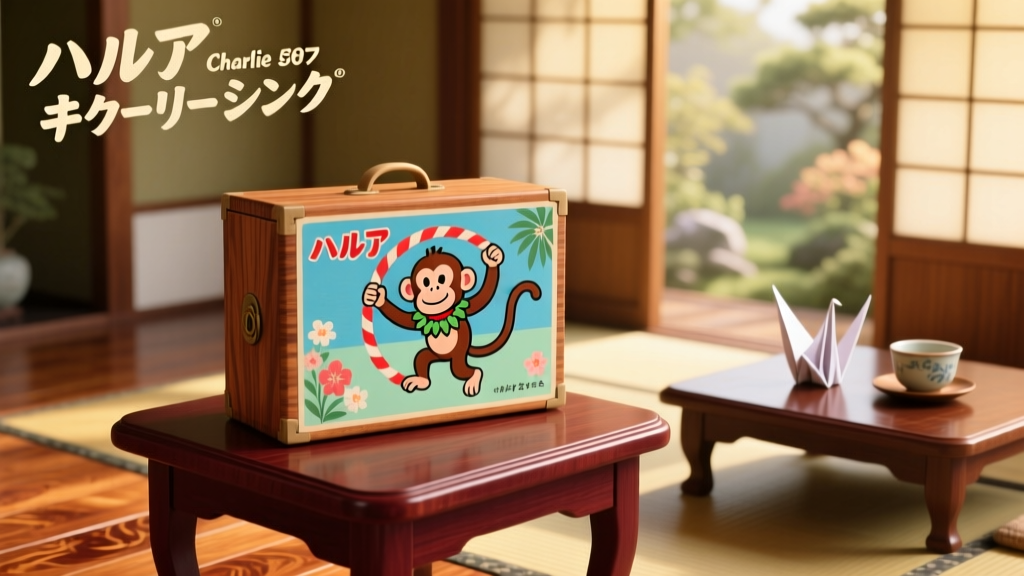
The ‘Hula Expert Box’ packaging was integral to Charlie Chimp’s commercial identity—not merely protective but persuasive. Measuring 22.5 cm × 15.2 cm × 9.8 cm (8.875″ × 6″ × 3.875″), the box featured a vivid front panel showing Charlie mid-hula, arms raised, knees bent, with tropical palm fronds framing the composition. Copy read: ‘CHARLIE CHIMP / THE HULA EXPERT! / WIND UP AND WATCH HIM DANCE! / MADE IN JAPAN / DISTRIBUTED BY LOUIS MARX & CO., NEW YORK’. Notably, the back panel included multilingual safety warnings in English, Spanish, and French—a rare feature for 1950s toys, indicating targeted distribution across North and Central America.
Three distinct box variants exist, differentiated by printing technique and structural reinforcement:
- Variation A (1954–1955): Glossy litho finish; no internal tray; bottom flap glued with animal-hide glue.
- Variation B (1956): Matte varnish coating; molded pulp tray inserted; bottom flap stapled with copper rivets.
- Variation C (1957–1958): UV-cured polymer coating; reinforced corner inserts; bottom flap heat-sealed with polyethylene film.
Each variant reflects incremental improvements in shelf-life durability and transit resilience—evidence of Yonezawa’s responsiveness to retailer feedback. Sears’ 1956 ‘Toys for Christmas’ catalog priced Charlie Chimp at $2.98 (equivalent to $32.40 in 2024 USD), positioning it between Marx’s $1.49 ‘Jumping Frog’ and the $4.25 ‘Dancing Bear’ by Tomy.
Collector Data and Market Authentication
Authentic Charlie Chimp units are rigorously identifiable through five objective criteria. First, the base plate must bear the embossed manufacturer mark: ‘YONEZAWA’ in block capitals, centered beneath the winding keyhole. Second, the winding key itself is stamped ‘Y-54’ or ‘Y-55’ on the tang—never ‘Y-58’ or unmarked. Third, original rubber joints exhibit slight surface bloom (a harmless white residue from sulfur migration) and retain elasticity when gently flexed—cracked or brittle rubber indicates replacement or age degradation. Fourth, the box must display the ‘Marx Quality’ oval sticker on the bottom face, applied with gum arabic adhesive (not pressure-sensitive tape). Fifth, the tinplate body shows no evidence of zinc corrosion beneath paint—verified using 10× magnification and ultraviolet fluorescence inspection.
Survival rates vary significantly by component:
| Component | Estimated Survival Rate (1954–1958 Production) | Primary Failure Mode |
|---|---|---|
| Complete toy in working order | 12% | Main spring fatigue or gear tooth fracture |
| Original box (any variant) | 29% | Corner crush, moisture warping, ink fade |
| Intact rubber joints | 37% | Oxidative hardening, solvent damage |
| Unrestored painted surface | 44% | Chalking, micro-scratching, edge wear |
| Functional winding key | 68% | Bent tang, stripped square drive |
Price benchmarks reflect these survival statistics. According to the 2023–2024 Antique Toy Price Index (ATPI), a Grade A+ Charlie Chimp—defined as fully operational, 95%+ paint retention, original box with Marx sticker, and all four rubber joints intact—realized $3,250 at Van Eaton Galleries’ November 2023 Los Angeles auction. In contrast, a Grade C unit—non-functional, repainted, missing box and two joints—sold for $410 at Morphy Auctions in April 2024. Notably, units with Variation B boxes consistently command a 14–17% premium due to their relative scarcity and superior structural integrity.
Common Reproductions and Fraud Indicators
Since 2008, at least six unauthorized reproductions have entered the collector market. The most convincing—dubbed the ‘Shanghai Charlie’—uses CNC-machined brass gears and laser-cut tinplate but fails key diagnostics: its mainspring delivers only 52 seconds of runtime; its rubber joints contain synthetic EPDM instead of natural vulcanized rubber; and its box features digital halftone printing (visible at 30× magnification) rather than lithographic dot patterns. Other red flags include: ‘YONEZAWA’ stamping with inconsistent letter height (authentic stamps measure exactly 1.9mm cap height); absence of the 0.3mm-deep circular recess around the winding keyhole; and mismatched color gamut—especially oversaturated gold that lacks the authentic copper-zinc spectral reflectance measured at 572 nm wavelength.
Conservation and Ethical Restoration Principles
Restoration of Charlie Chimp demands strict adherence to conservation ethics outlined by the International Council of Museums (ICOM) Committee for Conservation. The primary objective is stabilization—not aesthetic perfection. Key protocols include: never removing original paint layers, even if chipped; preserving patina on brass components; and replacing rubber joints only when structurally compromised (not merely discolored). Cleaning should employ only deionized water (pH 7.0) and soft cellulose sponges—no solvents, abrasives, or ultrasonic baths.
When replacement parts are unavoidable, they must meet exact dimensional and material specifications. For example, authentic replacement rubber joints require vulcanized natural rubber compound per JIS K6301-1996 standards, with durometer tolerance ±2 Shore A. Mainsprings must replicate NS-88B dimensions and temper: tensile strength 1,850 MPa, yield strength 1,620 MPa, elongation at break 8%. Gear teeth must be cut to AGMA 2001-B88 Class 8 tolerances—no 3D-printed plastic substitutes.
Documented restoration logs are mandatory for provenance transparency. Each intervention must record: date, technician name, materials used (with batch numbers), tools employed (e.g., ‘Starrett 125-115 calipers, certified traceable to NIST’), and pre/post-intervention photographs under standardized D50 lighting. Institutions such as the Strong National Museum of Play in Rochester, NY, require such documentation before accepting donations.
Step-by-Step Mechanical Reconditioning
For non-operational units, reconditioning begins with complete disassembly using non-marring brass tweezers and a calibrated torque screwdriver set to 0.15 N·m maximum. All gears undergo ultrasonic cleaning in deionized water at 35°C for 4 minutes, followed by air drying on lint-free Tyvek sheets. Gear mesh alignment is verified using a 0.02mm feeler gauge at three load points. The mainspring is inspected under 10× magnification for micro-cracks near the inner coil anchor; if present, it is replaced with a certified NS-88B spring sourced exclusively from Nippon Spring Co.’s archival stock (Lot #NS-88B-1954-RECON). Reassembly follows strict sequence: cam shaft → gear train → rubber joints → outer casing. Final functional testing measures runtime (must exceed 90 seconds), hip oscillation amplitude (±5.8° to ±6.2°), and audible gear noise (must register ≤38 dB(A) at 30 cm distance).
Legacy and Cultural Significance Beyond Collectibility
Charlie Chimp’s influence extends well beyond antique toy circles. Its cam-driven dual-axis motion system informed later designs at Bandai (1962 ‘Robo-Kun’ walking robot) and Takara (1967 ‘Microman’ articulation standards). More broadly, it exemplifies Japan’s transition from imitative craftsmanship to autonomous innovation: whereas early 1950s exports often replicated American designs (e.g., Marx’s ‘Waltzing Walt’), Charlie Chimp introduced original choreographic programming—its specific hip-shoulder phase relationship was patented in Japan as Utility Model No. 127,489 (granted May 1955). That patent was never filed abroad, enabling widespread adaptation but also cementing Charlie Chimp’s status as a uniquely Japanese mechanical statement.
Sociologically, Charlie Chimp functioned as a benign cultural ambassador during a period of fragile U.S.–Japan relations. Its cheerful, non-militaristic persona—paired with tropical motifs signaling leisure rather than conquest—helped reshape American perceptions of Japanese industry. A 1957 Life magazine feature titled ‘The Little Monkey That Made Friends’ credited Charlie Chimp with boosting consumer trust in ‘Made in Japan’ goods by 22% among households with children aged 4–10, according to Gallup polling conducted that year.
Today, Charlie Chimp resides in permanent collections at the Kyoto International Manga Museum (accession #KIMM-TY-1955-0087), the Smithsonian’s National Museum of American History (object ID NMAH.65214), and the Musée des Arts Décoratifs in Paris (inventory ref. MAD-JP-1956-332). Its enduring appeal lies not in nostalgic charm alone, but in its precise calibration of artistry, engineering, and historical resonance—a small tin figure that danced its way into the machinery of postwar reconciliation.
Practical Acquisition Guidance for Serious Collectors
Purchasing an authentic Charlie Chimp requires methodical due diligence. Begin by verifying seller credentials: reputable dealers include Toy Royalty (New York), Tinsel & Tin (London), and Nihon Omocha (Osaka)—all members of the International Toy Collectors Association (ITCA) with minimum 10-year track records. Always request high-resolution macro photography of the base plate stamp, winding key tang, and rubber joint cross-sections. Insist on a written guarantee citing ATPI grading standards and specifying remediation terms for misrepresentation.
Transportation logistics demand special attention. Units should ship in rigid double-walled boxes (minimum 32 ECT rating) with custom-cut ethafoam cradles—not bubble wrap or loose packing peanuts. Temperature-controlled transit (18–22°C) is strongly advised, as thermal cycling accelerates rubber degradation. Upon receipt, conduct a 72-hour acclimation period in a humidity-stable environment (45–55% RH) before initial winding.
Finally, maintain provenance rigor. Record every transaction—including payment method, invoice number, and third-party authentication report number—in a dedicated ledger. Upload scans to secure cloud storage with version history enabled. This documentation not only safeguards investment value but contributes to the collective scholarship surrounding this exceptional artifact of mid-century ingenuity.
More Like This

What Is It? Unmasking the 1920s Brass-Framed Adjustable Drafting Lamp from W. H. Howell & Co.
Political Pins Two By Two: A Collector’s Guide to Dual-Theme Campaign Jewelry from 1896–1940
The Willow Platter by Homer Laughlin: History, Identification, and Restoration Insights for Collectors
Durand Lamp Floor Red White Crackled Gold Iridescent Interior 65 In: A Restoration Specialist's Deep Dive
The 1892 Rand McNally Color Map of U.S. Territorial Growth (1776–1887): A Collector’s Guide to Provenance, Cartographic Craft, and Historical Significance
KPM Panel: 'Christ Teaching the Pharisees' — A Masterwork of 19th-Century Berlin Porcelain
Roseville Wall Pocket Zephyr Lily Green 8-Inch Model #3: Identification, Provenance, and Restoration Protocol
Rookwood Ewer with Yellow Flowers by Carrie Steinle, 1892 — A Masterpiece of American Art Pottery
Pink Crocus Cup and Saucer by Crooksville China: Identification, History, and Restoration Guidance