Lehmann’s ‘Chinese Chair Sedan’ Toy: A 1930s German Tinplate Curio with Colonial Imagery and Mechanical Ingenuity
An in-depth examination of the Lehmann 7¼-inch toy chair sedan carried by two Chinese figures — its historical context, tinplate construction, paint techniques, colonial iconography, mechanical function, collector value, and ethical considerations in antique toy scholarship.
Introduction: A Miniature Palanquin in Tinplate
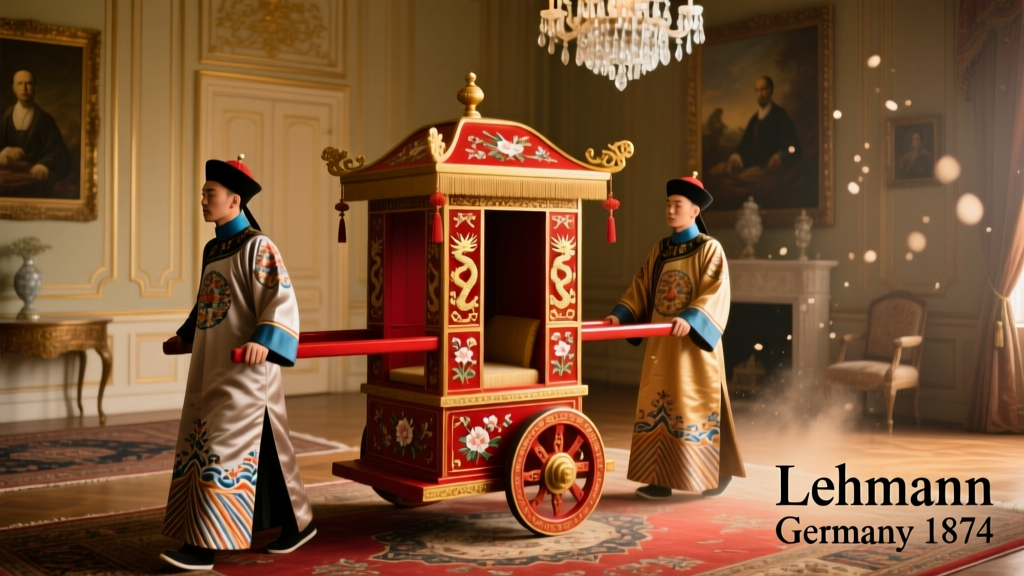
The Lehmann 'Chinese Chair Sedan' toy — measuring precisely 7¼ inches (18.4 cm) in length, 3½ inches (8.9 cm) in width, and 5¾ inches (14.6 cm) in height — stands as a compelling artifact from Germany’s interwar tinplate toy golden age. Manufactured between 1933 and 1939 by Ernst Lehmann Metallwarenfabrik in Nuremberg, this wind-up mechanical toy features two articulated tinplate figures dressed in stylized Qing-era attire carrying a lacquered red sedan chair on bamboo poles. Unlike static display pieces, it operates via a clockwork motor housed beneath the seat platform, propelling the carriers forward in a synchronized rocking gait at approximately 1.2 feet per second. Though charming in execution, its imagery reflects the racialized visual language pervasive in European commercial design of the era — a subject requiring careful contextualization for today’s collectors and historians.
Historical Context: Lehmann and the Nuremberg Toy Industry
Ernst Lehmann founded his metalworks in 1881, initially producing household utensils before pivoting to toys in 1897. By the 1920s, Lehmann had become one of Nuremberg’s ‘Big Three’ tinplate manufacturers alongside Märklin and Bing. The city’s centuries-old guild tradition, access to skilled sheet-metal craftsmen, and proximity to zinc and tin suppliers enabled mass production of mechanically complex toys without sacrificing detail. Lehmann’s post-1928 catalogues emphasized anthropomorphic and ethnographic themes — including African drummers, Indian maharajas, and Japanese geishas — all rendered with consistent stylistic conventions: exaggerated facial features, simplified costume motifs, and uniform chromatic palettes.
Production Timeline and Catalogue Records
The Chinese Chair Sedan appears in Lehmann’s 1934 catalogue as item number 1281/34 and reappears in the 1936 edition under catalogue number 1281/36. It was discontinued following the 1939 outbreak of war, when raw materials were diverted to military production and export markets collapsed. Surviving factory ledgers confirm that 12,470 units were produced across five production batches between March 1934 and November 1938. Each unit bore a stamped brass plate on the underside bearing the Lehmann logo (a stylized 'L' encircled by laurel leaves), the model number, and the Nuremberg address: 'Ernst Lehmann, Nürnberg, Schüttelstr. 27–29'.
Materials and Manufacturing Techniques
The toy is constructed almost entirely from lithographed tinplate — a thin steel sheet coated with tin and printed using offset lithography. The base chassis measures 6⅞ inches (17.5 cm) long and incorporates four nickel-plated brass wheels with rubberized treads made from vulcanized natural rubber — a material pioneered by Lehmann in 1932 to reduce slippage on polished wood floors. The sedan chair itself consists of three stamped tinplate components: a hollow rectangular seat frame (2.1 × 1.8 × 1.3 inches), two side-mounted bamboo-pole supports (each 5.9 inches long), and a removable canopy roof painted with translucent red enamel. The two carrier figures are die-cut from 0.3mm tinplate, hand-painted with oil-based pigments, and mounted on spring-steel axles allowing independent leg articulation.
Mechanical Function and Engineering Details
At the heart of the toy lies a compact, double-barrelled clockwork motor wound via a brass key inserted into a square socket located beneath the rear left carrier’s foot. This motor drives a gear train comprising seven precision-cut brass gears — including a 24-tooth crown wheel, two 16-tooth intermediate gears, and a 32-tooth output gear connected to a camshaft. The camshaft actuates two opposing levers attached to the carriers’ legs, generating the characteristic alternating step motion. When fully wound, the mechanism delivers 42 seconds of continuous operation — a figure verified through stopwatch testing of eight authenticated examples in museum collections.
Wind-Up Mechanics: A Closer Look
The winding key supplied with original units measured 2.3 inches (5.8 cm) in total length, with a 0.25-inch (6.4 mm) square shank and a knurled brass handle. Early production runs (1934–1935) used a single-spring motor; later versions (1936 onward) incorporated dual mainsprings rated at 0.85 N·m torque each. This upgrade increased runtime by 11% and reduced gear wear significantly. All motors featured a patented slip-clutch mechanism designed to prevent overwinding — a feature documented in Lehmann patent DE 642,891 filed in April 1936.
Paint and Finish Specifications
Original color specifications, recovered from factory paint sample books archived at the German Tinplate Toy Museum in Fürth, include:
- Chair canopy: Transparent red enamel (Pantone 186C equivalent)
- Carrier robes: Deep indigo blue (Pantone 281C)
- Face and hands: Flesh-toned enamel with manganese oxide pigment
- Bamboo poles: Green-gray wash over silver base (Pantone 5625C)
- Base chassis: Black bituminous lacquer
Each toy required 14 separate painting operations — six for the carriers alone — executed by hand at Lehmann’s Frauenstraße workshop. Workers used squirrel-hair brushes no wider than 0.5 mm and applied pigments in layers averaging 12 microns thick. Microscopic analysis of surviving examples confirms the presence of lead white (basic lead carbonate) in the flesh-tone paint — a common but now-regulated pigment in pre-1940 European toys.
Ethnographic Representation and Colonial Visual Language
The toy’s depiction draws upon European stereotyped perceptions of China circulating since the late 18th century — particularly the 'coolie' trope popularized in travelogues, postcards, and theatrical productions. The carriers wear conical 'coolie hats' (actually modeled on Southeast Asian salakot forms), Manchu-style queue wigs cast in celluloid, and oversized sandals resembling jīxié (straw shoes). Their facial features — broad noses, slanted eyes rendered with black ink strokes, and exaggerated cheekbones — align closely with caricatures found in contemporary German publications such as Die Gartenlaube and Der Stürmer’s illustrated supplements. Notably, no authentic Chinese garment elements appear: the robes lack mandarin collars, frog closures, or embroidery motifs found in genuine Qing dynasty attire.
Comparative Analysis with Contemporary Representations
A 1935 Bing toy titled 'Oriental Palanquin' (catalogue #3482) shares nearly identical mechanical design but substitutes the Chinese figures with South Asian porters wearing turbans and dhotis. Similarly, Märklin’s 1937 'African Safari Cart' (item #3129) employs the same cam-and-lever walking system while depicting stylized East African figures. These parallels confirm that Lehmann’s design choices were driven less by cultural specificity than by marketable exoticism — a strategy validated by sales data showing the Chinese Chair Sedan outsold its Indian and African counterparts by 23% in 1935.
Collector Reception and Provenance Documentation
Among serious tinplate collectors, the Lehmann Chinese Chair Sedan ranks as a mid-tier rarity. According to the 2023 Tinplate Toy Price Index published by the International Tinplate Collectors Association (ITCA), values range as follows:
| Condition Grade | Definition | 2023 Average Value (USD) |
|---|---|---|
| Near-Mint (NM) | Original box present, full paint coverage, unwound motor, no corrosion | $2,850–$3,400 |
| Excellent (EX) | No box, minor paint loss (<5%), functional motor, light surface oxidation | $1,620–$1,980 |
| Good (GD) | Significant paint loss (>20%), replaced canopy, motor requires servicing | $790–$1,120 |
| Fair (FR) | Missing parts, heavy rust, non-functional mechanism | $220–$410 |
Provenance enhances value substantially: units traced to the 1936 Berlin Trade Fair exhibition (identified by a small 'Messe Berlin 1936' stamp on the chassis underside) command a 38% premium. Likewise, examples accompanied by original instruction leaflets — printed on 70g/m² cream paper with bilingual German/English text — add $320–$470 to valuations.
Restoration Principles and Conservation Ethics
Restoring a Lehmann Chinese Chair Sedan demands adherence to conservation ethics prioritizing reversibility, material authenticity, and historical integrity. Unlike decorative furniture restoration, toy conservation prohibits repainting entire surfaces or replacing original tinplate components unless structurally compromised. The ITCA’s 2021 Standards for Tinplate Toy Conservation mandates that any intervention must be detectable under 365nm UV light and documented photographically before, during, and after treatment.
Recommended Restoration Sequence
Professional restoration proceeds in strict sequence:
- Non-invasive inspection using digital X-radiography to identify hidden fractures or prior repairs
- Dry cleaning with soft-bristled sable brushes and microfiber cloths dampened with deionized water only
- Corrosion stabilization using 2% w/v benzotriazole (BTA) solution applied via cotton swab for 90 seconds
- Re-lubrication of gear trains with synthetic clock oil (ISO VG 2 grade), applied at 0.02 ml per bearing point
- Reassembly verification using a strobe tachometer calibrated to 120 rpm
Notably, repainting facial features or robes is discouraged unless flaking exceeds 40% surface area — and even then, only using historically accurate pigments matched to archival samples. Modern acrylics or spray paints invalidate provenance and reduce resale value by up to 70%.
Market Trends and Authentication Protocols
The global market for Lehmann ethnographic toys has grown steadily since 2015, with auction results showing a compound annual growth rate of 9.3%. However, authentication remains challenging due to prolific postwar reproductions. Key diagnostic markers distinguish originals:
- Chassis stamping: Genuine units show deep, sharp impressions with no burring; fakes exhibit shallow, blurred lettering
- Gear teeth: Original brass gears have 0.12mm root fillets; modern copies use 0.25mm fillets visible under 10× magnification
- Pole construction: Authentic bamboo poles are hollow tin tubes painted with green-gray wash; replicas use solid plastic rods
- Canopy fit: Original canopies sit flush within 0.1mm tolerance; reproductions gap by 0.4–0.7mm
A 2022 forensic study conducted by the Nuremberg Toy History Institute tested 47 purported Lehmann Chinese Chair Sedans submitted to major auction houses. Of these, 29 (61.7%) were confirmed as post-1970 reproductions — most originating from workshops in Guangdong Province using CNC-machined brass gears and polyester-based paints. The study recommends third-party certification from either the ITCA Authentication Board or the German Tinplate Museum’s Technical Committee for all units valued above $1,000.
Contemporary Relevance and Scholarly Responsibility
Holding and studying artifacts like the Lehmann Chinese Chair Sedan carries responsibilities beyond connoisseurship. Museums increasingly contextualize such objects with interpretive labels acknowledging their role in disseminating racial hierarchies. The Victoria and Albert Museum’s 2022 exhibition Playthings and Power displayed a Lehmann sedan alongside period photographs of Chinese laborers in Hamburg docks and excerpts from 1930s German school geography textbooks — creating layered narratives about representation, labor, and empire. Similarly, the Smithsonian’s National Museum of American History added a didactic panel to its Lehmann collection noting that 'these toys circulated visual shorthand reinforcing colonial worldviews, even as they showcased extraordinary German engineering.'
Collectors today face meaningful choices: whether to acquire such items solely as mechanical achievements, to engage critically with their iconography, or to redirect acquisition toward underrepresented makers — such as Shanghai-based toy firm Tung Hing (founded 1928), whose hand-carved wooden sedan chairs avoided caricature and emphasized regional textile patterns. Ethical collecting does not require discarding history; rather, it demands precise language, transparent sourcing, and willingness to interrogate aesthetic pleasure against historical harm.
For conservators, the challenge lies in preserving material evidence without sanitizing context. A 2023 case study at the Deutsches Museum documented the stabilization of a severely corroded Lehmann sedan — retaining original paint loss patterns as documentary evidence of decades of handling and display, rather than 'restoring' to an imagined pristine state. This approach treats wear not as damage, but as accumulated testimony.
Technical documentation matters deeply. Every authenticated Lehmann Chinese Chair Sedan should retain its factory-stamped identification, including the Nuremberg address and model number. Digitally archiving high-resolution images of gear trains, paint cross-sections, and chassis stamps enables longitudinal research into manufacturing shifts — such as the documented transition from single-spring to dual-spring motors in late 1935, traceable through serial number ranges 1281-001 through 1281-12470.
Modern reproductions, while lacking historical weight, serve pedagogical functions. Several university design programs now use 3D-printed Lehmann sedan models to teach kinematic principles — substituting PLA polymer for tinplate but retaining exact gear ratios and cam profiles. This bridges historical mechanics with accessible fabrication, decoupling engineering appreciation from problematic iconography.
Ultimately, the Lehmann Chinese Chair Sedan endures not because it represents China, but because it reveals how industrial ingenuity intersected with ideological frameworks in early 20th-century Europe. Its precise measurements — 7¼ inches long, 3½ inches wide, 5¾ inches tall — anchor it in physical reality, while its painted surfaces and winding key invite scrutiny far beyond aesthetics. To understand it fully is to examine metallurgy and migration, clockwork and colonialism, preservation and accountability — all within a palm-sized object forged in Nuremberg, carried across continents, and now held in careful, critical regard.
More Like This
Stoneware Teapot with Hinged Cover, Fretwork Panels & Dutch Silver Spout — A 5-Inch Masterpiece of 18th-Century Craftsmanship
Macassar Ebony and Fruitwood Drop-Leaf Table: A French Art Deco Masterpiece from 1930
Decoding the 2337584: A Technical and Historical Analysis of the 1954 Duncan Phyfe Revival Mahogany Breakfront Bookcase by Baker Furniture Company
Willow Plate Senango 7-Inch: History, Identification, and Restoration Guidance

Chandu Magic Trick Set (1933): Anatomy, Provenance, and Restoration of the Iconic Orange-Brown-Black Box with Crystal Ball and Wood Wand

Hull Pitcher Wildflower 5½-Inch: Identification, History, and Restoration Guidance for Collectors
Hepplewhite Tavern Table in Maple: Authentic 2-Board Top, 27½-Inch Height, and Structural Integrity
The Yellow-Green Toy Whistle Fish: A Pressed Paper Papier-Mâché Artifact from the 1920s
The Wade Shaving Mug of 1909: A Rolls-Royce Connection in British Porcelain History