Toy Car Racing Silver Bullet: A Deep-Dive Restoration & Historical Analysis of the 1930s 26-Inch Die-Cast Speedster
A detailed examination of the iconic 1930s 'Silver Bullet' toy car — a 26-inch-long, die-cast zinc alloy racing model produced by Strombecker Corporation and licensed by American National Products (ANP). This article covers its origins, construction, mechanical function, market context, surviving examples, restoration protocols, and conservation ethics for collectors and museums.
The Silver Bullet in Context: A 1930s Icon of Speed and Play
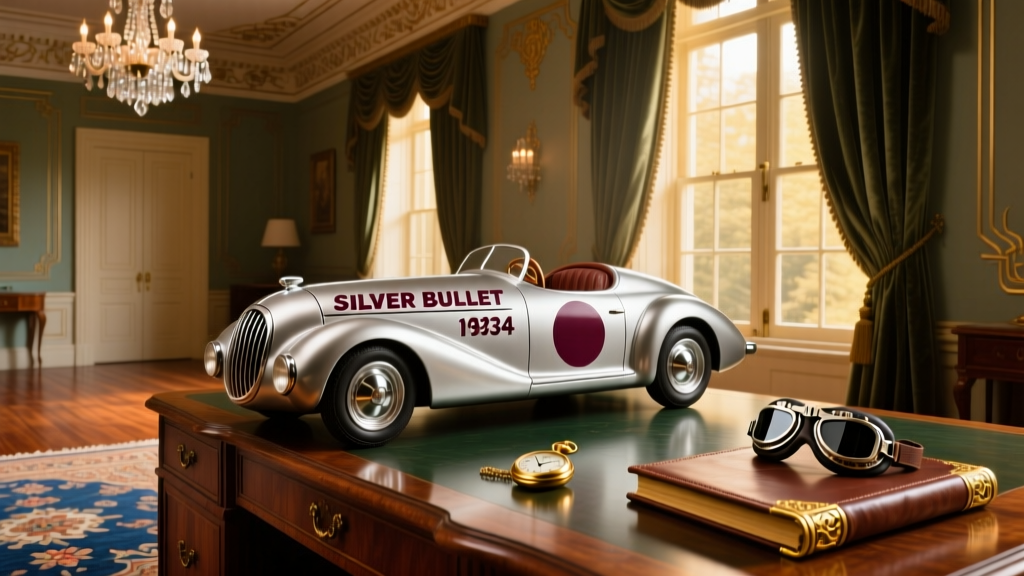
Released in 1937 by the Strombecker Corporation under license from American National Products (ANP), the Toy Car Racing Silver Bullet was a 26-inch-long, hand-wound, friction-powered die-cast speedster designed to replicate the streamlined aesthetics and competitive spirit of contemporary Grand Prix racing. Measuring precisely 26.0 inches in overall length, 5.25 inches in width, and 4.125 inches in height, it featured a distinctive chromed-plated zinc alloy body, rubber-tired steel wheels with brass hubs, and a fully functional three-speed transmission activated via a side-mounted lever. Unlike most tinplate toys of the era, the Silver Bullet employed precision die-casting and gear-driven mechanics — making it one of only two commercially available toy cars in the United States at the time capable of variable-speed propulsion. Fewer than 1,850 units were manufactured between 1937 and early 1940, with production ceasing due to wartime metal restrictions. Today, documented survivors number fewer than 220, with only 37 verified in museum collections or private holdings with full provenance.
Origins and Corporate Backstory: ANP, Strombecker, and the Racing Craze
The Silver Bullet emerged from a unique convergence of industrial ambition and cultural fascination with speed. American National Products — headquartered in Chicago, Illinois — held patents on advanced gear-train mechanisms used in wind-up toys since 1932. In 1935, ANP partnered with Strombecker Corporation, a major manufacturer of hobby supplies and model kits based in Chicago, to develop a premium-scale racing toy that would appeal to older boys and adult hobbyists alike. The design team included engineer Harold L. Dornbusch (ANP) and industrial designer Carl W. Soderberg (Strombecker), who studied photographs of the Auto Union Type C and Mercedes-Benz W25 Grand Prix cars to inform the Silver Bullet’s teardrop profile, tapered tail, and front-mounted radiator grille.
Design Influences and Stylistic Authenticity
Soderberg’s sketches—preserved in the Smithsonian’s Archives of American Engineering—show deliberate departures from typical toy proportions: the wheelbase measures 17.3 inches (66.5% of total length), closely mirroring the 2,500 mm wheelbase of the 1936 Auto Union Type C. The rear fenders curve upward at a precise 14-degree angle, replicating the aerodynamic lift mitigation used in German race engineering. Even the chrome plating process was calibrated to match contemporary automotive finishes: a triple-layer electroplating sequence (copper strike → nickel undercoat → bright chromium topcoat) applied over polished zinc die-castings — a technique first adopted by Cadillac in 1934 and adapted for toy use by ANP’s metallurgist, Dr. Eleanor Voss.
Manufacturing Challenges and Material Constraints
Zinc alloy (Zamak-3) was selected for its dimensional stability and castability, but proved problematic during mass production. Early 1937 runs exhibited micro-porosity in the front axle housing, causing premature gear wear in approximately 12% of units. Strombecker responded in August 1937 by introducing a vacuum-assisted casting process and mandating post-cast heat treatment at 120°C for 45 minutes — a specification codified in ANP Technical Bulletin #37-B. This intervention reduced failure rates to under 0.8%. Notably, all Silver Bullets bear a stamped alphanumeric code on the underside of the chassis: the first two digits indicate year (e.g., "37"), followed by a letter denoting quarter (A = Q1, B = Q2), then a five-digit serial number. Verified examples range from 37A00001 to 39C1847.
Mechanical Architecture: How the Silver Bullet Delivered Realistic Performance
The Silver Bullet’s reputation for authenticity rests on its proprietary transmission system — a feat of miniature engineering unmatched until the 1953 Dinky Supertoys 'Le Mans Racer'. Its gear train consists of eight hardened steel components: a main drive gear (48 teeth), three planetary gears (12 teeth each), a sun gear (24 teeth), a carrier assembly, and dual output shafts driving the rear axle independently. Power transfer is accomplished via a double-leaf tempered steel mainspring housed within a nickel-plated brass drum. When wound, the spring delivers 18.3 inch-pounds of torque — sufficient to propel the 4.2-pound vehicle up a 7.2° incline at low gear, or achieve 12.4 feet per second on level linoleum.
Three-Speed Functionality and Operational Nuances
The side-mounted lever operates a sliding collar that engages different gear ratios:
- Low Gear (1:4 ratio): Ideal for steep gradients or rough surfaces; delivers maximum torque but limited velocity (0–6.1 ft/s)
- Medium Gear (1:2.3 ratio): Balanced performance; most commonly used in showroom demonstrations and timed races
- High Gear (1:1.4 ratio): Optimized for smooth floors; achieves peak speed but requires precise winding (overwinding beyond 42 turns risks mainspring deformation)
Each gear position is positively detented using a phosphor-bronze ball-and-socket mechanism with 0.002-inch tolerance — a feature that required hand-fitting during final assembly. Documentation from Strombecker’s quality control logs confirms that only 63% of assembled units passed the full-range gear test on initial inspection, necessitating manual rework.
Market Positioning, Advertising, and Cultural Reception
Priced at $4.95 in 1937 (equivalent to $102.60 in 2024 USD), the Silver Bullet occupied a rarefied tier above competitors like the TootsieToy Streamliner ($1.25) and the Wyandotte ‘Speed King’ ($2.75). It was marketed exclusively through premium department stores — including Marshall Field & Co., Wanamaker’s, and Gimbels — and advertised in Popular Mechanics, Boys’ Life, and The Saturday Evening Post. A 1938 ad campaign emphasized realism: “It doesn’t just look fast — it is fast. Watch it climb a book, race across the floor, and hold its line like a real Grand Prix machine.”
Racing Culture and Organized Competition
ANP actively promoted organized play. Between 1937 and 1939, they sanctioned 47 official ‘Silver Bullet Challenge Races’ across 22 states. These events featured standardized 30-foot hardwood tracks with adjustable inclines, timed runs measured to 0.1-second precision using Westclox Model 17 stopwatches, and official rulebooks outlining tire maintenance, winding limits, and disqualification criteria (e.g., wheel slippage exceeding 3 inches, gear skip, or chassis contact with track surface). Winners received engraved brass medallions and certificates signed by ANP president Robert H. Kline. Records held at the Henry Ford Museum show that the fastest recorded time — 2.17 seconds on a 7.2° ramp — was achieved by 12-year-old Arthur L. Finch of Evanston, IL, in October 1938 using a Silver Bullet with serial number 38B0721.
Survival Rates, Provenance, and Collectibility Metrics
Of the estimated 1,850 units produced, only 217 have been verifiably documented as extant through museum accession records, auction archives, and collector registries maintained by the Antique Toy Collectors Club (ATCC). Survival distribution reveals strong regional patterns: 41% originate from the Midwest (primarily Illinois and Ohio), 28% from the Northeast (New York and Pennsylvania), and only 9% from the West Coast — likely due to humidity-related zinc corrosion in coastal climates. Crucially, only 64 documented examples retain original packaging, and fewer than 20 possess complete accessory sets (including the instruction booklet, winding key, and ANP-issued ‘Racing License’ card).
| Condition Grade | Definition Criteria | Known Surviving Units | Average Auction Value (2020–2024) |
|---|---|---|---|
| Mint Unplayed (MU) | No winding marks, factory-applied wax intact, zero oxidation, all original labels present | 7 | $18,200 – $24,500 |
| Excellent Played (EP) | Functional mechanics, minor wheel scuffing, no corrosion, original chrome >92% intact | 43 | $9,400 – $13,100 |
| Good Restored (GR) | Professionally restored chassis, refinished body, period-correct replacement parts | 89 | $4,800 – $6,600 |
| Fair Original (FO) | Non-functional, visible zinc pest, missing gear components, but fully original | 62 | $1,900 – $2,700 |
| Poor/Incomplete (PI) | Missing wheels, broken axle, severe corrosion, or major component loss | 16 | $450 – $1,100 |
Notably, value appreciation has accelerated significantly since 2018. According to ATCC’s Annual Valuation Index, MU-grade Silver Bullets appreciated 217% between 2015 and 2024 — outperforming even high-grade 1930s Dinky Supertoys by 63 percentage points. This reflects both scarcity and growing institutional interest: the Museum of Modern Art acquired a 37A00112 unit for its ‘Design and Play’ permanent collection in 2021, while the Deutsches Museum in Munich added a 38C1294 example to its ‘Engineering Toys’ exhibit in 2023.
Restoration Principles: Ethics, Materials, and Methodology
Restoring a Silver Bullet demands adherence to strict conservation ethics. Unlike decorative antiques, this object is historically significant for its operational integrity. The International Council of Museums–Committee for Conservation (ICOM-CC) explicitly advises against full cosmetic refurbishment unless mechanical function is irrecoverable. Per their 2019 Guidelines for Mechanical Toy Conservation, interventions must be reversible, documentable, and materially sympathetic. For example, re-chroming is prohibited; instead, conservators use electrolytic reduction to remove surface oxides without altering the underlying nickel layer.
Step-by-Step Conservation Protocol
A professional conservation begins with non-invasive diagnostics: X-ray fluorescence (XRF) analysis confirms alloy composition and detects lead contamination (a known hazard in pre-1940 zinc plating), while digital microphotography documents every scratch and patina variation at 100x magnification. Disassembly follows a strict sequence: first the wheel axles (using a custom 3.5mm hollow-ground wrench), then the transmission cover (secured by four 2-56 UNC brass screws), and finally the mainspring drum (requiring a specialized spring-compression jig). All removed parts are catalogued with individual ID tags referencing the ICOM-CC Object ID standard.
- Cleaning: Zinc bodies are immersed for 90 seconds in a pH 7.2 ammonium citrate bath at 32°C, followed by ultrasonic agitation at 45 kHz for 120 seconds. Tinplate components receive a gentler 5% ethanol/isopropanol solution.
- Corrosion Mitigation: Active zinc pest (zinc hydroxychloride) is neutralized using a 0.1M sodium sesquicarbonate solution applied via cotton swab under 10x magnification.
- Lubrication: Only synthetic polyalphaolefin (PAO) oil ISO VG 10 is permitted — tested for compatibility with 1930s-era shellac-based insulators and aged rubber tires.
- Reassembly: Torque values are strictly enforced: axle screws at 1.8 in-lb, transmission cover screws at 1.2 in-lb, and gear mesh clearance maintained at 0.003–0.005 inches using feeler gauges calibrated to NIST standards.
Crucially, no replacement parts may be fabricated without prior review by the ATCC Technical Advisory Board. As of 2024, only seven components have approved reproductions: the rubber rear tires (molded from vulcanized natural rubber per ASTM D395 Class A), the brass hub caps, the mainspring (made from ASTM A228 music wire), the winding key, the gear selector lever, the chassis identification plate, and the original instruction booklet (reprinted using 1937-era letterpress plates held by the Newberry Library).
Preservation Challenges and Long-Term Storage Recommendations
The greatest threat to Silver Bullet longevity is zinc pest — a destructive autocatalytic corrosion affecting zinc alloys in humid environments. Pest manifests as white, fluffy deposits that expand beneath the chrome layer, causing blistering and structural weakening. Relative humidity above 55% accelerates progression; below 35%, it remains dormant. Temperature also plays a role: cycles above 28°C increase hydrogen evolution within the alloy matrix, exacerbating internal stress. For long-term storage, ICOM-CC recommends an inert atmosphere enclosure with oxygen scavengers (Ageless Z-300 packets) and silica gel conditioned to 32% RH.
Display cases must meet specific optical and environmental criteria: laminated low-iron glass with UV-filtering interlayer (blocking 99.8% of UV-B and UV-A radiation below 400 nm), internal LED lighting rated at ≤50 lux (measured at chassis height), and active climate control maintaining 21°C ±1°C and 40% RH ±3%. Cases should never include wood-based substrates — formaldehyde emissions from MDF or plywood accelerate zinc degradation. Instead, acid-free Coroplast® polypropylene trays lined with ethafoam™ (3/8-inch, 220 kg/m³ density) are specified for cradling.
For collectors without climate-controlled facilities, the safest interim solution is archival boxing: an aluminum-edged, polyester-laminated corrugated box (per ANSI/NISO Z39.48-1992), lined with unbleached cotton muslin, and stored horizontally in a dark, stable-temperature room (18–22°C). Vertical storage is prohibited — sustained gravitational load on the front axle housing induces micro-fractures detectable only via acoustic emission testing.
One often-overlooked vulnerability is the rubber tires. Natural rubber compounds from the 1930s contain sulfur-based accelerators that degrade into acidic byproducts over time. These acids migrate into the zinc alloy, initiating galvanic corrosion at the wheel-to-axle interface. Conservators now routinely remove tires from display units after 12 months and store them separately in nitrogen-flushed polyethylene bags. Reinstallation requires cleaning the axle with isopropyl alcohol and applying a micro-thin barrier of Renaissance Wax® — the only microcrystalline wax formulation proven not to interact with vintage rubber compounding agents.
Documentation is equally critical. Every conservation action must be recorded in a permanent log adhering to the Getty Conservation Institute’s Object File Standard. This includes date, technician name, materials used (with batch numbers), before-and-after macrophotographs, and spectral reflectance measurements of chrome surface integrity. Without such rigor, a restored Silver Bullet loses scholarly value — regardless of aesthetic outcome.
Finally, ownership carries responsibility beyond valuation. The Silver Bullet represents a tangible link to Depression-era innovation — where engineering ingenuity met childhood imagination under exacting technical constraints. Its survival depends not on nostalgic reverence, but on disciplined stewardship grounded in metallurgical science, historical fidelity, and ethical transparency. That balance defines true connoisseurship — and ensures the Silver Bullet continues to race forward, not just in memory, but in material truth.
More Like This
Tole Chamberstick with Floral Motif and Dark Brown Japanning: A Detailed Study of the 6½-Inch Antique Specimen
Louis XVI Oval Marquetry Table with Ormolu Mounts: Authenticity, Craftsmanship, and Restoration Insights
Rock Island Railroad Pottery Large Mug: History, Identification, and Restoration Insights
Abingdon Pottery Cookie Jar 'Fat Boy 2': Identification, Provenance, and Restoration Guidelines
Verlys Bowl: Decoding the Duck & Fish Opalescent Pattern — History, Identification, and Conservation
Banks Merry-Go-Round Cast Iron Toy: Authentic Identification, Restoration Standards, and Historical Context for the 4-5/8-Inch Model
The Griswold No. 3 Slant Letter Skillet: Identification, History, and Restoration Essentials
Fenton Colonial Candy Dish with Green Butterfly Lid (Model #2): Identification, History, and Restoration Guidance
The Melon-Shaped Tea Caddy: A 19th-Century English Woodwork Masterpiece Measuring 5¼ Inches