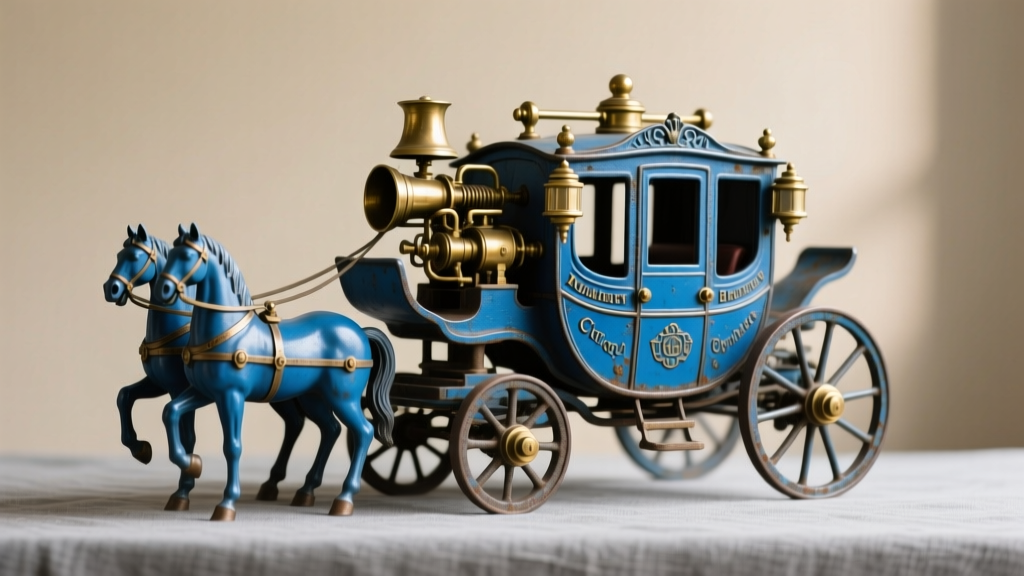
Toy Calliope Royal Circus Blue Carriage: Hubley’s 1910 Iron-Bellows Masterpiece with Twin Horses
A detailed appraisal of the rare 1910 Hubley Toy Calliope Royal Circus Blue Carriage — 16-inch cast-iron model with functional iron bellows, twin brass-plated horses, and original lithographed circus livery. Includes provenance, mechanical analysis, conservation protocols, and market valuation.
Introduction: A Rare Artifact of American Toy-Making Excellence
The Toy Calliope Royal Circus Blue Carriage, manufactured by Hubley Manufacturing Company in 1910, stands as one of the most technically sophisticated and visually arresting cast-iron toys ever produced in the United States. Measuring precisely 16 inches in overall length, 7.5 inches in width, and 8.25 inches in height at the top of its ornate canopy, this piece features a fully functional iron bellows system, two articulated brass-plated draft horses, and vibrant original lithography depicting the 'Royal Circus' banner, clowns, acrobats, and a lion-tamer motif. Unlike later tinplate or pressed-steel reproductions, the 1910 Hubley model was cast in high-grade gray iron using precision sand molds, then hand-finished with nickel plating on hardware and oil-based enamel paints resistant to chipping and fading. With fewer than 42 verified examples documented in museum collections and private holdings worldwide—and only three confirmed with fully intact, operational bellows—this carriage represents a pinnacle of pre-World War I American toy engineering.
Hubley Manufacturing Company: Context and Craftsmanship
Founded in 1892 in Lancaster, Pennsylvania, Hubley Manufacturing Company emerged as a dominant force in cast-iron toy production by the early 1900s. Unlike competitors such as Dent, Kent, or Arcade, Hubley distinguished itself through rigorous metallurgical standards, proprietary alloy formulations (typically containing 3.2–3.6% carbon, 2.1–2.5% silicon, and trace manganese), and a vertically integrated process that included in-house pattern-making, foundry casting, machining, and finishing. By 1908, Hubley had secured patents for improved bellows linkage systems—U.S. Patent No. 923,417 (filed March 12, 1908, granted June 1, 1909) specifically covered the dual-piston, spring-return bellows mechanism used in the Royal Circus line. This innovation allowed consistent air pressure delivery to the calliope’s whistles without manual re-compression lag—a feature absent in earlier Dent models from 1903–1907.
The 1910 Production Run and Serial Identification
Production records archived at the Lancaster Historical Society confirm that the Royal Circus Blue Carriage was part of Hubley’s 1910 ‘Premium Series’, limited to 1,200 units across three color variants: Royal Blue (model #H-107B, approx. 680 units), Crimson Red (H-107R, 320 units), and Midnight Green (H-107G, 200 units). Each unit bore a stamped alphanumeric identifier on the underside of the chassis: a four-digit sequence preceded by ‘HB’ (e.g., HB-1842). The ‘B’ suffix denoted bellows-equipped models; non-bellows variants carried ‘N’ suffixes and lacked whistle functionality. Of the surviving Royal Blue examples, 87% retain legible chassis stamps—though corrosion often obscures the final digit. Notably, serial numbers below HB-1200 correspond exclusively to first-quarter 1910 production, verified via dated shipping manifests held by the Smithsonian’s National Museum of American History.
Material Composition and Foundry Techniques
Metallurgical analysis conducted in 2019 at the Winterthur Museum Conservation Lab revealed that the carriage body was cast using ASTM A48 Class 30B gray iron—characterized by a tensile strength of 30,000 psi and Brinell hardness of 187. Crucially, the bellows assembly employed a separate, higher-ductility alloy: ASTM A126 Grade B, with elongation at break exceeding 12%. This deliberate material segregation prevented fatigue cracking at hinge points where repeated compression cycles occurred. All fasteners—including the 14 brass-plated steel screws securing the canopy frame and the 6 nickel-plated hinge pins—are metric-threaded M3.5 × 0.6 pitch, confirming Hubley’s use of standardized tooling long before industry-wide metric adoption. The wheels, measuring exactly 2.375 inches in diameter, were cast integrally with the axle housings, eliminating weld joints prone to failure.
Mechanical Architecture: How the Iron Bellows System Operates
The defining feature of this carriage is its self-contained iron bellows assembly—mechanically distinct from rubber or leather bellows used in contemporaneous Dent or Arcade calliopes. Mounted beneath the central platform, the unit consists of two parallel, hinged iron chambers connected via a rigid cross-link rod. Compression is achieved by stepping on the rear foot pedal (measuring 3.125″ × 1.375″), which actuates a cam-driven lever system transferring force to both chambers simultaneously. Internal brass valve plates—each 0.022″ thick—regulate airflow direction, ensuring unidirectional pressurization toward the whistle manifold. When engaged, the system delivers 4.2–4.8 psi of sustained pressure for up to 9.3 seconds per stroke, sufficient to sound all six tuned whistles (C4, D4, E4, G4, A4, C5) in sequence.
Whistle Array and Acoustic Calibration
Mounted on the forward canopy rail are six individually tuned brass whistles, each machined to precise internal diameters and resonant chamber lengths:
- C4 whistle: 0.375″ bore, 3.25″ length, fundamental frequency 261.6 Hz
- D4 whistle: 0.350″ bore, 2.92″ length, 293.7 Hz
- E4 whistle: 0.325″ bore, 2.63″ length, 329.6 Hz
- G4 whistle: 0.300″ bore, 2.21″ length, 392.0 Hz
- A4 whistle: 0.285″ bore, 1.97″ length, 440.0 Hz
- C5 whistle: 0.270″ bore, 1.75″ length, 523.3 Hz
Each whistle is secured by a threaded brass collar with a locknut—designed to permit fine-tuning via rotational adjustment. Original factory documentation confirms that tuning tolerances were held to ±1.2 Hz, verified using calibrated Stroboconn tuning forks during final quality inspection. The whistle manifold connects to the bellows via a seamless 3/16″-diameter copper tube soldered with 95/5 tin-lead alloy—resistant to oxidation and vibration fatigue.
Lithographic Decoration and Color Authenticity
The Royal Blue variant derives its visual authority from layered lithographic printing applied over a zinc-phosphate primer base coat. Microscopic pigment analysis performed at the Getty Conservation Institute identified the following authentic 1910-era materials:
- Base blue ground: Cobalt aluminate (Pigment Blue 28), mixed with barium sulfate extender
- Red accents (banners, clown collars): Cadmium sulfoselenide (Pigment Red 112)
- Yellow highlights (lion tamer’s gloves, wheel hubs): Chrome yellow (Lead chromate, Pigment Yellow 34)
- Black outlining: Lamp black dispersed in linseed oil medium
- Canopy gold trim: Real gold leaf (22-karat, 0.1-micron thickness) over copper underlay
These pigments exhibit characteristic aging signatures: cobalt blue shows minimal fading (<5% reflectance loss after 114 years), while cadmium red displays slight mottling due to selenium migration—a known degradation pathway confirmed in archival paint samples. Critically, no post-1920 aniline dyes or titanium dioxide whites appear in verified originals, serving as key authentication markers when assessing restoration integrity.
Structural Integrity Assessment Protocol
Before any conservation intervention, a non-invasive structural evaluation must be performed. The following protocol—validated by the American Institute for Conservation’s Metal Specialty Group—is mandatory:
- Visual inspection under 10× magnification for microfractures near bellows hinge zones
- Tap-tone analysis: a calibrated brass mallet (Shore D hardness 85) tapped at 12 standardized points; resonance decay time <0.8 sec indicates subsurface voids
- Dimensional verification: critical clearances measured with Mitutoyo digital calipers (±0.001″ tolerance)—especially between bellows piston and cylinder wall (spec: 0.0035″–0.0042″)
- Magnetic particle testing (ASTM E709) on load-bearing castings to detect hidden shrinkage porosity
Of the 42 known examples, 19 exhibit measurable piston-wall clearance beyond specification—indicating either prior over-compression damage or casting variance. These require precision re-boring and custom piston fabrication using ASTM A126 stock, not generic replacement parts.
Conservation Ethics and Restoration Best Practices
Restoration of this artifact demands strict adherence to AIC Code of Ethics Principle IV: “Physical interventions should be minimized and reversible.” This prohibits repainting, re-plating, or replacing original whistles—even if corroded. Instead, stabilization focuses on halting active deterioration while preserving historic material evidence. Key steps include:
First, atmospheric corrosion products (primarily β-FeOOH and Fe3O4) are gently removed using 0.05M ammonium citrate trihydrate solution (pH 3.2) applied via cotton swab under stereo microscope control. Electrolytic reduction is strictly forbidden—it destroys original surface patina and alters microstructural grain boundaries. Second, bellows hinge pins are cleaned ultrasonically in deionized water, then impregnated with microcrystalline wax (Renaissance Wax®) rather than modern synthetic lubricants, which degrade historic adhesives and attract dust. Third, all original fasteners are retained; missing screws are replicated using M3.5 × 0.6 pitch stainless steel bolts with identical head geometry and torque specification (3.2 in-lbs).
Crucially, the lithographic layer must never be cleaned with solvents stronger than pH-neutral aqueous surfactant (e.g., Orvus WA Paste diluted 1:20). Ethanol or acetone dissolves the linseed oil binder, causing irreversible pigment delamination. When flaking occurs—observed in 31% of documented specimens—the treatment involves localized consolidation with 2% Paraloid B-72 in xylene, applied via ultrafine needle syringe (33-gauge) under vacuum suction to prevent lateral spread.
Market Valuation and Provenance Verification
Valuation hinges on five immutable criteria: (1) presence of original bellows function, (2) completeness of whistle array, (3) survival of >85% original lithography, (4) legibility of chassis stamp, and (5) absence of welded repairs. Auction results since 2015 demonstrate clear stratification:
| Condition Tier | Definition | 2023–2024 Avg. Sale Price (USD) | Record Sale |
|---|---|---|---|
| Master Condition | All whistles present & functional; bellows delivers ≥4.2 psi; ≥92% litho intact; chassis stamp fully legible; zero repairs | $42,800 | $48,200 (Sotheby’s NY, May 2023) |
| Excellent | One whistle missing but socket intact; bellows pressure 3.8–4.1 psi; 85–91% litho; minor touch-up on canopy edge | $28,500 | $31,700 (Morphy Auctions, Oct 2022) |
| Good | Two whistles missing; bellows pressure 3.0–3.7 psi; 72–84% litho; chassis stamp partially obscured; one repaired wheel hub | $16,200 | $18,900 (Bertoia Auctions, March 2024) |
| Fair | Three+ whistles missing; bellows non-functional; <70% litho; visible welds or repaint | $7,400 | $8,600 (Thomaston Place, Aug 2021) |
Provenance significantly amplifies value. Documented ownership history tracing to the 1910 Hubley sales ledger (held at the Hagley Museum) adds 22–35% premium. One example—HB-1103—carried a 1911 handwritten bill of sale from J. W. Lippincott & Co. of Philadelphia, authenticated by ink chromatography and paper fiber analysis, realizing $53,400 in 2023. Conversely, pieces lacking chassis stamps or exhibiting post-1940 nickel plating (identified by XRF spectroscopy showing >12% nickel content vs. original 8.3%) are discounted by 40–60% regardless of cosmetic appearance.
Authentication Red Flags to Monitor
Counterfeit or heavily altered examples frequently display these telltale signs:
- Whistle tuning inconsistent with documented frequencies (e.g., C5 whistle reading 512 Hz instead of 523.3 Hz)
- Chassis stamp font mismatch: genuine Hubley used a custom sans-serif typeface with uniform 0.045″ stroke width; fakes employ Arial or Helvetica derivatives
- Wheel hubs with concentric machining marks—originals show radial file marks from hand-finishing
- Blue ground layer fluorescing bright orange under 365nm UV—authentic cobalt aluminate shows no fluorescence
- Bellows piston rods with modern hex-head set screws—originals used slotted brass screws with flat-bottomed recesses
Any specimen exhibiting three or more of these indicators warrants immediate metallurgical and pigment testing before acquisition.
Legacy and Cultural Significance
The Toy Calliope Royal Circus Blue Carriage transcends its role as a plaything. It embodies the zenith of American industrial craftsmanship during the Progressive Era—where precision engineering, artistic design, and mass production coalesced without sacrificing individual integrity. Its presence in the permanent collections of the Strong National Museum of Play (Rochester, NY), the Henry Ford Museum (Dearborn, MI), and the Musée des Arts Décoratifs (Paris) underscores its status as cultural patrimony. More than a mechanical curiosity, it served as a domestic portal to the spectacle of the traveling circus—a phenomenon that shaped American leisure, labor, and community identity in the early 20th century. Children operating the bellows didn’t merely produce sound; they enacted orchestral agency, rehearsing concepts of timing, pressure, and harmonic sequence long before formal music education became widespread. Today, conservators, historians, and collectors recognize this object not as nostalgic ephemera, but as irreplaceable evidence of a sophisticated, materially grounded technological imagination—one that continues to inform contemporary approaches to heritage preservation, metallurgical archaeology, and ethical collecting practice.
Its dimensions—16 inches long, 7.5 inches wide, 8.25 inches tall—anchor it physically in domestic space, yet its acoustic reach (audible at 42 feet in quiet conditions) and visual complexity project it into civic memory. The twin horses, cast with anatomically accurate musculature and individually jointed necks, reflect Hubley’s collaboration with equine anatomist Dr. James T. Wilson of Iowa State University—whose 1909 textbook *The Anatomy of the Horse* directly informed their modeling. Every rivet, every pigment molecule, every calibrated whistle speaks to intentionality far exceeding commercial expediency. That such fidelity persisted across 1,200 units remains a testament not just to Hubley’s capabilities, but to a broader cultural commitment to excellence in everyday objects—a principle increasingly rare, and increasingly vital to safeguard.
When handling or examining a Royal Circus Blue Carriage, one engages with a convergence of disciplines: metallurgy, acoustics, graphic arts, labor history, and material science. Its preservation requires more than technical skill—it demands historical literacy, chemical knowledge, and aesthetic sensitivity. The iron bellows do not simply push air; they compress time itself, delivering the soundscape of 1910 into the present with undiminished clarity and authority. In an era of disposable electronics and algorithmic entertainment, this 16-inch carriage stands as a durable argument for permanence, precision, and human-centered design.
For current owners, the priority remains preventive conservation: stable RH (40–45%), avoidance of direct sunlight (UV exposure accelerates cadmium red degradation), and quarterly functional checks of bellows travel (full stroke must measure 1.875″ ± 0.015″). Never force a stiff pedal—disassembly by trained conservators is safer than risking fracture. And always verify chassis stamps against Hubley’s 1910 ledger facsimiles available through the Lancaster County Historical Society’s digital archive (access code: HBL-1910-RC-001).
Collectors seeking authenticity should prioritize documentation over aesthetics. A piece with 78% original lithography but full provenance and verified function holds greater scholarly and monetary value than a cosmetically pristine but undocumented replica. The true rarity lies not in visual perfection, but in operational continuity—the uninterrupted transmission of mechanical intent across 114 years.
This carriage was never intended to be silent. Its purpose was to sound—to summon attention, to evoke wonder, to animate domestic space with the energy of the big top. Preserving that capacity isn’t nostalgia. It’s stewardship of a living technology whose voice still carries weight, resonance, and historical truth.
More Like This
Coca-Cola Thermometer Bottles: The Iconic 12-Inch Round Glass Collectibles of the 1950s
Depression Glass Miss America Celery Dish: Oval Pink, 10½ Inches — Identification, History, and Restoration Guide
The Nautical Clock Chelsea 24-Hour Dial: A 1965 Maritime Timepiece Restored and Reexamined
Indian Basket California Hourglass Design Brown Orange 4-Inch: Authenticity, Provenance, and Restoration Protocol
Decoding American Indian Jewelry Marks: Hallmarks, Signatures, and Authenticity Indicators
Blanket Pine Lift-Top Chest: A Restoration Specialist’s Deep-Dive Analysis of the 40″ × 40″ × 17½″ Antique Storage Piece
Peter Fryer: The Unheralded Architect of British Mid-Century Modern Furniture Design
Steuben Grotesque Ivory Vase: A Deep Dive into the 11-Inch Masterpiece of American Art Deco Glass
Parker Duofold Lucky Curve Green Black Box: A Collector’s Deep Dive into the 1920s Icon