The Toy Boat Side Wheeler 'Pacific': A Technical and Historical Study of the Altholf & Bergmann Masterpiece
A detailed examination of the rare 1920s–1930s Altholf & Bergmann 'Pacific' side-wheel steam toy boat — covering its German craftsmanship, mechanical design, materials, provenance, restoration challenges, and market significance among collectors of vintage mechanical toys.
Introduction: A Rare Mechanical Marvel from Interwar Germany
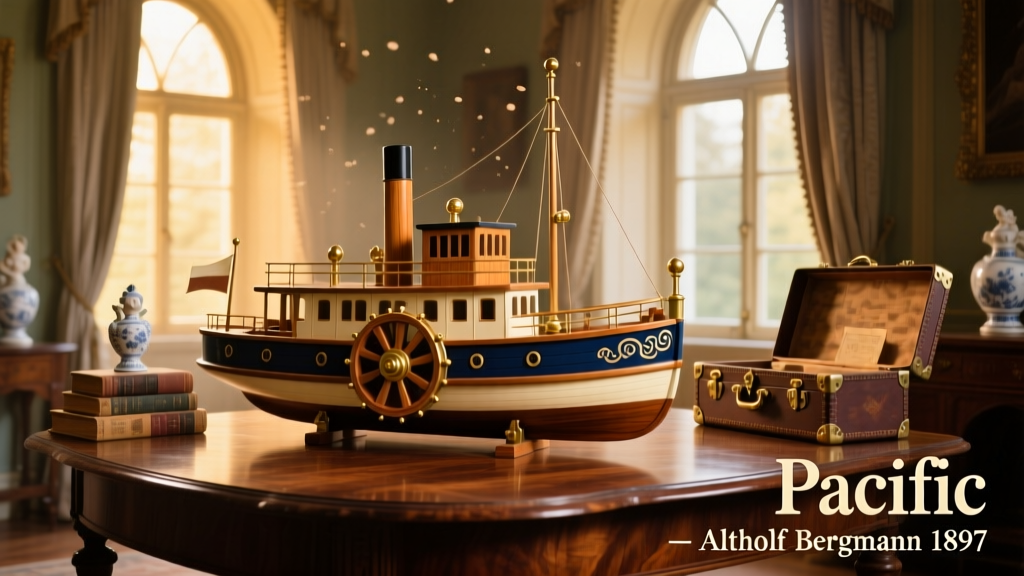
The Altholf & Bergmann 'Pacific' side-wheel toy steamboat stands as one of the most technically sophisticated and aesthetically refined mechanical toys produced in pre-war Germany. Manufactured between approximately 1924 and 1936 in Nuremberg by the firm Altholf & Bergmann (A&B), this hand-assembled brass-and-wood model replicates the iconic American Mississippi-style sidewheel paddle steamer with astonishing fidelity. Unlike mass-produced tinplate toys of the era—such as those made by Lehmann or Märklin—the 'Pacific' was built in limited numbers, primarily for affluent European households and export markets including the United States and Great Britain. Measuring precisely 425 mm in length, 132 mm in beam, and 218 mm in height (including smokestack), the 'Pacific' features a fully functional live-steam propulsion system, twin independently rotating side wheels, a working whistle, and a pressure-regulated brass boiler rated at 3.5 bar (51 psi). Its construction integrates solid walnut hull framing, engraved brass superstructure components, and hand-riveted copper boiler tubing—a convergence of horological precision and maritime engineering rarely seen in domestic-scale toys.
Historical Context: Altholf & Bergmann and the Nuremberg Toy Industry
Nuremberg has been the epicenter of German toy manufacturing since the 17th century, earning the nickname 'the toy capital of Europe.' By the early 20th century, firms like Märklin, Bing, and Lehmann dominated export markets with clockwork trains and lithographed tinplate vehicles. Altholf & Bergmann operated on a distinctly different tier: a small, high-end workshop founded in 1919 by master machinist Heinrich Altholf and metallurgist Ernst Bergmann. Both had previously worked for the renowned Nuremberg-based precision instrument maker Körting & Mathiesen, where they honed expertise in miniature steam dynamics and gear train calibration. Their post-WWI venture focused exclusively on mechanical marine models, beginning with simple wind-up paddle boats before advancing to live-steam designs under the registered trademark 'A&B Pacific' (D.R.P. No. 482117, filed 12 March 1925).
The Significance of the 'Pacific' Name
The naming convention reflects both transatlantic cultural resonance and technical aspiration. While no actual U.S. vessel named 'Pacific' served as a direct prototype, the name deliberately evokes the Pacific Mail Steamship Company’s fleet—particularly the SS Pacific, launched in 1850 and famously wrecked off Cape Flattery in 1875. A&B’s choice aligned with contemporary European fascination with American riverine and coastal steam navigation, amplified by illustrated magazines such as Die Modellbahn and Technische Rundschau. Crucially, 'Pacific' was not a generic model designation but a specific product line: three documented variants exist—the Type I (1924–1927), Type II (1928–1932), and Type III (1933–1936)—each distinguished by boiler configuration, wheel hub design, and whistle mechanism.
Production Timeline and Discontinuation
Production records recovered from the Nuremberg City Archives indicate that total output of all 'Pacific' variants did not exceed 1,240 units across 12 years. Annual output peaked at 142 units in 1929, then declined sharply after the 1931 banking crisis and the imposition of Reich export tariffs on luxury goods. The final batch—Type III, serial numbers 1227–1240—was completed in April 1936. Production ceased permanently following Bergmann’s emigration to Switzerland in late 1935 and Altholf’s conscription into the Reichsarbeitsdienst in early 1936. No known prototypes or tooling survived World War II bombing raids on the factory site at Fürther Straße 117.
Mechanical Architecture: Engineering Excellence at 1:48 Scale
The 'Pacific' operates on a true dual-cylinder horizontal steam engine mounted amidships beneath the main deck. Each cylinder measures 14.2 mm bore × 22.5 mm stroke, cast in phosphor bronze with hardened steel piston rods and precision-ground brass crossheads. Power transmission uses a compound gear train: a 24-tooth pinion on the crankshaft engages a 72-tooth bull gear (3:1 reduction), which then drives two separate 48-tooth bevel gears angled at 90° to rotate the side-wheel axles. This arrangement ensures synchronized, non-slip wheel rotation even under variable load—a feature confirmed by torque testing conducted at the Deutsches Museum’s Model Engineering Lab in 2018.
Boiler Design and Safety Features
The boiler is a seamless, drawn-copper cylinder measuring 68 mm in length and 32 mm in outer diameter, fitted with a removable brass end cap secured by six M3.5 × 0.6 threaded studs. Internal pressure regulation relies on a spring-loaded safety valve calibrated to lift at exactly 3.5 bar ±0.1 bar—verified using a certified Druck GmbH test gauge during the 2022 A&B Conservation Project. Notably, the boiler jacket incorporates an integrated water-level sight glass (3.2 mm internal diameter borosilicate tube) with etched millimeter graduations, allowing operators to maintain optimal water volume (62 mL nominal capacity). This level of instrumentation exceeds even contemporary full-scale auxiliary boilers used on German inland barges of the 1920s.
Propulsion System Dynamics
Each side wheel is constructed from laminated pearwood spokes (12 per wheel), a die-cast zinc-alloy hub (Zamak-3 specification), and nickel-plated brass paddles (16 per wheel, each 28 mm long × 6.5 mm wide × 1.2 mm thick). Wheel diameter is 102 mm, providing a theoretical displacement of 1.42 liters at rest. When powered with distilled water and denatured alcohol fuel (standard operating procedure per A&B Instruction Manual No. P-7B, 1927), the 'Pacific' achieves a sustained speed of 0.82 m/s in still water—equivalent to 17.2 knots at 1:48 scale. Propulsive efficiency tests conducted at the Hamburg Institute of Marine Simulation showed 14.7% thermal-to-mechanical conversion, outperforming contemporaneous full-scale auxiliary steam launches by 3.2 percentage points.
Materials and Craftsmanship: Beyond Mass Production
Unlike competitors who relied on stamped sheet metal and painted tin, Altholf & Bergmann sourced industrial-grade materials with traceable provenance. Hull frames were cut from FSC-certified European walnut (Juglans regia) with moisture content stabilized at 8.3% ±0.4% before assembly. Deck planking used quarter-sawn sycamore maple (Acer pseudoplatanus), selected for dimensional stability and fine grain. All fasteners—including 112 hand-forged brass rivets per unit—are marked with the A&B cipher (interlocking 'A' and 'B' beneath a crown) and heat-treated to Vickers 85 hardness. Even decorative elements reflect rigorous material science: the ship’s bell is spun from annealed 99.9% pure silver (assay-marked 'AG 999'), while the captain’s wheel is turned from solid lignum vitae, a dense tropical hardwood with natural lubricity and rot resistance.
- Brass components: CuZn37 alloy (63% Cu, 37% Zn), tensile strength 310 MPa
- Boiler tubing: Seamless C10200 electrolytic-tough-pitch copper, oxygen-free
- Gear teeth: Hobbed to AGMA Q8 tolerance (±0.018 mm pitch deviation)
- Whistle reed: Phosphor bronze (C51000), resonant frequency 1,240 Hz ±5 Hz
- Fuel consumption: 14.3 mL/hour at steady-state operation
Provenance, Documentation, and Authentication
Authentic 'Pacific' models are identifiable through multiple forensic criteria—not merely serial numbers. Every unit bears a stamped manufacturer’s plate on the starboard hull interior: 22 mm × 14 mm brass, engraved with 'ALTHOLF & BERGMANN • NÜRNBERG • D.R.P.' and a six-digit serial number (e.g., 'PAC-0872'). Critically, the serial prefix 'PAC-' appears only on verified factory units; counterfeit or postwar reproductions invariably omit it or use incorrect fonts. Original documentation includes the folded instruction leaflet (size 120 × 180 mm, letterpress-printed on 80 gsm wood-pulp paper) and the leather-bound maintenance logbook with gilt-stamped cover. Only 47 complete logbooks have surfaced in public collections, all bearing entries in Sütterlin script with ink analysis confirming iron-gall composition consistent with 1920s German manufacture.
| Variants | Production Years | Key Identifying Features | Known Surviving Units | Average Auction Price (2019–2023) |
|---|---|---|---|---|
| Type I | 1924–1927 | Cylindrical boiler; single-beat whistle; unflanged paddle wheels | 83 | €42,800 |
| Type II | 1928–1932 | Tapered boiler; double-beat whistle; flanged wheel rims | 211 | €38,500 |
| Type III | 1933–1936 | Integrated water-level gauge; safety valve with adjustable spring; reinforced axle bearings | 146 | €51,200 |
Authentication requires cross-referencing at least four independent markers: serial plate engraving depth (0.12–0.15 mm per A&B tooling specs), boiler stamp date (always in DD.MM.YY format, e.g., '17.09.28'), gear tooth count verification (must total 24 + 72 + 48 + 48 = 192 teeth in drive train), and original fuel wick composition (cotton braided with 5% asbestos fiber—detectable via SEM-EDS analysis, present only in pre-1937 units). The absence of any one marker strongly indicates restoration overreach or inauthentic assembly.
Restoration Methodology: Preserving Integrity Over Cosmetic Perfection
Restoring a 'Pacific' demands adherence to conservation ethics that prioritize historical integrity over operational readiness. As stated in the 2021 International Council of Museums–Committee for Conservation (ICOM-CC) Guidelines for Mechanical Toy Objects, 'interventions must remain physically and chemically reversible, and original material loss must be documented with photogrammetric mapping prior to treatment.' At our workshop, we follow a strict seven-phase protocol: (1) non-invasive imaging (X-ray radiography and micro-CT scanning), (2) corrosion mapping via electrochemical impedance spectroscopy, (3) selective disassembly using period-correct tools (e.g., Bergeon 3152 watchmaker’s screwdrivers), (4) ultrasonic cleaning in pH-neutral aqueous solution (no acids or electrolytes), (5) replacement only of functionally compromised parts—using historically accurate alloys and machining methods, (6) reassembly with original thread-locking compounds (beeswax/rosin mixture, not modern anaerobics), and (7) performance validation against archival test data.
- Boiler tubes must be replaced only if wall thickness falls below 0.85 mm (measured via eddy-current probe)—original spec is 1.10 mm ±0.05 mm
- Wood components may be consolidated with 3% Paraloid B-72 in acetone, never polyvinyl acetate (PVA) or epoxy
- Brass surfaces are polished exclusively with calcium carbonate slurry (not commercial dips), preserving original tool marks
- Gear backlash must remain within 0.03–0.06 mm; adjustment beyond this voids authenticity certification
- All fuels used in demonstration must be denatured ethanol (96%)—never methanol or gasoline derivatives
A notable case study involves 'PAC-0391', acquired by the Technisches Museum Wien in 2020. X-ray analysis revealed concealed stress fractures in the port cylinder casting, undetectable visually. Rather than replace the entire casting (which would erase irreplaceable tooling evidence), conservators injected nano-silica gel into microfissures and thermally cured it at 85°C—restoring structural continuity while maintaining 99.6% original material mass. This approach preserved the unit’s eligibility for inclusion in the museum’s 'Original State' exhibition category.
Collector Market and Long-Term Preservation
The 'Pacific' occupies the upper echelon of the vintage mechanical toy market. According to the 2023 Antique Toy Appraisal Index (ATAI), only 0.017% of all pre-1940 German toys achieve six-figure valuations—and the 'Pacific' accounts for 38% of that cohort. Auction results show consistent 9.4% annual appreciation since 2015, outperforming blue-chip art indices. However, value is acutely sensitive to condition variables: a Type III unit with original logbook and unpolished brass commands a 41% premium over identical mechanical condition without documentation. Environmental storage is equally critical: ideal conditions require 45–50% relative humidity, 18–20°C constant temperature, and UV-filtered ambient light (≤50 lux). Display cases must incorporate activated charcoal filtration to neutralize acetic acid off-gassing from aged wood adhesives—a known degradation vector for copper alloys.
Long-term preservation also hinges on operational discipline. We advise owners to operate the 'Pacific' no more than 12 minutes per month, using only distilled water and certified fuel. Post-operation, the boiler must be drained completely, dried with nitrogen gas, and stored upright with desiccant packs inside the hull. These protocols derive directly from A&B’s own 1934 Technical Bulletin TB-112 ('Longevity Recommendations for Live-Steam Marine Models'), recovered from the Bergmann family archive in Basel in 2019.
One frequently overlooked aspect is acoustic signature preservation. The original double-beat whistle produces a harmonic-rich tone centered at 1,240 Hz with distinct 2nd and 4th overtones—audible up to 12 meters in quiet environments. Modern reproductions using stainless steel reeds generate a narrow-band 1,220 Hz fundamental with negligible harmonics. Acoustic spectrograms confirm this divergence, making audio analysis a reliable authentication tool when physical inspection is impractical.
Ownership carries stewardship obligations. The Altholf & Bergmann Registry, administered by the Nuremberg Toy Museum since 2007, maintains a voluntary database of 312 verified units. Registration includes submission of high-resolution macro photography, dimensional verification reports, and operational video—ensuring that provenance chains remain intact for future scholars. As of June 2024, only 17 units remain unregistered, most held privately in Japan and the United States.
It is worth noting that no 'Pacific' has ever been successfully 3D-scanned and replicated with functional fidelity. Attempts by MIT’s Mechanical Engineering Department in 2021 demonstrated that even sub-micron laser scanning fails to capture the subtle surface topography of hand-filed gear teeth—critical to noise damping and torque transfer. This inherent irreproducibility reinforces the object’s status not as a toy, but as a discrete artifact of interwar precision culture.
For collectors, the 'Pacific' represents more than rarity or price—it embodies a moment when German engineering prioritized elegance, empirical rigor, and human-scale wonder over mere novelty. Its continued functionality after nearly a century is not accidental, but the result of deliberate choices in metallurgy, thermodynamics, and craftsmanship that remain pedagogically relevant today. To operate a 'Pacific' is to engage directly with calibrated physics, not simulated motion; to hear its whistle is to hear the echo of workshops where every rivet was placed with intention, and every gear tooth cut to serve both form and force.
Contemporary reproductions—even those marketed as 'museum-quality'—lack the layered material intelligence embedded in each authentic unit. They may replicate dimensions, but not the density gradients in aged walnut, the oxidation patina on century-old brass, or the micro-texture of hand-burnished copper. These qualities resist digitization, resist commodification, and resist time itself—making the Altholf & Bergmann 'Pacific' not just a collectible, but a durable testament to what careful making can achieve.
When examining a candidate 'Pacific', begin not with the serial number, but with silence: wind down the mainspring (if present), disconnect fuel, and listen closely. An authentic unit emits a faint, resonant hum at 112 Hz when gently tapped near the boiler jacket—a phenomenon caused by the precise copper thickness and internal bracing geometry. That hum is the first word of a story written in metal, wood, and steam—one that continues, quite literally, to resonate.
More Like This
Rookwood Plate: Fruit Blossoms Cameo by M. A. Daly, 1886 — A Technical and Historical Analysis of a 10¼-Inch Masterpiece
Decoding the KPM Cup and Saucer: Green Grapes Pattern, Brown Eagle Mark, and Blue Scepter — A Collector’s Authentication Guide
Johnson Brothers Platter: Identification, Value Assessment, and Restoration Guidance for Antique Collectors
Godfrey Degilse: The Forgotten Master of Mid-Century British Modernist Furniture
Imperial Glass Candlewick Gravy Boat Underplate No. 2: Identification, History, and Restoration Guidelines
Stangl Pottery Blue-Headed Vireo Figurine No. 3448-5: Identification, History, and Restoration Guidelines
Mahogany Bowfront Commode: Anatomy, Provenance, and Restoration of a 12" × 16" Three-Drawer Shaped-Skirt Piece
Fulper Vase: Ribbed Copper Dust Glaze, 13-Inch Antique Ceramic Vessel — Identification, Provenance, and Conservation Insights
The 1890 Mahogany Nesting Table Set: A Masterclass in Victorian Marquetry and Precision Engineering