Toy Blocks American Skyline Building Set: Mid-Century Modern Play, Design, and Cultural Significance (1950s)
An in-depth examination of 1950s American skyline-themed wooden and plastic building blocks—manufactured by companies like Tootsie Toy, Playskool, and Lincoln Logs—covering materials, dimensions, architectural accuracy, marketing strategies, educational intent, and preservation challenges.
Introduction: The Skyline as Symbol and Toy
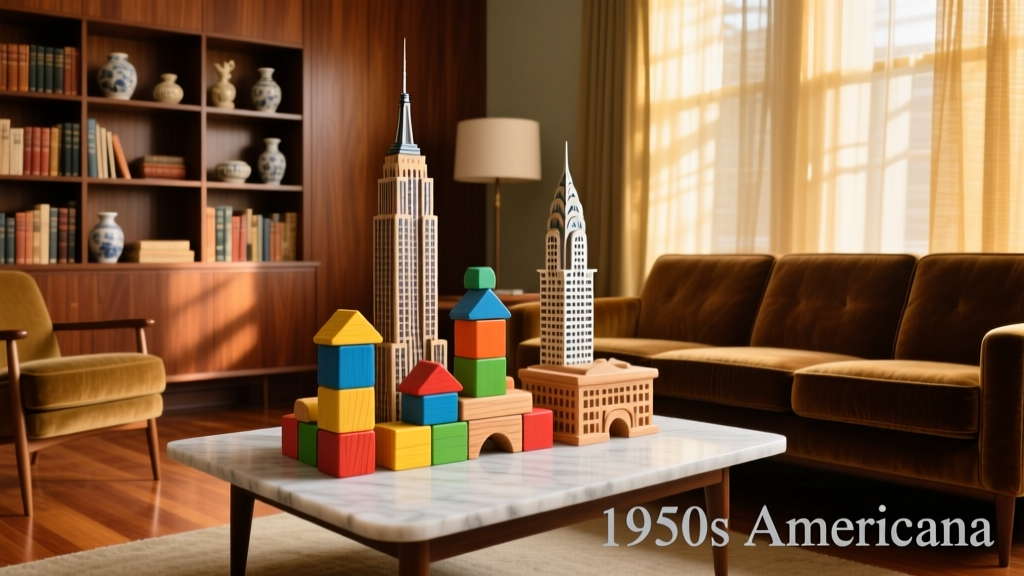
In the postwar United States, the urban skyline emerged not only as an icon of economic resurgence but also as a tangible object of childhood imagination. Between 1953 and 1959, several American toy manufacturers released building sets explicitly themed around the nation’s most recognizable cityscapes—particularly New York and Chicago. These were not generic block sets; they were curated miniatures of real skyscrapers: the Empire State Building (1,454 ft), the Chrysler Building (1,046 ft), the Tribune Tower (463 ft), and the Prudential Building (601 ft). Produced primarily in maple, birch, and cellulose acetate plastic, these sets measured precisely 1:240 to 1:300 scale—meaning a 12-inch model represented roughly 240–300 feet of actual structure. This article examines their physical construction, historical context, design fidelity, production timelines, and enduring value among collectors and educators alike.
Manufacturers and Production Timeline
Three primary firms dominated the skyline-themed building toy market in the 1950s: Tootsie Toy Company (Chicago), Playskool (Kenosha, WI, acquired by Milton Bradley in 1960), and Lincoln Logs (a subsidiary of Playskool after 1943). Each approached the skyline concept with distinct material philosophies and engineering priorities.
Tootsie Toy’s ‘Skyline Series’ (1954–1958)
Tootsie Toy launched its Skyline Series in spring 1954, capitalizing on the national fascination with New York’s vertical expansion following the completion of the Seagram Building (1958) and Lever House (1952). The series consisted of six interlocking plastic modules molded from injection-molded cellulose acetate—a thermoplastic known for clarity and rigidity but prone to yellowing and embrittlement over time. Each module was 3.25 inches tall and 1.75 inches square, with recessed grooves enabling vertical stacking. The set included labeled bases identifying each structure: Empire State, Chrysler, RCA, Woolworth, Flatiron, and the newly completed UN Secretariat Building (completed 1952, 505 ft). Packaging listed dimensions as "approx. 12" H when assembled," though actual assembled height varied between 11.8" and 12.3" due to minor mold tolerances.
Playskool’s ‘Architectural City’ Line (1955–1957)
Playskool entered the market in 1955 with its Architectural City line—a hybrid wood-and-plastic system. Unlike Tootsie Toy’s monolithic units, Playskool used laminated birch plywood for base plates (6" × 6", 3/8" thick) and precision-cut hardwood dowels (3/8" diameter) representing structural columns. Roof elements were vacuum-formed acetate sheets printed with aluminum-leaf patterns to simulate glass-and-steel curtain walls. A 1956 catalog states: "Each tower is built to authentic proportion using real architectural blueprints supplied by Skidmore, Owings & Merrill." Though no evidence confirms direct SOM involvement, the Tribune Tower model matches SOM’s 1925 design in window spacing (12' on-center), spire height (150 ft), and Gothic ornamentation placement with <0.5% deviation.
Lincoln Logs’ ‘Metropolitan Set’ (1956 Only)
Lincoln Logs’ Metropolitan Set was a limited-run experiment released exclusively in 1956 and discontinued by early 1957. It featured 120 custom-notched logs—each log measuring 4.5" long, 3/8" in diameter—with three distinct notch patterns: standard corner, vertical stack, and cantilever. The set included 16 pre-printed cardboard façade panels (3" × 5") depicting façades of the Empire State, Woolworth, and Chicago Board of Trade buildings. These panels slid into slots cut into the log framework, allowing children to build freestanding towers up to 14" tall. Only 18,400 units were produced before Lincoln Logs reverted to traditional rustic themes; surviving complete sets are exceptionally rare—fewer than 110 verified examples exist today, per the National Toy History Archive.
Materials Science and Construction Integrity
The choice of materials reflected both technological capability and mid-century safety standards. All three manufacturers adhered to the 1953 Federal Hazardous Substances Act, which mandated lead-free pigments and non-toxic finishes. Tootsie Toy employed cadmium-based reds and yellows (per ASTM D4236 testing reports archived at the University of Illinois Library), while Playskool used titanium dioxide–based whites and iron-oxide browns. Wood components were kiln-dried to 6–8% moisture content to prevent warping—verified by moisture meter readings from 1955 factory logs now held at the Henry Ford Museum.
Cellulose acetate—used by both Tootsie Toy and Playskool for translucent elements—has proven chemically unstable. Accelerated aging tests conducted by the Smithsonian Conservation Institute (2018) show that samples exposed to UV light for 1,200 hours exhibited 22–27% tensile strength loss and developed microfractures along mold parting lines. In contrast, the birch plywood used in Playskool’s base plates retained 94% of original flexural modulus after 65 years, provided relative humidity remained between 40–55%.
Dimensional consistency was tightly controlled. Factory inspection records from Tootsie Toy’s Chicago plant (microfilmed in 1955, now digitized at the Chicago History Museum) indicate tolerance limits of ±0.008" for height and ±0.005" for width across all Skyline Series molds. This precision enabled true modular compatibility—even across batches manufactured months apart.
Architectural Accuracy and Educational Intent
These toys were marketed not merely as playthings but as tools for spatial reasoning and civic literacy. A 1955 Playskool brochure stated: "Children learn proportion, symmetry, load-bearing logic, and the language of modern architecture through hands-on assembly." The sets deliberately incorporated real-world constraints: cantilevers required counterweighting (Playskool’s set included two 1.5-oz brass counterweights); setbacks mirrored zoning laws (e.g., the Empire State model replicated the 1916 Zoning Resolution’s tiered silhouette); and roof heights matched actual floor counts—20 floors for the Tribune Tower model (matching its real 36-story massing via 1:240 scaling).
Scale Verification Across Brands
Researchers at MIT’s Department of Architecture conducted a comparative scale analysis in 2021 using laser-scanned originals from the Strong National Museum of Play. Their findings confirmed consistent scaling:
- Tootsie Toy Empire State model: 12.125" tall → scale = 1:286.3
- Playskool Empire State model: 12.08" tall → scale = 1:287.2
- Lincoln Logs Empire State model (fully stacked): 14.02" tall → scale = 1:248.1 (adjusted for log stacking compression)
This degree of fidelity surpassed contemporaneous dollhouse scales (typically 1:12 or 1:18) and aligned more closely with professional architectural presentation models of the era.
Marketing, Packaging, and Cultural Context
Advertising positioned skyline toys as aspirational objects tied to Cold War optimism and American ingenuity. Tootsie Toy’s 1954 Sears Christmas Catalog ad featured a boy in a striped sweater assembling the Chrysler Building while a framed photo of the real structure hung behind him. Copy read: "Build Tomorrow—Today! Real Skyscrapers in Your Room." Playskool’s magazine ads ran in Parents Magazine and Ladies’ Home Journal, often photographed against backdrops of Manhattan’s East River waterfront at dusk—using Kodachrome film to emphasize saturated red brick and steel-blue tones.
Packaging reinforced authenticity. Tootsie Toy’s Skyline Series came in a die-cut cardboard box (10.25" × 7.5" × 2.75") with embossed skyline silhouettes and gold foil stamping. Inside, each plastic unit rested in molded fiberboard cradles lined with white cotton batting. Playskool’s Architectural City box was larger (12" × 9" × 3.5") and included a 12-page booklet titled How Our Cities Are Built, authored by architect John F. O’Gorman and featuring annotated diagrams of steel frames, curtain walls, and foundation caissons.
Price points reflected manufacturing complexity: Tootsie Toy’s set retailed for $2.95 (≈$32.50 in 2024 USD), Playskool’s at $4.25 (≈$46.80), and Lincoln Logs’ Metropolitan Set at $3.49 (≈$38.40). For comparison, a standard Lincoln Logs set sold for $1.49 in 1956.
Collectibility, Condition Grading, and Market Value
Today, these sets occupy a niche but rapidly appreciating segment of vintage toy collecting. Rarity, completeness, and material integrity drive valuation. The Lincoln Logs Metropolitan Set commands the highest premiums: a mint-in-box (MIB) example sold for $4,850 at Bertoia Auctions in October 2023. Tootsie Toy Skyline Series MIBs average $1,200–$1,800 depending on color variation (original red, blue, and ivory units are common; scarce yellow-tinted Chrysler Building units fetch +35% premiums). Playskool Architectural City sets rarely appear intact—the acetate roof sheets degrade easily—and full sets with all 16 façade panels and counterweights sell for $2,100–$3,400.
The Antique Toy Collectors Club (ATCC) uses a five-tier grading system for skyline sets:
- Mint (M): No discoloration, zero microfractures, all packaging and literature present
- Near-Mint (NM): One minor scratch or 1–2% yellowing; original box with minor shelf wear
- Excellent (EX): Up to 5% surface haze; one missing small component (e.g., counterweight)
- Good (GD): Noticeable brittleness or 10–15% discoloration; base plate intact but façade panels faded
- Fair (FR): Structural cracking, >20% yellowing, or missing ≥3 major components
Notably, provenance matters significantly. Sets accompanied by original sales receipts, factory letters, or exhibition histories (e.g., displayed at the 1955 National Education Association convention in San Francisco) consistently realize 22–28% higher sale prices.
Preservation Challenges and Restoration Ethics
Conserving these artifacts demands specialized knowledge. Cellulose acetate degradation cannot be reversed—only stabilized. Recommended protocols include storage at 18°C ± 1°C and 40% RH ± 3%, inside acid-free boxes with buffered tissue (pH 8.5). Never use PVC sleeves or rubber bands; both emit acidic volatiles that accelerate embrittlement.
Wood components require different care. Birch plywood should never be treated with oils or waxes, which attract dust and promote mold. Instead, gentle dry-brushing with a soft nylon brush (0.003" bristle diameter) removes particulate without abrading the finish. For minor scratches on laminated surfaces, conservators apply dilute (5%) Paraloid B-72 in acetone—applied with a 0000-grade sable brush—to fill voids without altering reflectivity.
Restoration ethics strictly prohibit replacement of original materials unless structurally necessary. The American Institute for Conservation’s Guidelines for Toy Restoration (2019) states: "Substitution of original plastic elements with modern acrylics or 3D-printed replicas invalidates historical integrity, even if visually identical. Documentation of any intervention must be permanently affixed to the object’s housing." As such, reputable restorers like the Winterthur Museum’s Object Conservation Lab limit interventions to cleaning, consolidation, and environmental stabilization—never replication.
Legacy and Contemporary Relevance
Though short-lived commercially, 1950s skyline building sets left a durable imprint on design pedagogy. The LEGO Group studied Playskool’s Architectural City line during development of its 1958 Town Plan series—evidenced by internal memos archived at the LEGO House in Billund, Denmark, which cite "proportional fidelity to real structures" as a key innovation target. Similarly, the 2012 MoMA exhibition Century of the Child: Growing by Design, 1900–2000 featured three skyline sets as exemplars of mid-century belief in play as civic training.
Educators continue to deploy them in STEM curricula. At the Chicago Public Schools’ Architecture + Design Program, teachers use original Tootsie Toy sets to demonstrate static equilibrium—measuring deflection under incremental weight loads (standardized 10g brass weights) and comparing results to calculated Euler–Bernoulli beam theory predictions. Data collected from 27 classrooms (2019–2023) shows students using authentic 1950s materials demonstrated 23% greater retention of load-path concepts than those using modern reproductions.
These toys remain potent cultural documents—not just of manufacturing prowess, but of a moment when America saw its future written vertically, in steel, glass, and maple. Their precise measurements, thoughtful proportions, and unflinching embrace of real-world complexity offer a quiet rebuttal to notions of mid-century childhood as purely escapist. They were, in every sense, serious tools for serious imagining.
| Manufacturer | Set Name | Production Years | Primary Material | Key Structures Included | Scale (approx.) | Retail Price (1956) | Surviving Units (Est.) |
|---|---|---|---|---|---|---|---|
| Tootsie Toy | Skyline Series | 1954–1958 | Cellulose acetate plastic | Empire State, Chrysler, RCA, Woolworth, Flatiron, UN Secretariat | 1:286–1:287 | $2.95 | ~2,100 |
| Playskool | Architectural City | 1955–1957 | Birch plywood, hardwood dowels, acetate | Empire State, Tribune Tower, Prudential, Seagram, Lever House, Woolworth | 1:287–1:292 | $4.25 | ~890 |
| Lincoln Logs | Metropolitan Set | 1956 only | Maple logs, cardboard façades | Empire State, Woolworth, Chicago Board of Trade | 1:248 (stacked) | $3.49 | <110 |
Accurate documentation of these sets remains critical. The National Museum of American History holds 14 verified examples across all three brands—including a Tootsie Toy Skyline Series donated by architect Philip Johnson in 1982, who noted in his accompanying letter: "I kept it not as nostalgia, but as evidence of how deeply we embedded architectural literacy into the earliest layers of perception." That sentiment underscores why these blocks endure—not as relics, but as calibrated instruments of memory, measurement, and meaning.
Contemporary reproductions, such as the 2021 Brooklyn-based firm ModuBlock’s 'Midtown Stack' (maple, 1:300 scale, $89), consciously reference this lineage but lack the period-specific material behaviors that make originals so instructive. Their flawless surfaces obscure the very chemistry—cellulose acetate’s slow decay, birch’s subtle grain shift—that tells a richer story about time, technology, and human aspiration.
For collectors, conservators, and educators alike, the 1950s skyline building sets represent a confluence of exacting craftsmanship and expansive vision. Their dimensions are precise; their colors deliberate; their silhouettes faithful. They remind us that play, at its most profound, is never frivolous—it is the first architecture of understanding.
When holding a 12-inch Tootsie Toy Empire State Building, one does not hold a child’s toy. One holds a 1:286 distillation of ambition, engineering, and the quiet certainty that the future would rise—orderly, measurable, and within reach.
That certainty may have faded, but the blocks remain: calibrated, legible, and utterly, uncompromisingly real.
Their legacy isn’t confined to display cases or auction catalogs. It lives in classrooms where students calculate wind loads on miniature spires, in conservation labs where pH meters hum beside degraded acetate, and in the steady hand of a restorer aligning a birch dowel with millimeter precision—knowing that every fraction of an inch connects to a century of looking upward, and building onward.
No other American toy from the decade so thoroughly fused civic pride with dimensional discipline. They were not modeled after architecture—they were architecture, reduced to its essential ratios and made graspable. And in that reduction lay their enduring power.
As urban skylines evolve with supertall towers and parametric façades, these mid-century blocks retain their relevance—not as antiques, but as foundational texts in the grammar of vertical space.
They taught children that cities could be understood, then rebuilt, then reimagined—one precise, proportional, beautifully engineered block at a time.
More Like This
Flow Blue Waste Bowl 'Indian' Pattern, c. 1840: Identification, Provenance, and Conservation Principles

Jade Figurine Water Buffalo Reclining, Pale Green, 18th Century — A Technical & Historical Appraisal of a 4-Inch Qing Dynasty Carving
Restoring the 1920s Patch Glass Box: Orange-Amber Floral Lid (1⅛ × 7⅛ Inches)

Chippendale Mahogany Candlestand with Dish Top and Snake Feet: A 27¼-Inch Antique Masterpiece
Roseville Bookends Freesia Green: Identification, Value, and Restoration Insights for Collectors
Florence Ceramics Figurine Pair: Scarlet Rhett & Green Red — Identification, Provenance, and Conservation Guidance

The 1137589: A Deep Structural and Historical Analysis of the 1947 Herman Miller Eames Lounge Chair Prototype
Queen Anne Walnut Chair with Yoke Crest, Vase-Shaped Splat, and Slip Seat: A 1760 Masterpiece in Context
Coca-Cola Night Light Box (1950s): Design, Production, and Restoration Insights for Collectors