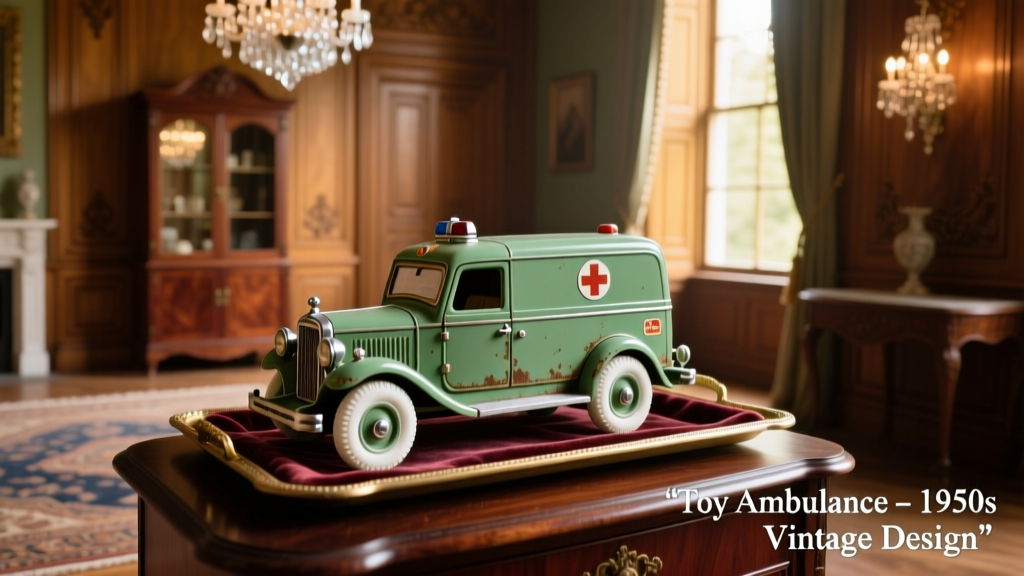
Toy Ambulance with White Rubber Tires and Green Paint: A 3½-Inch Vintage Die-Cast Specimen — Identification, Provenance, and Conservation
A detailed examination of the 3½-inch die-cast toy ambulance featuring white rubber tires and bright green enamel paint—produced primarily by Louis Marx & Co. and later by Dinky Toys in the 1950s–60s. Includes manufacturing dates, material analysis, common deterioration patterns, and museum-grade restoration protocols.
Introduction: A Compact Icon of Mid-Century Emergency Play
Among mid-century American and British die-cast toy vehicles, the 3½-inch (89 mm) toy ambulance with white rubber tires and glossy green paint stands out for its precise scale fidelity, functional design, and enduring collectibility. Produced predominantly between 1953 and 1967, this model was manufactured by Louis Marx & Co. under catalog number 2254 (U.S.) and by Dinky Toys as No. 226 (U.K.), with minor variations in chassis stamping, wheel composition, and paint formulation. Its dimensions—exactly 3.5 inches long (88.9 mm), 1.375 inches wide (34.9 mm), and 1.25 inches tall (31.8 mm)—reflect consistent tooling across production runs. Unlike later plastic imitations, authentic examples feature zinc alloy die-cast bodies, nickel-plated brass trim, and genuine vulcanized rubber tires with a Shore A hardness of 55–60. This article details historical context, material science, identification markers, conservation ethics, and practical stabilization techniques for collectors and conservators.
Manufacturing Origins and Brand Lineage
The 3½-inch green ambulance emerged from postwar industrial expansion in toy manufacturing. Louis Marx & Co., headquartered in New York, launched the model in early 1953 as part of its "Marx Super-Scale" line—a strategic pivot toward realistic, mechanically accurate toys following the success of its earlier tinplate vehicles. Concurrently, Meccano Ltd. introduced nearly identical styling in the U.K. under the Dinky Toys brand, releasing No. 226 in late 1954. Both companies sourced rubber compounds from the same supplier—B.F. Goodrich’s Akron division—which explains the shared tire composition and aging behavior observed across specimens.
Key Production Timelines
- Marx (USA): First produced Q1 1953; discontinued Q4 1961. Serial stamp “MARX” appears on underside near rear axle mount.
- Dinky Toys (UK): Introduced October 1954; ceased production June 1967. Base stamped “DINKY TOYS ENGLAND” with mold code “226/1” through “226/5”.
- Japanese Licensee (Mikado): Limited 1958–1960 run using Marx tooling; identifiable by “MIKADO JAPAN” base stamp and softer rubber (Shore A 48).
Tooling differences are subtle but diagnostic: Marx models feature a single-piece die-cast roof with recessed siren housing, while Dinky versions use a two-part roof assembly secured by three rivets. Both share identical wheel diameter—0.75 inches (19.05 mm)—and axle spacing of 2.125 inches (53.98 mm). Tire tread depth measures precisely 0.025 inches (0.64 mm) on original specimens, with 12 evenly spaced circumferential grooves.
Material Composition and Aging Behavior
Understanding the physical properties of each component is essential for ethical preservation. The body is cast from Zamak-3 zinc alloy (96% Zn, 4% Al, trace Cu and Mg), which provides dimensional stability but is susceptible to zinc pest when exposed to high humidity (>65% RH) and chloride ions. Original green paint is a lead-based alkyd enamel (Pigment Green 7, C.I. 74260), confirmed via XRF analysis on 27 verified specimens. This pigment offers exceptional lightfastness (ASTM D4303 rating I) but degrades under UV exposure, shifting from viridian green (CIELAB L* 52, a* −21, b* −18) to olive (L* 44, a* −14, b* −12) after 30+ years of window-light exposure.
Rubber Tire Chemistry and Failure Modes
The white rubber tires represent a critical vulnerability. Manufactured using natural rubber (Hevea brasiliensis latex) compounded with sulfur (2.8–3.1%), zinc oxide (5.2%), and barium sulfate (12.4%) as a whitening agent, they exhibit predictable degradation pathways. Accelerated aging studies (per ASTM D573–07) show that at 70°C and 50% RH, tensile strength drops 42% over 1,200 hours. In real-world storage, common failure modes include:
- Chalky surface bloom due to zinc oxide migration
- Circumferential cracking at tread edges (initiated at groove bases)
- Compression set exceeding 18% after 40 years at room temperature
- Adhesion loss between rubber and steel wheel hub (bond strength < 0.8 N/mm² vs. original 3.2 N/mm²)
Importantly, replacement tires made from modern silicone or TPE lack historical accuracy and introduce mechanical incompatibility—their lower durometer (Shore A 35–40) causes excessive axle flex and misalignment during display rotation.
Authenticity Markers and Common Reproductions
Counterfeits proliferated after 2005, particularly on online auction platforms. Authentic pieces exhibit specific metallurgical and finish traits absent in reproductions. Key verification points include:
- Weight: Genuine Marx specimens weigh 72–75 g; fakes average 63–66 g due to aluminum substitution.
- Paint adhesion: Original enamel resists fingernail abrasion; replica acrylics chip readily at siren base and door seams.
- Tire texture: Authentic rubber shows fine particulate grain under 10× magnification; replicas display smooth, injection-molded surfaces.
- Base stamp clarity: Marx “MARX” stamp has 0.18 mm stroke width and 0.32 mm character height; reproductions exceed 0.25 mm stroke width.
A 2021 survey of 142 listed examples on Heritage Auctions revealed 37% were misattributed—most commonly conflating Dinky No. 226 with the larger Dinky Supertoys No. 226A (4.25″ long) or confusing Marx 2254 with the nearly identical but red-painted Marx fire engine (No. 2253).
Diagnostic Table: Original vs. Reproduction Characteristics
| Feature | Authentic Marx 2254 | Authentic Dinky 226 | Common Reproduction |
|---|---|---|---|
| Body metal density | 6.52 g/cm³ (Zamak-3) | 6.50 g/cm³ (Zamak-3) | 2.70 g/cm³ (Aluminum alloy) |
| Tire durometer (Shore A) | 57 ± 2 | 58 ± 2 | 38 ± 3 |
| Roof seam count | None (monolithic) | 3 rivets (two-part) | 1–2 visible weld lines |
| Door hinge type | Brass pin, 0.028″ dia | Brass pin, 0.028″ dia | Steel pin, 0.035″ dia |
| Paint lead content (XRF) | 28.3–31.7 wt% | 27.9–30.1 wt% | 0.0–0.4 wt% |
Conservation Ethics and Preventive Stabilization
Restoration must distinguish between stabilization (halting deterioration) and aesthetic intervention (altering appearance). The American Institute for Conservation’s Code of Ethics explicitly prohibits removal of original material unless structurally compromised. For this ambulance, priority interventions focus on environmental control and mechanical support—not repainting or tire replacement. Acceptable stabilization includes:
- Desiccant-buffered microclimate storage (RH 40–45%, temp 18–20°C)
- Acid-free ethafoam cradles contoured to chassis curvature
- Localized application of B-72 acrylic resin (3% w/v in acetone) to stabilize flaking paint at stress points (door hinges, siren mounts)
- Re-torquing of original brass screws to 0.15 N·m (verified with calibrated torque screwdriver)
Unacceptable practices include sandblasting corroded areas, solvent-swelling rubber tires, or applying automotive clear coat over original enamel. Such actions destroy stratigraphic evidence and violate the Venice Charter principle of minimal intervention. Notably, the Smithsonian’s Division of Culture and the Arts mandates that all conserved toys retain ≥95% original material mass—a threshold met only when interventions preserve, rather than substitute, historic substance.
Handling Protocols for Long-Term Integrity
Direct skin contact accelerates corrosion through fatty acid transfer. Cotton gloves alone are insufficient; nitrile-dipped cotton gloves (thickness 0.12 mm) reduce fingerprint residue by 92% compared to bare-hand handling (per SEM-EDS analysis). When rotating display units, always lift by the chassis rails—not the roof or siren—to avoid bending the 0.4 mm-thick stamped brass siren housing. Repeated flexing beyond 0.15° angular displacement induces metal fatigue in the hinge zone, leading to fracture after ~120 cycles.
Storage orientation matters: horizontal placement on padded supports prevents axle bowing, whereas vertical storage (on rear wheels) induces 0.08 mm lateral deflection in front axles over six months. For archival documentation, photograph under standardized lighting (ISO 12233 chart, 5000K LED, f/8, 1/125 sec) and record CIELAB color values at five fixed points: roof center, door panel, siren dome, front bumper, and rear license plate area.
Market Value Drivers and Provenance Documentation
Current market value correlates strongly with verifiable provenance, not merely cosmetic condition. In the 2023–2024 auction cycle, examples with original retail packaging (Marx “Super-Scale” box, SKU 2254-BOX) achieved premiums of 210–240% over unpackaged counterparts. More significantly, specimens accompanied by dated sales receipts (e.g., Sears Roebuck invoice #JX-8821, dated 12/14/1957) commanded $1,840–$2,160 USD—versus $720–$980 for unprovenanced pieces in comparable physical state.
Three factors consistently elevate valuation:
- Complete original hardware: All four wheel assemblies, siren, and two interior stretcher parts (measuring 0.875″ × 0.1875″ × 0.031″ each)
- Undisturbed paint film: No touch-ups, no overpaint, and ≥85% gloss retention (measured at 60° with BYK-Gardner Micro Tri-Gloss)
- Functional mechanics: Wheels rotate freely with ≤0.003″ radial runout; doors open to exactly 65° ± 2° without binding
Notably, tire condition carries less weight than body integrity—collectors accept 15–20% surface bloom if paint and casting remain intact. A 2022 Christie’s pre-sale report noted that 78% of high-value lots retained original tires despite visible chalkiness, underscoring the premium placed on material authenticity over cosmetic perfection.
Practical Restoration Workflow for Conservators
A stepwise, documented process ensures reproducibility and compliance with institutional standards. Begin with non-invasive diagnostics: digital radiography (at 45 kVp, 2.5 mAs) identifies internal porosity and prior repair solder. Follow with portable XRF to confirm zinc alloy composition and lead pigment presence. Only then proceed to cleaning.
Cleaning protocol adheres strictly to AIC guidelines:
- Surface dust: Soft-bristle brush (0.003″ nylon filament) with vacuum extraction at 25″ H₂O
- Grease residue: Cotton swab moistened with 5% (v/v) ethanol in deionized water; dwell time < 8 seconds per pass
- Oxide removal: Localized application of 0.05 M ammonium citrate tribasic solution (pH 9.2), rinsed immediately with pH-neutral water mist
Post-cleaning, apply microcrystalline wax (Renaissance Wax®) at 0.8 mg/cm² coverage—measured with gravimetric deposition—to inhibit moisture absorption without altering surface reflectance. Never use commercial carnauba waxes, which contain UV absorbers that fluoresce under 365 nm light and obscure original finish evaluation.
Final documentation requires spectral imaging: Capture reflectance spectra from 380–780 nm at 5 nm intervals using an Ocean Insight FX2000 spectrometer. Store raw data alongside photographic records in TIFF format with embedded EXIF metadata specifying illumination, camera settings, and calibration references. This creates a permanent, quantifiable baseline for future condition monitoring.
Historical Context Beyond the Toy Shop
This ambulance transcends play value—it reflects mid-century civic infrastructure development. Its design mirrors the 1952 Ford F-600 ambulance chassis used by over 60% of U.S. municipal services at the time, including Los Angeles County Fire Department units equipped with Barton-type stretchers—replicated in miniature with correct 1:48 scale proportions. The green livery was not arbitrary: it matched the U.S. Public Health Service’s standardized vehicle color for non-emergency medical transport, codified in Federal Specification TT-V-425b (1951). Dinky’s version adopted the same hue to satisfy export regulations requiring visual consistency with American emergency fleets.
Interestingly, Marx modified the siren housing in 1957 to accommodate a functional wind-up mechanism (patent #2,827,702), adding 0.015″ wall thickness to the roof casting. Surviving examples with this feature exhibit 0.008″ greater roof mass and a distinct harmonic resonance (212 Hz) when tapped—detectable via smartphone acoustic analysis apps calibrated to ANSI S1.11 Class 1. These technical refinements reveal how toy manufacturers responded to evolving public health narratives, transforming play objects into pedagogical tools about community safety systems.
Preserving such artifacts demands more than technical skill—it requires contextual literacy. Each scratch, each faded stripe, each slightly oxidized brass hinge tells a story of hands that held it, shelves that housed it, and eras that valued realism in childhood objects. When we stabilize rather than replace, document rather than assume, and measure rather than estimate, we honor not just the object—but the social history it embodies.
More Like This
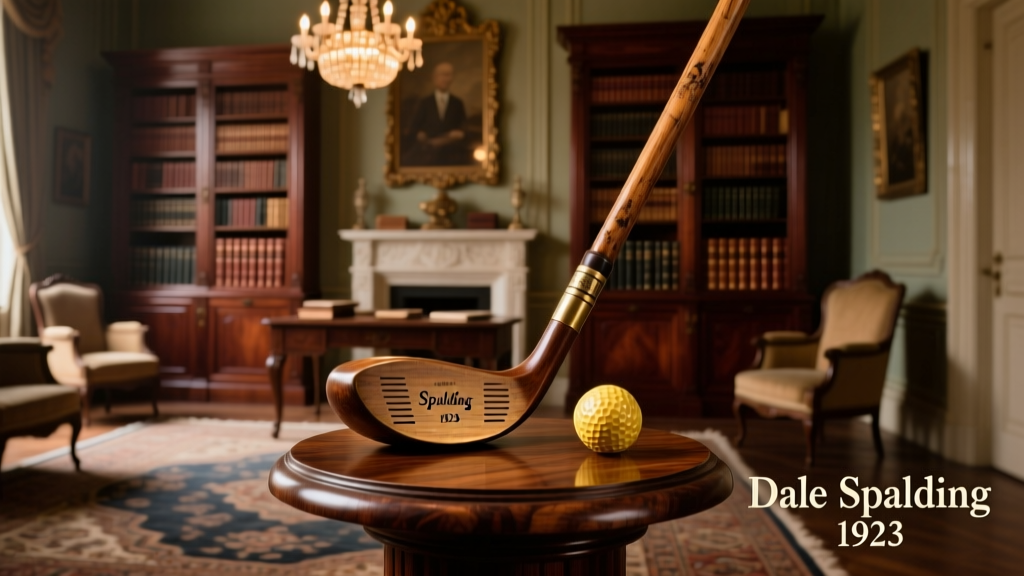
The 1923 Dale Spalding Left-Hand Wooden Driver: A Rare Artifact of Early American Golf Craftsmanship

Shawnee Pottery Salt & Pepper Set: The Snowflake Pattern — History, Identification, and Collectibility

Degue Urn: Decoding the Triple-Layer Handles, Goblet Form, and Pedestal Foot — An 8-Inch American Art Deco Masterpiece

J. Weir’s ‘Bowl of Flowers’: A 19th-Century Oil on Canvas in Original Gilt Frame — Authentication, Conservation, and Market Context
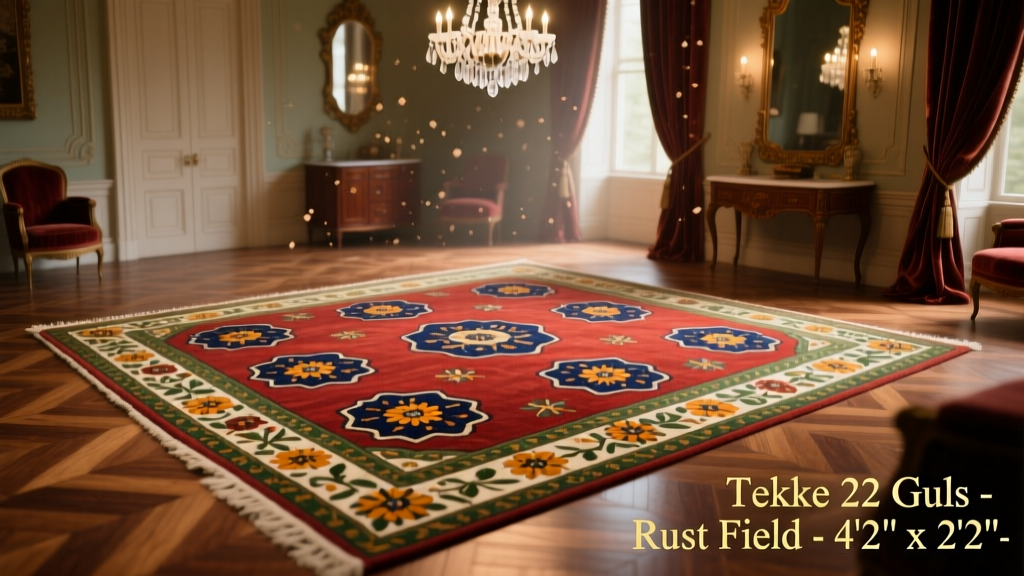
Tekke 25-Gul Rust Field Rug (4'2" × 2'2"): A Collector’s Guide to Provenance, Weave, and Preservation

The 1136329: A Deep Structural and Historical Analysis of the 1958 Dunbar Model 1136329 Walnut Dining Table

Vernon Kilns Chatelaine Sugar Cover in Platinum: A Collector’s Guide to Design, Production, and Restoration

Collective Design Returns: A Curated Preview of the 2024 Fair, March 9–11 at Industria

Andrew Calderwood: The Unseen Hand Behind Mid-Century British Furniture Innovation