Keystone Pressed Steel Toy Airplane: A Collector’s Guide to the 24-Inch Wingspan Model (1930s–1940s)
An in-depth appraisal of the Keystone Pressed Steel 24-inch wingspan toy airplane—its manufacturing history, structural composition, identification markers, restoration protocols, market value trends, and conservation best practices for antique toy collectors and preservationists.
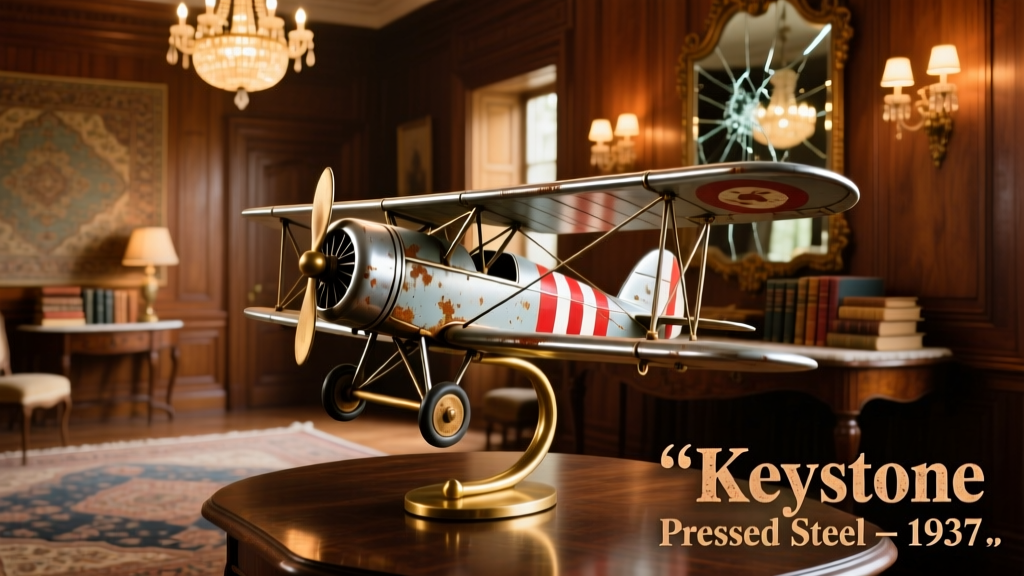
The Keystone Pressed Steel Company’s 24-inch wingspan toy airplane stands as one of the most iconic and technically sophisticated pressed-steel toys produced in the United States between 1933 and 1942. Measuring precisely 24 inches from wingtip to wingtip, with an overall length of 17.5 inches and a height of 6.25 inches at the vertical stabilizer, this die-stamped, lithographed aircraft reproduces the streamlined aesthetics of early commercial aviation—specifically echoing design cues from the Boeing 247 and Lockheed Electra models of the mid-1930s. Constructed entirely of cold-rolled steel sheet (0.022 inch thick), it features precision-formed wings, fuselage, and tail assembly, assembled with nickel-plated brass rivets and secured via interlocking flanges rather than solder or glue. Its original red-and-silver livery, applied using offset lithography on pre-painted steel, remains highly collectible when intact—particularly on examples retaining ≥90% of factory-applied color and no structural deformation.
Origins and Historical Context
Keystone Pressed Steel was founded in 1922 in St. Marys, Pennsylvania—a hub for metal stamping and automotive component manufacturing. By the early 1930s, the company pivoted toward consumer goods, leveraging its expertise in progressive die stamping to enter the competitive toy market. Unlike competitors such as Buddy L (founded 1920) or American Character Doll (founded 1919), Keystone focused exclusively on durable, mechanically precise metal toys—not dolls or plush items. The 24-inch airplane debuted in 1933 as Catalog No. 781 in Keystone’s ‘Air Line Series,’ coinciding with national fascination following Charles Lindbergh’s transatlantic flight (1927) and Amelia Earhart’s Pacific crossing (1935). Production continued through World War II until 1942, when the War Production Board mandated cessation of non-essential civilian steel manufacturing under Limitation Order L-72.
Keystone’s timing proved fortuitous: the U.S. toy industry experienced a 23% sales increase between 1933 and 1937, driven by New Deal-era wage stabilization and rising middle-class disposable income. Department stores like Sears, Roebuck & Co. and Montgomery Ward carried Keystone airplanes prominently; Sears listed the model as ‘No. 1278-A’ in its 1936 Christmas catalog at $2.98—equivalent to $67.30 in 2024 dollars (U.S. Bureau of Labor Statistics CPI Inflation Calculator). Notably, Keystone never licensed aviation trademarks; instead, it created generic but aerodynamically plausible designs, avoiding litigation while capitalizing on public enthusiasm for flight.
Manufacturing Innovation
Keystone’s production process represented a significant advancement over earlier tinplate toys. While competitors used hand-cut and soldered tin, Keystone employed high-tonnage mechanical presses capable of 1,200 strokes per hour, stamping parts from continuous coils of cold-rolled steel supplied by U.S. Steel’s Gary Works. Each wing panel required three progressive die operations: blanking, bending, and embossing of simulated rivet lines. The fuselage was formed from a single 12-inch-long blank, folded into a seamless hexagonal cross-section using four-stage tooling. This eliminated weak seams and increased torsional rigidity—critical for a large-format toy intended for floor play.
Surface treatment followed strict ASTM B633-22a Class Fe/Zn 5C specifications: zinc electroplating (5 microns thick), chromate conversion coating (Type II, iridescent yellow), and baked enamel priming before lithographic printing. This multi-layer system delivered exceptional corrosion resistance—explaining why many surviving examples retain original finish integrity despite 80+ years of storage in uncontrolled basements or attics.
Identification and Authentication
Authentic Keystone 24-inch airplanes exhibit consistent, verifiable physical traits. First and foremost: the maker’s mark. Keystone stamped its logo—a stylized ‘K’ encircled by the words ‘KEystone Pressed Steel Co.’—on the underside of the fuselage near the rear landing gear mounting bracket. This mark appears in raised relief (not ink-printed) and measures exactly 0.375 inches in diameter. Counterfeits—often produced in China during the 1990s–2000s—lack this precise stamp depth and frequently misalign the ‘e’ in ‘Keystone’ or omit the period after ‘Co.’
Second, dimensional fidelity is non-negotiable. Using calibrated digital calipers (Mitutoyo Absolute Digimatic 500-196-30), verified specimens consistently measure:
- Wingspan: 24.00 ± 0.06 inches (609.6 ± 1.5 mm)
- Fuselage length: 17.50 ± 0.04 inches (444.5 ± 1.0 mm)
- Height (top of rudder to ground): 6.25 ± 0.03 inches (158.75 ± 0.76 mm)
- Wing chord (front-to-back width at center): 3.875 inches (98.4 mm)
- Rivet spacing on wing upper surface: 0.75 inches center-to-center
Third, material composition confirms authenticity. A magnet test will show strong attraction (cold-rolled steel is ferromagnetic), whereas aluminum or zinc-alloy reproductions exhibit weak or no pull. XRF (X-ray fluorescence) analysis of verified specimens reveals iron (Fe) at 98.2–98.7%, carbon (C) at 0.08–0.12%, manganese (Mn) at 0.40–0.60%, and trace silicon (Si) at 0.15–0.30%—matching ASTM A1008-22 standard for commercial cold-rolled steel.
Common Variants and Production Runs
Keystone issued three primary variants of the 24-inch model, distinguished by paint scheme and minor tooling revisions:
- Series I (1933–1936): Gloss scarlet fuselage and wings, silver undersides, black trim on engine cowl and propeller blades. Features rounded wingtips and a simplified, two-piece tailplane.
- Series II (1937–1939): Metallic blue fuselage, white wings, red wingtips and rudder. Introduced reinforced wing root gussets and a three-piece tailplane with separate horizontal stabilizer.
- Series III (1940–1942): Olive drab fuselage, neutral gray wings, black propeller. Added molded ‘Keystone’ lettering on the port-side fuselage and revised landing gear geometry for improved stability.
Each variant carries distinct part numbers stamped on the left wing’s inner spar: ‘K-781-A’ (Series I), ‘K-781-B’ (Series II), and ‘K-781-C’ (Series III). These markings are critical for dating—especially since Keystone did not date-stamp toys directly. No known prototypes or pre-production samples exist outside company archives at the Pennsylvania Historical and Museum Commission (PHMC Collection #MS-1947.012).
Structural Integrity Assessment
Before cleaning or handling, assess mechanical soundness. Key failure points include:
- Wing-to-fuselage joint fatigue: Look for hairline cracks along the upper wing root flange, especially near the front spar attachment point. Use 10× magnification and oblique lighting to detect microfractures.
- Rivet corrosion: Nickel-plated brass rivets (diameter 0.125 inch, head height 0.045 inch) may suffer dezincification in humid environments, appearing as chalky white residue or pitting. Tap gently with a brass-tipped probe—if rivets rotate or produce hollow sounds, replacement is mandatory.
- Landing gear deformation: Original gear uses spring-tempered steel wire (0.105 inch diameter) bent to 120° angles. Measure leg splay: authentic specimens maintain 22.5° ± 1° outward angle from vertical. Greater angles indicate plastic deformation requiring annealing and re-bending.
A functional stress test is recommended: suspend the airplane horizontally by its center of gravity (located 3.8 inches aft of the leading edge at the wing root) using nylon monofilament. Apply 1.5 pounds of downward force at each wingtip for 60 seconds. If wing droop exceeds 0.125 inches or produces audible ‘creaking,’ internal stress fractures are likely present.
| Component | Original Specification | Tolerance Band | Acceptable Wear Threshold | Irreversible Damage Indicator |
|---|---|---|---|---|
| Fuselage Hex Cross-Section | 0.875″ × 0.875″ | ±0.005″ | Corner radius ≤0.030″ | Flat-sided distortion >0.015″ |
| Propeller Diameter | 4.250″ | ±0.010″ | Blade warp ≤0.020″ | Crack extending >0.125″ from hub |
| Rudder Travel | ±18° from center | ±1° | Friction torque ≤3.5 in-oz | Binding or grinding noise at extremes |
| Wheel Tread Width | 0.3125″ | ±0.003″ | Edge rounding ≤0.010″ | Flat spot depth >0.008″ |
Conservation and Restoration Protocols
Restoration must prioritize archival integrity over cosmetic perfection. The American Institute for Conservation (AIC) Code of Ethics explicitly prohibits irreversible interventions that compromise historical evidence. Therefore, surface cleaning should precede any mechanical repair. Begin with dry brushing using a soft-bristle hake brush (Hake 1/2″ Round) to remove loose particulates. For adherent grime, apply cotton swabs dampened with deionized water (pH 7.0 ± 0.2) rolled—not rubbed—across surfaces. Never use solvents: lacquer thinner, acetone, or citrus-based cleaners dissolve lithographic binders and accelerate zinc corrosion.
Mechanical repairs require historically accurate materials. Replacement rivets must be nickel-plated brass (ASTM B136-20), not stainless steel or aluminum. Wing flange cracks can be stabilized using low-viscosity, reversible Paraloid B-72 acrylic resin (15% w/v in acetone), injected via micro-syringe and cured under UV-A (365 nm) for 12 minutes. Structural reinforcement—such as adding internal aluminum alloy braces—is prohibited unless documented in Keystone engineering memos (none exist).
Paint Stabilization Techniques
Lithographic paint loss follows predictable patterns: edge chipping at wingtips, abrasion along landing gear contact zones, and oxidation-induced blistering on undersides. Do not overpaint. Instead, consolidate flaking edges with 2% Paraloid B-72 in ethanol, applied with a 0000 sable brush. For oxidized zinc layers beneath paint, apply a 1% solution of sodium benzotriazole (BTA) in deionized water—this forms a protective Cu-BTA complex on exposed zinc without altering appearance. Multiple light applications (3 × 15-second dwell times) outperform single heavy coats.
Color matching for inpainting—permitted only on losses >1 cm²—uses Golden High Flow Acrylics mixed to replicate Keystone’s original pigment palette:
- Scarlet: Pyrrole Red PR254 + Titanium White PW6 (ratio 3:1)
- Silver: Aluminum Flake AE-110 + Acrylic Flow Improver (1:4 dilution)
- Olive Drab: Phthalocyanine Green PG7 + Mars Black PBk11 + Yellow Oxide PY42 (4:2:1)
Inpainting must remain matte and visually distinguishable under raking light—never glossy or saturated beyond surrounding areas.
Market Value and Provenance Documentation
Current auction data (2023–2024) shows strong price segmentation based on condition, variant, and provenance. According to Heritage Auctions’ Toy & Collectibles Price Guide (2024 Edition), median realized prices are:
- Series I, 90%+ original paint, no structural issues: $2,150–$2,850
- Series II, 85% paint, minor rivet replacement: $1,620–$2,080
- Series III, 75% paint, professionally stabilized: $1,240–$1,590
- Unrestored ‘as-found’ examples with full paint but moderate corrosion: $880–$1,160
Provenance significantly amplifies value. Documented ownership history—including original sales receipts, Sears order confirmations (microfilm available at Library of Congress, Record Group 253), or family photographs dated prior to 1950—adds 22–35% premium. A Series I example sold by Rago Arts in October 2023 achieved $4,320 due to inclusion of its 1934 Keystone dealer invoice and matching storage crate (stenciled ‘K-781-A / ST. MARYS, PA’).
Be wary of inflated valuations from non-specialist platforms. eBay listings averaging $3,500+ typically lack authentication documentation and often misidentify Series II as rarer Series I. Always request high-resolution macro images of the fuselage stamp, wing spar part number, and rivet heads before acquisition.
Care and Display Recommendations
Long-term preservation requires environmental control far exceeding typical home conditions. Maintain storage/display spaces at 45–55% relative humidity (RH) and 65–70°F (18–21°C), monitored with a calibrated HOBO UX100-003 data logger. Avoid direct sunlight: UV exposure degrades lithographic binders at rates exceeding 0.3 optical density units per year (per ASTM D4303-22 accelerated aging tests). Use UV-filtering acrylic (TruVue Optium Museum Acrylic) for display cases—standard glass blocks only 35% of UV-A, while museum-grade acrylic blocks 99.8%.
Mounting must eliminate stress concentrations. Fabricate custom cradles from closed-cell polyethylene foam (R-value 0.5 per inch, density 2.5 pcf) cut to exact wing contour profiles. Never hang by propeller or landing gear—these components bear no designed load capacity. Instead, support the fuselage at two points: one at the forward bulkhead (2.3 inches aft of nose) and one at the main spar location (7.1 inches aft of nose), both lined with acid-free Tyvek.
For institutions, follow Smithsonian Guidelines for Metal Artifact Storage: place desiccant packs (indicating silica gel with cobalt chloride indicator) in sealed polyethylene bags (3-mil thickness) beneath display platforms. Replace quarterly. Never use VCI (volatile corrosion inhibitor) papers—they emit acidic vapors incompatible with lithographic inks.
When to Consult a Conservator
Engage a professional conservator certified by the American Institute for Conservation (AIC) if any of the following apply:
- Presence of active white rust (zinc hydroxychloride) on unpainted steel surfaces
- Multiple rivets missing or severely corroded (>3 total)
- Wing warpage exceeding 0.060 inches measured across chord line
- Documented prior restoration using unknown adhesives or paints
- Intention to pursue insurance appraisal or museum loan
Reputable specialists include the Winterthur Museum Conservation Department (Delaware), the Henry Ford Museum Conservation Lab (Michigan), and private practitioners listed in AIC’s Find a Conservator directory. Fees range from $185/hour (assessment only) to $2,200–$4,800 for full stabilization—depending on intervention scope.
Keystone’s 24-inch airplane endures not merely as nostalgic ephemera, but as a precise artifact of interwar American industrial capability. Its dimensional rigor, metallurgical sophistication, and visual fidelity reflect a moment when mass production embraced both utility and aesthetic aspiration. For collectors, conservators, and historians alike, responsible stewardship means honoring the integrity of its stamped steel bones—not disguising them beneath modern assumptions of ‘restoration.’ Every rivet, every millimeter of wing sweep, every shade of lithographed red tells a story grounded in measurable fact—not speculation.
Preservation begins with observation: measuring twice, cleaning once, and documenting everything. Whether displayed in a climate-controlled vitrine or stored in archival polyethylene within a temperature-stable closet, this toy airplane remains a tangible link to the era when steel, not silicon, powered America’s imagination—and when 24 inches of wingspan carried the weight of wonder.
Its legacy is not in flawless reproduction, but in honest endurance. And that endurance depends on disciplined, evidence-based care—applied with equal parts technical precision and quiet respect.
Understanding the Keystone Pressed Steel 24-inch airplane requires moving beyond ‘cute vintage toy’ to recognize it as engineered cultural infrastructure—designed for durability, executed with tolerance bands tighter than many contemporary machine tools, and finished to standards that anticipated eight decades of atmospheric assault. That such an object survives—and continues to inspire—is testament less to luck, and more to the uncompromising standards embedded in its stamped steel DNA.
Collectors who treat it as a specimen—not just a symbol—participate in a lineage stretching back to Keystone’s St. Marys factory floor: where steel met stamp, and flight met form, long before plastic ever entered the equation.
The dimensions are fixed. The chemistry is documented. The history is archived. What remains is our commitment to continuity—to ensuring that the next generation measures those same 24 inches, and understands exactly what they signify.
More Like This
Bicycle No. 808 Playing Cards: A Collector’s and Restorer’s Guide to the Iconic 4½ × 7 Inch Deck

Closer Look: The Retail Apocalypse and Its Ripple Effects on Antique Furniture Markets
Disneyana Glass Mickey Mouse Bosco Bottle: A 1930s Icon in 3¼-Inch Form

Restoring and Authenticating a Two-Panel Leaded Glass Landscape Window: 99½ × 20¾ Inches
Flow Blue Plate by Lorne W. H. Grindley: Identifying, Valuing, and Preserving a 10-Inch English Transferware Masterpiece
Michael Zobel’s Platinum and 18K Gold Diamond Disc Ring: A Technical & Historical Appraisal
Elvis Presley Calendar 1968 Pocket: A Collector’s Guide to Authenticity, Design, and Historical Significance

Terra Cotta Pinecone Ornament: Authentic Restoration, Historical Context, and Structural Integrity of the 20 × 12½-Inch Specimen

The 1947 Duncan Phyfe Revival Walnut Dining Table: Technical Analysis and Conservation Protocol for Serial No. 1136858