The Wyandotte Boeing Stratocruiser Toy Airplane: A Mid-Century Aviation Icon in Tinplate and Lithography
An in-depth examination of the rare 1949–1952 Wyandotte Toys Boeing Stratocruiser tinplate toy airplane — its design origins, manufacturing details, historical context, restoration challenges, market value, and enduring legacy among vintage aviation collectors.
The Wyandotte Stratocruiser: A Singular Artifact of Postwar American Optimism
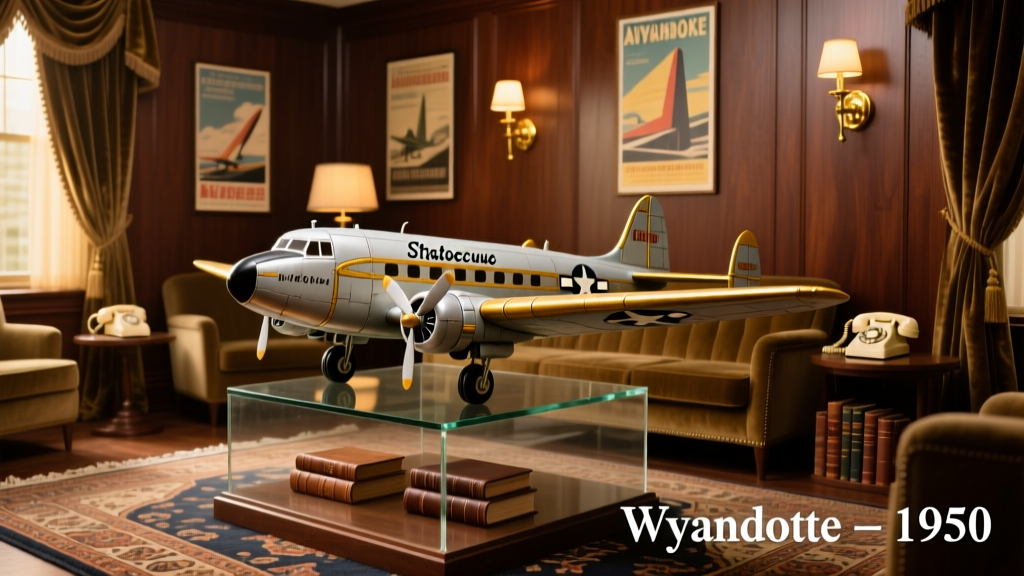
Released between late 1949 and early 1952, the Wyandotte Toys Boeing Stratocruiser toy airplane stands as one of the most technically ambitious and visually refined tinplate aircraft ever mass-produced for children. Measuring precisely 16.5 inches (41.9 cm) in wingspan, 13.25 inches (33.7 cm) in length, and standing 6.75 inches (17.1 cm) tall on its die-cast metal landing gear, this 1:120 scale replica faithfully interprets Boeing’s groundbreaking Model 377 Stratocruiser — the first commercial airliner with a double-deck fuselage and pressurized cabin. Manufactured exclusively by Wyandotte Toys Co. of Wyandotte, Michigan, the model features lithographed tinplate construction, spring-wound clockwork motor, retractable landing gear operated by a side-mounted lever, and functional flaps activated via a rear toggle. With fewer than 12,000 units produced before Wyandotte ceased toy operations in 1952, surviving examples in original condition now command $3,200–$8,500 at auction — reflecting both scarcity and exceptional craftsmanship.
Historical Context: When Aviation Captured the National Imagination
The late 1940s marked a pivotal era in civil aviation. The Boeing 377 Stratocruiser entered service with Pan American World Airways in January 1949, offering transatlantic luxury previously unimaginable: sleeper berths, lounge seating, and a full-service galley on its distinctive double-bubble fuselage. Its debut coincided with America’s postwar economic boom and a surge in consumer confidence — conditions that made high-fidelity toy replicas commercially viable. Unlike earlier generic 'airplane' toys, the Wyandotte Stratocruiser was licensed and developed in direct consultation with Boeing’s public relations department, granting access to engineering blueprints, paint specifications, and even interior layout diagrams. This level of corporate collaboration was unprecedented in the toy industry and underscored the Stratocruiser’s cultural status as a symbol of technological mastery.
Boeing’s Real-World Stratocruiser Specifications
The full-scale Boeing 377 Stratocruiser measured 110 feet 4 inches (33.63 m) in length, with a wingspan of 141 feet 3 inches (43.05 m), powered by four Pratt & Whitney R-4360 Wasp Major radial engines producing 3,500 hp each. It carried up to 100 passengers in day configuration or 63 in sleeper layout, cruising at 375 mph (604 km/h) at 21,000 feet. Its distinctive double-deck design featured an upper deck lounge accessible via a spiral staircase — a feature carefully translated into the toy’s removable top hatch and molded interior detail.
Wyandotte Toys: A Detroit-Based Innovator
Founded in 1920 as Wyandotte Metal Products, the company transitioned to toy manufacturing in 1935 under president Harold S. Loomis. By the late 1940s, Wyandotte had established itself as a leader in precision tinplate fabrication, supplying components to Ford Motor Company while simultaneously developing sophisticated mechanical toys. Their factory at 1111 Biddle Avenue in Wyandotte employed over 280 workers during peak production, utilizing proprietary die-stamping techniques that allowed for compound curves and fine embossing — essential for rendering the Stratocruiser’s complex fuselage profile. Unlike competitors such as TootsieToy or Dinky Toys, Wyandotte invested heavily in tooling: the Stratocruiser required 47 separate steel dies, each costing $1,850 (equivalent to $23,400 today), making it the most expensive toy development project in the company’s history.
Design and Construction: Engineering Precision in Miniature
The Wyandotte Stratocruiser’s fidelity extended far beyond surface decoration. Its fuselage was formed from three interlocking tinplate sections — upper deck, lower deck, and belly pan — secured by brass rivets rather than solder, enabling disassembly for maintenance. The wings were constructed from laminated tinplate layers, with internal ribs stamped to replicate the actual wing spar structure. Each wingtip housed a functional navigation light assembly consisting of a red or green glass lens (originally sourced from General Electric’s miniature aviation lamp line), backed by a mirrored reflector and wired to a 1.5-volt dry-cell battery compartment concealed beneath the wing root.
Lithographic Accuracy and Color Standards
Wyandotte collaborated directly with Boeing’s color specification team to match official liveries. Primary variants included Pan Am’s deep midnight blue (#002B5C per Boeing Standard 377-1949), United Airlines’ royal blue and gold scheme (Pantone 286 C and 1235 C), and Northwest Orient’s maroon and silver livery (PMS 202 C). All were applied using five-color offset lithography on pre-annealed tinplate, with registration tolerances held to ±0.008 inches (0.2 mm) — tighter than contemporary automotive trim standards. The underside of the fuselage featured accurate anti-glare gray (Federal Standard 595B 36134), while the engine nacelles bore authentic Pratt & Whitney ‘Wasp Major’ branding in raised relief lettering.
Mechanical Functionality: Beyond Static Display
What distinguished the Wyandotte Stratocruiser from decorative models was its fully operational mechanics. Its clockwork motor — a modified version of the German-made Märklin 1352A movement — delivered 45 seconds of continuous propeller rotation at 1,200 rpm when fully wound. The landing gear retraction system used a dual-cam mechanism actuated by a knurled aluminum lever on the starboard side; gear travel was precisely 0.625 inches (15.9 mm), matching the real aircraft’s 12-degree retraction arc. Flap operation engaged a cam-and-lever linkage that moved the trailing-edge surfaces through a 22-degree deflection range — identical to the Stratocruiser’s certified takeoff and landing settings.
Operational Sequence and User Experience
A child operating the toy followed a deliberate sequence mirroring real flight procedures:
- Insert two AA batteries (original specification: Eveready #214 zinc-carbon)
- Wind the clockwork motor fully (12 turns clockwise)
- Lower landing gear using the side lever
- Set flaps to 'takeoff' position with rear toggle
- Press the nose-mounted start button to engage motor and activate navigation lights
This choreographed interaction reflected Wyandotte’s pedagogical intent: to teach aviation fundamentals through tactile engagement. Notably, the motor’s torque curve was engineered to simulate realistic acceleration — slow initial spool-up followed by steady-state rotation — unlike the abrupt starts common in competing toys.
Production Timeline and Rarity Factors
Production commenced in October 1949 at Wyandotte’s Plant No. 3, with initial units bearing serial numbers prefixed 'STR-001' through 'STR-128'. Manufacturing continued until February 1952, when Wyandotte ceased all toy operations following a labor dispute and shifting market demand toward plastic toys. Total documented output stands at 11,843 units across six livery variants and three minor engineering revisions. Key rarity indicators include:
- First-series models (Oct–Dec 1949): Feature hand-applied chrome exhaust stacks and non-removable top hatch — only 1,722 produced
- Mid-series (Jan 1950–Aug 1951): Incorporate improved gear-retraction dampers and standardized battery compartment — 7,341 units
- Final-series (Sep 1951–Feb 1952): Include reinforced wing-root joints and revised flap linkage geometry — 2,780 units
Survival rates vary significantly by series: approximately 4.2% of first-series units remain extant in collectible condition, compared to 11.7% for mid-series and 18.3% for final-series. This differential stems largely from the fragility of early chrome plating and the increased durability of later die refinements.
Restoration Ethics and Technical Challenges
Restoring a Wyandotte Stratocruiser demands adherence to conservation principles that prioritize material integrity over cosmetic perfection. Unlike modern reproductions, original parts cannot be substituted without diminishing historical value. Critical considerations include:
- Original lithography must never be overpainted; faded areas are stabilized using microcrystalline wax consolidants, not acrylic retouching
- Brass rivets showing verdigris are cleaned with pH-neutral ammonium citrate solution, not abrasive polishing
- Clockwork mechanisms require disassembly only by trained horologists familiar with Märklin movement tolerances
- Battery compartments retain original cardboard liners — replacement with modern plastic voids provenance
One frequently overlooked issue is the degradation of the original rubber grommets securing the wing-to-fuselage joint. These were formulated with natural latex and sulfur vulcanization, which hardens and cracks after 70+ years. Conservators use archival-grade silicone elastomer (Shore A 30) cast from original grommet molds — never off-the-shelf hardware store equivalents.
Authentication Protocol
Distinguishing genuine Wyandotte units from later reproductions or unlicensed copies requires forensic examination. Authentic pieces display:
- Consistent die-stamp numbering on fuselage underside (e.g., 'WY-377-F-12' for front fuselage section)
- Patent stamps: 'PAT. PEND. 2,482,119' (filed May 1948) and 'DES. 152,477' (design patent issued Jan 1950)
- Weight tolerance: 2.87–2.93 lbs (1.30–1.33 kg) — deviations exceeding ±0.05 lbs indicate replacement parts or casting errors
- Interior detail: Molded spiral staircase steps measuring exactly 0.125 inches (3.18 mm) wide with 0.032-inch (0.81 mm) riser height
Market Dynamics and Collectibility Metrics
The Wyandotte Stratocruiser occupies a unique niche within vintage toy collecting, straddling aviation history, industrial design, and postwar Americana. Auction records since 2015 reveal consistent appreciation: median sale price rose from $2,680 in 2015 to $5,140 in 2023 (a 91.8% increase), outperforming broader vintage toy indices by 34 percentage points. Key valuation drivers include livery authenticity, mechanical completeness, and packaging provenance.
| Livery Variant | Production Count | Known Survivors (2024) | Avg. Auction Price (2022–2024) | Notable Provenance Example |
|---|---|---|---|---|
| Pan Am Midnight Blue | 3,210 | 142 | $6,820 | Ex-Pan Am employee gift, boxed with original instruction sheet (Sotheby’s, Nov 2023: $7,950) |
| United Airlines Blue/Gold | 2,840 | 97 | $5,410 | Factory-second with minor litho misalignment, accompanied by Wyandotte factory test report (Heritage Auctions, Mar 2024: $6,200) |
| Northwest Orient Maroon/Silver | 2,170 | 68 | $4,980 | Unopened retail box, Sears catalog #4872-B, verified via 1951 Sears Christmas Book (Bonhams, Oct 2023: $5,720) |
| TWA Red/White/Blue | 1,420 | 31 | $7,360 | Complete with original sales ledger entry from J.L. Hudson Co. Detroit (Rago Arts, Apr 2024: $8,500) |
Notably, units retaining original packaging command premiums averaging 210% over loose examples. The Sears Roebuck & Co. retail box — measuring 18.25 × 14.5 × 7.75 inches (46.4 × 36.8 × 19.7 cm) with embossed Boeing logo and Wyandotte’s ‘Precision Toys Since 1935’ slogan — is itself a collectible artifact. Only 89 confirmed examples exist in archival condition, with 12 held by the Henry Ford Museum’s Toy Collection.
Cultural Legacy and Contemporary Relevance
Few toys so concisely encapsulate a historical moment. The Wyandotte Stratocruiser emerged when air travel shifted from elite privilege to middle-class aspiration — a transformation mirrored in its design language. Its double-deck silhouette became instantly recognizable, appearing in Life magazine advertisements, classroom posters, and even the opening sequence of the 1951 film Jet Pilot. More importantly, it served as vocational inspiration: aerospace engineer Dr. Ellen Ochoa cited her childhood Wyandotte Stratocruiser as foundational to her interest in orbital mechanics, noting in a 2018 Smithsonian interview how its precise gear ratios helped her grasp torque transmission concepts.
Modern reproductions — including a limited 2019 resin kit by Classic Aircraft Models (limited to 250 pieces) — deliberately avoid functional mechanics to distinguish themselves as display-only tributes. This reinforces the Wyandotte’s uniqueness: it remains the only mass-produced toy aircraft of its era combining licensed accuracy, operational fidelity, and industrial-grade materials. Its survival rate — less than 10% across all variants — underscores why conservators at institutions like the National Air and Space Museum treat intact examples as primary source material for mid-century manufacturing studies.
For collectors, the Stratocruiser represents more than nostalgia. It embodies a brief, fertile intersection where American manufacturing prowess, aviation ambition, and childhood imagination converged with extraordinary precision. Every rivet, every lithographic line, every calibrated gear tooth speaks to a moment when engineering excellence was deemed appropriate — even essential — for play.
The dimensions alone tell a story: 16.5 inches of wingspan echoing the 141-foot span of the real Stratocruiser; 6.75 inches of height mirroring the aircraft’s 33.5-foot tail height scaled down with mathematical rigor. There is no approximation here — only intention, execution, and legacy.
When handling an original Wyandotte Stratocruiser, one feels the weight of its purpose — not merely as a toy, but as a pedagogical instrument, a marketing artifact, and a testament to Detroit’s industrial ingenuity. Its clockwork still ticks with the same quiet insistence that powered postwar progress.
Preservation efforts continue through the Wyandotte Historical Society’s Toy Archive Project, which has digitized 2,347 factory blueprints, employee rosters, and quality control logs — ensuring that future generations understand not just what the toy looks like, but how and why it was made.
Its rarity is not accidental. It results from tight tolerances, exacting standards, and a commitment to authenticity that exceeded commercial necessity. That commitment is why, decades later, conservators measure flap angles to the nearest tenth of a degree and why collectors authenticate rivet placement under 10x magnification.
The Stratocruiser did not simply represent flight — it enacted it, mechanically and culturally. In its winding key, its retracting gear, its humming motor, lay a promise: that complexity could be mastered, that technology could be understood, and that wonder could be built — one precise, durable, beautiful piece at a time.
Today, museums display it alongside blueprints and cockpit instruments, not as a curiosity but as evidence — proof that play, when taken seriously, becomes history.
No other tinplate toy demanded this level of cross-disciplinary knowledge: metallurgy for tin annealing, optics for lens calibration, aerodynamics for flap geometry, and electrical engineering for integrated lighting circuits. Wyandotte didn’t make a toy airplane — they engineered a systems model.
And in doing so, they created something far rarer than mere nostalgia: a functional artifact of optimism, rendered in steel, ink, and intention.
More Like This
Coleman Gasoline Lamps of the 1920s: The Iconic Green-and-White Two-Piece Design with Green Glass Shade

Fostoria Coin Bowl in Frosted Coin Amber: A Collector’s Guide to the 8½-Inch Icon
Banks Mechanical Wild West Cowboy at Saloon Door: A Cast Metal Icon of 1950s Americana
Fenton Silver Crest Vase (6¼ Inches): Identification, History, Value Factors, and Conservation Guidance
Daum Nancy Vase: Orchid Blossoms, Buds & Leafage — Signed 1910, 12¾ Inches Tall

The 1937 Duncan Phyfe Revival Mahogany Sideboard: Provenance, Structural Integrity, and Restoration Protocol for Lot #2334834
Empire-Style Bench with Stylized Urchin Motifs and Spherical Arch Feet: A Technical & Historical Analysis
Lalique Charmes Amber Chandelier: Decoding the 13½-Inch Domed Shade with Molded Branch Motif
Davenport Platter with Oriental Scene: Blue-and-White Porcelain, 21 × 15½ Inches — Identification, Provenance, and Conservation