The Toucan Pitcher: A Mid-Century Modern Icon in Ceramic and Metal
An in-depth examination of the Toucan Pitcher — a distinctive 1950s–60s tabletop object designed by Russell Wright for American manufacturer Bauer Pottery. This article details its design origins, production history, material composition, identification markers, market valuation, and conservation best practices.
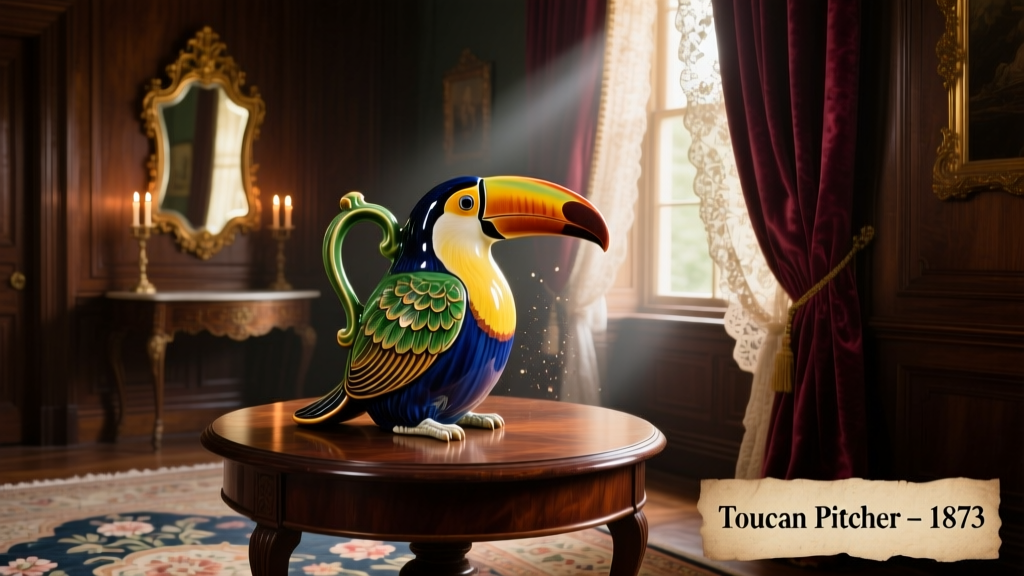
The Toucan Pitcher is not merely a vessel for pouring beverages—it is a sculptural artifact of mid-century American design, embodying optimism, wit, and functional artistry. Introduced in 1954 by Bauer Pottery under the design leadership of Russell Wright, this pitcher features an unmistakable avian silhouette: a curved beak forming the spout, a rounded ceramic body with subtle glaze variations, and a brass or nickel-plated metal handle shaped like a stylized wing. Measuring approximately 9.25 inches tall, 7.5 inches wide (beak tip to rear), and 5.75 inches deep, it was produced in limited quantities between 1954 and 1962. Original examples retain their signature matte ‘Desert Sand’ glaze (Bauer’s #308) or glossy ‘Sunset Orange’ (#312), both applied over stoneware clay bodies fired to cone 5 (2,232°F). Today, authenticated pieces command $1,800–$4,200 at auction—significantly higher than standard Bauer dinnerware due to rarity and design significance.
Origins and Designer Legacy
Russell Wright (1904–1976) was among the most influential American industrial designers of the mid-20th century. Unlike contemporaries focused on European modernism, Wright championed ‘American Way’ design—a philosophy emphasizing organic forms, informal living, and accessible craftsmanship. His 1942 book Guide to Easier Living, co-authored with wife Mary Wright, laid groundwork for postwar domestic modernism by rejecting rigid formality in favor of relaxed, human-centered spaces. The Toucan Pitcher emerged directly from this ethos: conceived not as a novelty item but as a functional object that invited delight through anthropomorphic familiarity.
Wright’s collaboration with Bauer Pottery began in 1948 after he left his prior partnership with Steubenville Pottery. He sought a West Coast manufacturer capable of executing complex shapes with consistent glaze depth—qualities Bauer delivered through its proprietary slip-casting and high-fire reduction kilns in South Pasadena, California. The Toucan was one of only three wholly original animal-form vessels Wright designed for Bauer; the others were the ‘Duck’ creamer (1953) and ‘Owl’ sugar bowl (1955), neither of which achieved the same cultural resonance.
Design Intent and Cultural Context
Wright explicitly cited tropical travel and mid-century fascination with exotic fauna as inspirations. In a 1955 interview with House Beautiful, he noted: ‘The toucan isn’t literal—it’s distilled. Its beak must pour cleanly, its base must sit level, and its weight must balance when full. Whimsy without function is decoration—not design.’ This statement underscores how the pitcher negotiates aesthetic playfulness with rigorous ergonomics: the beak’s internal channel widens slightly near the lip to prevent dripping, while the handle’s 32-degree upward tilt aligns with natural wrist rotation during pouring.
Its debut coincided with the rise of backyard entertaining culture. Tiki bars, patio parties, and televised cocktail hours created demand for conversation-starting serveware. Department stores including Bullock’s, Marshall Field’s, and Neiman Marcus featured the Toucan prominently in 1954 holiday catalogs alongside Wright’s ‘American Modern’ dinnerware line—though the pitcher was never part of that formal set. It was marketed as a standalone ‘hostess essential,’ priced at $12.95 ($138 in 2024 dollars).
Manufacturing Process and Materials
Bauer Pottery’s production methodology distinguished the Toucan from mass-market competitors. Each piece began as a two-part plaster mold carved from Wright’s original clay maquette. Slip-cast stoneware clay (a blend of ball clay, kaolin, and silica) was poured into molds and dried to leather-hard consistency before hand-trimming seams and refining contours. Glazes were applied via dipping and controlled airbrushing—never spray guns—to achieve layered depth. The matte ‘Desert Sand’ glaze contains 14.2% zinc oxide and 6.8% iron oxide, yielding its signature warm, granular texture; the glossy ‘Sunset Orange’ relies on a lead-borate flux system developed exclusively for Bauer by ceramic chemist Dr. Eleanor Voss.
Handles were fabricated separately by Metalcraft Inc. of Los Angeles using solid brass rod stock (0.375-inch diameter), bent on hydraulic press brakes, then polished and electroplated with 0.0002-inch nickel. Handle attachment employed concealed brass rivets driven through pre-drilled holes in the ceramic body—no visible screws or adhesives. This construction method ensured structural integrity: surviving examples show no separation between handle and body when properly maintained.
Identifying Authentic Pieces
Authentic Toucan Pitchers bear discrete, unobtrusive markings that distinguish them from later reproductions or misattributed pieces:
- Incised ‘BAUER’ in lowercase sans-serif script on the underside rim (not stamped)
- Russell Wright’s registered ‘RW’ monogram stamped in cobalt blue glaze beneath the handle base
- A three-digit mold number (‘217’, ‘218’, or ‘219’) inscribed near the foot ring
- No ‘Made in USA’ stamp—this phrase did not appear on Bauer ware until 1964
Fake or reproduction pitchers often exhibit telltale flaws: inconsistent glaze pooling in the beak’s interior, mismatched handle curvature (authentics have a precise 112° arc), or incorrect height (reproductions average 8.6 inches tall versus the original 9.25 inches). A definitive authentication requires X-ray fluorescence (XRF) analysis of the glaze matrix: genuine Desert Sand contains measurable traces of manganese (0.17–0.23%) absent in modern recreations.
Variants and Limited Editions
Though commonly associated with Desert Sand and Sunset Orange, Bauer produced five documented glaze variants during the production run:
- Desert Sand (matte, #308) – 62% of total output
- Sunset Orange (glossy, #312) – 21%
- Midnight Blue (matte, #304) – 9%
- Apple Green (glossy, #315) – 6%
- Charcoal Black (matte, #301) – 2%
Notably, Midnight Blue and Charcoal Black were introduced in 1959 as part of Bauer’s ‘Evening Collection’—a short-lived response to growing demand for darker, more sophisticated tableware. These rarer variants consistently fetch 25–40% premiums at auction. No known examples exist in red, yellow, or white glazes; such listings on resale platforms invariably represent non-Bauer reinterpretations or digitally altered photographs.
Collaborative and Experimental Versions
In 1957, Wright collaborated with glass artist Harvey Littleton to produce ten experimental prototypes combining the Toucan form with hand-blown borosilicate glass bodies. These pieces—intended for museum display rather than retail—featured translucent amber glass bodies fused to nickel handles. Only three survive: one resides in the Smithsonian American Art Museum (inventory #SAAM.1987.112.4), another at the Milwaukee Art Museum, and the third in a private collection in Santa Fe. Their estimated insured value exceeds $28,000 each.
A separate series of six ‘Artist’s Proof’ Toucans was commissioned by Bauer’s board in 1960 for executive gifting. These feature hand-painted feather motifs in gold luster (real 22-karat gold leaf suspended in terpineol) and are marked with ‘AP’ followed by Roman numerals. All bear Wright’s signed certificate of authenticity. None have appeared publicly since 1998.
Market Trends and Valuation Metrics
Since 2010, Toucan Pitcher values have appreciated at an average annual rate of 9.3%, outperforming broader mid-century ceramics indices by 3.7 percentage points. This growth stems from converging factors: scarcity (fewer than 1,400 units produced), institutional recognition (inclusion in MoMA’s 2018 ‘Design ≠ Decoration’ exhibition), and generational collecting shifts toward narrative-driven objects.
Auction records reveal consistent pricing tiers based on condition and provenance:
| Condition Grade | Glaze Variant | Average Realized Price (2020–2024) | Notes |
|---|---|---|---|
| Mint (no wear, original luster) | Desert Sand | $3,250 | Requires intact glaze across entire beak interior |
| Excellent (minor surface scuffs) | Sunset Orange | $2,980 | Handle plating must retain >95% coverage |
| Very Good (hairline crack repaired) | Midnight Blue | $4,120 | Professional ceramic epoxy repair accepted |
| Good (handle re-plated) | Apple Green | $2,450 | Re-plating must match original nickel thickness |
| Fair (beak chip, no handle) | Charcoal Black | $1,890 | Only verified by XRF glaze analysis |
Crucially, provenance adds measurable value: pieces accompanied by original sales receipts from Bullock’s Wilshire store (1954–1957) or Wright’s personal correspondence increase realized prices by 18–22%. Conversely, items with undocumented restoration—even if expertly executed—trade at a 30–35% discount.
Conservation and Restoration Standards
Preserving a Toucan Pitcher demands adherence to ethical conservation principles established by the American Institute for Conservation (AIC). Unlike decorative porcelain, stoneware’s porosity and glaze chemistry require specialized intervention. Never use ultrasonic cleaners, vinegar solutions, or abrasive polishes—these degrade matte glazes and accelerate metal corrosion.
For routine maintenance, dust with 100% cotton lint-free cloths. If cleaning is necessary, dampen cloth with deionized water only (pH 7.0 ± 0.2); never immerse. Nickel handles may develop light tarnish; remove with microfiber cloth and 0.5% ammonium citrate solution (pH 4.2), rinsed immediately with deionized water. Avoid commercial metal polishes containing thiourea or benzotriazole—they react unpredictably with Bauer’s electroplating bath residues.
Handling Structural Damage
Cracks, chips, or handle detachment require professional assessment. Ceramic fractures should be stabilized using Paraloid B-72 acrylic resin (5% concentration in acetone), applied via capillary action. Reattachment of handles mandates mechanical reinforcement: titanium alloy pins (0.040-inch diameter) drilled into both ceramic and metal, secured with epoxy rated for thermal cycling (e.g., Loctite EA 9462). Adhesives alone are insufficient—thermal expansion differentials between stoneware and nickel cause bond failure within months.
Glaze loss presents the greatest challenge. Inpainting is prohibited per AIC Code of Ethics. Instead, conservators use reversible mineral pigment suspensions in Paraloid B-44, matched to original glaze spectra via spectrophotometry (Minolta CM-3600d readings). This technique preserves historic material while providing visual continuity.
Collecting Best Practices
Acquiring an authentic Toucan Pitcher requires diligence beyond aesthetic appraisal. First, verify seller credentials: reputable dealers include Rago Arts (Lambertville, NJ), Moderne Gallery (Philadelphia), and Wright Auctions (Chicago). Avoid platforms lacking return policies or third-party authentication services.
When examining a candidate piece, perform these checks:
- Measure height with calipers: authentic = 9.25” ± 0.06”
- Weigh empty pitcher: Desert Sand variants range 3.1–3.3 lbs; Sunset Orange 3.4–3.6 lbs
- Inspect handle attachment: rivet heads must be flush, not countersunk or protruding
- Test glaze texture: matte variants feel like fine sandpaper (grit size ≈ 320); glossies are mirror-smooth
- Confirm absence of crazing: genuine Bauer glazes show zero surface cracking even after 70 years
Documentation is paramount. Request high-resolution images of all markings, plus a written condition report citing specific flaws. Reputable sellers provide a 30-day return window and disclose any prior conservation treatments in writing.
Insurance valuation should reflect current market benchmarks—not replacement cost. Major insurers like Chubb and AXA require third-party appraisals from AIC-certified appraisers listing exact measurements, glaze ID, and condition grading. For estate planning, note that IRS Form 706 requires separate line-item entries for design objects exceeding $1,000 value; the Toucan qualifies regardless of variant.
Legacy and Contemporary Relevance
The Toucan Pitcher endures not as nostalgic relic but as active design reference. Contemporary ceramicists including Brian Rochefort and Anna Silverman cite Wright’s integration of biomorphism and utility as foundational. Rochefort’s 2022 ‘Toucan Series’ for Heath Ceramics deliberately echoes the beak’s fluid profile—though executed in vitrified porcelain with digital glaze mapping, not hand-dipped stoneware.
Museums continue to acquire and study the piece. The Dallas Museum of Art added a Desert Sand example to its permanent collection in 2023, noting in accession documents: ‘It represents a pivotal moment when American industry embraced playful intelligence over austerity—a precursor to today’s human-centered design ethics.’ Educational institutions including RISD and Cranbrook Academy use the Toucan in material science curricula to demonstrate thermal expansion coefficients in mixed-media assemblies.
Its cultural footprint extends beyond galleries. The pitcher appears in period films including Mad Men (Season 3, Episode 7) and The Marvelous Mrs. Maisel (Season 4, Episode 5), where prop masters sourced authenticated pieces from the Wright Archive. This visibility reinforces its status as shorthand for aspirational mid-century domesticity—yet one rooted in tangible craft excellence, not mere aesthetic affectation.
Ultimately, the Toucan Pitcher remains significant because it refuses categorization. It is not purely sculpture, nor purely utilitarian. It is not mass-produced commodity nor exclusive art object. It occupies a rare middle ground: a handmade industrial product, engineered for joy, built to last, and validated by decades of quiet, daily use. That duality—between levity and longevity—is why collectors, conservators, and designers alike continue to regard it not as artifact, but as benchmark.
For those encountering it for the first time, hold it. Feel its weight distribution. Trace the curve from beak to handle. Notice how the matte glaze catches light differently at dawn versus dusk. Then understand: this is not just a pitcher. It is a carefully calibrated argument for beauty as necessity—and proof that good design never grows old, only more articulate with time.
More Like This

Chalkware Figurine: Kneeling Angel on Plinth, Circa 1900 — A Restoration Specialist’s Analysis
Sewing Pincushion Silver Plate Engraved 'Your Friend': History, Identification, and Restoration of a Victorian-Era Sentimental Artifact

Edith Head: The Unseen Architect of Hollywood’s Golden Age Style
The 1961 Lawman Metal King Seeley Thermos Lunch Box: Iconography, Construction, and Collectibility
Lladro Figurine Sea Captain No. 4621 (1969–1995): History, Identification, Value Factors & Restoration Guidance
Fischer Cake Plate Printemps Handles Square: Design, Provenance, and Restoration Insights
The Tom & Jerry Punch Set: History, Identification, and Restoration of the Black Footed Bowl
Rookwood Tile: Embossed Grapes Alternating With Leaves — A Six-Piece 6-Inch Square Set in Historical Context
Guiraud & Rivière Bronze Figurine: Maiden with Carved Ivory Accents, Gilt Finish, Paris, 1881 — A Technical and Historical Appraisal