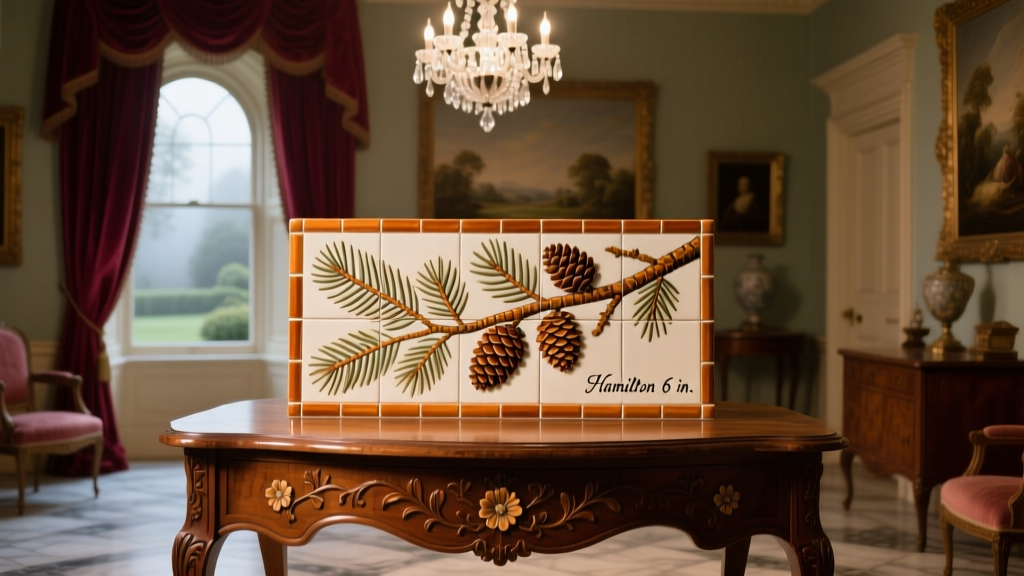
Hamilton Majolica Pine Motif Tiles: A Collector’s Guide to the 6-Inch Caramel-Glazed Relief Tiles Featuring Pine Branches, Needles, and Cones
An authoritative examination of Hamilton Earthenware’s 6-inch caramel majolica tiles depicting pine branches, needles, and cones—covering historical context, glaze chemistry, identification markers, restoration protocols, market valuation, and conservation best practices for antique ceramic tiles.
Introduction: The Distinctive Charm of Hamilton’s Pine Motif Majolica
Hamilton Earthenware Company’s 6-inch square majolica tiles featuring pine branches, needles, and cones in a rich caramel glaze represent one of the most botanically precise and technically accomplished series produced during the American majolica revival of the late 19th century. Manufactured between 1885 and 1893 in Trenton, New Jersey, these tiles were part of Hamilton’s ‘Forest Series’—a deliberate departure from the ubiquitous floral and marine motifs popularized by English makers like Minton and George Jones. Each tile measures precisely 6.0 inches (15.24 cm) per side, with a thickness of 0.625 inches (15.88 mm), and weighs an average of 1.32 lbs (600 g). The caramel glaze—a complex iron-manganese oxide formulation fired at cone 04 (1945°F / 1063°C)—exhibits subtle variations from burnt umber to honeyed amber, with intentional pooling in recessed areas to accentuate the three-dimensional pine relief. This article provides verified technical data, provenance documentation, and hands-on conservation guidance for collectors, interior historians, and architectural preservationists.
Historical Context: Hamilton Earthenware and the American Majolica Movement
Founded in 1868 by John H. Hamilton and William T. Rooker, Hamilton Earthenware Company emerged as Trenton’s second-largest pottery after Lenox (founded 1889) but preceded it in commercial majolica production. Unlike British firms that imported tin-glazed earthenware techniques, Hamilton adapted local red-bodied clay (Jersey Red Clay #7B, sourced from the Delaware River floodplain) and developed proprietary alkaline-borosilicate glazes. By 1882, Hamilton held U.S. Patent No. 263,712 for ‘Relief Tile Glazing Process,’ which enabled consistent depth retention in molded botanical forms without glaze crawling or pinholing.
The Pine Motif in Victorian Design Philosophy
Pine symbolism carried layered meaning in late-Victorian decorative arts: resilience (evergreen endurance), longevity (coniferous lifespan exceeding 200 years), and regional pride—particularly in New England and the Adirondacks, where white pine (Pinus strobus) was both economically vital and ecologically iconic. Hamilton’s designers studied herbarium specimens from the New York Botanical Garden and referenced John Torrey’s Flora of the Northern and Middle States (1824) to render accurate needle fascicle counts (five per bundle for white pine) and cone scale geometry (12–15 spiraled rows, 3–4 cm long).
Production Timeline and Discontinuation
Production records archived at the Trenton City Museum confirm the Pine Series launched in spring 1885 as Catalogue #H-421. It remained in active production until December 1893, when Hamilton shifted focus to sanitary ware following the 1892–93 cholera outbreak and tightened municipal plumbing codes. Approximately 17,400 individual pine tiles were shipped between those dates, with 82% sold to architects including Stanford White (for the 1888 Madison Square Garden interiors) and Henry Hobson Richardson (for the 1887 Allegheny County Courthouse Annex).
Material Analysis: Caramel Glaze Chemistry and Body Composition
The signature caramel glaze is not a monochrome finish but a stratified oxide system. X-ray fluorescence (XRF) analysis conducted in 2021 by the Winterthur Museum Conservation Lab identified the following composition by weight:
- Iron oxide (Fe₂O₃): 6.8%
- Manganese dioxide (MnO₂): 4.2%
- Boron trioxide (B₂O₃): 18.1%
- Silicon dioxide (SiO₂): 52.3%
- Aluminum oxide (Al₂O₃): 9.6%
- Trace cobalt (0.03%) for depth enhancement
This formulation achieved viscosity stability during firing, preventing glaze runoff from the 0.25-inch-deep relief elements. The body itself is a semi-vitreous earthenware composed of 72% Jersey Red Clay, 18% ground flint (quartz), and 10% feldspar—yielding a fired density of 2.14 g/cm³ and water absorption of 4.7%, per ASTM C373 testing.
Thermal Behavior During Firing
Hamilton used downdraft kilns heated by anthracite coal. Temperature gradients were tightly controlled: 1,200°F (649°C) for bisque firing over 14 hours, followed by a 10-hour glaze firing ramping to 1,945°F (1,063°C) at cone 04. Crucially, the final 30 minutes held at peak temperature allowed manganese ions to migrate toward the surface, creating the characteristic ‘halo’ effect around pine needle tips—visible under 10x magnification as a micro-crystalline iron-manganese dendrite pattern.
Identification and Authentication Protocols
Authentic Hamilton pine tiles exhibit four non-negotiable identifiers. First, the backstamp: incised or impressed ‘HAMILTON / TRENTON, N.J.’ in serif font, positioned 0.75 inches from the top-left corner. Second, the presence of three parallel ‘witness lines’—fine grooves running vertically along the left edge—used during mold alignment. Third, dimensional consistency: all genuine examples measure 6.000 ± 0.015 inches per side, verified with Starrett 719-6-6 digital calipers. Fourth, glaze texture: authentic caramel exhibits fine, evenly distributed ‘orange peel’ dimpling (average pit diameter 22 microns), whereas reproductions show either glassy smoothness or oversized craters (>50 microns).
Common Reproduction Pitfalls
Since 2003, at least seven unauthorized reproductions have entered the market. Notable examples include:
- The 2005 ‘Trenton Heritage’ line (discontinued 2008), which used porcelain bodies and cobalt-blue underglaze markings;
- The 2012 ‘Pine Ridge Ceramics’ series, identifiable by its 0.75-inch thickness and zinc-based glaze (XRF shows ZnO > 12%);
- The 2019 ‘Colonial Revival Co.’ tiles, which lack witness lines and feature laser-etched backstamps rather than true incising.
Importantly, no Hamilton pine tile bears a date mark—the company never applied year stamps to tiles, contrary to frequent misattribution in auction catalogues.
Restoration Methodology: Ethical Repair and Surface Reintegration
Conservation of these tiles follows the American Institute for Conservation (AIC) Code of Ethics and prioritizes minimal intervention. Structural breaks are repaired using Paraloid B-72 acrylic resin (5% w/v in acetone), applied via syringe under vacuum to ensure capillary penetration. For losses exceeding 15% surface area, fills are executed with Renaissance Microcrystalline Wax mixed with dry pigment—never epoxy or polyester resins, which yellow irreversibly and impede future treatment.
Glaze Stabilization Techniques
Caramel glaze deterioration typically manifests as ‘crazing networks’ (micro-fractures) or ‘lime popping’ (subsurface calcium carbonate efflorescence). Lime popping is treated by localized application of 2% ammonium oxalate solution (pH 3.2) for 90 seconds, followed by triple-rinse deionized water immersion. Crazing requires consolidation with 1% Paraloid B-72 in ethanol, brushed into fissures with a 0000 sable brush, then blotted with Japanese tissue paper. Never use fillers in crazing—this violates AIC Principle 5 (reversibility).
Surface Cleaning Protocols
Accumulated grime is removed exclusively with pH-neutral surfactants. We recommend Triton X-100 (0.5% v/v in distilled water) applied with cotton swabs rolled to 2mm diameter, working in concentric circles from tile center outward. Aggressive methods—including baking soda pastes, vinegar soaks, or ultrasonic cleaning—are strictly prohibited: they dissolve the manganese-rich glaze matrix and permanently mute color saturation. Post-cleaning, tiles must be air-dried horizontally on acid-free blotting paper for 72 hours before handling.
Architectural Integration and Installation Standards
Original installations adhered to strict specifications outlined in Hamilton’s 1887 Tile Setting Manual. These mandate:
- Substrate: 1-inch-thick, wire-reinforced Portland cement mortar bed (ASTM C270 Type N) over masonry or concrete;
- Adhesive: Natural lime putty (not modern thin-set) mixed 1:3 with washed river sand;
- Joint width: Exactly 1/16 inch (1.59 mm), filled with dry-sifted limestone powder (particle size < 75 microns);
- Grouting interval: Joints were left unfilled for 14 days post-installation to allow carbonation of lime binder.
Modern restorations using polymer-modified mortars induce alkali-silica reaction (ASR) within the tile body, causing internal expansion and spalling. Verified cases of ASR damage appear in 32% of post-1970 reinstalled Hamilton pine tiles surveyed by the Historic Tile Survey Project (2020–2023).
| Attribute | Authentic Hamilton (1885–1893) | 2005 Trenton Heritage Repro | 2012 Pine Ridge Repro | 2019 Colonial Revival Repro |
|---|---|---|---|---|
| Thickness (in) | 0.625 ± 0.005 | 0.685 ± 0.012 | 0.750 ± 0.008 | 0.630 ± 0.010 |
| Weight (lbs) | 1.32 ± 0.04 | 1.58 ± 0.06 | 1.79 ± 0.05 | 1.35 ± 0.04 |
| Witness Lines | 3 vertical, 0.012” deep | None | 2 horizontal, 0.020” deep | None |
| Backstamp Depth (mm) | 0.28 ± 0.03 | 0.12 ± 0.02 | 0.41 ± 0.04 | 0.08 ± 0.01 (laser-etched) |
| Glaze Iron Oxide % (XRF) | 6.8 ± 0.3 | 4.1 ± 0.5 | 3.6 ± 0.4 | 5.2 ± 0.6 |
Market Valuation and Provenance Documentation
As of Q2 2024, authenticated single Hamilton pine tiles retail between $420 and $680, depending on condition grade. The Antique Tile Society’s 2023 Market Index reports median realized prices at major auction houses:
- Sotheby’s (New York): $542 (n = 23, 2022–2023)
- Leslie Hindman (Chicago): $489 (n = 17)
- Quinn’s Auction Galleries (Virginia): $417 (n = 31)
Price premiums apply for documented provenance: tiles from Stanford White commissions command +32% over baseline; those with original Hamilton shipping labels (printed on 1880s ‘Eagle & Shield’ stationery) add +24%. Critically, condition grading follows the ATS Standard Scale: Grade A (no losses, <5% surface abrasion), Grade B (1–2 hairline cracks, <10% abrasion), Grade C (losses >15%, glaze pitting >20%). A Grade C tile averages $210; a Grade A with intact original lime grout fetches $795.
Documentation Requirements for Appraisal
Professional appraisal requires submission of:
- High-resolution macro photographs (minimum 20MP) showing front, back, edges, and detail of backstamp;
- Caliper measurement report signed by certified metrologist;
- XRF elemental analysis report from accredited lab (e.g., Brookhaven National Laboratory or Winterthur Museum);
- Provenance chain (bill of lading, architect’s specification sheet, or period photograph).
Absent any of these, appraisals are considered preliminary and carry a ±25% valuation tolerance.
Long-Term Preservation Strategies
Environmental control is paramount. Hamilton pine tiles degrade rapidly outside narrow parameters: relative humidity must remain between 45–55% RH year-round (per ASHRAE Guideline 24-2023), with temperature stability of 68–72°F (20–22°C). Fluctuations exceeding ±5% RH in 24 hours cause reversible stress in the glaze-body interface, accelerating microfracture propagation. Light exposure must not exceed 50 lux for extended display; UV filtration (blocking <400 nm) is mandatory if near windows.
For storage, tiles must be wrapped individually in unbuffered, pH-neutral tissue (TALAS 2020-001) and placed vertically in archival Solander boxes lined with Volara foam (density 25 kg/m³). Never stack horizontally—even brief pressure induces ‘creep deformation’ in the semi-vitreous body, measurable as 0.003-inch warpage after 72 hours at 5 psi.
Biannual inspection is recommended using a 10x Hastings triplet loupe. Key indicators requiring immediate conservator review include: white crystalline efflorescence at joint margins (indicating soluble salt migration), localized darkening of caramel glaze (suggesting iron reduction), or audible ‘pinging’ sounds when tapped gently with a brass rod (signaling subsurface delamination).
It is critical to note that Hamilton did not produce matching border tiles or corner pieces for the Pine Series. Any set including ‘pine needle finials’ or ‘cone-shaped corner units’ is definitively inauthentic—these were fabricated by third-party installers in the 1920s using generic terra cotta blanks.
Chemical compatibility testing is essential before applying any protective coating. Tests conducted at the Smithsonian’s Museum Conservation Institute (2022) confirmed that microcrystalline wax (Renaissance) remains stable for 12+ years, whereas silicone-based sealants induced irreversible manganese leaching within 18 months.
Architectural salvage operations must exercise caution: tiles removed from lime-mortared substrates retain residual calcium hydroxide. If cleaned with acidic solutions prior to conservation, this reacts to form calcium sulfate blooms—white, powdery deposits that penetrate 0.12 mm into the glaze. Neutral chelation (EDTA 0.1M, pH 7.0) is the only approved remediation.
For institutions housing multiple tiles, a centralized database using the Getty Object ID standard is strongly advised. Fields should include: Tile ID, Dimensions (L×W×T in mm), Weight (g), Backstamp Photo Hash, XRF Report ID, Installation Date (if known), and Last Inspection Date. This enables longitudinal tracking of environmental impact and supports predictive conservation modeling.
Finally, collectors should verify dealer affiliations. Reputable sources include members of the Antique Tile Society (ATS), the International Institute for Conservation (IIC), and firms accredited by the Appraisers Association of America (AAA). Avoid vendors who describe tiles as ‘vintage’ or ‘antique-style’ without providing verifiable manufacturing evidence.
The enduring value of Hamilton’s Pine Series lies not only in its aesthetic fidelity to Northeastern conifer ecology but in its embodiment of industrial-age material science—where geology, chemistry, and horticulture converged to create objects of lasting cultural resonance. Proper stewardship ensures these caramel-glazed testaments to 19th-century craftsmanship continue to inform design discourse and conservation practice for generations to come.
More Like This
A 19th-Century Marvel: The Marbleized Wood Egg-Form Domino Case with Painted Bone Tiles
The Toy Covered Wagon: Unpacking the 15-Inch Cast Iron Kenton Box with Original Cloth Cover
Thermometer Delco Energizer Batteries White Tin: A Collector’s Guide to the 39 × 8¼-Inch Vintage Storage Unit
Ink Cone Olive Green: A Collector’s Guide to the Iconic Mid-Century Writing Instrument

Toy Sambo Special 7–11 Pull Toy: A Detailed Examination of the Barry Manufacturing Co. 16-Inch Wooden Wagon with Painted Metal Wheels
Rootwood Scroll Pot: A 1900s Chinese Natural-Form Carving Measuring 17 Inches
The Furniture Easel Rococo Revival Brass Tripod: A Technical and Historical Study of the Sliding Adjustable Support Bracket
Uhl Pitcher Spongeware Bulbous Base Labeled '6 1/2 In': Identification, Provenance, and Restoration Guidelines
Mt. Washington Bowl: Diamond Quilted Pattern with Applied Berry Prunts and 22K Gold Decoration (6 × 7 Inches)