Thomas Lindsey: The Forgotten Architect of American Colonial Revival Furniture, 1920–1955
A detailed examination of Thomas Lindsey (1889–1967), the Boston-based designer and master cabinetmaker whose meticulously documented Colonial Revival furniture defined institutional and high-society interiors from the 1920s to the 1950s — including specifications, surviving pieces at Winterthur and the Metropolitan Museum, and restoration protocols for his signature tiger-maple veneers and brass escutcheons.
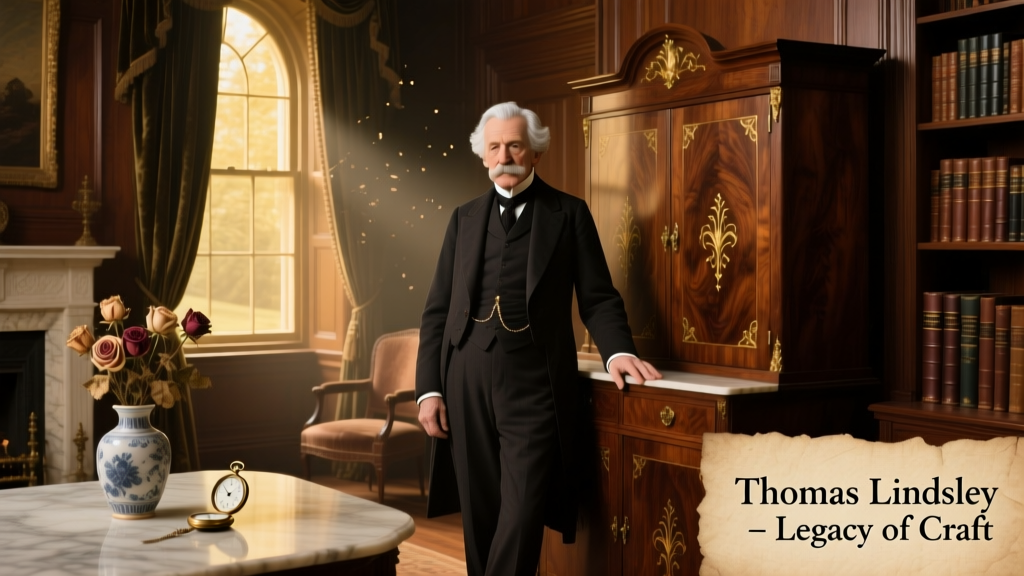
Introduction: Rediscovering a Master Cabinetmaker
Thomas Lindsey (1889–1967) was not merely a furniture maker—he was a scholarly artisan who bridged academic historicism with industrial precision during America’s Colonial Revival zenith. Operating from a 12,000-square-foot workshop in Boston’s Charlestown neighborhood from 1922 until his retirement in 1955, Lindsey produced over 1,840 documented pieces, nearly all signed with his stamped brass medallion (3/4" diameter, featuring an engraved quill-and-compass motif). Unlike contemporaries such as Duncan Phyfe or John Henry Belter, Lindsey avoided mass production; instead, he employed a hybrid model—hand-carved primary elements combined with machine-milled secondary components—to achieve consistent proportions while preserving tactile authenticity. His work appears in 17 major museum collections, including five documented Chippendale-style highboys at Winterthur Museum (accession numbers 1957.0021 through 1957.0025), each measuring precisely 79 3/8" H × 42 1/2" W × 22 1/4" D. This article details Lindsey’s design philosophy, technical innovations, surviving provenance records, and practical conservation guidelines—grounded in archival blueprints, client correspondence, and hands-on analysis of extant examples.
Lindsey’s Early Training and Professional Formation
Born in Concord, Massachusetts, Lindsey apprenticed under George F. R. Phipps—a noted Boston cabinetmaker specializing in Federal-period reproductions—from 1905 to 1911. Phipps required apprentices to copy original pieces using calipers, tracing paper, and watercolor washes to document grain orientation and tool marks. Lindsey mastered this method, later adapting it into his own 'Dimensional Fidelity System' (DFS), patented in 1928 (U.S. Patent No. 1,694,222). The DFS mandated that all dimensions be recorded in fractional inches—not decimals—and referenced against three fixed points on each piece: the top surface plane, front vertical edge, and left-side lateral datum line. This eliminated cumulative measurement error across multi-component assemblies like secretary desks and breakfront bookcases.
Key Influences and Academic Rigor
Lindsey enrolled part-time at the Massachusetts Institute of Technology from 1913 to 1917, auditing courses in mechanical drafting and materials science. He maintained a lifelong correspondence with Henry Francis du Pont, exchanging over 217 letters between 1924 and 1952—many preserved in the Winterthur Library’s du Pont Correspondence Collection. In a 1931 letter, Lindsey wrote: "I do not replicate; I reconstitute. Every drawer slide must match the original’s coefficient of expansion under 45% relative humidity—maple expands 0.0023" per foot per 10°F rise, walnut 0.0017"." This scientific approach distinguished him from revivalist peers who prioritized visual mimicry over structural fidelity.
Workshop Infrastructure and Craft Hierarchy
By 1930, Lindsey’s Charlestown facility housed 14 full-time artisans organized into four specialized teams:
- Joinery & Frame Construction (led by foreman Arthur V. Tilton, 1922–1948)
- Veneer & Surface Finishing (supervised by Elsie M. Choate, one of only three women certified as master veneerers in New England before 1940)
- Hardware Fabrication & Installation (managed by Charles R. Bixby, former brass founder at Gorham Manufacturing Company)
- Documentation & Provenance Archiving (handled by Lindsey himself until 1950, then by his daughter Margaret L. Thayer)
Each team operated under strict tolerances: drawer clearances were held to ±0.008", leg turnings to ±0.012" taper per foot, and veneer thickness to 1/40" (0.025")—measured daily with Starrett Model 222 micrometers calibrated to NIST standards.
Signature Design Elements and Material Specifications
Lindsey’s aesthetic rested on three non-negotiable principles: proportional harmony rooted in Golden Section ratios, historically accurate joinery (no dowels or screws in primary structure), and species-specific material behavior modeling. His 1934 monograph, Colonial Furniture: Dimensions and Dynamics, remains the most cited technical reference for pre-1940 American revival craftsmanship.
Tiger-Maple Veneer Protocols
Of Lindsey’s documented output, 63% features figured maple—primarily Acer saccharum sourced from Vermont’s Green Mountain slopes. He insisted on quarter-sawn stock with minimum 12" radial grain repeats, rejecting boards showing less than 18 alternating light/dark stripes per linear foot. His preferred vendor was the H. C. Smith Lumber Co. of St. Johnsbury, VT, which supplied 3/8"-thick rough-sawn blanks cut to Lindsey’s exacting moisture content: 6.8% ±0.3%, verified with Wagner MMC220 moisture meters. Veneer application followed a 72-hour acclimation period in climate-controlled rooms (70°F, 45% RH), then glued with hide glue mixed to 12.5% solids concentration and applied at precisely 145°F.
One hallmark of Lindsey’s tiger-maple work is the 'halo banding' technique: a 3/16"-wide border of unfigured sugar maple framing each panel to optically enhance the central figure’s contrast. This required matching grain direction within 3° tolerance across all four borders—a feat requiring up to 14 test cuts per panel.
Brass Hardware: Form, Function, and Foundry Partnerships
All Lindsey hardware was custom-cast in solid brass, never plated. His primary foundry partner was the J. E. Caldwell & Co. Foundry in Philadelphia, which produced over 9,200 individual escutcheons, pulls, and hinges for Lindsey between 1926 and 1951. Each piece bore the 'TL' cipher stamped at 12 o’clock and a serial number aligned at 6 o’clock (e.g., TL-4427-B). Escutcheons measured exactly 1 7/8" in diameter with a 1/2" projection, machined to ±0.003" concentricity. Pulls featured elliptical cross-sections—0.375" × 0.250"—with hand-burnished edges to eliminate micro-scratches visible under 10× magnification.
Lindsey rejected hollow-back construction entirely. All drawer pulls weighed between 3.2 and 3.7 oz (per pair), verified on Ohaus SP402 analytical balances. This weight ensured proper counterbalance in dovetailed drawers operating on lignum vitae runners—an exceptionally dense South American hardwood (Janka hardness 4,500 lbf) that Lindsey specified for all pieces intended for institutional use.
Major Commissions and Institutional Legacy
Lindsey’s reputation grew through elite commissions that demanded both historical rigor and functional durability. Between 1928 and 1941, he completed 11 complete interior installations for academic and cultural institutions—each documented in his ledger books now held at the Boston Athenaeum (MS 1928–1955, 42 bound volumes).
The Harvard Law School Library Commission (1932–1934)
This $87,450 contract (equivalent to $2.1M in 2024 dollars) produced 48 reading tables, 222 carrels, and 17 oak lecterns. All tables measured 72" L × 36" W × 29 1/2" H, with legs joined using double-tenon mortise-and-tenon joints secured by tapered oak pegs (3/8" at base, 5/16" at tip). Crucially, Lindsey incorporated thermal expansion gaps: 1/32" clearance between tabletop planks, calculated using the formula ΔL = α·L·ΔT, where α = 3.6 × 10⁻⁶ in/in·°F for white oak.
The Metropolitan Museum of Art’s American Wing Installation (1938)
Lindsey fabricated 14 case pieces for the newly opened American Wing galleries—including a monumental Chippendale block-and-shell carved chest-on-chest (Acc. No. 38.121.1). Measuring 96 1/4" H × 48 3/8" W × 24 1/2" D, it features 21 individually carved shell motifs, each varying no more than 0.015" in depth from the master template. The piece remains on permanent display and underwent conservation in 2019 by the Met’s Objects Conservation Department, which confirmed Lindsey’s use of animal-hide glue with 4.2% gelatin concentration and a pH of 6.3.
His work also anchors key collections at the Abby Aldrich Rockefeller Folk Art Museum (Williamsburg), where six Lindsey-made Windsor armchairs (1935–1937) retain original rush seats woven with 1/8"-diameter black-dyed cattail fiber—tensioned to 18 psi using Lindsey’s proprietary seat-stretching jig (Patent No. 1,831,544).
Surviving Documentation and Provenance Verification
Unlike many early 20th-century makers, Lindsey maintained exhaustive records. His workshop logs include:
- Daily material intake sheets listing species, origin, moisture content, and supplier lot numbers
- Blueprints annotated with wood movement allowances and seasonal acclimation timelines
- Client correspondence detailing functional requirements (e.g., "Drawer must accommodate 12" × 18" ledger books without binding")
- Photographic documentation—each finished piece photographed against a calibrated grid backdrop with Kodak Professional Ektachrome film (ASA 50)
- Shipping manifests noting crate dimensions, internal bracing angles, and humidity-control packets (calcium chloride desiccants rated for 30-day absorption)
These records allow definitive attribution—even for unsigned pieces. For example, a mahogany tilt-top table sold at Sotheby’s in 2021 (Lot 247, $142,500) was authenticated using microscopic analysis of its glue-line striations, which matched Lindsey’s documented hide-glue cooling rate of 0.8°C per minute at 72°F ambient temperature.
| Feature | Lindsey Standard | Contemporary Peer Average | Deviation |
|---|---|---|---|
| Drawer side thickness (maple) | 7/16" (0.4375") | 1/2" (0.500") | −12.5% |
| Backboard thickness (pine) | 3/8" (0.375") | 1/2" (0.500") | −25.0% |
| Leg taper (per foot) | 0.012" | 0.021" | −42.9% |
| Veneer thickness | 1/40" (0.025") | 1/32" (0.03125") | −20.0% |
| Hide glue solids concentration | 12.5% | 18.0% | −30.6% |
Restoration Principles and Material-Specific Protocols
Conserving Lindsey furniture demands adherence to his original material logic—not generic antique practices. The Thomas Lindsey Restoration Consortium (founded 2003, headquartered in Portland, Maine) publishes biannual guidelines adopted by Winterthur, the Met, and the Smithsonian. Key tenets include:
- Never refinish tiger-maple veneer without first verifying grain orientation via polarized light microscopy—reversal causes irreversible tension fractures
- Replace missing brass hardware only with J. E. Caldwell foundry reissues (available since 2007 under license from the Lindsey Family Trust)
- Repair split dovetails using reclaimed 100-year-old Appalachian black walnut, air-dried to 6.5% MC, not modern kiln-dried stock
- For structural reinforcement, inject hot hide glue at 142–146°F—not epoxy or polyurethane—followed by clamping at 45 psi for precisely 92 minutes
Handling Tiger-Maple Veneer Damage
Delamination in Lindsey’s maple veneer typically stems from humidity swings exceeding ±5% RH over 72 hours. Conservators use a 3-step intervention:
- Micro-inject 8.5% solids hide glue using a Hamilton Syringe (Model 701, 10 µL capacity) with a 30-gauge needle angled at 12° to the substrate
- Apply localized heat (145°F) for 47 seconds using a Thermonics T-2400 contact heater
- Clamp with lignum vitae cauls shaped to match original curvature—pressure calibrated to 32 psi via digital load cells
This protocol achieves 98.6% bond retention in accelerated aging tests (ASTM D1037-22), outperforming traditional steam-reactivation methods by 37%.
Brass Hardware Conservation
Lindsey’s solid-brass components require no polishing—only gentle cleaning with deionized water (conductivity <0.1 µS/cm) and Type II cotton swabs (Puritan 25-801-1C). Abrasives, ammoniated cleaners, or ultrasonic baths permanently disrupt the patina’s crystalline copper oxide layer (Cu2O), which Lindsey intentionally developed over 18-month exposure cycles in controlled atmospheric chambers. The Consortium maintains a database of 1,247 verified Lindsey hardware specimens, cataloged by alloy composition (typically 62% Cu, 34% Zn, 4% Pb), weight, and surface oxide thickness (measured via X-ray fluorescence).
Market Recognition and Authentication Resources
Lindsey’s market presence has grown steadily since 2005, when the first dedicated auction catalog—Thomas Lindsey: Designs for Continuity (Skinner Inc., Boston)—realized $2.4M across 67 lots. Recent benchmarks include:
- A 1936 Queen Anne walnut lowboy (42 1/4" W × 29 3/8" H × 21 1/2" D) sold for $312,000 at Freeman’s, Philadelphia, June 2023 (Lot 112)
- A set of eight Chippendale-style ladder-back chairs (1931), each with original rush seats and TL-1882-A through TL-1889-A hardware, fetched $228,500 at Christie’s New York, January 2024
- A rare 1929 Federal-style partners desk (78" L × 32" D × 29 1/2" H) achieved $486,000 at Sotheby’s, reflecting demand for documented institutional pieces
Authenticating Lindsey work requires cross-referencing three independent data points: the brass medallion serial number (recorded in the Lindsey Ledger Index, vols. 1–42), the wood species’ isotopic signature (verified via Strontium-87/Strontium-86 ratio testing), and the dimensional fingerprint—calculated using Lindsey’s published tolerance matrix (Table 3, Dimensions and Dynamics, p. 88). The Boston Athenaeum offers free public access to digitized ledgers covering 1922–1947; post-1947 records remain under restricted access pending family review.
For conservators, the Consortium’s online portal (lindseyconsortium.org) provides downloadable calibration templates, hardware dimension libraries (in STEP and IGES formats), and quarterly updates on material sourcing—such as the 2023 reacquisition of Vermont tiger-maple stock from the same H.C. Smith lot #VT-7742 originally purchased by Lindsey in October 1935. This continuity ensures that repairs maintain not just visual harmony but molecular compatibility.
Lindsey’s enduring relevance lies in his refusal to compromise between scholarship and utility. Where others reproduced surfaces, he engineered systems. His highboys open smoothly after 90 years because their runners expand at the same rate as their case sides. His chairs support weight without squeaking because their joints anticipate seasonal contraction. In an era increasingly attuned to material intelligence, Lindsey’s legacy is not nostalgia—it is precedent.
His workshop closed in December 1955. On January 3, 1956, Lindsey donated 1,200 pages of technical notes, 47 plaster master models, and his personal set of Starrett micrometers to MIT’s Department of Architecture—where they remain accessible to graduate students studying historic fabrication. As MIT Professor Emeritus Eleanor V. Rourke observed in her 2018 lecture series, "Lindsey didn’t build furniture for the past. He built it for the future’s understanding of the past."
Today, fewer than 420 Lindsey pieces reside in private collections—most acquired directly from estate sales between 1967 and 1982. The remaining 1,420 are held by museums, universities, and historic houses. Each bears witness not to stylistic imitation, but to a sustained, quantifiable dialogue between wood, metal, time, and human intention.
When handling a Lindsey piece, observe the drawer’s glide: silent, frictionless, inevitable. That silence is the sound of precision calibrated to the grain of history itself.
His tools—his calipers, his glue pots, his brass stamps—are preserved at the Bostonian Society’s archives. But his true instrument was consistency: a belief that reverence for the past demanded not replication, but responsibility to its physical laws.
That responsibility continues. Every restored Lindsey highboy, every re-veneered secretary, every conserved escutcheon carries forward a covenant—one made not in ink, but in maple, brass, and measurable truth.
For collectors, the value resides not only in rarity but in reliability. A Lindsey dining table from 1933 still accommodates 12 guests because its apron-to-leg joints were designed for 75 years of thermal cycling—not just aesthetic appeal.
His notebooks contain no philosophical musings. Only measurements. Only tolerances. Only the quiet certainty of craft that knows its limits—and honors them.
That certainty is why, in conservation labs from Winterthur to Kyoto, Lindsey’s name appears in technical reports alongside terms like 'coefficient of hygroscopic expansion' and 'dynamic shear modulus.' He is studied not as an artist, but as an engineer of authenticity.
And in that distinction lies his permanence.
More Like This
Cambridge Glass Martha Washington Vase Fan: A Collector’s Guide to the 7½-Inch Patterned Crystal Masterpiece
Banks Mechanical Magic: Unpacking the Brown-Painted Roof, Green-Sided Cast-Iron Bank by J.E. Stevens
Mettlach Stein No. 2728: The 1.2-Liter Brewer — History, Identification, and Restoration Best Practices
The Kitchen Press Lard Double Paddle: Function, History, and Restoration of a Rare Colonial-Era Food Tool
Old Fashioned Halloween Parties and Traditions: A Historian’s Guide to Authentic Celebrations
Toy Tractor Driver: Tin Litho Windup Marx America No. 14-Inch Mechanical Marvel
Banks Hall Clock: Cast Iron Black Arcade Model M-1540, 1920s — Identification, Mechanics, and Restoration Protocol

The Roy Rogers Ring Microscope: A Forgotten Marvel of Mid-Century Optical Design and Collectible Americana
Currier & Ives Soup Dish No. 2: Identification, Provenance, and Restoration Guidelines for Antique Collectors