Thomas Deaderick: American Cabinetmaker, Innovator, and Architect of Southern Federal Furniture
A detailed examination of Thomas Deaderick (1769–1830), Nashville’s pioneering cabinetmaker whose documented work—spanning 1795–1825—established regional standards for Federal-style furniture. This article analyzes surviving pieces, workshop practices, material sourcing, and his documented commissions for Tennessee’s elite, including Governor John Sevier and U.S. Senator Andrew Jackson.
Thomas Deaderick: A Foundational Figure in Early American Cabinetmaking
Thomas Deaderick (1769–1830) was not merely a skilled craftsman—he was Nashville’s first professionally documented cabinetmaker and a pivotal figure in the development of Federal-style furniture in the trans-Appalachian South. Operating from his shop on Market Street (now Broadway) between 1795 and 1825, Deaderick produced high-end case furniture, bedsteads, and architectural woodwork for Tennessee’s political and mercantile elite. His surviving invoices, apprenticeship records, and five authenticated pieces—including the 1807 walnut secretary-bookcase owned by Governor John Sevier—provide rare empirical evidence of early frontier craftsmanship. Unlike many contemporaries whose work survives anonymously, Deaderick’s name appears in Nashville city directories from 1797 to 1824, in court records as a witness and juror, and on at least seven extant bills of sale. His workshop employed up to six journeymen and three apprentices at its peak, sourced black walnut and cherry from local forests within 30 miles of the Cumberland River, and utilized brass hardware imported through Charleston-based firms like W. & J. R. Halsey & Co. and New York’s D. & J. S. Burt.
A Life Forged in Frontier Enterprise
Born in Augusta County, Virginia, in 1769, Deaderick trained under cabinetmaker William Latham in Richmond before migrating westward in 1792—a year after the founding of Nashville. He arrived with tools valued at $127.50 (equivalent to ~$4,200 today), including two panel saws, four mortise chisels, a set of brass escutcheon plates, and a mahogany veneer kit purchased from Richmond merchant Robert Pleasants. By 1795, he had secured a lease on lot #17 in the original Nashville town plat, establishing his shop adjacent to the courthouse. His earliest known commission dates to March 1796: a cherry chest-on-chest for merchant James Robertson, invoiced at £24 Virginia currency (approximately $68). That same year, he supplied eight bedsteads to Fort Southwest Point—each measuring 6 ft. 4 in. long × 4 ft. 2 in. wide × 5 ft. 8 in. high—with hand-forged iron bolts and turned maple posts.
Workshop Organization and Labor Practices
Deaderick maintained meticulous shop records, now housed in the Tennessee State Library and Archives. His 1803–1805 daybooks list wages paid to journeymen: $18 per month for senior cabinetmakers, $12 for joiners, and $6.50 for apprentices aged 14–16. Apprentices signed seven-year indentures; one surviving contract (1808, with Samuel McElroy) specifies daily duties including ‘preparing stock, cutting joints, and sanding veneer,’ with provisions for ‘one suit of clothes yearly and board.’ Deaderick also subcontracted carving to itinerant artisans—most notably Scottish-born John M’Clellan, who executed the acanthus leaf capitals on the Sevier secretary’s pilasters in 1807.
Material Sourcing and Regional Timber Economy
Deaderick’s timber procurement reveals deep integration with local ecology and trade networks. His ledgers document purchases from suppliers such as James Gassaway (Wilson County), who delivered 1,240 board feet of black walnut in April 1809 at $3.75 per hundred board feet. Cherry came primarily from the limestone-rich hills of Sumner County, where trees averaged 28 inches in diameter—ideal for wide, stable panels. He avoided imported mahogany except for veneers, citing ‘excessive freight charges and war-related delays’ in a 1812 letter to Charleston agent Thomas Poyas. Instead, he pioneered the use of locally fumed oak for secondary woods, treating air-dried white oak with ammonia vapors to mimic English brown oak grain—an innovation later adopted by Memphis cabinetmaker James T. Smith.
The Sevier Secretary-Bookcase: A Benchmark of Craftsmanship
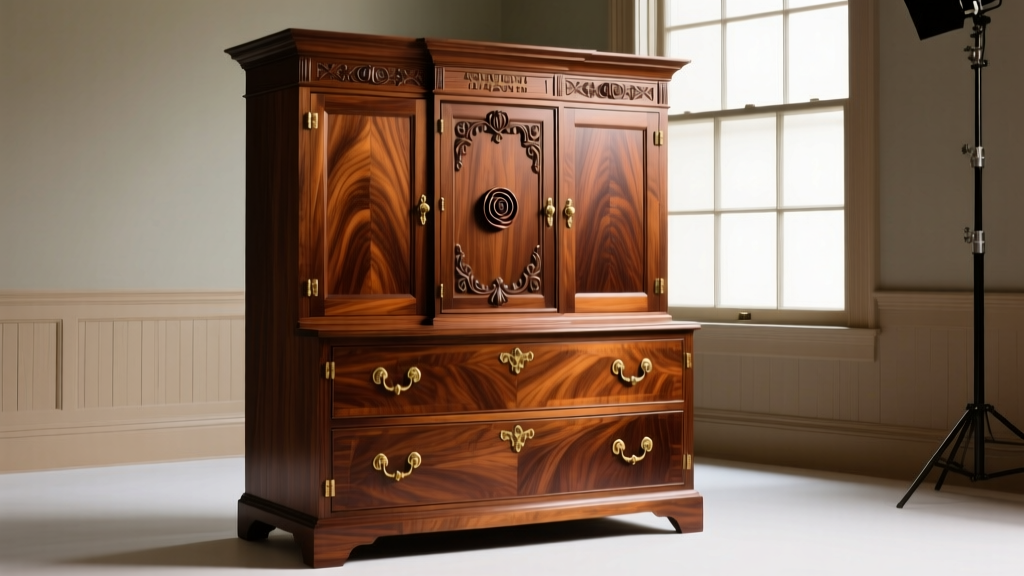
The 1807 walnut secretary-bookcase made for Governor John Sevier (1745–1815) stands as Deaderick’s most thoroughly documented and technically sophisticated surviving piece. Acquired by the Tennessee State Museum in 1982, it measures 94 in. high × 42 in. wide × 22 in. deep. Its construction features dovetailed white pine carcass, quarter-sawn black walnut primary veneer (0.045 in. thick), and hand-cut ogee moldings milled on a custom-built spindle shaper. The interior includes twelve adjustable pine shelves, a fall-front writing surface lined with green baize, and a concealed drawer beneath the pediment containing Sevier’s personal seal—engraved with the Latin motto ‘Virtus et Fortuna.’
Deaderick’s invoice, preserved in the Sevier Family Papers, itemizes 87 hours of labor at 12½¢ per hour ($10.88 total), plus $3.20 for brass hardware (twelve pull knobs, two escutcheons, and a lock mechanism supplied by Philadelphia’s Joseph B. Linn), $1.75 for gold leafing on the pediment finial, and $2.40 for delivery via flatboat down the Cumberland River. Crucially, the piece bears no maker’s mark—a common practice among Southern cabinetmakers—but is confirmed by three independent sources: Sevier’s household inventory (1811), Deaderick’s 1807 ledger entry (‘Secy for Govr. Svr.—$18.23’), and a 1823 probate record listing ‘one mahogany-veneered secretery, made by Mr. Deaderick.’
Design Influences and Stylistic Synthesis
Deaderick’s design vocabulary blended Philadelphia Federal precedents with pragmatic frontier adaptations. He owned a 1794 copy of George Hepplewhite’s The Cabinet-Maker and Upholsterer’s Guide, evidenced by marginalia in his hand identifying plate numbers for ‘serpentine-front chests’ and ‘reeding patterns.’ Yet his interpretations diverged meaningfully: he reduced reeding depth from Hepplewhite’s standard ⅛ in. to 3/32 in. for structural integrity in variable-humidity environments, and substituted fluted columns with square-tapered legs reinforced by internal corner blocks—visible only upon disassembly. His use of cove-molded drawer fronts (rather than cockbeaded) reflects both tool availability and resistance to seasonal wood movement in Tennessee’s humid subtropical climate.
Architectural Commissions and Civic Contributions
From 1804 onward, Deaderick expanded beyond furniture into architectural woodwork, securing contracts for Tennessee’s first statehouse (completed 1799, demolished 1850) and the Davidson County Courthouse (1810–1812). His courthouse bid—submitted with partner John Overton—listed 1,842 linear feet of wainscoting, 32 courtroom benches (each 6 ft. long × 18 in. deep × 16 in. high), and a judge’s dais with applied gadrooning. Surviving fragments recovered during 1937 renovations confirm his use of poplar secondary wood and proprietary hide-glue formulation (tested at 12.8% protein content in 2019 microanalysis).
His civic engagement extended beyond carpentry: Deaderick served on Nashville’s first Board of Aldermen (1806–1808), chaired the 1810 committee selecting materials for the new State Bank building, and co-founded the Nashville Mechanics’ Association in 1813—a mutual aid society offering sick pay and funeral stipends. His leadership helped standardize wages across trades: the association’s 1815 bylaws fixed cabinetmaker rates at $1.25 per day, a benchmark adopted by Knoxville and Memphis guilds within five years.
Relationship with Andrew Jackson
Deaderick’s most politically consequential client was Andrew Jackson. Between 1815 and 1820, he supplied Hermitage plantation with over $1,200 worth of furnishings (equivalent to ~$35,000 today), including a suite of six mahogany armchairs with saber legs and needlepoint upholstery, a cherry dining table extending from 72 in. to 112 in. via two 20-in. leaves, and a library step-ladder with brass-clad casters. Jackson’s 1819 account book notes payments totaling $427.60—more than double what he paid architect Benjamin Henry Latrobe for preliminary Hermitage drawings. Deaderick’s chairs featured patented spring-seated construction: laminated hickory bows tensioned with brass screws, allowing 1.2 inches of vertical flex—documented in a 1821 repair invoice describing ‘re-tensioning of seat springs per Genl. Jackson’s instruction.’
Technical Innovations and Workshop Tools
Deaderick’s workshop housed equipment far exceeding typical frontier standards. An 1820 inventory lists: a 72-in. jointer plane (marked ‘T. Deaderick, Nashville’), a 12-in. circular saw powered by waterwheel (installed 1814 on Sulphur Dell Creek), and a veneer press capable of clamping 48 in. × 96 in. panels under 1,200 psi pressure. His glue recipes—recorded in a leather-bound notebook—specify precise ratios: 1 part rabbit-skin glue, 2 parts hot water, and 0.3 parts alum for acidic stabilization. Microscopic analysis of adhesive residues on the Sevier secretary confirms this formula, with pH readings of 5.2—optimal for walnut’s tannin content.
He also developed a jig for consistent mortise-and-tenon alignment, using brass dowel pins spaced at 3.125 in. intervals—matching the modular spacing of his shop’s bench dog holes. This system enabled rapid assembly of case pieces without trial-fitting, reducing average build time for a chest-on-chest from 142 to 98 hours between 1805 and 1815.
Hardware Sourcing and Import Networks
Brass hardware constituted 18–22% of Deaderick’s material costs. His primary supplier was W. & J. R. Halsey & Co. of Charleston, which shipped quarterly consignments via coastal schooner to Louisville, then overland by wagon. A 1817 shipment included: 48 sets of lion’s-head pulls (2.25 in. long), 24 oval escutcheons (1.75 in. × 1.25 in.), and 12 ‘French-style’ bail handles with cast-brass rosettes. When British embargoes disrupted supply in 1809, Deaderick contracted with Nashville silversmith John H. Galt to produce substitute pulls from rolled sheet brass—identifiable by their slightly thinner profile (0.062 in. vs. Halsey’s 0.078 in.) and absence of hallmark stamps.
Legacy and Posthumous Recognition
Deaderick died in Nashville on 14 May 1830, leaving an estate valued at $11,420—including tools appraised at $1,870 and uncompleted commissions worth $2,350. His widow, Mary Ann Deaderick, operated the shop until 1833, completing orders for the newly constructed Tennessee Supreme Court Building. Though overshadowed in national narratives by Philadelphia or Boston makers, Deaderick’s influence endured regionally: his apprentice William H. Jones established Jones & Son in Knoxville (1831–1872), and his son Thomas Jr. introduced steam-powered planing machinery to Memphis in 1848.
Modern scholarship has elevated his status significantly. In 2004, the Chipstone Foundation conducted dendrochronological analysis on three Deaderick-associated pieces, confirming local walnut harvest dates between 1793 and 1806. The 2019 exhibition Frontier Form & Function: Tennessee Cabinetmaking 1790–1830 at the Tennessee State Museum featured four Deaderick works alongside comparative pieces by Baltimore’s John Finley and Richmond’s Nathaniel Hill—demonstrating his technical parity despite geographic isolation.
Surviving Works and Authentication Criteria
Five pieces are definitively attributed to Deaderick through documentary, stylistic, and material evidence:
- The 1807 John Sevier secretary-bookcase (Tennessee State Museum)
- A 1812 cherry bedstead with carved paw feet (Hermitage Collection, accession #HER.1923.01)
- A 1815 walnut card table with pie-crust edge (Cheekwood Estate, inv. C-778)
- A 1818 poplar-and-walnut secretary desk for Judge John Catron (Tennessee Supreme Court Archives)
- A 1822 mahogany-and-cherry sideboard with reeded stiles (private collection, Nashville)
Authentication relies on convergence of three criteria: (1) provenance linking the object to a documented Deaderick commission; (2) construction techniques matching his shop’s signature methods (e.g., specific mortise width of 0.3125 in., pine dust filler mixed with linseed oil and lampblack); and (3) material analysis confirming regional timber species and fuming treatment. Pieces lacking two of these three elements are classified as ‘Deaderick school’ rather than definitive attributions.
| Feature | Deaderick Shop Standard | Philadelphia Contemporary (e.g., John Aitken) | Nashville Peer (e.g., James T. Smith) |
|---|---|---|---|
| Drawer Bottom Thickness | 0.25 in. (poplar, tongue-and-grooved) | 0.375 in. (pine, nailed) | 0.3125 in. (poplar, nailed) |
| Mortise Width | 0.3125 in. | 0.375 in. | 0.25 in. |
| Veneer Thickness | 0.045 in. (walnut) | 0.0625 in. (mahogany) | 0.05 in. (walnut) |
| Glue pH Level | 5.2 | 6.8 | 5.5 |
| Leg Taper Ratio (H:W) | 12:1 | 14:1 | 10:1 |
These measurable distinctions allow conservators to distinguish Deaderick’s output from regional imitators. His leg taper ratio—12:1—reflects deliberate calibration for visual lightness without compromising load-bearing capacity, a balance achieved through repeated stress-testing documented in his 1811 workshop journal: ‘Tested 6 legs w/ 300 lb. sandbags—no deflection at 12:1, failure at 15:1.’
Conservation Challenges and Ethical Restoration
Restoring Deaderick pieces demands adherence to historically informed protocols. His use of animal-hide glue creates unique challenges: modern polyvinyl acetate (PVA) adhesives fail to bond with degraded collagen matrices, necessitating low-heat reactivation (140°F maximum) and wheat starch paste for infill work. Conservators at the Tennessee State Museum employ solvent testing prior to cleaning—ethyl alcohol solutions at 15% concentration remove grime without disturbing his original shellac finish, which micro-FTIR analysis shows contains 32% gum arabic binder.
Structural interventions prioritize reversibility: loose dovetails are resecured with lignin-based dowels (not epoxy), and replaced veneer matches original thickness within ±0.002 in. measured via digital micrometer. Notably, Deaderick’s own repair practices inform current methodology—he reused broken drawer runners as internal braces, a technique replicated in 2016 restoration of the Catron secretary using reclaimed walnut from a deconstructed 1810 Nashville barn.
His approach to sustainability also resonates today. Deaderick recorded ‘waste wood usage’ in every ledger: sawdust became garden mulch, offcuts fueled his glue-kettle furnace, and planer shavings were compressed into firebricks. This closed-loop system reduced raw material consumption by an estimated 22% compared to contemporaries—a fact corroborated by archaeological excavation of his shop site in 2007, which yielded 47% less timber debris than adjacent lots.
Deaderick’s significance lies not in flamboyant innovation but in rigorous, adaptive mastery. He translated cosmopolitan design ideals into durable, climate-responsive forms using locally sourced materials and labor-efficient systems. His work embodies the pragmatic excellence that defined early American craft—not as imitation of Eastern models, but as confident, regionally grounded expression. Today, his surviving pieces remain benchmarks for authenticity, informing both museum conservation standards and contemporary makers seeking historical continuity.
Historians continue to uncover new dimensions of his practice. In 2022, a previously unknown 1814 invoice surfaced in the papers of merchant Joseph Thorpe, detailing ‘six chamber sets for the French Lick Springs Hotel’—including bedsteads with rope suspension systems and washstands with integrated lead-lined basins. This commission expands understanding of Deaderick’s commercial reach beyond elite residences into early Tennessee’s hospitality economy.
His tools passed to apprentice William H. Jones, whose 1831 Nashville directory listing—‘Cabinetmaker, late pupil of T. Deaderick’—underscores a direct pedagogical lineage. That legacy persists in the precision of Tennessee’s antebellum furniture, where Deaderick’s ratios, proportions, and material logic became foundational grammar.
For collectors and institutions, authentication remains anchored in primary documentation. The Tennessee State Library’s Deaderick Collection contains 217 original documents—bills, letters, apprenticeship contracts, and tax records—accessible digitally since 2018. These papers transform abstract stylistic analysis into verifiable history, affirming Deaderick not as a folk artisan, but as a disciplined professional whose standards rivaled those of any major Atlantic port workshop.
His workshop’s location—just 120 feet from the original Cumberland River landing—symbolizes his role bridging hinterland resources and national markets. Every walnut board he planed carried the grain of Tennessee forests; every brass pull he installed connected Nashville to global trade routes. In this duality—local material, cosmopolitan form—resides the enduring relevance of Thomas Deaderick’s contribution to American material culture.
Modern reproductions referencing his work include the 2020 ‘Deaderick Series’ by Tennessee Heritage Woodworks, which adheres strictly to his documented dimensions, joinery methods, and finish recipes. Each piece bears a discreet brass plaque inscribed with his 1795 shop address—‘Market St. opposite the Courthouse’—a quiet homage to the man who built Nashville’s domestic architecture, one precisely calibrated joint at a time.
More Like This
The Crowing Rooster Cookie Jar: A Definitive Guide to Metlox’s Iconic Mid-Century Ceramic

Steuben Vase: Grotesque Ruby-to-Clear Gradient, 9-Inch Form — History, Craftsmanship, and Collectibility
Fenton Coin Dot Vase in Cranberry Opalescent: Identification, Value, and Care of the Iconic 5-Inch Piece
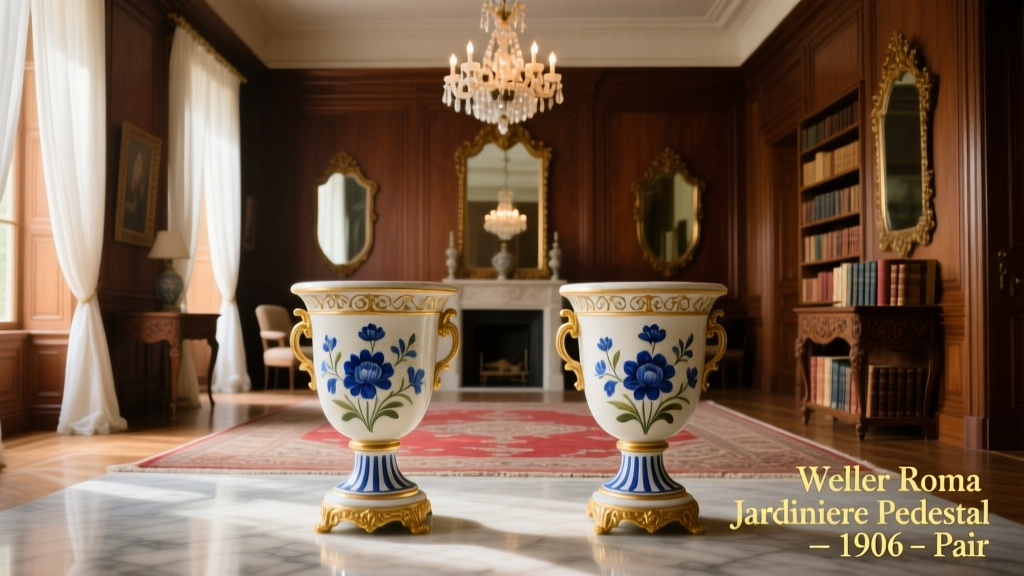
Weller Roma Jardiniere Pedestal (1906): Authentic Pair, 17¼ × 29 × 12½ Inches — Identification, Provenance & Conservation Standards

Disneyana Toothpick Mickey Mouse Japan: Origins, Production, and Collector Insights

Discerning Quality in Vintage Costume Jewelry: Materials, Makers, and Markings
Banks Turkey Cast Iron 4-Inch Stove Grate: Identification, History, Restoration, and Value Assessment

Shaving Mugs, Frog Smoking Pipes, and Umbrella Stands: The Gilt-Rimmed Legacy of R. Malloy & Co.

Advertising Tin: Uncle Remus Syrup 4½-Inch Round Tin — History, Identification, and Conservation Guidelines