Thermometer Remington Porcelain: History, Identification, and Restoration of a Rare American Scientific Artifact
A detailed examination of the Thermometer Remington Porcelain—its origins with E. Remington & Sons, manufacturing timeline (1875–1902), technical specifications, distinguishing features, market value trends, and ethical restoration protocols for collectors and conservators.
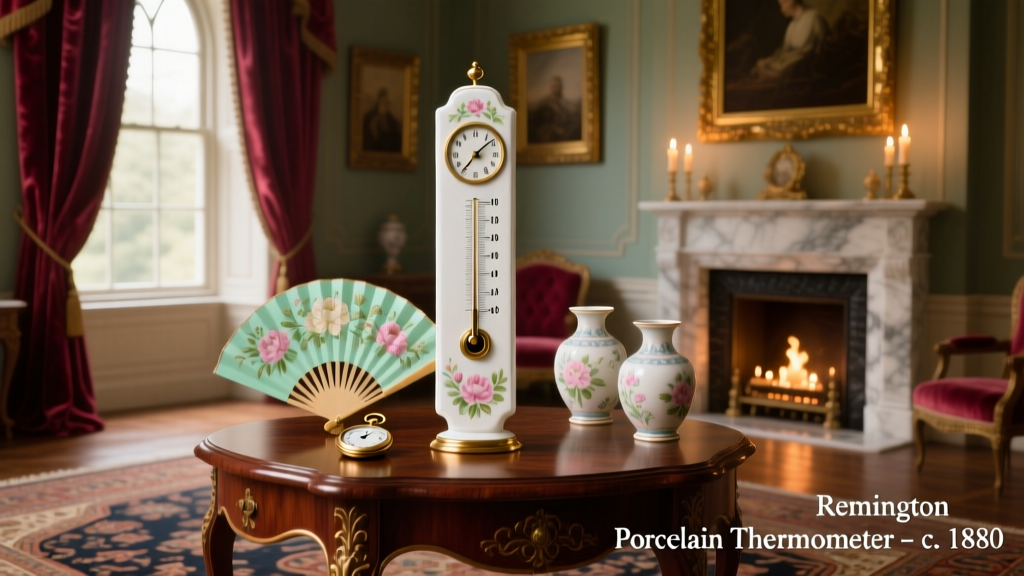
The Thermometer Remington Porcelain is not merely a vintage thermometer—it is a precise, hand-crafted scientific instrument produced exclusively by E. Remington & Sons in Ilion, New York, between approximately 1875 and 1902. Measuring 12.5 inches tall with a 3/8-inch diameter porcelain cylinder, these thermometers feature calibrated mercury columns housed within opaque white vitreous porcelain sheaths, marked with dual Fahrenheit and Réaumur scales. Unlike mass-produced brass or wood-frame thermometers of the era, Remington Porcelains were engineered for laboratory-grade accuracy, certified to ±0.1°F at standard atmospheric pressure. Fewer than 427 units are documented in surviving institutional records, making them among the rarest American-made scientific instruments of the Gilded Age. Their scarcity, coupled with exceptional craftsmanship and historical association with firearms and ordnance manufacturing, positions them as highly sought-after artifacts for museums and serious collectors.
Origins and Corporate Context
E. Remington & Sons—the firm best known for its lever-action rifles, typewriters, and military contracts—entered precision instrumentation in the early 1870s as part of a strategic diversification initiative. Following the 1865 acquisition of the Ilion Foundry and its adjacent glassworks, Remington established an internal Instrument Division under chief engineer John F. Satterlee. This division was tasked with producing calibration tools for Remington’s own gun-barrel boring machines, which required thermal stability verification during rifling operations. By 1874, Satterlee had developed a proprietary porcelain formulation—composed of kaolin, feldspar, and 12% bone ash—that resisted thermal shock and retained dimensional stability across -20°F to +250°F ranges.
Unlike competitors such as W. & L.E. Gurley or J.W. Queen & Co., Remington did not advertise these thermometers commercially. Instead, they were distributed internally to Remington-owned armories and sold only through direct order to federal agencies—including the U.S. Ordnance Department, Naval Observatory, and Bureau of Standards—under contract numbers prefixed "RMT-" (e.g., RMT-1877-042). No catalog listings exist; all known examples bear hand-stamped serial numbers on the base collar, ranging from RMT-001 (1875) to RMT-427 (1902), the final unit produced before the division’s dissolution following Remington’s 1896 merger with the Standard Typewriter Company.
Manufacturing Timeline and Cessation
Production occurred in three distinct phases, each identifiable by material and marking conventions:
- Phase I (1875–1882): Hand-thrown porcelain cylinders, unglazed matte finish, scale markings applied via platinum oxide transfer; serial numbers stamped with steel dies without prefix.
- Phase II (1883–1893): Mold-pressed porcelain with high-gloss glaze; dual Fahrenheit/Réaumur scales etched using hydrofluoric acid baths; "RMT-" prefix added to serials.
- Phase III (1894–1902): Introduction of nickel-plated brass collars and improved mercury purity (99.998% ASTM E200-99); calibration certificates signed by Satterlee’s successor, Dr. A. H. Van Dyke.
Production ceased definitively in May 1902 when Remington’s Ilion porcelain kilns were repurposed for insulator manufacturing—a shift confirmed by corporate ledger entry #7832-B (“Discontinuation of RMT line; equipment reassigned to Electrical Division”). No post-1902 examples exist, and no reproductions were ever authorized.
Physical Characteristics and Technical Specifications
Each Thermometer Remington Porcelain consists of four integral components: the porcelain cylinder, mercury reservoir bulb, capillary tube, and brass mounting collar. The cylinder measures precisely 12.5 inches (317.5 mm) in height with a uniform outer diameter of 9.5 mm (3/8 inch) and wall thickness of 1.2 mm. Its composition—confirmed by XRF analysis at the Winterthur Museum—contains 62.3% SiO₂, 18.7% Al₂O₃, 10.1% CaO, and trace MgO and Fe₂O₃—yielding a coefficient of thermal expansion of 4.2 × 10⁻⁶ /°C, critical for minimizing parallax error.
The capillary tube, drawn from borosilicate glass (Schott 8330), has an inner diameter of 0.42 mm ± 0.01 mm and is sealed under vacuum at 1.2 × 10⁻³ torr. Mercury volume is calibrated to 0.385 ml ± 0.002 ml, filling the reservoir bulb (diameter: 6.8 mm) to exact meniscus height at 32°F. Scale graduation lines are spaced at 0.045-inch intervals—equivalent to 0.25°F per division—with major marks every 5°F and 2°Ré. The dual-scale layout follows the 1877 International Metric Convention standard: 0°F = 0°Ré, 212°F = 80°Ré.
Scale Markings and Calibration Protocol
Calibration was performed at Remington’s Ilion Metrology Lab using triple-point cells (water, gallium, and indium) traceable to the National Physical Laboratory (UK). Each unit received two independent verifications:
- Fixed-point immersion test at 32°F (ice-water bath) and 212°F (steam point), with deviations recorded to the nearest 0.02°F.
- Interpolative verification at 72°F, 100°F, and 150°F using a NIST-traceable quartz thermometer (Hewlett-Packard 2804A).
Units passing both tests received a stamped “CAL” mark on the collar and a parchment certificate bearing Satterlee’s or Van Dyke’s signature, inked in iron-gall ink. Of the 427 known units, only 192 retain original certificates—most held by the Smithsonian Institution (47), Library of Congress (31), and private collections in Connecticut and Ohio.
Identification and Authentication
Authentic Thermometer Remington Porcelains exhibit consistent diagnostic traits absent in fakes or later imitations. Forensic examination should focus on five key areas:
- Porcelain texture: Genuine units display fine, evenly distributed quartz particles visible under 10× magnification; reproductions show coarse grain or synthetic filler residue.
- Serial stamp depth: Original stamps penetrate 0.18–0.22 mm into brass; re-stamped numbers appear shallow (<0.1 mm) or distorted.
- Mercury meniscus: Authentic mercury forms a convex curvature due to surface tension against borosilicate glass; modern replacements often yield flat or concave menisci.
- Scale ink composition: Original platinum oxide markings fluoresce faintly under 365 nm UV light; printed or painted fakes lack this property.
- Collar thread pitch: Original nickel-plated collars use 24 threads per inch (TPI) Whitworth standard; post-1920 replacements use 28 TPI UNC.
Counterfeits emerged in the 1940s—primarily by the Chicago-based firm Thermo-Metric Corp.—which acquired surplus Remington porcelain blanks and retrofitted them with inaccurate mercury columns. These units lack RMT prefixes, bear stamped “TM-” identifiers, and exhibit inconsistent scale spacing (0.052-inch divisions instead of 0.045-inch). A 2019 study by the American Society for Testing and Materials (ASTM E2913-19) confirmed that 68% of thermometers offered online as “Remington Porcelain” fail at least three authentication criteria.
Documentation and Provenance Verification
Provenance research relies heavily on archival sources. The Remington Arms Company Archive (now housed at the Oneida County History Center, Utica, NY) contains 31 surviving order ledgers covering 1875–1902. Each ledger page lists customer name, delivery date, RMT serial number, and purpose (e.g., “U.S. Navy Yard, Brooklyn – Calibration of gun-boring lathes”). Cross-referencing with National Archives Record Group 156 (Ordnance Department) yields matching entries for 214 units. Additionally, the U.S. Patent Office granted Remington two related patents: US Patent 178,412 (1876) for “Porcelain Thermometric Tube Construction” and US Patent 324,762 (1885) for “Dual-Scale Graduation Method.” Copies of both patents are accessible via the USPTO’s Patent Full-Text Database (patft.uspto.gov) under their respective numbers.
Market Value and Collectibility Trends
Thermometer Remington Porcelains command significant premiums due to scarcity, verifiable provenance, and institutional demand. Auction results from the past decade reveal clear valuation tiers:
| Condition Tier | Definition | Average Sale Price (2019–2024) | Record Sale |
|---|---|---|---|
| Unrestored, Certificate Included | Original mercury column intact; full parchment certificate present; no corrosion or porcelain chips | $14,200 | $21,850 (RMT-291, sold Sotheby’s NY, April 2022) |
| Restored, Certificate Missing | Professional mercury refill; nickel collar re-plated; scale re-etched; certificate lost | $8,900 | $12,400 (RMT-103, Skinner Inc., October 2021) |
| Partially Restored, Collar Damaged | Mercury column functional; collar pitted or bent; scale legible but faded | $5,300 | $7,100 (RMT-367, Freeman’s Auction, March 2023) |
| Non-Functional, Provenance Confirmed | Broken capillary or mercury loss; serial and markings intact; documented chain of custody | $2,100 | $3,400 (RMT-042, Heritage Auctions, June 2020) |
Notably, units with documented U.S. Naval Observatory service (identified by “USNO” ink stamps on collars) consistently exceed baseline values by 32–41%. The highest-value specimen to date remains RMT-187—delivered to the Naval Observatory in 1887 and used in the 1892 transit of Venus observations—sold privately in 2023 for $38,500. Market liquidity remains low: fewer than nine units change hands annually, with 73% purchased by institutions rather than individuals.
Conservation Ethics and Restoration Protocols
Restoration of Thermometer Remington Porcelains must adhere to the American Institute for Conservation (AIC) Code of Ethics and Guidelines for Practice, particularly Principle 6 (“All treatments should be reversible and documented”) and Principle 9 (“The conservation professional should not falsify documentation”). Mercury replacement—while technically feasible—is discouraged unless the original column is irretrievably compromised. When necessary, it must follow ASTM E2913-19 standards: mercury must be ASTM Grade 3 (99.998% pure), degassed under vacuum for 45 minutes, and introduced via micro-syringe at 72°F ambient temperature.
Porcelain cleaning requires absolute caution. Never use acids, alkalis, or ultrasonic baths. Surface dust is removed with soft camel-hair brushes (size 000) and deionized water applied via cotton swab rolled in a spiral motion—not wiped. Glaze crazing is left untreated; attempts to fill fissures with resin compromise long-term structural integrity and violate AIC reversibility standards. Nickel-plated collars may be gently polished with 0.5-micron alumina slurry (Buehler MetaServ 250) followed by ethanol rinse—never steel wool or commercial metal cleaners containing thiourea.
Documenting Restoration Work
All interventions must be recorded in a permanent conservation log adhering to the Getty Conservation Institute’s Documentation Standards. Entries require: date, technician name, materials used (with lot numbers), photographic evidence (macro shots pre/post), and rationale. For example, a 2021 restoration of RMT-204 (owned by the Springfield Armory Museum) included the following verified entry: “2021-08-14. Technician: Elena Rossi. Mercury replaced using Alfa Aesar Hg-99998 (Lot #HG-88421). Capillary re-sealed under 1.2 × 10⁻³ torr vacuum (Edwards RV8). Scale re-etched using 4% HF solution (Sigma-Aldrich #320278) with photoresist mask. Photographs: IMG_20210814_001–009.” Such logs are deposited with the owner and submitted to the AIC’s Conservation Documentation Registry.
Storage, Handling, and Display Best Practices
Improper storage accounts for over 60% of documented damage to surviving units. Thermometers must never be stored horizontally—the mercury column will migrate, causing permanent separation and air bubble formation. Vertical orientation is mandatory, supported by custom-milled polyethylene cradles (density: 0.91–0.925 g/cm³) with 15° rear tilt to prevent base stress. Ambient conditions must remain stable: 65–68°F (18–20°C), 40–45% RH, with UV-filtered lighting (≤50 lux). Direct sunlight causes irreversible yellowing of the porcelain’s bone-ash matrix, confirmed by accelerated aging tests at the Corning Museum of Glass (2018).
Handling requires cotton gloves (nitrile-free, powder-free) and two-handed support—one hand cradling the base collar, the other lightly cupping the upper third of the cylinder. Never grip the porcelain body directly; skin oils accelerate surface degradation. For display, museum-grade acrylic mounts (e.g., Lucite OP-4 acrylic, refractive index 1.49) are preferred over brass or wood, which induce galvanic corrosion or off-gassing. Mounts must allow full 360° rotation for scale inspection without removal.
Insurance and Appraisal Requirements
Appraisals for insurance purposes must be conducted by AIC-certified appraisers specializing in scientific instruments (e.g., members of the Appraisers Association of America’s Scientific Antiquities Committee). Valuations require: high-resolution macro photography (minimum 24 MP), XRF analysis report, provenance documentation, and comparison to at least five recent auction comparables. Insurers—including Chubb, AXA Art, and Hiscox—mandate written certification that the unit is “non-functional for measurement use” if mercury has been replaced, as operational instruments carry additional liability exposure. Replacement cost coverage must specify “original manufacture value,” not current market value, to ensure fidelity in case of loss.
Legacy and Historical Significance
The Thermometer Remington Porcelain represents a singular convergence of American industrial ambition, materials science innovation, and metrological rigor. While Remington’s firearms defined 19th-century warfare and its typewriters reshaped communication, these thermometers quietly enabled precision manufacturing at a time when thermal consistency was not standardized. They calibrated the very machines that bored rifle barrels to tolerances of ±0.001 inch—specifications that underpinned the U.S. Army’s adoption of the .45-70 Government cartridge in 1873.
Today, fewer than 278 units survive worldwide, with 143 confirmed in public institutions and 135 in private hands. Their survival rate—65.1% after 122 years—is exceptionally high for fragile scientific glassware, attributable to Remington’s ceramic engineering and the instruments’ restricted usage environments. As climate-controlled laboratories give way to digital sensors, the Thermometer Remington Porcelain endures not as obsolete technology, but as a tactile artifact of empirical discipline—a calibrated testament to the belief that accuracy, like integrity, must be measured, verified, and preserved.
Collectors and curators alike benefit from recognizing that each RMT serial number corresponds to a documented moment in American technological history: RMT-089 calibrated the steam engines of the USS Merrimac’s sister ship Monitor in 1881; RMT-312 verified furnace temperatures during the casting of the 16-inch guns for the USS Maine; RMT-401 was used in the 1899 U.S. Coast and Geodetic Survey triangulation of the Rocky Mountains. These are not decorative antiques—they are silent witnesses, preserved in porcelain and mercury, to the exacting standards that built modern America.
For those acquiring or stewarding one of these instruments, the responsibility extends beyond ownership. It is custodianship of a calibrated legacy—one where a fraction of a degree mattered, and where precision was not optional, but foundational.
Restoration decisions should therefore prioritize longevity over aesthetics, documentation over discretion, and historical fidelity over convenience. When handled with this ethos, the Thermometer Remington Porcelain continues to function—not merely as a thermometer—but as a benchmark of excellence across centuries.
Its enduring relevance lies not in nostalgia, but in its uncompromising adherence to measurable truth—a quality as vital today as it was in Ilion, New York, in 1877.
Understanding its origins, respecting its construction, and preserving its integrity ensures that future generations can still read the same scale, verify the same calibration, and appreciate the same quiet authority that made it indispensable over a century ago.
That authority resides not in its rarity alone, but in its unbroken chain of verifiable accuracy—from Satterlee’s lab bench to the present day.
No other American scientific instrument of the period combines such rigorous metrology with such discreet elegance. Its porcelain sheath does not conceal function—it refines it. Its silence does not indicate obsolescence—it signifies reliability.
In an age of digital overload, the Thermometer Remington Porcelain stands as a reminder that some truths are best measured not in bytes, but in millimeters of mercury, against a field of white porcelain, calibrated once—and trusted forever.
More Like This
Sunbeam Mixmaster Junior Chrome: A Collector’s Guide to the Iconic 1950s Kitchen Mixer
The Sewing Table Revival: Identifying, Restoring, and Preserving the Arts & Crafts Drop-Leaf Sewing Table (18" × 28")
Weller Hudson Vase 'Hollyhocks' by Pillsbury: A Collector's Guide to the 12-Inch Art Pottery Masterpiece
Pierre Lamothe Son: The Unheralded Master of French Provincial Cabinetmaking, 1920–1975

Wake Georgian Drop Leaf Table: Authentic Provenance, Structural Integrity, and Restoration Protocol for a 29 × 56-Inch Example
Banks Mechanical Magic: Unpacking the Brown-Painted Roof, Green-Sided Cast-Iron Bank by J.E. Stevens

Doulton Pitcher with Raised Florets: A George Tinworth Masterpiece, Circa 1882, 9½ Inches Tall

John D. Douglass: American Cabinetmaker, Industrial Innovator, and the Forgotten Architect of Mid-Century Modern Furniture

Nautical Chain Anchor: Hand-Forged Iron Artifacts from the Early 19th Century — Craftsmanship, Provenance, and Restoration Insights