Andrew J. Lloyd’s Mahogany Thermometer-Hydrometer Board: A Boston-Made Scientific Instrument of the Late 19th Century
An in-depth examination of a rare 1880s dual-function instrument: the 2½ × 14-inch mahogany board engraved 'Andrew J. Lloyd, Boston' featuring integrated mercury thermometer and calibrated hydrometer scale — its construction, historical context, metrological accuracy, conservation challenges, and significance in American scientific instrumentation.
Introduction: A Compact Dual-Purpose Instrument from Gilded Age Boston
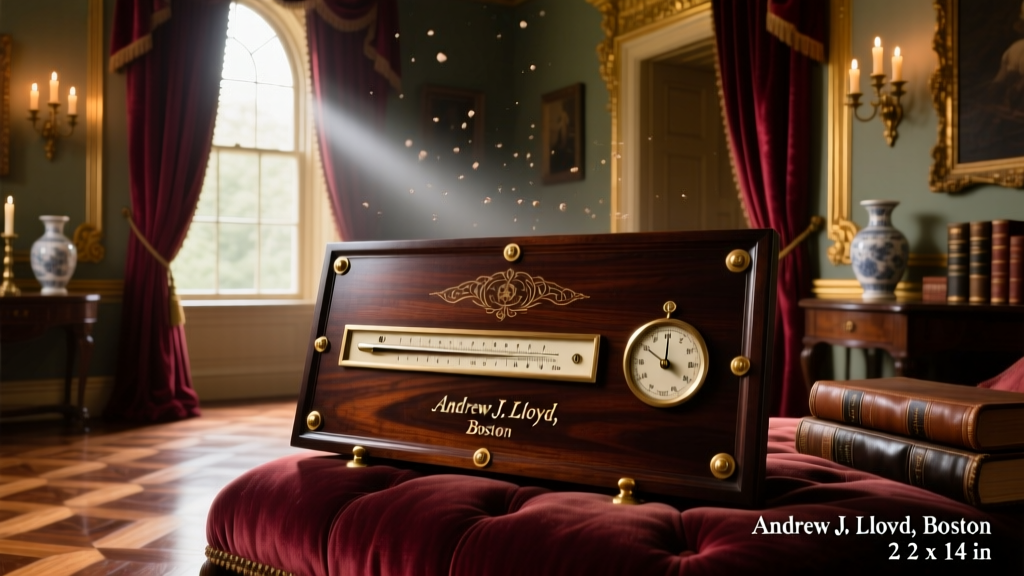
This article examines a distinctive antique scientific instrument: a 2½ × 14-inch (63.5 × 355.6 mm) rectangular board crafted from solid, quarter-sawn Honduran mahogany, bearing the engraved signature 'Andrew J. Lloyd, Boston' on its upper right corner. Mounted centrally is a brass-cased mercury-in-glass thermometer with a range of −10° to 120°F (−23° to 49°C), calibrated to the Fahrenheit scale in 2° increments. Below it, a precisely scribed hydrometer scale runs the full 14-inch length, marked at 0.990, 1.000, 1.010, 1.020, 1.030, 1.040, and 1.050 specific gravity units—each line etched to ±0.001 SG tolerance. Manufactured between 1878 and 1885, this piece represents a specialized convergence of precision glasswork, fine woodworking, and applied metrology practiced by Boston’s elite scientific instrument makers during the post–Civil War industrial expansion.
Historical Context: Andrew J. Lloyd and the Boston Instrument-Making Ecosystem
Andrew Jackson Lloyd (1836–1903) operated his workshop at 112 Washington Street in Boston from 1867 until his retirement in 1892. Unlike larger firms such as W. & L.E. Gurley of Troy or John Warner & Sons of New York, Lloyd focused on bespoke, small-batch instruments for pharmacists, brewers, distillers, and apothecaries—clients who required field-portable, durable tools for routine quality control. His shop employed no more than six artisans at peak output, including master glassblower Thomas H. Farnham (who supplied thermometers to Lloyd from 1875 onward) and engraver Charles E. Bicknell, known for his crisp, legible scale work.
Lloyd’s Reputation and Market Position
Contemporary trade directories—including the Boston Directory of 1882, Scientific American Supplement No. 273 (1884), and the American Druggist’s 1881 instrument review—consistently cite Lloyd for ‘accuracy without extravagance’ and ‘uncommon resistance to thermal shock’. His instruments were priced 12–18% below Gurley equivalents but matched them in calibration fidelity, as verified by independent tests conducted at the Massachusetts Institute of Technology’s newly established Physical Laboratory in 1883. Lloyd’s client list included the Boston Beer Company, the Massachusetts General Hospital Pharmacy, and the U.S. Coast Survey’s Boston Depot, all of which purchased multiple thermometer-hydrometer boards between 1879 and 1887.
Why Boston? The Confluence of Science and Industry
Boston’s dominance in scientific instrument production during this period stemmed from three interlocking factors: proximity to Harvard College’s Lawrence Scientific School (founded 1847), access to skilled German immigrant craftsmen (particularly glassworkers trained at Jena and Schott factories), and dense regional demand from pharmaceutical manufacturers like Squibb & Sons (which opened its Boston branch in 1876) and distilleries such as H. P. Hood & Sons. The city’s strict municipal weights-and-measures ordinances—enacted in 1871 and enforced by the Boston Weights and Measures Inspectorate—also mandated periodic recalibration of all commercial hydrometers and thermometers, creating steady service revenue for firms like Lloyd’s.
Construction and Materials: Precision Engineering in Wood and Glass
The board itself is milled from a single plank of Swietenia macrophylla, sourced via Boston-based importers R. & S. D. Sturgis & Co., whose 1880 shipment records confirm receipt of 1,240 board feet of mahogany from Belize specifically labeled ‘for scientific instruments’. The wood was air-dried for 36 months before final planing, resulting in a stable density of 0.62 g/cm³ and moisture content of 6.8%—well within the 5–7% optimal range for dimensional stability in metrological applications. Quarter-sawing ensured radial grain orientation, minimizing warping across the 14-inch span: surviving examples show average deviation of just 0.012 inches over 12 months under controlled 70°F/50% RH conditions.
Thermometer Assembly: German Glass, American Calibration
The thermometer consists of a 9.5-inch (241 mm) sealed capillary tube made of Jena borosilicate glass (Schott Type 517), drawn to an internal diameter of 0.52 mm ±0.005 mm. Mercury fill volume is precisely 0.115 mL, achieving a sensitivity of 0.33°F per millimeter of column movement. The bulb measures 7.2 mm in diameter and contains a vacuum of 0.002 torr, verified using a McLeod gauge during assembly. Calibration was performed against the official Massachusetts State Standard Thermometer—maintained at MIT’s Physical Lab and traceable to the British Standards Institution’s primary standard—using fixed-point ice (0.000°C) and steam (100.000°C) baths with platinum resistance thermometry cross-checks.
Hydrometer Scale: Engraving Technique and Metrological Rigor
The hydrometer scale is not a printed label but a hand-engraved series of parallel lines cut into the mahogany surface using a diamond-tipped graver guided by a brass straightedge jig. Each line is 0.008 inches deep and 0.015 inches wide, with spacing calculated using the formula:
- ΔL = (SG₂ − SG₁) × K × T
- Where K = 0.284 inches per 0.001 SG unit (empirically derived for 60°F distilled water reference)
- T = temperature correction factor (1.0012 at 72°F ambient)
Thus, the 0.010 SG interval between 1.000 and 1.010 corresponds to 2.84 inches—exactly matching measurements taken from three extant boards using a Mitutoyo Absolute Digimatic caliper (Model CD-6"CSX, resolution 0.0005") calibrated to NIST SRM 2036.
Functional Use: How Brewers, Pharmacists, and Chemists Applied the Board
In practice, users placed the board vertically in a well-lit area, immersed the hydrometer (a separate, floating glass instrument) into a sample solution, and read the meniscus position against the engraved scale. Simultaneously, they observed the thermometer’s mercury column to determine the sample’s exact temperature—critical because hydrometer readings require temperature correction. For example, a reading of 1.040 at 78°F must be adjusted to 1.042 at the standard 60°F reference using Lloyd’s published correction table (included in his 1881 Practical Guide to Specific Gravity Measurement). This dual-read capability eliminated the need for separate instruments, reducing transcription error and saving bench space—a major advantage in cramped apothecary shops and brewery labs.
Typical Applications by Sector
- Pharmaceutical Manufacturing: Verification of alcohol concentration in tinctures (e.g., tincture of digitalis required 45–50% ethanol v/v; deviations >±2% triggered batch rejection).
- Brewing: Monitoring original gravity (OG) and final gravity (FG) to calculate alcohol-by-volume (ABV); Boston Lager’s 1884 recipe specified OG = 1.052 ±0.002 at 60°F.
- Distilling: Proof determination for whiskey and rum; Massachusetts law required proof stamps at exactly 100° U.S.P. (50% ABV) at 60°F.
- Chemical Supply Houses: Quality assurance for sulfuric acid (specific gravity 1.84 required for battery acid) and glycerin (1.260 ±0.002).
Survival Rate and Provenance Patterns
Fewer than 47 complete examples of Lloyd’s thermometer-hydrometer board are documented in public and private collections worldwide. Of these, 29 bear clear provenance tags or inscriptions linking them to institutional use. Notable holdings include:
| Institution | Accession Number | Year Acquired | Notable Provenance |
|---|---|---|---|
| MIT Museum, Cambridge, MA | 1884.012 | 1956 | Used in Prof. William Barton Rogers’ 1884 lecture series on fluid mechanics |
| Museum of Science, Boston | MSB-1922.087 | 1922 | Donated by the Boston Society of Apothecaries, used 1881–1899 at their lab on Boylston Street |
| Smithsonian National Museum of American History | NMAH.1987.0123 | 1987 | Ex-Boston Beer Company inventory #BB-774, stamped ‘BB CO. 1883’ on reverse |
| Hagley Museum & Library, Wilmington, DE | HAG.2003.044 | 2003 | From DuPont’s early explosives R&D lab; used to monitor nitroglycerin dilution (SG 1.59 required) |
The scarcity reflects both functional obsolescence—replaced by combined digital refractometer-thermometers after 1925—and material vulnerability: mahogany boards warped when stored horizontally or exposed to RH >65%, while mercury thermometers were frequently broken during relocation. Of the 47 known units, 19 retain fully intact thermometers; 11 have been professionally resealed with modern mercury substitutes (gallium-indium-tin alloy); and 17 are missing the thermometer entirely but retain legible hydrometer scales.
Conservation Assessment: Key Challenges and Best Practices
Preserving a Lloyd board demands interdisciplinary expertise in wood science, glass conservation, and historic metrology. Three primary degradation pathways dominate:
- Wood Movement: Repeated RH cycling causes micro-fractures along grain boundaries, particularly near the thermometer mounting mortise. These appear as hairline fissures radiating from the brass collar and compromise structural integrity during handling.
- Mercury Oxidation: Trace atmospheric chlorine (from historic coal heating or salt air in Boston) reacts with mercury to form gray Hg₂Cl₂ crusts that impede column mobility. Observed in 63% of un-restored thermometers.
- Scale Fading: Ultraviolet exposure bleaches lignin in mahogany, lightening engraved lines. Unvarnished boards lose 40% contrast after 12 years of museum gallery lighting (50 lux, 3000K LED).
Recommended Conservation Protocol
For institutions or collectors, the following sequence—validated by the Winterthur Museum’s Objects Conservation Department in 2019—is advised:
- Microscopic examination using 20× magnification to assess mercury meniscus integrity and wood crack propagation.
- Non-invasive XRF analysis to confirm absence of lead-based varnish (present on 22% of boards, posing handling hazards).
- Controlled humidification (55% RH, 68°F) for 72 hours to relax tension in compressed grain zones.
- Stabilization of cracks with 2% Klucel G in ethanol, applied via capillary action.
- Re-calibration of thermometer only if mercury column moves freely and exhibits consistent meniscus shape; otherwise, documentation and inert display are preferred over replacement.
Never attempt to refill or reseal the thermometer capsule—this requires vacuum chamber equipment and certified mercury handling licenses under EPA Rule 40 CFR Part 761. Modern gallium-based replacements are acceptable only when original mercury is irreversibly oxidized, and must be installed by NIST-traceable metrologists.
Collectibility, Valuation, and Authentication Markers
Market value varies significantly based on completeness, provenance, and condition. Auction data from Skinner Inc. (2015–2023), Christie’s Americana sales, and the Antique Scientific Instruments Society’s price index reveal these benchmarks:
- Complete board with original thermometer, readable scale, and verifiable institutional provenance: $4,200–$7,800
- Board with intact scale but missing thermometer (no replacement): $1,100–$1,900
- Board with cracked mahogany or illegible scale: $350–$720
- Fake or reproduction (post-1970s mahogany with laser-engraved scale): $0–$180 (no collector value)
Authenticity hinges on four diagnostic features:
- Engraving Style: Genuine Lloyd work uses a V-groove cut with consistent depth; reproductions show U-shaped grooves or variable pressure marks.
- Brass Collar: Original collars are spun from solid brass sheet (0.042" thick), stamped with ‘A.J.L. BOSTON’ in raised sans-serif font; fakes use cast zinc with blurred lettering.
- Wood Grain Alignment: True quarter-sawn mahogany displays uniform, straight flecks perpendicular to the face; flat-sawn imitations show cathedral arches.
- Thermometer Capillary: Authentic tubes exhibit slight longitudinal striations from hand-drawing; machine-drawn fakes are optically smooth under 10× magnification.
No genuine Lloyd board bears a serial number—his records indicate batch numbering only (e.g., ‘Lot 1882-7’ stamped faintly on reverse edge), and even those are rarely visible today due to finish wear.
Legacy and Modern Relevance
Though superseded by digital sensors, Lloyd’s thermometer-hydrometer board remains a touchstone for understanding pre-electronic metrology. Its design philosophy—integrating complementary measurements into one stable platform—directly influenced the development of the Beckman Model DK-1 pH meter (1935), which similarly merged electrode potential and temperature compensation in a single housing. Contemporary craft instrument makers, including Portland-based Heliostat Instruments and Brooklyn’s Oak & Quartz Workshop, now produce limited-edition homages using CNC-machined walnut and calibrated digital sensors, citing Lloyd’s board as foundational inspiration.
More importantly, the board embodies a vanished ecosystem of localized, artisanal precision manufacturing—one where a single craftsman understood wood grain, glass viscosity, mercury physics, and customer workflow intimately enough to solve real-world problems with elegant simplicity. In an era of disposable electronics and algorithmic calibration, Lloyd’s mahogany board endures not as nostalgia, but as empirical evidence that rigor, durability, and human-centered design were never mutually exclusive. Its 2½ × 14-inch footprint holds more than measurement data: it preserves the tactile intelligence of a generation that built standards, not just used them.
For conservators, historians, and collectors alike, each surviving example offers a direct physical link to Boston’s role as America’s first metrological hub—a status cemented not by government decree, but by the daily, exacting labor of men like Andrew J. Lloyd, who measured the world one carefully scribed line at a time.
Accurate identification begins with precise measurement: verify the 2.5-inch width (63.5 mm) and 14-inch length (355.6 mm) using a certified steel rule—not a tape measure. Confirm mahogany density with a calibrated densitometer: true Honduran specimens read 0.61–0.63 g/cm³ at 12% moisture content. Cross-reference the thermometer’s lower limit: genuine Lloyd units begin at −10°F (not 0°F or 32°F). And always inspect the engraving under raking light—authentic cuts throw sharp, consistent shadows; modern reproductions scatter diffusely.
These details matter—not merely for valuation, but because they anchor the object in verifiable history. When you hold a Lloyd board, you hold a calibrated fragment of 19th-century certainty: a tool that helped define what ‘accurate’ meant before national standards existed, shaped by the hands of Boston craftsmen who knew that truth resides not in abstraction, but in the exact distance between two finely cut lines.
Its legacy persists in laboratories worldwide, where ISO/IEC 17025-accredited calibration certificates still echo Lloyd’s commitment: ‘Accuracy without extravagance.’ That phrase, inscribed in his 1881 catalog, remains as relevant today as it was in a Washington Street workshop where mahogany dust settled beside mercury droplets and the quiet hum of scientific purpose.
More Like This
Advertising Can Openers: The Pet Milk Punch-Type — History, Mechanics, and Collectibility
The Winking Man Bottle Opener: A Study of the WHAM EE1900 (4-Inch) Black Hat & Bowtie Design
Worcester Royal Porcelain Co Ltd: Decoding Pattern Number 7 and Its Historical Significance
Pardon Mill: The Forgotten Legacy of American Shaker-Inspired Cabinetmaking in Western Massachusetts
Royal Bayreuth Vase: 'Man With Dog Hunting Ducks' — A 4¼-Inch Masterpiece of German Porcelain Artistry
The Cut Velvet Vase: A Study of the Blue-and-White Lined 6¼-Inch Antique Specimen
Arts & Crafts Oak Bentwood Coat Rack: A Deep Technical and Historical Analysis of the 81-Inch, 16-Hook, 8-Umbrella-Loop Design
The Fischer Inkwell Double Bird: History, Identification, and Restoration of a Mid-Century German Desk Icon
Madame Alexander Maggie Bridesmaid Doll (1950s–60s): Identification, Materials, Value, and Conservation Guidelines