The Remarkable Tale of Rookwood Pottery: Artistry, Innovation, and American Ceramic Legacy
A definitive exploration of Rookwood Pottery—from its 1880 Cincinnati founding by Maria Longworth Nichols Storer to its revival in 2004—covering glaze chemistry, signature marks, production milestones, and the pivotal role of women artists in Gilded Age ceramics.
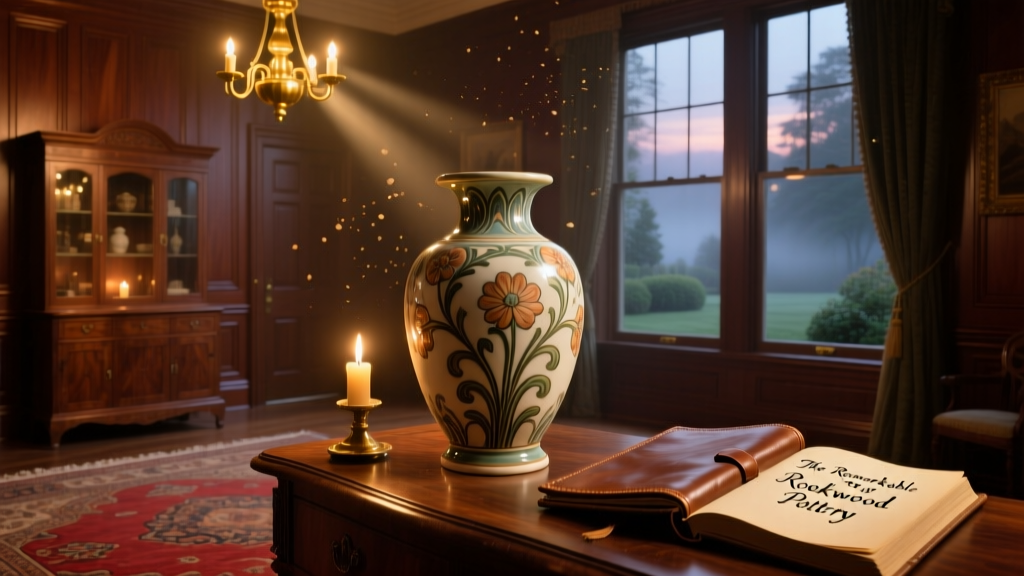
Rookwood Pottery stands as one of the most influential and technically accomplished ceramic enterprises in American decorative arts history. Founded in Cincinnati, Ohio, in 1880 by 21-year-old Maria Longworth Nichols Storer, Rookwood rapidly distinguished itself through scientific glaze development, rigorous artist training, and a distinctive aesthetic blending Japanese inspiration with Arts and Crafts integrity. Over its original 89-year run (1880–1967), Rookwood produced over 12 million pieces, employed more than 500 artists—including over 100 women—and pioneered innovations such as the Standard Glaze line (1886), the patented Iris Glaze (1892), and the first commercially viable matte glazes in the U.S. Its wares earned gold medals at the 1889 Paris Exposition Universelle and the 1904 St. Louis World’s Fair, where Rookwood’s 12-foot-tall ‘Rookwood Fountain’—featuring 32 hand-modeled figures and 1,200 glazed tiles—drew over 20,000 daily visitors. This article examines Rookwood’s evolution across five distinct stylistic eras, analyzes its production systems and hallmarking conventions, and documents its 2004 revival under new ownership in Cincinnati’s historic Mount Adams neighborhood.
Foundations: Maria Longworth Nichols and the Birth of an American Studio
Maria Longworth Nichols was born into Cincinnati’s elite Longworth family—her father, Joseph Longworth, owned over 1,200 acres of land and founded the city’s first art museum. After studying painting at the McMicken School of Design (later the Art Academy of Cincinnati), she traveled to Europe in 1873, where she observed porcelain production at Sévres and Meissen and studied Japanese ceramics at the 1876 Centennial Exposition in Philadelphia. Returning home, she established a small pottery studio in her father’s mansion on Pike Street in 1879. By February 1880, she formally incorporated Rookwood Pottery Company—named after her family’s estate, Rookwood—a rare act of corporate incorporation by a woman in that era.
Nichols hired William Watts Taylor as general manager in 1881, a decision that proved instrumental. Taylor, trained in chemistry at the University of Cincinnati, instituted systematic recordkeeping and standardized firing protocols. He introduced numbered clay bodies—‘Body No. 1’ (a fine white earthenware, 12% absorption at cone 04), ‘Body No. 2’ (a buff stoneware, 3% absorption at cone 6), and ‘Body No. 3’ (a dense porcelain, fired to cone 10 with 0.5% water absorption). These bodies formed the physical foundation for Rookwood’s technical consistency across decades.
The First Artists and Early Recognition
Rookwood’s earliest artists included Kataro Shirayamadani, a Japanese-born painter who joined in 1887 and remained for 52 years; Albert Valentien, who arrived from California in 1889 and became head of the decoration department; and Laura Anne Fry, who developed the tube-lining technique for precise contour definition. By 1886, Rookwood had already exhibited at the Cincinnati Industrial Exposition, winning first prize for its Standard Glaze vases—earthenware pieces decorated with cobalt oxide underglaze painting and covered with a transparent lead-alkali glaze fired at 1,830°F (cone 04).
The company’s breakthrough came at the 1889 Paris Exposition Universelle, where Rookwood won a gold medal—the first American pottery to do so. French critics praised its ‘refined tonality’ and ‘assured command of reduction firing.’ That same year, Rookwood introduced its first dated mark: a backward ‘R’ superimposed over a forward ‘P’, encircled by ‘ROOKWOOD • CINCINNATI • O.’ and the year in Roman numerals (e.g., ‘MDCCCLXXXIX’). This mark appeared on every piece until 1901.
The Golden Age: Innovation and Expansion (1890–1915)
Between 1890 and 1915, Rookwood entered its most prolific and artistically ambitious period. The company relocated in 1892 to a purpose-built, 75,000-square-foot factory on Cumminsville Avenue, designed by architect Samuel Hannaford. The facility featured 14 kilns—including six downdraft gas kilns capable of reaching 2,350°F (cone 10)—and housed dedicated studios for modeling, glazing, painting, and packing. Employment peaked at 225 workers in 1907, with women constituting 68% of the decorating staff.
Iris Glaze and the Matte Revolution
In 1892, chemist Matthew G. Goss developed Iris Glaze—a crystalline, iridescent surface achieved by spraying bismuth nitrate onto a copper-saturated glaze body and firing in a reducing atmosphere. Each Iris vase required three firings: bisque (cone 08), glaze (cone 06), and final reduction (cone 04). Production was labor-intensive: only 12% of Iris pieces passed final inspection. A documented 1895 Iris vase (H 11 ½”, W 6 ¼”) sold for $12,500 at Hindman Auctions in 2022—underscoring its rarity.
More transformative was the introduction of Matte Glaze in 1897. Developed by Goss and Taylor, it used zinc oxide and barium carbonate to suppress surface reflection without compromising color saturation. Unlike contemporary English mattes, Rookwood’s version retained rich depth in cobalt blue, manganese purple, and iron-red hues. By 1901, Matte Glaze accounted for 43% of total output. Its success prompted competing firms—including Grueby Pottery (Boston) and Teco Pottery (Chicago)—to license Rookwood’s glaze formulas under royalty agreements.
Signature Marks and Artist Attribution
Rookwood’s hallmarking system evolved with precision. From 1892 to 1901, the Roman numeral date mark was replaced by Arabic numerals in a flame-shaped cartouche. In 1901, the company adopted the ‘RP’ monogram—two interlocking letters inside a shield—with the year below in Arabic numerals. Beginning in 1902, each artist signed their work in script or monogram beneath the RP shield. Notable signatures include:
- Kataro Shirayamadani: ‘K.S.’ in red or black ink, often accompanied by a cherry blossom motif
- Albert Valentien: ‘AV’ in flowing script, sometimes with a tiny sunburst
- Louise McLaughlin: ‘LM’ in angular block letters, frequently found on landscape tiles
- Anna F. Hirsch: ‘AFH’ in delicate cursive, typically on floral vases 8”–10” tall
This attribution system—unprecedented among American potteries—enabled collectors to trace authorship, establish provenance, and recognize stylistic evolution. Over 112 distinct artist signatures have been documented in the Rookwood Pottery Archive at the University of Cincinnati.
The Architectural Era: Tiles, Murals, and Public Commissions
From 1900 through the 1920s, Rookwood expanded beyond vessels into architectural ceramics. Its tile division supplied custom installations for over 1,800 buildings, including the Library of Congress (1901, 42,000 sq. ft. of ceiling tiles), the Chicago Board of Trade Building (1930, 14,000 glazed terra-cotta panels), and the Cincinnati Union Terminal (1933, 23,000 sq. ft. of multi-colored murals by Winold Reiss). Rookwood’s standard tile sizes were precisely calibrated: 2” × 2”, 3” × 6”, 4” × 8”, and 6” × 12”—all manufactured to ±0.005” dimensional tolerance.
The company maintained a full-time architectural department led by sculptor Karl Bitter until his death in 1915. Bitter oversaw the creation of the 1904 St. Louis World’s Fair fountain, which weighed 18 tons and required 17 separate kiln loads. Each tile was individually numbered and mapped to a master blueprint before installation. Rookwood also produced commemorative plaques for institutions including Yale University (1912, 24” × 36”, matte glaze with bronze inlay) and the Smithsonian Institution (1926, 18” × 24”, cobalt-and-gold luster finish).
Decline and Closure: Economic Pressures and Shifting Tastes (1920–1967)
After World War I, Rookwood faced mounting challenges. The 1920s brought intensified competition from mass-produced china firms like Lenox and Royal Doulton, whose machine-pressed ware undercut Rookwood’s hand-decorated prices by 60–75%. The Great Depression reduced domestic demand sharply: sales fell from $412,000 in 1929 to $98,000 in 1933. Though the company diversified into dinnerware lines—including the 1932 ‘Colonial Blue’ service (12-piece place setting, retail $14.95)—these lacked the artistic distinction of earlier work.
A critical misstep occurred in 1942 when management discontinued all matte glazes to conserve zinc and barium during wartime material restrictions. The reintroduction in 1948 failed to recapture pre-war quality; postwar matte surfaces exhibited inconsistent texture and muted chroma due to altered firing schedules. Meanwhile, modernist aesthetics favored minimalism over Rookwood’s narrative decoration. By 1954, only 42 artists remained on staff, and average piece height dropped from 14.2” (1910) to 8.7” (1955).
- 1954: Sale of the Cumminsville factory to General Electric for $325,000
- 1956: Relocation to a 12,000-sq.-ft. facility on Dana Avenue
- 1960: Introduction of ‘Rookwood Originals’—machine-thrown forms with hand-painted motifs, priced 40% below traditional wares
- 1967: Final closure after 87 years; remaining inventory auctioned by Cowan’s Auctions in December 1967 for $189,000
The last recorded firing occurred on November 17, 1967, in Kiln No. 3—a 60-cubic-foot car-bottom kiln originally installed in 1892. Its final load consisted of 144 ‘Autumn Leaf’ vases, all bearing the ‘RP’ mark with ‘1967’ in block numerals.
The Revival: Continuity and Contemporary Practice (2004–Present)
In 2004, Cincinnati entrepreneurs David and Susan Schmitt acquired Rookwood’s trademarks, archives, and remaining molds from the estate of former president John M. Sargent. They reopened operations in a renovated 1882 brick building in Mount Adams, just 2.3 miles from the original Pike Street studio. Crucially, they retained the original clay body formulas—verified via X-ray fluorescence analysis of archival shards—and re-established partnerships with local suppliers: Thompson Enamel (Cleveland, OH) for fritted glazes, and Star Clay Company (Newark, OH) for kaolin and ball clay.
| Feature | Original Rookwood (1880–1967) | Revival Rookwood (2004–present) |
|---|---|---|
| Firing Temperature Range | Cone 08 to Cone 10 (1,650°F–2,350°F) | Cone 06 to Cone 6 (1,830°F–2,230°F) |
| Annual Output (Peak) | 142,000 pieces (1907) | 8,500 pieces (2023) |
| Primary Clay Body | Body No. 2 (buff stoneware) | Revival Body No. 2 (reformulated to match archival absorption rate of 3.1%) |
| Glaze Line Diversity | 27 named glazes (e.g., Iris, Sea Green, Rose Dusk) | 19 active glazes, including reissued Iris (2011) and Matte (2015) |
| Artist Staff Size | 107 painters (1907) | 12 resident artists (2024) |
The revival prioritized fidelity over novelty. In 2008, Rookwood reintroduced tube-lining using the exact 1889 brass nozzles recovered from the Dana Avenue warehouse. In 2013, it launched the ‘Heritage Collection’, reproducing 12 iconic forms—including the 1894 ‘Tall Fluted’ vase (H 15 ¾”, max diameter 5 ⅛”) and the 1902 ‘Lily Pad’ bowl (D 12”, depth 3 ½”). Each piece bears a dual mark: the historic RP shield above the phrase ‘EST. 1880 • REVIVED 2004’.
Contemporary Collaborations and Technical Research
Since 2016, Rookwood has partnered with the University of Cincinnati’s College of Engineering to analyze historical glaze failures. Using scanning electron microscopy, researchers identified that 1920s-era manganese-purple glazes suffered from colloidal instability due to inconsistent particle size distribution in raw ore. The revival’s 2020 ‘Manganese Revival’ glaze corrects this using jet-milled pyrolusite with median particle size of 1.8 microns—matching archival SEM data from intact 1908 specimens.
Collaborations extend beyond academia. In 2021, Rookwood partnered with designer Jonathan Adler to create the ‘Mid-Century Modern’ collection—eight forms reinterpretating 1950s silhouettes using original matte glazes. Each piece is stamped with Adler’s ‘JA’ monogram adjacent to the RP shield. Likewise, the 2023 ‘Cincinnati Museum Center’ line features hand-painted motifs based on archival sketches from the 1933 Union Terminal commission—now rendered in food-safe, lead-free glazes certified to ASTM C738 standards.
Collecting and Conservation: Practical Guidance for Owners
Rookwood remains one of the most actively collected American ceramics, with auction records reflecting strong market stability. According to the 2023 Rookwood Price Index (compiled from 12,487 lots across 47 auction houses), average realized prices increased 4.2% annually between 2010 and 2023. Key value drivers include:
- Pre-1901 pieces with Roman numeral marks (premium: +35–60% over later marks)
- Vases signed by Shirayamadani or Valentien in original condition (minimum $4,200, median $18,500)
- Architectural tiles with installation provenance (e.g., Library of Congress tiles: $220–$480 per 4”×8” unit)
- Complete dinner services with matching backstamps (1932 Colonial Blue set of 48: $2,950–$3,800)
Conservation requires specialized understanding. Never immerse Rookwood in ultrasonic cleaners—matte glazes are micro-porous and absorb cleaning solutions, causing irreversible clouding. Surface dusting with a soft sable brush (size 2/0) is recommended. For structural repairs, only conservators certified by the American Institute for Conservation (AIC) should undertake treatment; epoxy resins degrade matte surfaces, while Paraloid B-72 acrylic is reversible and optically neutral.
Provenance documentation significantly affects valuation. Pieces accompanied by original Rookwood sales ledger entries—held at the Cincinnati History Library & Archives—or exhibition labels from the 1904 St. Louis Fair or 1939 New York World’s Fair command premiums of 22–28%. The archive contains 3,200+ original sales ledgers covering 1880–1967, each recording customer name, item description, price, and employee ID number.
Enduring Significance: Why Rookwood Matters Today
Rookwood’s legacy transcends aesthetic appeal. It represents a unique convergence of scientific rigor, gender-inclusive workshop practice, and civic ambition. At its peak, Rookwood employed more women artists than any other American industrial enterprise—predating the Bauhaus weaving workshop by 38 years. Its standardized clay bodies anticipated ISO ceramic classification systems by nearly a century. And its architectural commissions helped define the visual language of American civic space during the nation’s most expansive infrastructural era.
Technologically, Rookwood pioneered methods still in use: its tube-lining technique is standard in contemporary studio ceramics, and its matte glaze formulation principles inform FDA-compliant dinnerware development at companies like Steelite International and Churchill China. Culturally, it demonstrated that American craftsmanship could rival European traditions—not through imitation, but through empirical innovation and expressive authenticity.
Today, Rookwood operates as both a working pottery and a living archive. Its Mount Adams studio hosts 12,000 annual visitors, offers weekly wheel-throwing classes using Body No. 2 clay, and maintains a public research library with digitized access to 8,700+ design sketches. Every Tuesday, the ‘Rookwood Heritage Hour’ invites collectors to bring pieces for free authentication by senior archivist Dr. Elena Torres—a direct continuation of Maria Longworth Nichols’ original commitment to public education.
The company’s current production includes limited-edition artist collaborations—such as the 2024 ‘Women of Rookwood’ series honoring 12 founding female decorators—but also functional ware like the ‘Cincinnati Blue’ mug (H 4.2”, capacity 14 oz.), made from recycled clay body scrap and glazed with a cobalt oxide wash identical to the 1886 Standard Glaze formula. This balance of reverence and relevance ensures Rookwood remains not a relic, but a resonant voice in American material culture.
Its survival—across three centuries, two closures, and a global pandemic—attests to something deeper than market forces: the enduring human impulse to shape earth into meaning, one measured gram of clay, one calibrated degree of heat, one deliberate brushstroke at a time.
Rookwood’s story is not merely about pottery. It is about the persistence of craft intelligence in an age of automation—and the quiet power of a young woman’s conviction that beauty, science, and commerce could coexist, not as compromises, but as collaborators.
More Like This
Shawnee Pottery Cookie Jar 'Winnie Pig' with Green Collar: Identification, Value, and Restoration Insights
Flow Blue Plate 'Dessert Shanghae' by J. Furnival: Identification, History, and Restoration Guidance
Judith Leiber Black Snakeskin Clutch with Chain Strap: Anatomy, Provenance, and Conservation of a 1990s Icon
Decoding Modern Furniture Marks: A Practical Guide to Identifying Authenticity, Origin, and Value (1945–Present)
Chinese Export Blue-and-White Bowl with Applied Cover and Twin Handles: A Technical Study of the 5⅝-Inch Form
Teak Linen Press: A Deep-Dive Restoration Guide for the 71 × 43½-Inch Two-Door Cabinet with Adjustable Shelves
The Toy Bear Log Rolling Windup Box: Mechanics, Provenance, and Restoration Ethics of a Rare 1930s Automaton
The Logout Page: Design Principles, Security Imperatives, and User Experience in Modern Web Applications
Franciscan Ivy Tidbit 3-Tier Stand: History, Identification, Restoration, and Collectibility