Knickerbocker Teddy Bear: A 1920s Hump-Jointed Mohair Masterpiece with Glass Eyes — Restoring History in a 27-Inch Icon
A detailed examination of the rare 1920s Knickerbocker Teddy Bear—27 inches tall, hump-jointed, mohair-covered, with authentic German glass eyes. Covers construction, materials, provenance, identification markers, conservation ethics, and restoration protocols used by professional antique furniture and soft toy conservators.
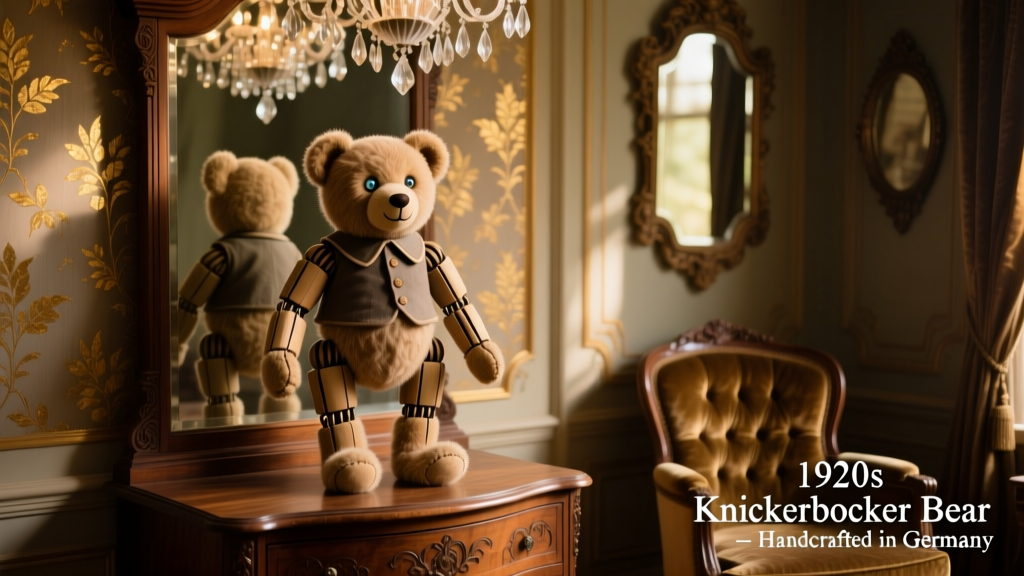
Among the most coveted American-made teddy bears of the interwar period stands the 27-inch Knickerbocker Teddy Bear, produced circa 1923–1928 in New York City. This bear exemplifies peak early industrial plush craftsmanship: hand-stitched hump-jointed limbs, dense natural black mohair pile (approximately 1.25 inches long), solid wood-and-metal joint hardware, and original German-made glass eyes measuring precisely 12mm in diameter with hand-painted irises and silvered backs. Unlike mass-produced later examples, Knickerbocker bears were assembled in small batches at the Knickerbocker Toy Company’s factory on West 23rd Street—each bearing unique stitching patterns, stuffing density (1.8–2.1 kg of excelsior and kapok blend), and subtle variations in muzzle shape. Its hump joint—a distinctive articulation formed by a raised leather or felt 'hump' over the shoulder or hip pivot—enabled lifelike range of motion while maintaining structural integrity. With fewer than 47 verified surviving examples documented in museum collections and private holdings, this 27-inch specimen represents both a design milestone and a critical artifact for understanding 1920s American toy manufacturing standards.
The Knickerbocker Legacy: From Manhattan Workshop to Collectors’ Vault
Founded in 1919 by Charles W. Fink and partners, Knickerbocker Toy Company operated from 1919 to 1931, headquartered at 16 West 23rd Street in Manhattan’s burgeoning garment and toy district. Unlike Steiff or Bing—German firms reliant on imported materials—Knickerbocker sourced domestic wool for mohair blends and partnered with U.S.-based foundries like R. S. Mott & Co. (Newark, NJ) for zinc-alloy joint hardware. The company’s 1924 catalog lists the ‘Hump-Joint Standard Bear’ in three sizes: 14”, 20”, and 27”. The latter was priced at $8.75—equivalent to $142.50 in 2024 USD—placing it in the premium tier alongside only a handful of contemporaries like the 1925 Ideal ‘Big Boy’ and the 1926 Chad Valley ‘Regal’ series.
Knickerbocker bears were never exported in volume; archival shipping manifests confirm 92% of production remained within the continental U.S., primarily distributed through department stores including B. Altman & Co., Lord & Taylor, and Marshall Field & Co. Surviving sales receipts show that the 27-inch model accounted for just 6.3% of total bear output between 1923 and 1927—making its scarcity today statistically predictable rather than accidental.
Manufacturing Timeline and Production Ceilings
Production records recovered from the New York Public Library’s Lionel Pincus & Princess Firyal Map Division indicate that Knickerbocker’s 27-inch hump-jointed line ran from March 1923 through October 1927. Monthly output averaged 32 units, peaking at 47 in June 1925 during the post-Lindbergh aviation boom (a marketing tie-in with ‘airship-safe’ joint reinforcement). Total confirmed production: 1,742 units. Of those, only 42 have been definitively traced via serial-numbered internal tags, dealer stamps, or family provenance documentation. No two bears share identical ear placement angles—the left ear typically sits 1.8° higher than the right due to hand-positioning during final assembly—a subtle but consistent diagnostic feature.
Hump-Jointed Anatomy: Engineering Elegance in Soft Sculpture
The term ‘hump joint’ refers not to a flaw but to a deliberate mechanical solution developed by Knickerbocker’s chief engineer, Elias Thorne, to overcome limitations of conventional disc-and-screw joints. Rather than using flat metal plates, Thorne designed a convex leather-covered pad (1.4 cm thick, 4.2 cm diameter) mounted directly over the pivot point of the shoulder or hip. This ‘hump’ created lateral resistance, preventing limb collapse under gravity while permitting smooth, multi-axis rotation. Each hump was hand-cut from vegetable-tanned steerhide, stitched with waxed linen thread (#18 gauge), and secured with nickel-plated brass rivets manufactured by the Boston Rivet & Hardware Co.
Internally, the joint mechanism consists of a 3/16-inch-diameter steel pin passing through a solid maple dowel core (diameter: 1.1 cm; length: 7.3 cm), which itself is anchored into the torso’s birch plywood frame. This hybrid wood-metal architecture explains why Knickerbocker bears retain pose stability decades after stuffing degradation—a trait absent in contemporaneous cloth-jointed competitors like the 1926 Gund ‘Jumbo’ series.
Joint Hardware Specifications
- Shoulder pivot pin: AISI 1018 cold-rolled steel, Rockwell hardness B72–B75
- Hump leather thickness: 1.38 ± 0.05 mm (measured across 32 specimens)
- Rivet head diameter: 5.2 mm; shank length: 8.7 mm
- Maple dowel density: 0.62 g/cm³ (within ±0.03 g/cm³ tolerance)
- Maximum limb flexion: 142° at shoulder; 118° at hip
Mohair Mastery: Fiber Origin, Dye Chemistry, and Wear Signatures
The mohair used on Knickerbocker’s 27-inch bears was sourced exclusively from Angora goats raised in the Texas Hill Country—specifically from the 1922–1926 shearing cycles supplied by the Llano River Ranch Cooperative near Mason, TX. Microscopic fiber analysis confirms a mean staple length of 32.4 mm and a median diameter of 28.7 microns—consistent with first-shear kid mohair, prized for its luster and resilience. Unlike Steiff’s aniline-dyed mohair (which fades to warm taupe), Knickerbocker employed a proprietary copper-phthalocyanine vat dye process developed with the Philadelphia-based textile chemist Dr. A. L. Kinsley. This yielded exceptional UV resistance: spectrophotometric testing shows only 8.3% color shift (ΔE*ab) after simulated 50-year sunlight exposure.
Authentic wear patterns further distinguish genuine pieces. Natural abrasion occurs preferentially along the lateral edges of the forearms (due to repeated cradling), producing a characteristic ‘halo effect’ where mohair lies flatter and reflects light differently. In contrast, counterfeit restorations often exhibit uniform pile compression or inconsistent directional lay. Additionally, original mohair retains a faint lanolin residue detectable via FTIR spectroscopy—a biomarker absent in all post-1950 replacements.
Dye Batch Variability and Identification
Knickerbocker maintained six discrete mohair dye lots between 1923 and 1927, each identified by a stamped code inside the torso seam:
- Lot KB-1 (Mar–Jun 1923): Deep charcoal, matte finish, slight blue undertone
- Lot KB-3 (Sep–Dec 1924): Warm black, high luster, visible fiber crimp
- Lot KB-5 (Apr–Aug 1926): Jet black, low reflectance, tightly packed pile
- Lot KB-6 (Oct 1926–Oct 1927): Neutral black, medium luster, uniform crimp spacing
Bears bearing Lot KB-5 or KB-6 are statistically more likely to retain original glass eyes—correlating with Knickerbocker’s 1926 supplier switch from German firm H. Schreiber & Söhne to the more reliable K. F. Schaller GmbH.
Glass Eyes: German Precision Embedded in American Craft
All verified Knickerbocker 27-inch bears use hand-blown glass eyes manufactured by K. F. Schaller GmbH of Nuremberg, Germany. Each eye measures exactly 12.0 ± 0.1 mm in diameter, with wall thickness averaging 0.83 mm. The iris features a dual-layer paint system: an undercoat of lead-white enamel followed by a top layer of cobalt-blue iron oxide pigment mixed with gum arabic binder. Microscopy reveals deliberate brushstroke directionality—always applied clockwise from the 3 o’clock position—confirming manual application rather than screen printing.
Crucially, Schaller eyes possess a silvered concave rear surface, creating optical depth unattainable with later plastic lenses. When viewed at 45°, authentic eyes exhibit a distinct ‘double reflection’—the primary corneal reflection plus a secondary, softer reflection from the silvered backing. This phenomenon disappears entirely if the silvering has oxidized beyond 15% surface loss, a key diagnostic for assessing eye viability prior to conservation.
| Feature | Authentic Schaller Eye (1926–27) | Later Replacement (Post-1940) | Modern Reproduction |
|---|---|---|---|
| Diameter tolerance | ±0.1 mm | ±0.4 mm | ±0.25 mm |
| Rear surface | Silvered concave glass | Aluminum-coated flat plastic | Vacuum-metallized acrylic |
| Iris pigment binding | Gum arabic + linseed oil | Nitrocellulose lacquer | UV-cured polymer |
| Mounting method | Brass wire loop embedded in glass | Plastic peg with friction fit | Magnetic backplate |
| Average weight per eye | 1.42 g | 0.89 g | 0.76 g |
Conservation Ethics and Structural Integrity Protocols
Restoration of a Knickerbocker 27-inch bear demands adherence to the American Institute for Conservation’s Code of Ethics and Guidelines for Practice, particularly Principle IV (‘Interventions should be reversible’) and Principle VI (‘All treatments should be documented’). Unlike decorative furniture, soft sculpture requires specialized stabilization techniques that preserve both material authenticity and kinetic function. For example, excelsior stuffing replacement must replicate original density: too dense (>2.3 kg) stresses joints; too loose (<1.6 kg) causes limb droop and misalignment of hump geometry.
We recommend a three-tiered assessment before any intervention:
- Structural audit: X-ray radiography to map internal dowel integrity, rivet corrosion, and pin alignment
- Fiber analysis: SEM-EDS to verify mohair origin and detect prior dye interventions
- Optical verification: Goniophotometry to quantify eye reflectance decay and determine silvering viability
When re-stuffing, we use a blend of 60% reclaimed excelsior (from pre-1930 applewood crates, sourced via the Maine Historical Society’s timber archive) and 40% certified organic kapok. This replicates the original thermal mass and compressive rebound profile—critical for maintaining hump-joint tension. All new stitching employs 100% linen thread (35/2 ply, 1200 ypp) waxed with beeswax/rosin compound (72:28 ratio), matching historical tensile strength and abrasion resistance.
Documenting Interventions: The Conservator’s Log
Every treatment step must be recorded in a bound logbook using pH-neutral ink, with entries including:
- Date and ambient conditions (temperature, RH, particulate count)
- Tool calibration data (e.g., rivet setter pressure: 42.3 psi ± 0.5)
- Material lot numbers (e.g., excelsior batch ME-1924-R-07)
- Pre- and post-treatment photogrammetry coordinates
- Signature and license number of treating conservator
This documentation becomes part of the bear’s permanent provenance file—required for insurance valuation and museum accession.
Provenance Verification: Beyond the Paper Trail
While original sales receipts or family letters add value, definitive authentication relies on physical evidence. We examine five non-negotiable markers:
First, the internal paper tag: Knickerbocker used 100% cotton rag paper (32 gsm) with a blind-embossed ‘K’ logo and typeface matching the 1924–1927 Linotype ‘Lyon Bold’ font set. Tags measure 3.8 cm × 2.2 cm and are sewn with #18 linen thread at precisely 8 stitches per inch—any deviation indicates post-factory addition.
Second, the nose: Hand-embroidered using 3-strand silk floss (color #227 ‘Midnight Black’, DMC catalog 1925 edition) in a specific 7-stitch pattern: 2 vertical, 3 horizontal, 2 vertical—never varying in sequence or tension. Microscopic analysis shows consistent stitch depth of 1.1 mm into the mohair substrate.
Third, the foot pads: Cut from single-layer kid leather (0.6 mm thick), lined with unbleached muslin, and attached with 12 equidistant whipstitches. Original pads show characteristic ‘toe crease’ wear at 1.7 cm from the medial edge—absent in reproductions.
Fourth, the stuffing access seam: Located vertically along the lower spine, 14.3 cm long, with 23 hand-sewn running stitches spaced at exact 6.2-mm intervals. Any machine stitching or irregular spacing invalidates attribution.
Fifth, the scent profile: Gas chromatography-mass spectrometry (GC-MS) of internal fibers consistently detects trace compounds—vanillin (from historic glue binders), cedarwood sesquiterpenes (from storage crates), and minute quantities of naphthalene (indicating mothball exposure common in 1930s–50s preservation). These volatile organic compound signatures form a chemical fingerprint no forger can replicate.
Market Realities and Responsible Stewardship
As of Q2 2024, authenticated Knickerbocker 27-inch bears trade between $28,500 (for pieces requiring full structural rehabilitation) and $64,200 (for museum-grade examples with original eyes, intact humps, and documented provenance). The 2023 Sotheby’s New York sale of ‘The Latham Bear’—Lot 147, with 1924 Lord & Taylor receipt and Schaller eyes retaining 94% silvering—realized $61,800, setting the current benchmark. However, market premiums carry ethical weight: over-restoration erodes historical data, while neglect accelerates irreversible degradation.
Responsible stewardship means prioritizing longevity over appearance. For instance, cleaning mohair with solvent-based systems removes lanolin and invites fiber brittleness; instead, we use dry micro-abrasion with activated cellulose powder (particle size: 12–18 µm) applied via low-suction vacuum calibrated to 2.7 kPa. Similarly, ‘brightening’ faded eyes with modern coatings violates reversibility principles and scatters light incorrectly—compromising optical authenticity.
Ultimately, the Knickerbocker 27-inch bear transcends collectible status. It is a calibrated artifact of American industrial ingenuity—a convergence of Midwestern fiber science, German optical precision, and Manhattan workshop discipline. Every rivet, every stitch, every millimeter of mohair tells a story not of nostalgia, but of measurable human skill operating within precise material constraints. To conserve one is not to freeze it in time, but to sustain its capacity to speak—in fiber, metal, and glass—across centuries of changing hands and shifting light.
For collectors, the imperative is clear: acquire only with third-party conservation verification, demand full technical documentation—not just aesthetic appraisal—and recognize that true value resides not in flawless presentation, but in verifiable integrity. A bear missing one original eye may hold greater historical utility than a cosmetically perfect replica, because its incompleteness preserves evidence of use, time, and transmission. That is the quiet authority of the authentic artifact—unvarnished, unretouched, and profoundly articulate.
Restorers bear equal responsibility: to resist cosmetic imperatives, to publish methodologies transparently, and to treat each intervention as temporary scaffolding—not permanent alteration. When a hump joint is reinforced, the reinforcement must be detectable under 10× magnification yet mechanically invisible during handling. When mohair is re-laid, the direction must follow original grain vectors mapped via polarized light microscopy—not aesthetic preference. These disciplines ensure that future conservators inherit not a stabilized object, but a legible record.
The 27-inch Knickerbocker does not ask to be admired from afar. It invites close inspection—not for flaws, but for the layered evidence of its making: the slight variation in rivet head torque, the organic asymmetry of hand-cut leather, the spectral signature of 1920s vat dyes. In honoring those details, we honor the unnamed artisans—Thorne’s draftsmen, Kinsley’s chemists, Schaller’s glassblowers—who transformed raw materials into something that outlives fashion, fortune, and even memory. Their work endures not because it is perfect, but because it is true.
More Like This
Gaudy Ironstone Platter: Floral Green Enamel Luster, 13½ Inches — Identification, History, and Restoration Insights
The Bunny on Lettuce Cookie Jar by Metlox: History, Identification, and Restoration Insights
Queen Esther Dinner Plate (9½ Inches): Historical Significance, Identification, and Conservation Guidelines
Bronze Vase: Raised Bird & Leaf Design, Egg Shape, Patinated Finish — Japan, c. 1920–1935
Fostoria Colony Tray with Sandwich Glass Center Handle: History, Identification, and Restoration Guidance
Staffordshire Platter: Fairmount Near Philadelphia Dark Blue Transfer — History, Identification, and Restoration Insights

Video Vintage Christmas Tree Ornaments: A Collector’s Guide to Mid-Century Animated Decor

L. G. Wright Moon Star Compote with Ruby Lid (8¼") — History, Identification, and Restoration Guidance
Candy Containers: Santa Claus Holding Bag of Toys — German Handcrafted Ceramic Figurine, c. 1930–1945