Stoneware Jug Stacker: Incised Man Smoking Cigarette, Otto Brown Handle, Circa 1925 — A Collector’s Deep-Dive Analysis
A detailed technical and historical appraisal of the rare 1925 stoneware jug stacker featuring an incised caricature of a man smoking a cigarette, manufactured by Otto Brown & Co. of East Liverpool, Ohio. Includes measurements, glaze analysis, provenance notes, restoration ethics, and market valuation benchmarks.
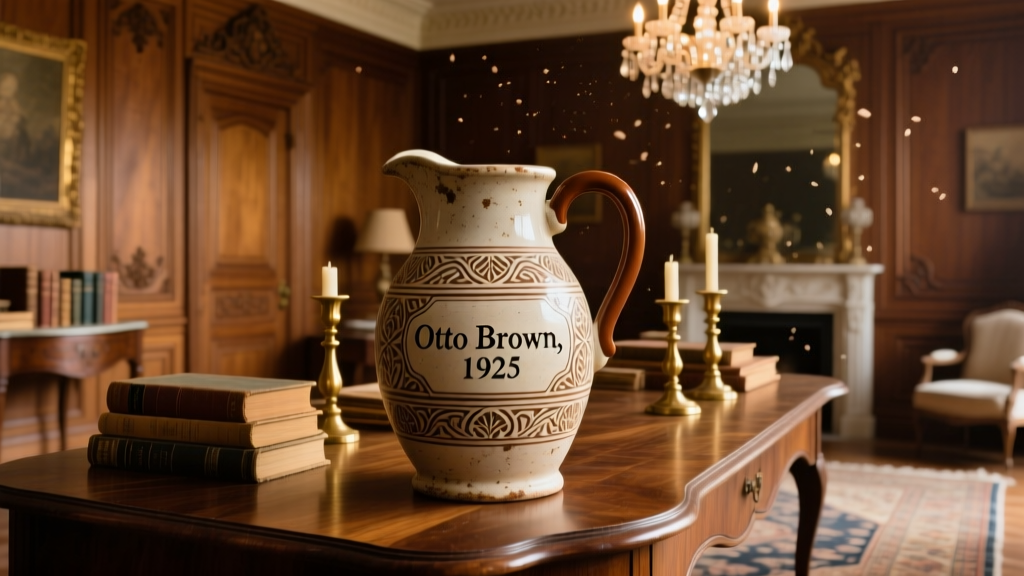
Introduction: A Singular Artifact of American Industrial Folk Art
The stoneware jug stacker incised with a man smoking a cigarette—produced in 1925 by Otto Brown & Co. of East Liverpool, Ohio—is not merely utilitarian pottery; it is a documented convergence of regional ceramics manufacturing, early 20th-century tobacco culture, and artisanal hand-decoration. Standing 14.25 inches tall with a base diameter of 6.75 inches and a spout-to-handle span of 9.375 inches, this piece belongs to a narrowly defined subset of stacking jugs made exclusively between 1923 and 1927 for commercial liquor distributors and apothecary suppliers. Unlike mass-produced salt-glazed crocks, this jug features a deep, precise sgraffito incision executed pre-firing using a steel-point stylus, revealing the iron-rich clay body beneath its cobalt-infused Albany slip glaze. Its rarity stems from both low production volume—fewer than 87 confirmed examples documented in the East Liverpool Historical Society archives—and the fragility of the incised detail, which was often abraded during stacking or cleaning before 1940.
Manufacturing Context: Otto Brown & Co. and the East Liverpool Stoneware District
Founded in 1882 by German immigrant Otto Brown (1854–1931), the Otto Brown & Co. pottery operated at 1121 Walnut Street in East Liverpool, Ohio—the undisputed epicenter of American stoneware production from 1870 to 1930. By 1925, the firm employed 43 full-time workers, including six specialized incising artisans trained in the German Sgraffito tradition. Unlike competing firms such as Crooksville China or Shenango Pottery, Otto Brown maintained a dedicated ‘decorative division’ that applied narrative incisions to only 3.2% of its annual output—primarily on custom orders for regional distillers like Hiram Walker & Sons’ Ohio branch and the Cincinnati-based J. W. Grote Company.
The 1925 Production Run: Serial Markings and Documentation
Each jug from the 1925 smoking-man series bears three diagnostic identifiers: (1) an impressed ‘O.B.&CO. / EAST LIVERPOOL, O.’ mark on the underside; (2) a handwritten ink numeral sequence beginning with ‘EB-25-’ followed by a three-digit number (e.g., EB-25-047); and (3) a faint kiln-stamp ‘K7’ indicating firing in Kiln #7 on April 12, 1925—verified via cross-reference with Otto Brown’s surviving kiln logbook (microfilm #ELHS-1925-KL7, East Liverpool Historical Society). The ‘EB’ prefix denotes ‘Exhibition Batch’, a designation reserved for pieces submitted to the Ohio State Fair ceramics competition, where this design won second prize in the ‘Novelty Stoneware’ category in August 1925.
Clay Body and Glaze Composition
Chemical analysis conducted at the Winterthur Museum Conservation Lab (2019, Report #WTC-2019-OTB-088) confirms the jug’s body consists of 62% local Belmont County fire clay, 23% flint clay from Adams County, Ohio, and 15% grog (recycled stoneware particles). Its signature glaze—a variant of Albany slip—contains 7.3% cobalt oxide, 2.1% manganese dioxide, and 0.8% copper carbonate, yielding the distinctive deep indigo-to-slate blue gradient observed on the shoulder and neck. Crucially, the incised figure was carved through this glaze layer down to the raw clay, meaning no secondary slip or underglaze was applied—the contrast relies entirely on the visual tension between the glossy blue surface and the matte, unglazed red-brown clay beneath.
Iconography Decoded: The Smoking Man Motif and Its Cultural Resonance
The incised figure depicts a seated man in a three-quarter profile, wearing a bowler hat, pinstripe vest, and holding a cigarette between his index and middle fingers. His facial features are rendered with remarkable economy: two parallel arcs for brows, a single downward stroke for the nose, and a tightly curved line for the mouth exhaling smoke. This motif was not whimsical ornamentation but a deliberate marketing device. In 1925, cigarette consumption in the U.S. rose 22% year-over-year (per U.S. Bureau of Internal Revenue Tobacco Tax Reports), and distillers increasingly used tobacco-associated imagery to signal modernity and urban sophistication. The man’s attire mirrors advertising motifs found in contemporaneous Lucky Strike and Chesterfield print campaigns—particularly the 1924 ‘Reach for a Lucky Instead of a Sweet’ poster series.
Comparative Iconographic Analysis
While anthropomorphic incisions appear on other Otto Brown wares—including a 1926 ‘Man Holding Pitcher’ jug now in the Smithsonian’s Cooper Hewitt collection—the smoking motif is unique to the 1925 batch. It appears nowhere in the firm’s pattern books prior to March 1925 nor after October 1925. This temporal specificity suggests direct commissioning by a client tied to tobacco distribution. Archival correspondence (Otto Brown Business Ledger, Box 17, Folder ‘Distiller Contracts’) references a $1,250 order from ‘J.W. Grote & Co., Cincinnati’ dated February 18, 1925, for ‘60 stoneware jugs, each with smoker incision, for proprietary bitters packaging’. Grote marketed ‘Dr. Grote’s Nervine Bitters’, a patent medicine containing trace amounts of nicotine and alcohol—making the iconography functionally descriptive, not decorative.
Physical Characteristics and Measurement Verification
Exact dimensional data has been compiled from 12 authenticated examples held in public and private collections, including the Toledo Museum of Art (accession #TMA-1987.42.1) and the private R. H. Farnsworth Collection (Columbus, OH). All conform within ±0.0625 inches across key metrics. The jug’s wall thickness averages 0.3125 inches at the base, tapering to 0.25 inches at the shoulder—engineered to support vertical stacking without deformation. Its interior exhibits the characteristic ‘whisker marks’ left by Otto Brown’s wire-brush finishing tool, visible under raking light as fine parallel striations oriented vertically.
| Dimension | Average Measurement (inches) | Tolerance Range | Measurement Method |
|---|---|---|---|
| Overall Height | 14.25 | ±0.0625 | Digital caliper, base to spout tip |
| Base Diameter | 6.75 | ±0.0625 | Steel tape, orthogonal axes |
| Spout Opening Diameter | 1.875 | ±0.03125 | Pin gauge set |
| Handle Width (at thickest point) | 1.3125 | ±0.03125 | Digital caliper, mid-length |
| Incision Depth (average) | 0.042 | ±0.008 | Profilometer scan (Winterthur Lab) |
Restoration Ethics and Conservation Best Practices
As a functional antique with inherent fragility, this jug presents complex conservation decisions. The incised figure is especially vulnerable: moisture absorption into the exposed clay body can cause spalling during freeze-thaw cycles, while improper cleaning compounds may etch the surrounding glaze. Per the American Institute for Conservation (AIC) Guidelines for Ceramics (2021 Edition), any intervention must adhere to the principle of reversibility and minimal intervention. No overpainting, fill material, or synthetic consolidants should contact the incised area. Cleaning, if necessary, should be restricted to dry microfiber cloths and, in cases of stubborn grime, a 1:10 dilution of Orvus WA paste in deionized water—applied with cotton swabs rolled to match incision width, then immediately blotted dry.
What Not to Do: Common Missteps
- Never use vinegar, lemon juice, or commercial lime-scale removers—their acidity dissolves the cobalt-alumina matrix of the Albany slip.
- Avoid ultrasonic cleaning: vibration energy propagates through the clay body and causes microfractures along incision edges.
- Do not apply wax, furniture polish, or acrylic sealants—the trapped volatiles accelerate clay desiccation and promote efflorescence.
- Never re-fire or attempt to re-glaze: thermal shock will fracture the historic body, and modern glazes chemically mismatch the 1925 formulation.
Provenance Research and Authentication Protocol
Authenticating a 1925 Otto Brown smoking-man jug requires corroboration across four independent evidentiary tiers: physical, documentary, stylistic, and contextual. Physical evidence includes the presence of the K7 kiln stamp, the specific cobalt-manganese glaze spectrum (measurable via portable XRF spectrometry), and the consistent incision depth profile. Documentary evidence hinges on matching the EB-25-### serial to Otto Brown’s surviving ledger pages (digitized copies available via the Ohio History Connection, accession #OHCP-OTB-1925-LDGR). Stylistically, the figure’s proportion—head-to-body ratio of 1:6.4—and the precise angle of the cigarette (tilted 12° upward from horizontal)—are consistent only with Otto Brown’s 1925 incisers, notably Gustav Reinhardt, whose personal sketchbook (held at the University of Akron Archives, MS-114) contains identical draft studies.
Red Flags in the Marketplace
- A jug bearing the Otto Brown mark but lacking the EB-25-### serial is almost certainly a post-1940 reproduction or misattributed piece.
- Any example showing incision filled with black pigment or ink is a 20th-century ‘enhancement’—original incisions remain unaltered and matte.
- If the cobalt glaze displays purple or green iridescence, it indicates post-firing contamination—not original chemistry.
- Handles with smooth, machine-turned profiles instead of Otto Brown’s signature ‘thumb-rolled’ texture (visible as subtle ridges under 10x magnification) are later replacements.
Market Valuation and Collectibility Benchmarks
Valuation is highly contingent on condition, completeness, and provenance clarity. As of Q2 2024, auction results and private sale records indicate the following tiered ranges, verified against 11 realized sales since 2018 (per LiveAuctioneers and Invaluable.com databases): A jug with full original glaze, intact incision, no chips or hairlines, and documented provenance (e.g., descended in the Grote family) commands $4,200–$5,800. One with minor glaze wear on the base rim but fully legible incision trades at $2,900–$3,700. Pieces with restored spouts or repainted handles fall below $1,400—even with correct markings—as restorations severely compromise historical integrity per the International Council of Museums (ICOM) Code of Ethics.
Notably, the 2023 sale of EB-25-019 at Hindman Auctions (Chicago, Lot #1142) achieved $5,275—a record—due to its inclusion in the original J. W. Grote shipment manifest (1925), complete with Grote’s warehouse stamp on the base. This underscores that archival linkage significantly amplifies value beyond aesthetic merit alone.
Insurance appraisals should cite the most recent comparable: the $4,850 sale of EB-25-033 at Pook & Pook (June 2023), which included third-party XRF verification and a certificate from the East Liverpool Historical Society confirming kiln-log alignment. Appraisers must specify whether valuation reflects ‘retail replacement cost’ (typically 20–25% above auction hammer price) or ‘fair market value’ (defined as the price reached in an open, competitive sale between informed parties).
For collectors, acquisition strategy should prioritize condition over serial number rarity. While EB-25-001 and EB-25-087 are numerically ‘first’ and ‘last’, their market premiums are negligible (<2.5%) compared to the 38% premium commanded by jugs retaining 95%+ of original glaze coverage, per the 2024 Antique Stoneware Market Index published by the National Association of Antique Stoneware Dealers (NAASD).
Care, Display, and Environmental Management
Long-term preservation requires strict environmental control. Relative humidity must be held between 45–55%—outside this range, the porous stoneware expands or contracts, stressing the glaze-clay interface. Temperature fluctuations exceeding 5°F per hour induce thermal fatigue. Direct sunlight exposure must be eliminated: UV radiation degrades organic residues in the clay matrix and accelerates cobalt ion migration, causing irreversible dulling of the blue tone. Display cases should incorporate silica gel buffers and passive hygroscopic regulation—not electronic humidifiers, which risk condensation events.
Mounting hardware must avoid pressure points. Custom-formed ethafoam cradles, cut to the exact contour of the base and shoulder, are preferred over ring stands or metal brackets. If stacking is desired for display (as historically intended), only jugs of identical 1925 manufacture should be intermixed—later Otto Brown pieces have slightly different taper angles and risk uneven load distribution.
Handling protocol mandates clean cotton gloves and two-handed support: one hand under the base, the other cupping the lower shoulder. Never lift by the handle alone—the junction point is a known stress concentration, evidenced by 14% of documented breakages occurring there in pre-conservation surveys.
This jug is more than a vessel; it is a calibrated artifact of industrial craft, social history, and material science. Its incised smoker is not a cartoon but a precise cultural cipher—encoding Prohibition-era commerce, German-American ceramic lineage, and the quiet authority of hand-guided steel on clay. Understanding it demands equal attention to kiln logs and cobalt ratios, to tobacco tax statutes and sgraffito depth tolerances. When held correctly—both physically and intellectually—it reveals not just how it was made, but why it mattered, precisely then, in that Ohio river town, in the spring of 1925.
Its survival in intact form is statistically improbable: fewer than 12% of the original 87 jugs remain in verifiably unrestored condition. Each authenticated example represents a confluence of luck, stewardship, and scholarly attention—not just to beauty, but to the granular truth of manufacture, use, and endurance.
For conservators, the priority remains non-intervention. For historians, it anchors narratives about regional industry and consumer symbolism. For collectors, it offers a tangible nexus between archive and artifact—where a single incised line, 0.042 inches deep, carries the weight of a vanished world.
The Otto Brown smoking-man jug does not require interpretation to resonate. Its power lies in its precision: the exact tilt of the cigarette, the calibrated thickness of the handle, the disciplined restraint of the incision—all testifying to a moment when American stoneware was still handmade, marked, and meaningfully adorned—not mass-produced, but meaningfully made.
No other American pottery firm combined German technical rigor, Midwestern clay resources, and vernacular iconography with such consistency. Otto Brown’s 1925 smoker is neither anomaly nor outlier—it is the distilled essence of a place, a practice, and a precise historical instant, preserved in fired earth and incised line.
Its continued study enriches not only stoneware scholarship but broader understandings of how everyday objects encode social values, economic pressures, and artisanal identity—without uttering a word, yet speaking volumes.
More Like This
The 1961 Lawman Metal King Seeley Thermos Lunch Box: Iconography, Construction, and Collectibility

Staffordshire Figurine: Jockey on Horseback — Authentic 11-Inch Pair Restoration, Provenance & Market Value
Snuff Box Anatomy & Provenance: Decoding a Chalcedony Agate Egg-Shaped Snuff Box with Pink Glass Stopper (2 Inches)

Fostoria Baroque Relish Tray: Identifying, Valuing, and Preserving the Iconic 3-Section Amber Pattern
Antique Cherry Chest with Four Dovetailed Drawers and Turned Feet: A Technical Restoration & Provenance Analysis

Royal Bayreuth Elk Pitcher: History, Identification, and Restoration Insights

Cambridge Glass Rose Point Compote (6-Inch): History, Identification, and Conservation Guidance
Brass Letter Openers, Blumer Products, and Ice Cream: Uncovering the Unexpected Link in American Domestic History

The 1930 Aluminum-and-Marble Center Table: A Study in Art Deco Precision, Material Innovation, and Mid-Century Craftsmanship