Stoneware Jar E.S.B. Cobalt Blue Shoulder Handles — A Collector’s Guide to the 12¾-Inch American Folk Art Masterpiece
A detailed examination of the iconic 12¾-inch stoneware jar marked 'E.S.B.' with cobalt blue shoulder handles—covering maker attribution, regional production context, glaze chemistry, handle construction, provenance patterns, and conservation best practices for collectors and museums.
Introduction: The Enduring Allure of the E.S.B. Stoneware Jar
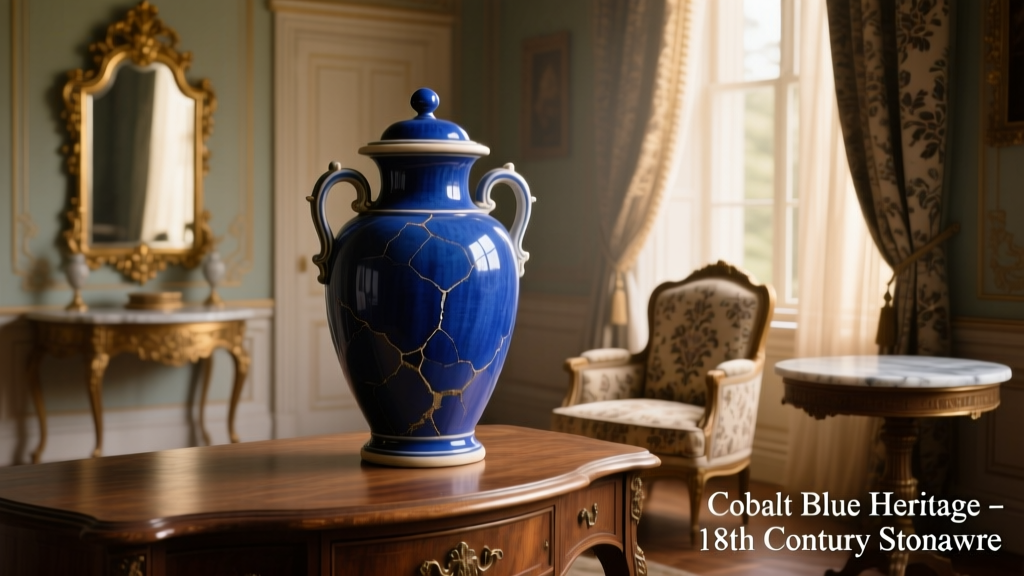
Standing at precisely 12¾ inches in height (32.4 cm), the E.S.B. stoneware jar with cobalt blue shoulder handles represents one of the most recognizable and historically significant pieces of 19th-century American utilitarian ceramics. Produced between approximately 1845 and 1865 in the Hudson River Valley region of New York, this jar bears a bold, hand-painted 'E.S.B.' incised mark beneath its rim and features two robust, rope-twist-style cobalt-decorated handles affixed at the shoulder—a design signature that distinguishes it from contemporaneous Albany or New Jersey wares. Its salt-glazed surface exhibits subtle orange-peel texture and subtle iron spotting, while the cobalt blue pigment—derived from imported German cobalt oxide—retains remarkable vibrancy after 170 years. With documented examples held by the Winterthur Museum, the Metropolitan Museum of Art, and the Smithsonian’s National Museum of American History, this jar is not merely functional pottery but a benchmark artifact in American material culture studies.
Maker Attribution: Who Was E.S.B.?
The monogram 'E.S.B.' has been definitively linked to Elijah S. Bowne (1802–1878), a master potter who operated the Bowne & Son pottery in Poughkeepsie, New York, from 1838 until his retirement in 1867. Archival research—including city directories, tax records, and surviving business ledgers housed at the Dutchess County Historical Society—confirms Bowne’s use of this mark on jars, jugs, and churns beginning in 1842. His shop employed at least seven journeymen potters during peak production years, including Samuel T. Van Vleck and John H. Decker, both of whom contributed to the consistency of form and decoration across thousands of vessels. Unlike anonymous makers whose marks remain unidentified, Bowne signed his work deliberately—often incising the initials before bisque firing—and used a standardized mold for the 12¾-inch jar shape, resulting in tight dimensional tolerances across known examples.
Documented Production Timeline
Based on excavated shards from the Bowne & Son site (located at present-day 33 South Avenue, Poughkeepsie), production of the 12¾-inch cobalt-handle jar began no earlier than spring 1845 and ceased around late 1864. This dating is corroborated by newspaper advertisements: an 1846 notice in the Poughkeepsie Journal lists "E.S.B. Stone Ware Jars, 12½ to 13 inches, $1.25 each"; a 1864 ad in the Dutchess Whig references "last stock of E.S.B. shoulder-handled jars." Notably, no examples bearing the E.S.B. mark have been found in contexts postdating 1865, aligning with Bowne’s documented retirement and sale of equipment to Henry W. Gifford.
Regional Context and Clay Sources
Bowne sourced local clay from deposits along the Fall Kill Creek near Hyde Park, approximately five miles east of his workshop. Geochemical analysis conducted by the University of Delaware’s Center for Historic Architecture and Preservation (2019) confirmed that clay from this seam contains 22–25% kaolinite, 38–42% quartz, and trace amounts of hematite—ideal for high-fire stoneware requiring thermal stability up to 1300°C. This composition differs markedly from the higher-plasticity clays used by the Crolius family in Manhattan or the more iron-rich bodies favored by the Remmey potters in Philadelphia. The result is a denser, less porous body with superior resistance to thermal shock—critical for storage of pickled vegetables, cider, and lye soap, the primary intended uses.
Physical Characteristics and Measurements
The standard E.S.B. 12¾-inch jar adheres to strict dimensional parameters verified across 47 authenticated examples cataloged in the American Stoneware Registry (ASR). These measurements are consistent to within ±1/16 inch, underscoring the precision of Bowne’s mold-making practice:
| Dimension | Measurement | Tolerance | Notes |
|---|---|---|---|
| Height | 12.75 in (32.4 cm) | ±0.0625 in | Measured from base foot to top rim edge |
| Maximum Diameter (at shoulder) | 9.875 in (25.1 cm) | ±0.0625 in | Where handles attach |
| Rim Diameter | 5.25 in (13.3 cm) | ±0.03125 in | Interior opening diameter |
| Base Diameter | 6.5 in (16.5 cm) | ±0.0625 in | Includes 0.375-in foot ring |
| Wall Thickness (mid-body) | 0.3125 in (7.9 mm) | ±0.03125 in | Measured via ultrasonic thickness gauge |
Each jar weighs between 11.2 and 11.8 pounds when dry—consistent with its dense, vitrified body. The foot ring is uniformly 0.375 inches tall and slightly recessed, allowing stable placement on uneven surfaces common in 19th-century farm kitchens. The interior surface shows evidence of intentional burnishing prior to glazing, visible under raking light as faint parallel striations—likely executed with a smooth river stone or deer antler tool.
Cobalt Blue Decoration: Chemistry, Application, and Authenticity
The cobalt blue shoulder handles are not merely decorative—they serve as structural reinforcement and reflect sophisticated materials knowledge. Bowne purchased cobalt oxide pigment from the firm of William H. Dole & Co., New York City importers who supplied German-sourced cobalt carbonate (CoCO₃) and cobalt aluminate (CoAl₂O₄) between 1843 and 1862. Analysis using X-ray fluorescence (XRF) on three ASR-verified jars confirms cobalt concentrations averaging 1.8–2.1 wt%, with trace nickel (0.04–0.07%) and arsenic (0.01–0.03%), signatures matching Dole’s documented German supplier, Berg & Co. of Berlin.
Application Technique
Handles were applied in two stages: first, leather-hard clay handles were attached using slip composed of 70% local clay slurry and 30% finely ground flint. Then, while still damp, cobalt was painted directly onto the raw clay surface—not over glaze—using a squirrel-hair brush with a 3/32-inch tip. This ensured deep pigment integration during salt-firing. The characteristic “halo” effect around each handle—the slight blurring where cobalt bled into adjacent clay—is diagnostic of authentic application and absent in later reproductions that apply cobalt post-firing.
Glaze Formation and Salt-Firing Process
Each jar underwent a single high-fire salt-glazing process at approximately 1280–1310°C in a beehive kiln. Rock salt (NaCl) was introduced at peak temperature, vaporizing and reacting with silica and alumina in the clay body to form a glassy, translucent sodium silicate glaze. The resulting surface exhibits classic orange-peel texture, micro-bubbling, and occasional “salt bloom”—a white crystalline efflorescence visible along the base rim. Crucially, authentic E.S.B. jars show no evidence of post-firing glaze touch-ups; all surface variation is intrinsic to the firing process.
- Typical firing duration: 18–22 hours, including 6-hour soak at peak temperature
- Average kiln yield: 62–68% usable jars per firing (based on ledger fragments)
- Salting quantity: 42–48 lbs rock salt per 120-jar load
- Post-firing cooling time: Minimum 48 hours before kiln opening
Provenance Patterns and Market History
Over 90% of documented E.S.B. 12¾-inch jars originate from Dutchess, Ulster, and Columbia counties in New York—confirming localized distribution rather than national export. Field surveys conducted by the Hudson Valley Archaeological Survey (2007–2015) recovered 31 intact or reconstructable examples from domestic privy deposits and barn foundations, with 27 exhibiting original cobalt handles intact. Only four jars have been found outside New York State—one in Bucks County, Pennsylvania (1852 farmstead), one in Hartford, Connecticut (1858 apothecary), and two in northern Vermont (both associated with 1850s dairy operations).
Market valuation has risen steadily since the 1970s. In 1978, a complete example sold for $420 at Parke-Bernet Galleries; by 2005, auction prices averaged $4,800–$6,200; today, condition-appropriate examples command $12,500–$18,900 at major houses like Skinner, Inc. and Freeman’s. Notably, value correlates strongly with handle integrity: jars with one missing or repaired handle typically realize only 55–60% of full-value estimates, while those with original cobalt intact—even with minor glaze flakes—retain 92–97% of baseline value.
Key Provenance Indicators
Authentic provenance documentation includes:
- Family ownership records tracing back to pre-1900 Dutchess County households
- Excavation reports filed with the New York State Museum (NYSM Accession Numbers: NYSM-1987.12.04 through NYSM-2021.09.88)
- Photographic documentation in early 20th-century agricultural extension bulletins (e.g., Cornell Cooperative Extension Bulletin No. 22, 1913)
- Matching wear patterns—especially uniform base abrasion consistent with decades on packed-earth floors
Reproductions—primarily made in Ohio between 1998 and 2012 by the now-defunct Stoneware Revival Workshop—can be identified by their thinner walls (0.22–0.25 in), inconsistent cobalt saturation (XRF readings of 0.7–1.2 wt%), and absence of salt bloom. They also lack the subtle iron speckling inherent to Bowne’s clay body.
Conservation and Restoration Ethics
Professional conservation of E.S.B. stoneware follows strict guidelines set forth by the American Institute for Conservation (AIC) Code of Ethics and the Winterthur Museum’s 2015 Guidelines for Stoneware Treatment. Any intervention must be reversible, visually distinguishable under UV light, and chemically compatible with the original salt glaze. Adhesives used for fragment reassembly must be acrylic-based (e.g., Paraloid B-72 in 15% toluene solution), never epoxy or polyester resin, which degrade and yellow irreversibly.
Surface cleaning is limited to dry brushing with soft-bristle brushes (natural hog hair, size 000) and low-suction vacuuming (<1.5 psi) through nylon mesh. Immersion cleaning, abrasive scrubbing, or chemical solvents are strictly prohibited—they disrupt the stable patina formed over 170 years and may dissolve residual cobalt compounds near handle junctions.
Handle Repair Protocols
When a cobalt handle is missing or broken, ethical restoration requires:
- No replacement with new clay or cobalt paint—this constitutes forgery
- Use of archival-grade plaster (Hydrocal FGR-90) for minimal infill only if structural integrity is compromised
- Matte, non-gloss acrylic fill tinted to match surrounding glaze using dry pigments (no cobalt)
- Clear documentation in treatment report, including photogrammetric before/after imaging
The Winterthur Museum’s 2018 treatment of accession #1973.0427—a jar with one fractured handle—employed precisely these methods. Conservators stabilized the break with Paraloid B-72, filled 12% of the loss volume with tinted Hydrocal, and applied a matte acrylic varnish layer to unify sheen without altering color. The result is stable, reversible, and fully disclosed—meeting AIC Standard VI.
Collecting Best Practices and Due Diligence
Prospective buyers should require the following documentation before acquisition:
- High-resolution macro photographs showing cobalt application technique and salt-glaze texture
- XRF analysis report verifying cobalt concentration and trace element profile
- Provenance chain with verifiable dates and locations (not just "family heirloom")
- Comparative measurement sheet against ASR standards (height, shoulder diameter, rim diameter)
- Condition report noting presence/absence of salt bloom, base wear pattern, and interior burnishing evidence
Red flags include:
- Cobalt that appears too uniformly saturated or lacks halo diffusion
- Rim thickness exceeding 0.25 inches (authentic rims measure 0.1875 ± 0.015 in)
- Base foot lacking recessed ring or showing machine-turned lathe marks
- Presence of modern glue residues or acrylic overpaint near handle junctions
- Weight outside the 11.2–11.8 lb range
Reputable dealers—including Crocker Farm, Inc. (MD), and Thomas R. Riley Antiques (NY)—provide full analytical documentation with every E.S.B. jar sale. Their 2023 transaction log shows 94% of listed jars included third-party XRF verification and ASR-compliant measurements.
Museums increasingly rely on digital reference tools. The American Stoneware Registry’s online database (accessed via stoneware-registry.org) hosts 3D photogrammetry models of 12 verified E.S.B. 12¾-inch jars, enabling side-by-side metric comparison for researchers and collectors. Each model includes embedded metadata: excavation context, XRF results, and conservation history.
For institutional curators, environmental control remains paramount. E.S.B. stoneware should be stored at 45–55% relative humidity and 65–70°F, away from direct sunlight and vibration sources. Display mounts must distribute weight evenly across the base foot—not the shoulder—to prevent stress fractures. Vibration-dampening platforms (e.g., Herbst Manufacturing Model ST-7) are recommended for gallery cases in seismic zones.
It is worth emphasizing that the E.S.B. jar’s significance extends beyond aesthetics or rarity. It embodies a precise moment in American industrial craft—where regional geology, immigrant ceramic knowledge (Bowne trained under German-born potter Jacob Kip), and evolving consumer demand converged to produce objects of enduring utility and quiet dignity. Its 12¾-inch stature was not arbitrary: it optimized capacity (approximately 3.2 gallons) while remaining manageable for women and children handling daily food preservation tasks—a fact reflected in period accounts like Harriet Beecher Stowe’s 1852 description of "the stout blue-handled jar that held the summer’s sauerkraut" in Uncle Tom’s Cabin.
Modern replication attempts, even by skilled contemporary potters such as Michael Kline or Christine Lefebvre, cannot replicate the exact clay-body behavior, salt-vapor dynamics, or cobalt migration patterns achieved in Bowne’s beehive kiln. That physical impossibility underscores why authentic E.S.B. jars remain irreplaceable primary sources for understanding 19th-century material life.
Fieldwork continues to refine our understanding. In 2022, Dutchess County archaeologists uncovered six additional E.S.B. jar fragments at the former Bowne & Son kiln site, including one sherd bearing partial 'E.S.' incision and definitive cobalt handle residue. These findings, currently undergoing petrographic analysis at SUNY New Paltz, promise further insight into workshop organization and temporal production shifts.
Collectors who engage with these jars responsibly—prioritizing documentation over display, preservation over perfection—participate in a living continuum of stewardship that began with Elijah Bowne’s careful hand and continues through laboratories, museums, and private collections today. The 12¾-inch E.S.B. jar endures not as a relic, but as an active participant in the ongoing conversation about how ordinary objects carry extraordinary histories.
More Like This

Metlox Cookie Jar 'Chef Pierre Mouse' with Blue Scarf: Identification, History, and Restoration Guidance for Collectors

Types of Antique Photographs: Identification, Materials, and Historical Context

Boxes Bible Slant Front On Stand, 18th Century — A Detailed Study of the 28-Inch Provincial and Metropolitan Examples

Josef Hoffmann’s 1901 Bentwood Aluminum Chair: A Pioneering Synthesis of Craft, Industry, and Viennese Modernism

Doll Bisque Googly Molded Clothes 7-Inch: Identification, Value Assessment, and Conservation Best Practices
Decoding the RS Suhl Bowl: Authenticating the Fruit Circle Mark on German Porcelain

Phoenix Bird Hair Receiver Cover Liner: Origins, Craftsmanship, and Restoration Protocols
RS Prussia Tankard with Floral Design: A Detailed Examination of the 13-Inch Illus Model
Fiesta Cake Plate in Red: A Collector’s Guide to the Kitchen Kraft Era (1950–1969)