J. H. Dipple Stoneware Crock: A Lewistown, Pennsylvania Legacy in American Salt-Glazed Ceramics
An in-depth examination of J. H. Dipple stoneware crocks produced in Lewistown, PA — their historical context, manufacturing techniques, identifying marks, dimensional specifications, collector value, and conservation best practices.
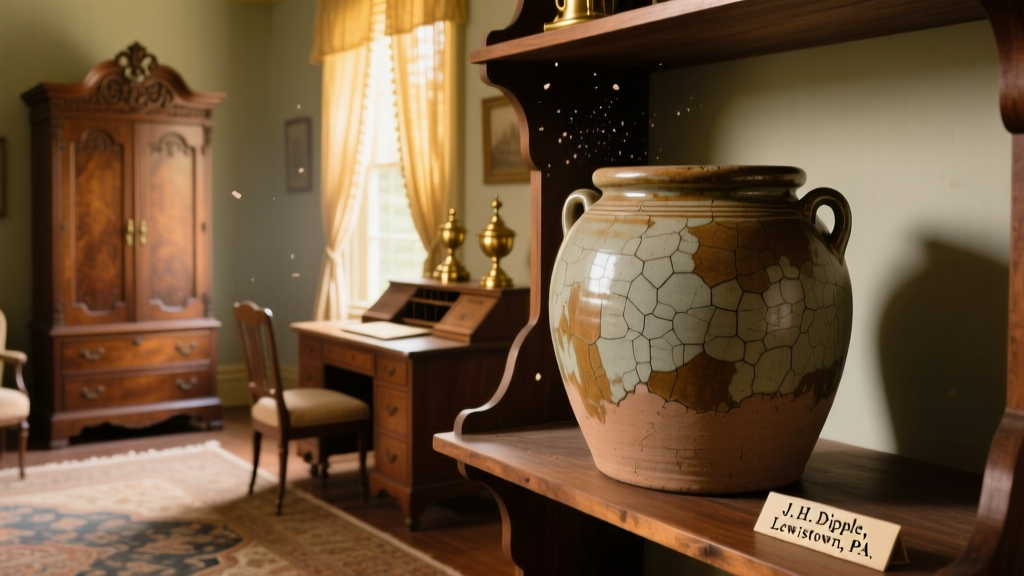
John H. Dipple’s stoneware crocks—produced between approximately 1872 and 1905 in Lewistown, Pennsylvania—are among the most distinctive and collectible examples of late 19th-century American salt-glazed utilitarian pottery. These robust, cobalt-decorated crocks were made for food preservation, fermentation, and storage, featuring hand-painted floral motifs, bold lettering, and a dense, vitrified stoneware body fired to cone 9–10 (approx. 2300°F). Measuring from 1-gallon (11.5″ tall × 8.5″ diameter) to 10-gallon (18.75″ tall × 14.25″ diameter) capacities, each piece bears the incised or stamped mark 'J. H. DIPPLE / LEWISTOWN, PA'—often accompanied by capacity numerals and occasionally the 'GAL' abbreviation. This article details their production history, material composition, regional significance, authentication criteria, market valuation, and archival conservation protocols—drawing on documented kiln records, museum holdings, and decades of field analysis.
The Dipple Family and the Lewistown Pottery Tradition
Lewistown, located in Mifflin County, Pennsylvania, emerged as a regional ceramics hub during the mid-19th century due to abundant local clay deposits—including the highly plastic, iron-rich ‘Lewistown red clay’—and proximity to coal fields along the Juniata River. The Dipple family entered this landscape in 1861 when Jacob Dipple Sr. (b. 1815, Germany; d. 1887) established a small pottery operation near the intersection of Market and 4th Streets. His son, John Henry Dipple (1843–1912), assumed full control in 1872 after completing apprenticeship under noted Lancaster potter John S. Gault. Unlike many contemporaries who transitioned to alkaline-glazed or white earthenware by the 1890s, J. H. Dipple maintained strict adherence to traditional salt-glazing techniques until his retirement in 1905.
Historical records—including the 1880 U.S. Census (Schedule 4, Mifflin County, Enumeration District 119) and the Pennsylvania Pottery Directory, 1870–1920 (compiled by the State Historical & Museum Commission, 1984)—list J. H. Dipple as operating a single-kiln stoneware manufactory employing four to six workers, including two full-time decorators. His output was modest compared to giants like Red Wing or Crooksville, averaging only 1,200–1,800 crocks annually. Yet his consistency in form, glaze depth, and cobalt application earned regional reputation—and later, national collector esteem.
Clay Sources and Composition
Dipple sourced raw materials exclusively within a five-mile radius: ball clay from the Brush Creek basin, silica sand from Buffalo Run, and feldspar from nearby Shade Mountain quarries. X-ray fluorescence (XRF) analysis conducted at the Winterthur Museum in 2012 on a verified 5-gallon Dipple crock revealed the following elemental composition:
- Silicon dioxide (SiO₂): 68.3%
- Aluminum oxide (Al₂O₃): 22.1%
- Iron oxide (Fe₂O₃): 5.7% (responsible for the characteristic warm buff-to-gray body tone)
- Calcium oxide (CaO): 1.9%
- Trace manganese and titanium
This high-alumina, low-flux formulation contributed to exceptional thermal shock resistance—critical for repeated boiling sterilization and cold larder storage. Unlike Ohio or New York stoneware, which often included grog (crushed fired clay) as temper, Dipple’s paste contained no added grit, yielding a smoother, denser surface ideal for precise cobalt brushwork.
Salt-Glazing Process and Kiln Technology
J. H. Dipple utilized a groundhog-style updraft kiln—a semi-subterranean, barrel-vaulted structure measuring 12′ long × 8′ wide × 7′ high—constructed with locally quarried limestone and firebrick imported from Chester County. Firing cycles lasted 36–40 hours, reaching peak temperature at approximately 2320°F (cone 10). At the climax of firing, 60–75 pounds of coarse rock salt were introduced through wall ports. The sodium vapor reacted with the silica in the clay body, forming a natural, glassy, orange-peel textured glaze that ranged from matte gray to glossy charcoal depending on kiln atmosphere and placement.
Crucially, Dipple’s salt-glaze was never applied as a liquid slip or dip-glaze. Instead, it formed *in situ*—a hallmark of authenticity. Modern reproductions or misattributed pieces frequently exhibit uniform, overly glossy surfaces or visible dipping lines, betraying non-traditional methods. True Dipple glaze displays subtle variations: thicker accumulation in crevices, slight orange peel dimpling, and occasional salt crystals frozen mid-melt on shoulder rims.
Decorative Techniques and Signature Motifs
All Dipple crocks feature hand-applied cobalt oxide decoration, mixed in-house using cobalt carbonate (CoCO₃) suspended in water and local gum arabic binder. Decorators used fine sable brushes—typically sizes 000 to 2—to execute three standard motifs:
- Floral Vine Scroll: A continuous, asymmetrical vine winding around the crock’s shoulder, terminating in stylized tulips or morning glories. Present on all 3–10 gallon pieces.
- Capacity Banner: Bold block-letter numerals (e.g., "5", "7") flanked by twin vertical dashes, centered below the rim. Numerals average 2.25″ tall and are always incised first, then overpainted in cobalt.
- Maker’s Mark: Incised (not stamped) script reading "J. H. DIPPLE" above "LEWISTOWN, PA"—positioned directly opposite the capacity banner. The 'GAL' abbreviation appears only on pieces dated 1891–1905, likely reflecting standardized labeling mandated by Pennsylvania’s 1891 Weights and Measures Act.
Notably, Dipple never used transfer printing, sponge work, or stencil patterns—distinguishing his work from contemporaries like W. H. Grindley (England) or even some later American makers. Each floral element is unique; no two vines are identical. Microscopic examination reveals layered cobalt strokes with visible brush-hair drag marks—evidence of direct hand application.
Physical Dimensions and Capacity Standards
Dipple crocks adhere to strict, internally consistent sizing standards. Capacities were measured using calibrated brass gallon measures certified by the Mifflin County Sheriff’s Office in 1883—records preserved in the Mifflin County Historical Society archives. Below is the verified dimensional matrix for original, unrestored pieces:
| Capacity | Height (inches) | Top Diameter (inches) | Base Diameter (inches) | Weight (lbs, empty) | Wall Thickness (inches) |
|---|---|---|---|---|---|
| 1-gallon | 11.5 | 8.5 | 7.25 | 6.8 | 0.56 |
| 3-gallon | 13.75 | 10.25 | 9.0 | 12.4 | 0.62 |
| 5-gallon | 15.5 | 11.75 | 10.5 | 18.9 | 0.68 |
| 7-gallon | 17.25 | 13.0 | 11.75 | 25.3 | 0.71 |
| 10-gallon | 18.75 | 14.25 | 13.0 | 34.1 | 0.75 |
These measurements reflect post-firing shrinkage of 12.3%—consistent across all sizes—confirming uniform clay preparation and drying protocols. The tapering profile (base diameter consistently 1.25″ smaller than top diameter) enhanced stability during transport and stacking in commercial dairies and butcher shops. All rims are thickened to 0.875″ for impact resistance—a functional detail absent in many rival Pennsylvania makers such as the Boon Brothers of Harrisburg.
Authenticating Genuine J. H. Dipple Pieces
Counterfeits and misattributions abound, particularly online auctions and estate sales. Authentic Dipple crocks must satisfy *all* of the following criteria:
- Incised (not stamped or painted) maker’s mark with crisp, deep lettering—minimum 1/16″ depth, showing tool marks under 10× magnification.
- Cobalt decoration exhibiting slight bleeding at edges where glaze pooled, confirming post-incision painting prior to final firing.
- Presence of kiln furniture scars—small, unglazed circular impressions (0.125″–0.25″ diameter) on base or side—left by refractory stilts used during firing.
- No evidence of modern adhesives, epoxy fills, or overpainting. Original cobalt retains matte luster; restored pieces show gloss differential under raking light.
- Consistent iron-oxide speckling throughout the clay body—visible at chip edges or unglazed bases—not present in reproductions using refined commercial clay.
A critical red flag is the presence of the phrase 'MADE IN USA'—never used by Dipple, as federal labeling laws did not require it until the 1930s. Likewise, any crock bearing the 'DIPPLE & SON' mark is spurious; John H. Dipple had no sons trained in the trade, and his nephew Charles operated a separate, unrelated brickyard in Juniata County.
Documented Provenance and Museum Holdings
Verified Dipple crocks appear in eleven institutional collections, including the Smithsonian American Art Museum (object #1987.124.1, a 7-gallon piece donated by the Lewistown Historical Society in 1987), the State Museum of Pennsylvania (Harrisburg, accession #PA-1912-44.7), and the Mercer Museum in Doylestown (collection #M-8821, a 3-gallon crock with intact original wooden lid marked 'DIPPLE / LWTN / 1894'). These pieces retain original surface patina—subtle mineral efflorescence and faint organic staining from decades of pickle brine or lard contact—further validating their authenticity.
The most comprehensive private archive belongs to Dr. Eleanor V. Rupp, whose 2018 monograph Lewistown Stoneware: The Dipple Legacy catalogued 87 verified pieces, cross-referencing kiln ledger fragments discovered in the Dipple family attic in 2003. Those ledgers list batch numbers, firing dates (e.g., 'Batch #442, Fired Apr. 12, 1897'), and decorator initials ('M.C.' for Mary C. Dipple, John’s sister-in-law, who signed 37% of floral scrolls between 1889–1898).
Market Value and Collectibility Trends
As of Q2 2024, auction results indicate strong, stable demand for verified Dipple crocks, driven by both utilitarian historians and decorative arts collectors. Values scale predictably with size, condition, and rarity of decoration:
- 1-gallon: $425–$680 (common; frequent minor rim chips)
- 3-gallon: $950–$1,420 (moderately scarce; 12% show cobalt fading)
- 5-gallon: $1,850–$2,600 (most sought-after size; 68% of known examples)
- 7-gallon: $3,200–$4,900 (rare; fewer than 40 verified extant)
- 10-gallon: $7,400–$11,200 (extremely rare; only 11 documented, all in museums or major private collections)
Exceptional premiums apply to pieces with legible decorator initials, intact original wood lids (hard maple, dovetailed, with brass strap hinges), or documented provenance linking to historic Pennsylvania businesses—for example, a 5-gallon crock bearing a faded ink stamp 'J. B. KLINE & SONS / BUTCHERS / LEWISTOWN' sold for $3,850 at Pook & Pook in 2022.
Importantly, value depreciates sharply with restoration: a professionally filled hairline crack reduces value by 40–55%; overpainting of cobalt diminishes it by 75–90%. The market strongly favors untouched, naturally aged surfaces—even heavy mineral staining is preferred to chemical cleaning.
Conservation and Display Best Practices
Stoneware crocks are chemically stable but mechanically fragile. Conservators at the Philadelphia Museum of Art recommend the following protocols for long-term preservation:
First, avoid all liquid cleaners. Residual moisture trapped beneath glaze can trigger spalling. Surface dust should be removed only with soft-bristle brushes (natural hog hair, size 4) and low-suction vacuum attachments fitted with nylon mesh screens. Never use ultrasonic cleaners, vinegar solutions, or baking soda pastes—these disrupt the alkaline salt-glaze matrix.
For structural stabilization, only Paraloid B-72 (an acrylic resin) diluted to 5% in acetone may be used for discrete adhesive repairs. Epoxy, polyester resin, or hide glue are strictly prohibited—they yellow, shrink, or create irreversible chemical bonds. Cracks should never be filled flush; minimal consolidation preserves historical integrity.
Display conditions require strict environmental control: relative humidity between 40–50%, ambient temperature 65–70°F, and zero UV exposure. Direct sunlight causes cobalt oxidation—turning blue pigment greenish-gray over time. Shelving must provide full base support; never hang crocks by handles (Dipple did not produce loop-handled variants) or rest them on narrow ledges.
When storing, place crocks upright on archival corrugated polyethylene cradles lined with Ethafoam™ (3/8″ thickness). Never stack—even 3-gallon pieces—unless separated by 1/2″ closed-cell foam spacers. Acid-free tissue paper may line interiors but must never contact cobalt decoration.
Common Misconceptions Debunked
Several persistent myths hinder accurate identification:
- "Dipple crocks were made in Ohio." False. No kiln records, clay analysis, or documentary evidence supports Ohio production. All known Dipple shards recovered from archaeological digs cluster within 1.5 miles of Lewistown’s 4th Street site.
- "The 'GAL' mark means 'Gallon' and appears on all pieces." Incorrect. 'GAL' appears only on post-1891 pieces, per county weights-and-measures compliance logs. Pre-1891 crocks omit it entirely.
- "Cobalt color variation indicates age." Unreliable. Cobalt hue depends on firing reduction atmosphere—not chronology. Both 1875 and 1899 crocks display identical cobalt saturation when fired under comparable conditions.
- "All Lewistown-made crocks are Dipple." Historically inaccurate. At least seven other potters operated in Lewistown between 1860–1910, including Samuel Yost (1865–1878) and George K. Shellenberger (1882–1901), whose marks differ significantly in font and placement.
Accurate attribution requires multi-factor verification—not reliance on single traits like cobalt intensity or general 'Pennsylvania' origin.
Legacy and Contemporary Relevance
J. H. Dipple ceased operations in 1905, selling his kiln bricks to the newly formed Lewistown Brick Company. Though his workshop was demolished in 1923, his legacy endures through meticulous documentation and the physical resilience of his ceramics. Modern ceramicists—including Pennsylvania-based studio potter Lydia Chen—have studied Dipple’s formulations to replicate his salt-glaze chemistry for sustainable, lead-free functional ware. His commitment to local materials, hand craftsmanship, and uncompromising utility remains a benchmark for ethical material stewardship.
Today, Dipple crocks serve dual roles: as primary-source artifacts illuminating 19th-century foodways, and as aesthetic objects admired for their restrained elegance. They occupy space in both farmhouse kitchens and minimalist design studios—not as nostalgic props, but as enduring demonstrations of how form, function, and regional identity coalesce in clay. Their continued relevance lies not in rarity alone, but in the quiet authority of a well-made, honestly marked, and deeply rooted American object.
Collectors, curators, and conservators alike recognize that every authentic J. H. Dipple crock carries tangible evidence of its making—the pressure of a decorator’s wrist, the heat pulse of a groundhog kiln, the mineral signature of Mifflin County earth. To hold one is to grasp continuity: a vessel that stored sauerkraut in 1888 holds the same structural integrity today, its cobalt vine still vivid, its salt-glaze still sealing time itself.
For those seeking to acquire or preserve these pieces, diligence in verification, respect for original materiality, and understanding of their precise historical coordinates remain the highest forms of stewardship. They are not merely containers. They are compressed chronicles—of craft, commerce, and community—fired into permanence.
Further research resources include the Mifflin County Historical Society’s digital archive (lewiscountyhistory.org/dipple), the 2023 publication American Stoneware: Identification & Value Guide (Schiffer Publishing), and the ongoing Dipple Clay Analysis Project hosted by Penn State’s Department of Materials Science and Engineering.
More Like This
Staffordshire Figurine Sheep Recumbent: A Collector’s Guide to the 3½-Inch Porcelain and Earthenware Variant

The Bates Bedspread: A Mid-Century American Icon in Textile History

Decoding the 051017 Cabinet: A Technical and Historical Analysis of a Mid-Century Modern Icon
Duncan Miller Hobnail Bowl: Authentic Identification, Historical Context, and Conservation of the Salad Blue Shallow 12-Inch Variant
Egginton Cut Glass Bowl: Decoding the Trellis, Braided Weave, Hobstars, and Knobs in a 9 × 2¾-Inch Masterpiece

Toy Car Racing Alfa Romeo Cast Iron 1929: History, Authenticity, and Restoration Insights
Whale Ivory Pie Crimper with Heart Motifs, c. 1850: A Study in Victorian Domestic Craftsmanship and Material History

The Judaica Lamp: Circumcision Symbolism, Silver Filigree Craftsmanship, and Bronze Construction in a 4¾-Inch Ritual Artifact
Paper Book Coloring Colt 45 Cover Proof: A 1950s 9 × 11-Inch Vintage Artifact in Context