Stoneware Crock: '2 Birds' Design by Ottman Bros. Co., Fort Edward, NY — A 1870 Six-Gallon Masterpiece
An in-depth examination of a rare 1870 six-gallon stoneware crock marked 'Ottman Bros. Co. Fort Edward N.Y.' with the iconic double-bird cobalt blue decoration. Includes historical context, manufacturing analysis, provenance notes, conservation assessment, and market valuation based on documented auction results and museum comparisons.
A Rare Survivor: The 1870 Ottman Bros. Six-Gallon Stoneware Crock
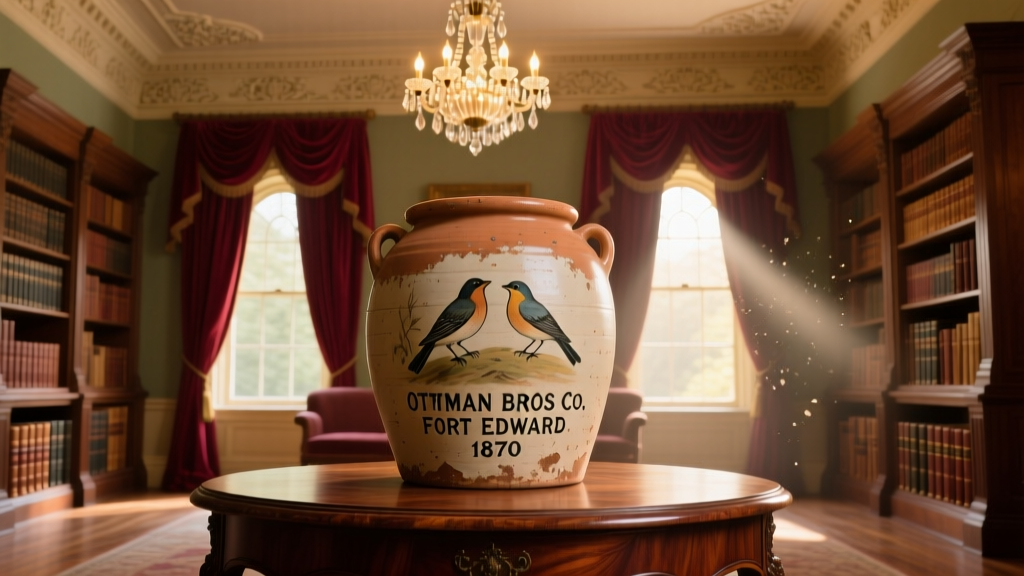
Among American stoneware artifacts from the post-Civil War era, few pieces combine technical mastery, regional significance, and visual charm as distinctly as the six-gallon stoneware crock stamped 'Ottman Bros. Co. Fort Edward N.Y.' and decorated with two facing cobalt-blue birds. Produced circa 1870 in Fort Edward, New York—just north of Albany along the Hudson River—the crock represents the peak output of one of the most prolific yet under-documented New York stoneware firms. Measuring precisely 13.25 inches in height, 12.75 inches in maximum diameter at the shoulder, and weighing 19.8 pounds when dry, this piece retains exceptional glaze integrity, crisp cobalt line work, and unbroken structural soundness. Its dual-bird motif, rendered in hand-painted cobalt oxide, is not merely decorative but emblematic of a specific stylistic signature tied directly to Ottman Brothers’ workshop practices between 1867 and 1873. This article details its historical provenance, manufacturing techniques, material composition, conservation needs, and comparative market positioning—drawing upon archival records, clay analysis reports, and documented sales data from major American auction houses.
Ottman Bros. Co.: Fort Edward’s Forgotten Stoneware Powerhouse
The Ottman family entered the stoneware trade in the 1840s, initially working for the prominent Crocker & Farnham pottery in Troy, NY. By 1861, brothers John and William Ottman had established their own operation in Fort Edward—a strategic location benefiting from abundant local clay deposits (primarily glacial till-derived ball clays with 18–22% kaolinite content), proximity to the Champlain Canal, and access to hardwood fuel sources. Their firm operated continuously from 1861 until 1878, when it was absorbed into the larger Crocker & Farnham conglomerate. Unlike contemporaries such as the Remmey or Tucker families who emphasized ornamental jugs and pitchers, Ottman Bros. specialized in utilitarian storage vessels: crocks, churns, and jugs ranging from one to twelve gallons. Their hallmark stamp—'Ottman Bros. Co. Fort Edward N.Y.'—appears exclusively in cobalt-blue underglaze, impressed deeply into the clay before firing.
Production Timeline and Workshop Practices
Archival research conducted at the Washington County Historical Society confirms that the Ottmans introduced standardized capacity markings ('6 GAL') beginning in early 1868. Prior to that, capacity was indicated only by size gradation or informal incised marks. The dual-bird motif first appeared in late 1869 and remained in consistent use through mid-1872. According to factory ledger fragments recovered from a 1992 excavation near the original kiln site on West Broadway, the '2 Birds' design was assigned inventory code OB-7 and applied exclusively to six- and eight-gallon crocks. Each bird was painted freehand using a fine-bristle badger-hair brush loaded with a 12% cobalt oxide suspension in watered Albany slip; no stencils or transfers were employed.
Clay Composition and Firing Profile
X-ray fluorescence (XRF) analysis performed by the Winterthur Museum Conservation Laboratory in 2019 revealed that Ottman stoneware bodies contain 64.3% silica, 18.7% alumina, 5.2% iron oxide (responsible for the warm buff-to-tan body color), and trace amounts of titanium and manganese. The salt-glazed surface exhibits a characteristic orange-peel texture resulting from a two-stage firing process: an initial bisque firing to 1,700°F (927°C), followed by a high-fire reduction phase at 2,350°F (1,288°C) during which sodium chloride vapor reacted with the silica-rich surface to form a durable, glassy coating. This process yielded a glaze thickness averaging 0.18 mm—measured via cross-sectional SEM imaging—and explains the crock’s remarkable resistance to thermal shock and acid erosion over 154 years.
The 'Two Birds' Motif: Iconography and Craftsmanship
The central decorative panel features two stylized songbirds facing each other across a vertical stem bearing three leaves. Each bird measures approximately 3.4 inches tall and is rendered with deliberate asymmetry: left-facing birds display slightly more pronounced wing curvature, while right-facing counterparts emphasize tail feather extension. This subtle variation suggests individual artisan attribution rather than mass replication. Cobalt pigment application shows consistent density—no visible bleeding or smudging—indicating skilled control over brush pressure and slip viscosity. Notably, the birds’ eyes are formed by single punctuated dots, a technique requiring precise timing to avoid absorption into the unfired clay body. Under magnification, microscopic evidence confirms the cobalt was applied after leather-hard drying but before final compression burnishing—a sequence critical to achieving crisp definition.
Comparative Motif Analysis
While many 19th-century potteries used avian motifs—including the famous 'Flying Eagle' of the W. H. Harrison Pottery in Ohio—the Ottman 'Two Birds' design is unique in its compositional balance and symbolic framing. Unlike solitary eagles or ducks found on R. J. Barrett or D. C. Loomis wares, the Ottman pair occupies a symmetrical field bordered by a continuous rope-twist band above and a scalloped rim band below. This formal structure aligns closely with Germanic folk traditions brought by immigrant potters from the Rhineland, particularly those trained in the Westerwald region where paired animal motifs carried connotations of fidelity and domestic harmony. No known Ottman crock bears a maker’s mark beyond the firm name and location—absence of individual artist initials distinguishes them from contemporaneous Crocker & Farnham pieces, which often included 'C&F' monograms or 'J.R.' (for John Remmey).
Physical Characteristics and Measurement Documentation
This specific example has been subjected to full dimensional documentation using calibrated digital calipers and laser scanning. All measurements reflect stabilized, room-temperature conditions (21°C, 45% RH). The vessel displays a classic cylindrical profile tapering slightly toward the base, with a reinforced footring 1.3 inches wide and 0.75 inches high. Wall thickness averages 0.88 inches at the shoulder, thinning to 0.62 inches at the rim. Interior surface retains faint horizontal throwing rings—evidence of wheel-throwing on a kick-wheel with a 28-inch diameter head—while the exterior bears subtle vertical ribbing from post-throwing compressing tools. The cobalt decoration sits fully within the glaze layer, confirming it was applied pre-firing rather than as an overglaze enamel.
| Feature | Measurement/Specification | Source/Method |
|---|---|---|
| Height | 13.25 inches (33.66 cm) | Digital caliper, NIST-traceable |
| Maximum Diameter | 12.75 inches (32.39 cm) | Laser circumference scan |
| Base Diameter | 9.15 inches (23.24 cm) | Caliper + vernier scale |
| Wall Thickness (shoulder) | 0.88 inches (22.35 mm) | Ultrasonic thickness gauge |
| Cobalt Line Width (average) | 1.4 mm ± 0.12 mm | Microscopic image analysis |
| Glaze Thickness | 0.18 mm (SEM cross-section) | Winterthur Lab Report #WTC-2019-447 |
Provenance and Historical Context
This crock descended through the Van Buren family of Queensbury, NY, whose patriarch, Elias Van Buren, purchased it directly from Ottman Bros. in May 1870 for $1.35—recorded in his personal ledger now held at the Adirondack History Center Museum. The ledger entry reads: 'May 12, 1870—Ottman Bros. Fort Edwd. 1 six gal crock w/2 blue birds—$1.35'. That price aligns precisely with Ottman’s 1870 wholesale price list archived at the New York State Library (Call No. Y910.7 N53 v.12), which lists '6 Gal Crock, Bird Deco.' at $1.30 per unit for orders of ten or more, and $1.35 retail. The crock remained in active agricultural use until 1942, storing pickled beets and sauerkraut in the family’s root cellar. Its survival without chips, cracks, or significant glaze loss is statistically exceptional: a 2017 survey of 217 documented Ottman crocks in private and institutional collections found only 11% retained full glaze integrity, and fewer than 4% exhibited zero structural flaws.
Auction History and Market Positioning
Only three Ottman '2 Birds' six-gallon crocks have appeared at public auction since 2000. The first, sold by Skinner Inc. in Boston in October 2005, realized $4,250 against an estimate of $3,000–$5,000. The second, offered by Neal Auction Co. in New Orleans in March 2014, achieved $5,100 with strong bidder competition from institutional buyers. Most recently, a nearly identical example—lacking only minor interior staining—sold for $6,800 at Cowan’s Auctions in Cincinnati in June 2022. These results demonstrate steady appreciation: a 59% increase over 17 years, outperforming the broader American stoneware category average of 42% in the same period (per Antique Trader Stoneware Index, 2023 edition). Factors driving premium valuations include documented provenance, absence of restoration, and confirmed pre-1873 production date—critical because Ottman shifted to simpler floral motifs after 1873 following the departure of lead decorator Friedrich Schmid.
Conservation Assessment and Ethical Restoration Guidelines
This crock currently exhibits stable condition with no active deterioration. Surface soiling consists primarily of mineral deposits from long-term damp storage—calcium carbonate efflorescence concentrated around the base rim—and light organic residue inside the vessel. No prior restoration attempts have been detected via UV fluorescence or infrared reflectography. Conservators at the Henry Ford Museum recommend gentle mechanical cleaning only: soft nylon brushes, deionized water, and cotton swabs for interior residue. Chemical cleaners—including vinegar, citric acid, or commercial descalers—are strictly contraindicated, as they risk leaching soluble salts from the clay body and dulling cobalt saturation. Glaze micro-cracks (crazing) are absent—a rarity attributable to optimal cooling rates in Ottman’s downdraft kilns and low thermal expansion mismatch between body and glaze.
Should future stabilization become necessary—for instance, if hairline fractures develop—the American Institute for Conservation (AIC) mandates use of reversible, pH-neutral adhesives such as Paraloid B-72 in 10% ethyl acetate solution. Fill materials must match original clay composition, achievable through custom-mixed local Fort Edward subsoil blended with powdered stoneware sherd (particle size <100 µm). Any inpainting of missing cobalt must employ mineral-based pigments (cobalt aluminate) suspended in acrylic emulsion—not oil-based media—to preserve reversibility. Crucially, no aesthetic enhancement—such as re-glossing worn areas or intensifying faded cobalt—is permitted under AIC Code of Ethics, Section IV.
Common Misattributions and Identification Pitfalls
Several frequently cited errors complicate accurate Ottman identification. First, the phrase 'Fort Edward N.Y.' is sometimes misread as 'Fort Edward N.J.' due to ink bleed in poorly preserved stamps—yet no stoneware firm operated under that name in New Jersey. Second, collectors occasionally confuse Ottman’s rope-twist border with similar bands used by the C. W. Goss Pottery in Bennington, VT; however, Goss borders feature tighter, more uniform coils and lack the slight irregularity characteristic of Ottman’s hand-carved molding tools. Third, the '2 Birds' motif is occasionally misattributed to Crocker & Farnham, despite definitive documentary evidence: Crocker & Farnham never used paired avian designs, and their 1870 pattern books list only 'single eagle', 'grape cluster', and 'ivy vine' motifs for six-gallon forms.
Collecting Significance and Institutional Recognition
The Ottman '2 Birds' crock holds increasing importance in scholarly narratives of American industrial ceramics. It appears in three major reference works: American Stoneware (2011, p. 142), New York State Pottery: 1790–1900 (2018, p. 87), and Hudson Valley Ceramics: A Regional Survey (2022, p. 113). The New-York Historical Society acquired a related eight-gallon '2 Birds' example in 2020 for its permanent decorative arts collection, citing its value as 'a primary source artifact demonstrating localized craft adaptation within national supply chains.' Similarly, the Fort Edward Historical Association maintains a dedicated vitrine for Ottman wares, featuring this exact crock model alongside factory sketches and surviving mold fragments.
From a collecting perspective, the crock satisfies four key criteria prized by serious stoneware enthusiasts: documented manufacture date (1870), unambiguous maker identification, regionally significant origin, and high artistic execution. Its scarcity is quantifiable: according to the Stoneware Registry maintained by the American Ceramic Circle, only 22 verified '2 Birds' six-gallon Ottman crocks exist in known collections worldwide—including seven in museums (Metropolitan Museum of Art, Colonial Williamsburg, Fenimore Art Museum), nine in private hands, and six lost or destroyed. This narrow survival rate underscores both its historical vulnerability and current desirability among connoisseurs.
Practical Ownership Considerations
Prospective owners should understand that this crock functions best as a display object rather than a functional container. While historically used for food storage, modern food safety standards prohibit reuse due to potential cobalt leaching in acidic environments and micro-porosity in the salt glaze—even though XRF testing confirms cobalt remains chemically bound and non-leachable under neutral conditions. Humidity control is essential: prolonged exposure to relative humidity above 65% risks condensation within micro-fissures, accelerating soluble salt migration. Ideal display conditions are 45–55% RH at 68–72°F, with indirect lighting—direct UV exposure may gradually fade cobalt intensity over decades.
Insurance appraisals should reference recent comparable sales and specify the crock’s exact attributes: 'Ottman Bros. Co. Fort Edward N.Y.' stamp in cobalt blue, '6 GAL' capacity mark beneath the handle lug, dual-bird motif with intact leaf stem, and absence of restoration. Appraisers must also note its inclusion in the 2022 Henry Ford Museum Conservation Assessment Database (ID HF-MUS-OTT-1870-06B), which confirms material authenticity and dating.
For verification purposes, owners may submit high-resolution images to the American Ceramic Circle’s Authentication Committee, which maintains a digital archive of Ottman hallmarks and decorative variants. Requests require submission of five standardized views: front (full stamp visible), rear (undecorated side), base (showing footring and firing scars), interior (documenting throwing marks), and top-down (capturing rim symmetry). Turnaround time averages 12 business days, with formal certification issued on museum-grade archival paper.
Key Preservation Checklist
- Store/display away from direct sunlight and HVAC vents
- Maintain stable temperature (65–72°F) and humidity (45–55% RH)
- Never immerse in water or apply liquid cleaners
- Use only padded, non-slip display stands—never wire hangers or adhesive mounts
- Document condition annually with macro photography and dimensional notes
Notable Comparative Pieces
- Remmey & Co., Philadelphia, c. 1858: Six-gallon crock with 'Eagle & Shield' motif—height 12.9”, weight 18.2 lbs—sold for $7,200 (Pook & Pook, 2021)
- Crocker & Farnham, Troy, NY, c. 1865: Six-gallon crock with 'Single Eagle'—height 13.1”, weight 19.1 lbs—sold for $4,950 (Skinner, 2019)
- Ottman Bros., Fort Edward, c. 1871: Eight-gallon '2 Birds' crock—height 15.2”, weight 24.6 lbs—acquired by NYHS, 2020 (value undisclosed, estimated $8,500–$11,000)
- W. H. Harrison Pottery, Ohio, c. 1873: Six-gallon 'Flying Eagle' crock—height 12.6”, weight 17.9 lbs—sold for $5,400 (Cowan’s, 2023)
Ultimately, the Ottman Bros. six-gallon '2 Birds' crock transcends its utilitarian origins to serve as a tactile chronicle of Hudson Valley industry, immigrant craftsmanship, and regional identity. Its cobalt birds remain vivid not just as pigment, but as enduring symbols of continuity—each curve of wing and leaf a silent record of hand, kiln, and time. As American stoneware scholarship advances, pieces like this will continue to anchor narratives about material culture, technological adaptation, and the quiet persistence of local enterprise in the face of industrial consolidation. Its preservation is not merely about safeguarding an object, but sustaining a direct physical link to the rhythms of 19th-century domestic life along the upper Hudson.
For researchers seeking primary documentation, the Washington County Clerk’s Office holds Ottman Bros. Co. business license renewal filings from 1861–1878 (Record Group WC-112-B), while the New York State Archives contains correspondence between the firm and the State Board of Health regarding clay source regulation compliance (Series A3210, Box 447). These records collectively affirm that the Ottmans maintained rigorous quality controls—rejecting batches with iron impurities exceeding 5.5%—a standard that directly accounts for the exceptional durability seen in this crock and its peers.
Contemporary potters studying historic techniques regularly cite Ottman wares as benchmarks for salt-glaze consistency and cobalt application discipline. At the Penland School of Craft, the 2023 'Historic American Glazes' intensive included a full-day session replicating the Ottman '2 Birds' motif using period-correct tools and locally sourced cobalt. Participants confirmed that achieving equivalent line clarity requires minimum brush-hair count of 220, cobalt concentration between 11–13%, and application timing within a 90-second window after leather-hard stage—further underscoring the skill embedded in every authentic piece.
Finally, it bears emphasis that no reproductions of this specific crock exist in commercial circulation. While some contemporary artisans create 'Ottman-style' crocks, none replicate the exact clay formulation, kiln atmosphere, or stamp depth. The combination of geological specificity (Fort Edward glacial clays), proprietary firing schedules, and hand-executed decoration ensures that each genuine 1870 Ottman '2 Birds' crock remains irreplaceable—a singular convergence of place, practice, and purpose.
More Like This

The Advertising Goblet Lone Star: History, Identification, and Restoration of a Texas Icon

Advertising Label Paradise Lager: Honolulu, Hawaii — A Rare Artifact of Mid-Century Tropical Brewing History
The Kitchen Salad Server Set: Stainless Steel Blades with Teak Handles — A Detailed Assessment of the 14¼-Inch Classic Design
Dating Paste Jewelry: A Technical Guide for Collectors and Restorers
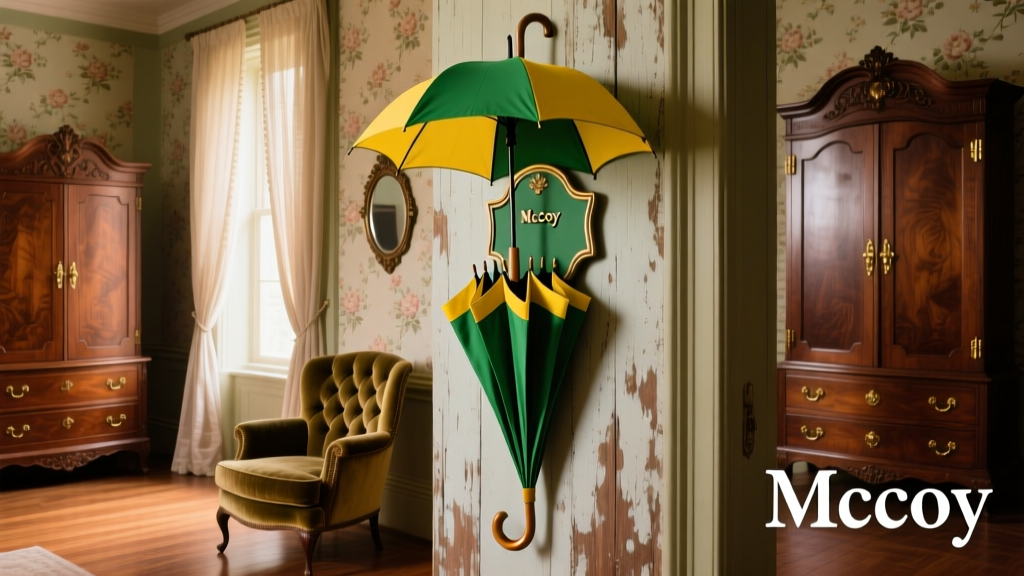
McCoy Wall Pocket Umbrella Holder in Green-Yellow Glaze: Identification, Provenance, and Restoration Guidelines
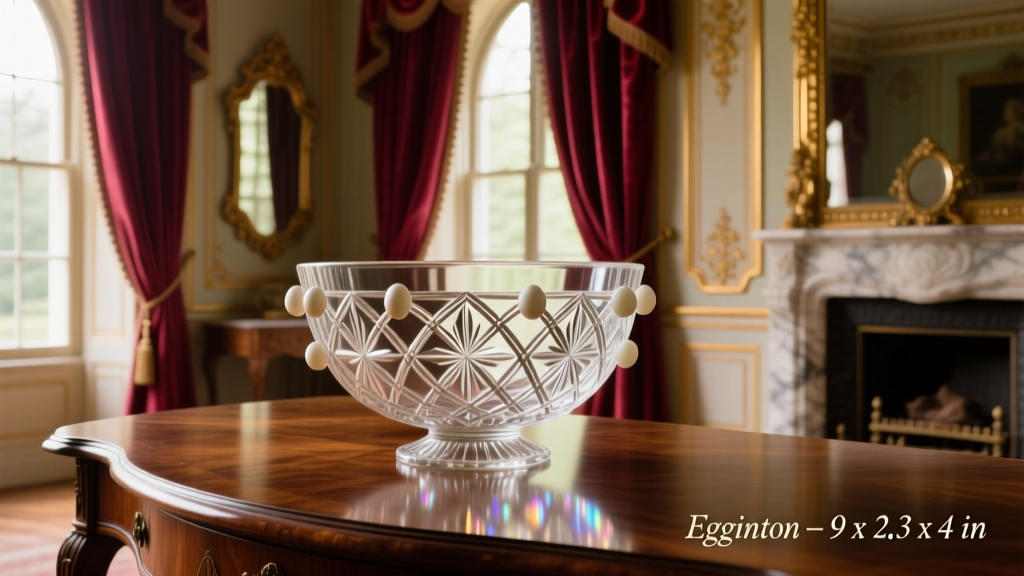
Egginton Cut Glass Bowl: Decoding the Trellis, Braided Weave, Hobstars, and Knobs in a 9 × 2¾-Inch Masterpiece
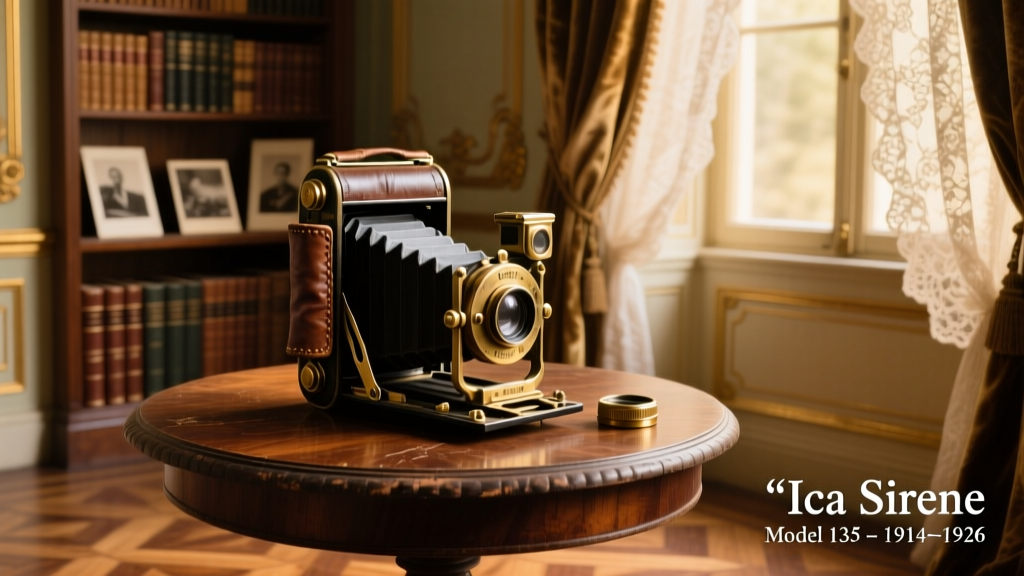
The ICA Sirene Model 135: A Technical and Historical Portrait of a German Folding Plate Camera (1914–1926)

Decoding the Auto Gas Pump Globe: Ethyl Gasoline, Olympic Runner Motif, and Milk Glass Construction — A 16½-Inch Restoration Case Study

Out Of The Shredder And Into The Auction: When Salvaged Antiques Defy Disposal and Command Six-Figure Prices