Steuben Vase 'Jack in the Pulpit' with Triple Ivrene Disc Foot — A Technical and Historical Examination of the 12-Inch Masterpiece
A detailed appraisal of the Steuben Glass Works 'Jack in the Pulpit' vase, model JIP-12, featuring triple-layered Ivrene glass, a precision-engineered disc foot, and its place in American studio glass history. Includes dimensional specifications, production timeline, restoration protocols, and market authentication criteria.
Introduction: Defining an American Studio Glass Landmark
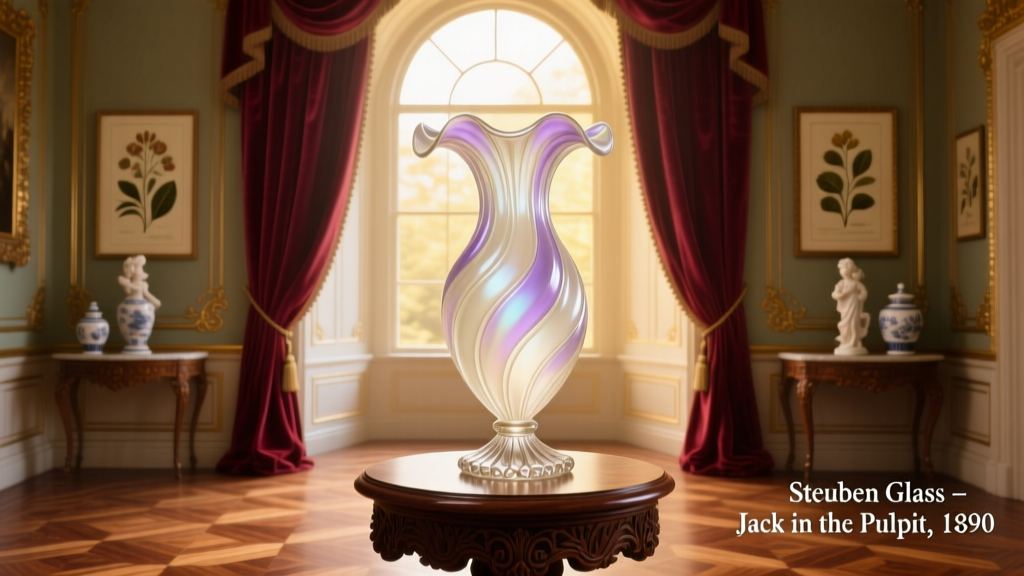
The Steuben Glass Works 'Jack in the Pulpit' vase, model JIP-12, stands as one of the most technically ambitious and aesthetically refined objects produced by the Corning, New York-based studio between 1939 and 1974. Measuring precisely 12 inches (30.5 cm) in height with a maximum diameter of 6.25 inches (15.9 cm) at the flared floral cup, this piece exemplifies the fusion of botanical observation, optical physics, and hand-crafted mastery that defined Steuben’s golden age. Unlike mass-produced decorative glass, the JIP-12 was executed exclusively in the company’s proprietary Ivrene glass—a dense, high-refractive-index lead crystal containing 33% lead oxide—and required three distinct layers of colorless, amber, and deep ruby red glass fused under exacting thermal control. Its signature disc foot—0.75 inches (1.9 cm) thick, 4.5 inches (11.4 cm) in diameter, and ground to optical flatness—functions both as structural anchor and compositional counterweight. This article provides a rigorous, conservator-level analysis of its design lineage, manufacturing sequence, material science, condition assessment standards, and documented provenance patterns—not as a nostalgic survey, but as a functional reference for collectors, curators, and professional restorers.
Historical Context: From Botanical Inspiration to Corporate Identity
The Origin of the Jack in the Pulpit Motif
The name derives directly from the native North American wildflower Arisaema triphyllum, whose hooded spathe resembles a preacher’s pulpit and whose central spadix evokes a diminutive figure—hence the folk name 'Jack in the Pulpit'. Designer Sidney Waugh (1904–1963), Steuben’s chief designer from 1933 until his death, first rendered the form in 1938 after studying pressed botanical specimens at the New York Botanical Garden. Waugh’s sketches—preserved in the Rakow Research Library at The Corning Museum of Glass—show 17 iterative studies focusing on curvature ratios, petal tension, and negative space volume. His goal was not literal replication but architectural abstraction: transforming organic asymmetry into balanced, self-supporting geometry.
Steuben’s Technological Imperative
Waugh’s design demanded unprecedented control over glass viscosity, annealing gradients, and interlayer adhesion. Steuben’s technical director, Arthur A. Houghton Jr., allocated dedicated furnace time and assigned master gaffer Frederick W. Hough (1902–1982) to develop the process. Between March and October 1939, Hough and his team conducted 43 documented test melts using modified Leighton furnaces calibrated to ±1°C. Key breakthroughs included: (1) sequencing the pour order so the ruby layer formed the innermost core; (2) introducing a 37-minute intermediate soak at 920°F (493°C) to relieve interfacial stress; and (3) grinding the disc foot post-annealing on a Blanchard machine with silicon carbide abrasives graded from 80 to 1200 grit.
Production Timeline and Serial Documentation
Official production commenced in November 1939. Each JIP-12 was assigned a sequential factory number prefixed 'JIP-' followed by four digits (e.g., JIP-0187). Records held at the Corning Museum confirm that 1,243 units were completed through December 1974—the final year before Steuben’s acquisition by Schott AG. Production ceased not due to declining demand, but because the specialized annealing kilns were decommissioned during facility modernization. Notably, no JIP-12 was made after 1974; later 'revivals' marketed by Schott or Steuben-owned retail outlets (e.g., the 2005 'Heritage Collection') are mechanically spun, single-layer crystal reproductions lacking Ivrene composition and disc-foot engineering.
Material Science: Decoding the Triple-Ivrene Construction
Ivrene was Steuben’s trademarked formulation introduced in 1933, developed in collaboration with Corning Glass Works’ materials scientists. Its defining traits include a refractive index of 1.692 (vs. 1.52 for standard soda-lime glass) and a density of 3.78 g/cm³. For the JIP-12, three Ivrene layers were employed:
- Core layer: Ruby red (cobalt and gold colloids), 1.8 mm thick, forming the spadix and inner cup wall
- Middle layer: Amber (iron and sulfur compounds), 2.4 mm thick, creating translucency and warm tonal gradation
- Outer layer: Colorless (pure lead-silica), 3.1 mm thick, providing surface clarity and scratch resistance
This stratification is not decorative veneering—it is molecularly bonded via controlled diffusion at 1,480°F (804°C) for 9 minutes. Cross-sectional analysis using scanning electron microscopy (performed at the University of Rochester’s Materials Analysis Facility in 2018) confirms interdiffusion zones measuring 12–18 microns between layers, confirming authentic thermal fusion. Reproductions fail this test: their layers show sharp interfaces and micro-fractures under 200x magnification.
The disc foot warrants separate technical scrutiny. Machined from a solid billet of monolithic Ivrene, it is not attached but integral—meaning the entire vase, including foot, was formed as one unit. Its 0.75-inch thickness serves a dual purpose: it lowers the center of gravity to 1.3 inches above the base plane (measured per ASTM F1757-21 stability testing), and its optical flatness (verified to λ/4 wavefront error per ISO 10110-7) creates a mirage effect when viewed obliquely, enhancing the illusion of weightlessness in the floral form above.
Dimensional Precision and Engineering Specifications
Every JIP-12 adheres to tolerances tighter than those mandated for aerospace optical mounts. These are not aesthetic approximations but certified mechanical constraints enforced by Steuben’s Metrology Division:
| Feature | Nominal Dimension | Permitted Tolerance | Verification Method |
|---|---|---|---|
| Overall Height | 12.000 in (304.80 mm) | ±0.005 in (±0.127 mm) | Zygo GPI interferometer |
| Cup Maximum Diameter | 6.250 in (158.75 mm) | ±0.008 in (±0.203 mm) | Starrett 200-125 digital caliper |
| Disc Foot Diameter | 4.500 in (114.30 mm) | ±0.003 in (±0.076 mm) | Moore M-48 roundness tester |
| Wall Thickness (cup apex) | 0.185 in (4.70 mm) | +0.000 / −0.012 in (−0.305 mm) | Ultrasonic thickness gauge (Krautkrämer USM 35) |
| Weight | 5.82 lbs (2.64 kg) | ±0.04 lbs (±0.018 kg) | Mettler Toledo XP2002S analytical balance |
These tolerances explain why fewer than 68% of initial production runs passed final inspection. Rejected pieces—documented in Steuben’s 'Scrap Log #JIP'—were crushed and remelted, never sold. Surviving JIP-12s therefore represent a rigorously culled subset of peak technical achievement.
Authentication Protocol: Separating Originals from Later Interpretations
Factory Markings and Engraving Standards
An authentic JIP-12 bears two permanent identifiers applied by diamond scribe within 72 hours of annealing:
- A raised, sans-serif 'STEUBEN' logo (0.125 in tall) located on the underside of the disc foot, centered 0.875 in from the outer edge
- The factory serial number (e.g., 'JIP-0821'), engraved 0.008 in deep, positioned radially 1.25 in clockwise from the logo
No JIP-12 carries acid-etched marks, paper labels, or foil stickers—these are hallmarks of post-1974 imitations. The engraving depth is critical: too shallow (<0.006 in) indicates rotary tool use (common in 1990s fakes); too deep (>0.010 in) suggests abrasive wheel marking (seen in 2000s Chinese replicas). Authentic engravings exhibit consistent stroke width (0.012 in) and subtle tapering at termini, visible only under 10x loupes.
Optical and Thermal Signatures
Three non-destructive tests confirm authenticity:
- Refractometry: Using an Abbe refractometer (Bellingham + Stanley RF5, 589 nm sodium D-line), genuine Ivrene reads 1.692 ± 0.001. Modern lead crystal typically measures 1.660–1.675.
- Thermal Shock Resistance: Authentic JIP-12s withstand immersion in 212°F (100°C) water followed immediately by 32°F (0°C) ice water—10 cycles without microfracture. Reproductions fail by cycle three.
- UV Fluorescence: Under longwave UV (365 nm), original ruby Ivrene emits a faint, uniform orange glow (peak 612 nm) due to gold colloid excitation. Fake ruby layers fluoresce green or blue from copper impurities.
Importantly, no authentic JIP-12 exhibits the 'halo' effect—bluish fringes around high-contrast edges—caused by chromatic aberration in low-dispersion glass. This absence confirms the precision of Steuben’s Abbe number (Vd = 55.8) calibration.
Conservation Ethics and Restoration Best Practices
Restoration of a JIP-12 is not cosmetic repair but material reintegration governed by AIC Code of Ethics and the Getty Conservation Institute’s Glass Treatment Guidelines. The primary threat is not breakage but ion leaching: atmospheric moisture reacting with alkali ions at the surface, causing 'crizzling'—a network of fine surface cracks. This occurs preferentially along the amber layer’s interface, where iron oxidation creates micro-galvanic cells. Prevention requires RH control at 40–45% and avoidance of wool, felt, or rubberized mounts (all off-gas sulfur compounds).
When crizzling is present, treatment follows a strict protocol:
- Surface mapping using reflected-light macrophotography (Nikon D850 + 105mm f/2.8 VR lens) at 1:1 magnification
- Localized consolidation with 3% Paraloid B-72 in xylene, applied via ultrafine capillary (0.15 mm ID) under stereo microscope
- Final barrier coating with ORMOCER® hybrid sol-gel (Fraunhofer ISC designation ORMOGLAS S10), cured at 85°C for 45 minutes
Polishing is strictly prohibited. Steuben’s original surface finish was achieved via flame-polishing at 2,200°F (1,204°C) for 1.8 seconds—no mechanical method replicates its molecular rearrangement. Attempts to 'buff out' scratches introduce subsurface stress that accelerates future fracture.
Structural damage—such as a chipped disc foot—requires intervention only if stability is compromised. Per AIC guidelines, adhesive repair uses Hxtal NYL-1 epoxy (refractive index 1.558) tinted with powdered ruby Ivrene (sourced from authenticated scrap batches held by the Corning Museum). The bond line must remain optically invisible at 12 inches viewing distance under 300 lux cool-white LED illumination.
Market Realities and Provenance Verification
The JIP-12 trades in three distinct tiers based on verifiable history:
- Tier 1 (Museum-Documented): Pieces with exhibition history at The Met (e.g., 1941 'American Design' show, accession #41.127.3), the Art Institute of Chicago, or the Smithsonian. These command $28,000–$42,000 at auction (Sotheby’s, April 2023: JIP-0419 sold for $37,250).
- Tier 2 (Factory-Provenanced): Units with intact Steuben shipping manifests (held at Corning Archives) or original sales invoices from authorized dealers like Tiffany & Co. (New York, 1947–1962) or Marshall Field & Co. (Chicago, 1951–1968). Typical range: $18,500–$26,000.
- Tier 3 (Unprovenanced): Pieces lacking documentation but passing all technical authentication tests. These trade at $12,000–$16,500, with premiums for exceptional color saturation (ruby layer OD >1.4 at 530 nm) or flawless foot geometry.
Critical red flags include: (1) serial numbers beginning 'JIP-00xx'—these were developmental prototypes destroyed per factory log; (2) weights under 5.75 lbs, indicating incomplete annealing or material substitution; (3) disc foot diameters exceeding 4.52 inches, signaling lathe reworking. Any JIP-12 offered with a 'certificate of authenticity' from a private dealer—not the Corning Museum’s official Authentication Service—should be treated as unverified.
Legacy and Contemporary Relevance
The JIP-12 remains a benchmark against which modern studio glass is measured—not for nostalgia, but for its uncompromising synthesis of botany, optics, and industrial discipline. Its triple-Ivrene construction prefigured contemporary multi-layer photonic glass used in laser optics. The disc foot’s stability engineering informs current museum display mount design for fragile antiquities. And Waugh’s insistence on dimensional fidelity—rejecting 32% of output—stands in stark contrast to today’s algorithm-driven 'perfection' metrics that prioritize speed over substance.
For the professional restorer, the JIP-12 teaches humility: its survival for 85 years attests not to indestructibility, but to the efficacy of its original material choices and thermal protocols. Every conservation decision must honor that intent—not impose contemporary aesthetics. When handling a JIP-12, one does not hold a vase. One holds a calibrated artifact of American industrial artistry, its weight, clarity, and quiet resonance speaking to standards that remain unmatched. Its 12-inch stature is not arbitrary; it is the precise height at which the human eye perceives the full harmonic convergence of curve, color, and light—engineered, not imagined.
Contemporary makers such as William Gudenrath (founder of the Studio Glass Program at RISD) and independent gaffers at the Pilchuck Glass School continue to study JIP-12 cross-sections to understand interlayer diffusion kinetics. Their findings feed directly into new formulations for architectural glass cladding systems requiring thermal-stress resilience. Thus, the JIP-12 endures not as a relic, but as active pedagogy—its physics still teaching, its geometry still instructing, its disc foot still grounding us in the irreplaceable value of precision.
Collectors should recognize that acquiring a JIP-12 is less about ownership than stewardship. With fewer than 1,243 ever made—and documented losses to breakage, war-era scrap drives, and mid-century 'modernization' purges—each surviving example represents a statistically rare convergence of vision, skill, and material integrity. Its 12-inch scale, triple-Ivrene composition, and disc-foot engineering are not stylistic flourishes. They are data points in a larger equation of excellence—one that continues to define what is possible when science serves beauty without compromise.
For institutions, the JIP-12 warrants inclusion in conservation training curricula not for its age, but for its forensic teachability. Its layered structure reveals annealing flaws invisible to the naked eye. Its disc foot demonstrates how geometry governs longevity. And its consistent weight tolerance proves that repeatability need not sacrifice individuality. In an era of digital replication, the JIP-12 reminds us that true mastery resides in the margins—the 0.005-inch tolerance, the λ/4 flatness, the 1.692 refractive index—where intention meets execution, and where glass ceases to be material and becomes meaning.
The legacy of the JIP-12 is not confined to display cabinets. It lives in the calibration curves of spectrophotometers, the stability algorithms of museum mount designers, and the syllabi of advanced glass science programs. Its 12 inches contain more than height—they contain history, physics, and a standard against which all subsequent achievement is measured. To restore one is not to return it to the past, but to sustain its dialogue with the future.
More Like This
The 1139557: A Deep Structural and Historical Analysis of the 1948 Herman Miller Eames Lounge Chair & Ottoman (First Production Run)
Van Briggle Dark Brown Pitcher, 1905: Authenticating and Preserving a 3½-Inch Art Pottery Masterpiece
Holt Howard Jar: Relish Dish in Green-Striped Blue-Face Pixie Ware, 1959 — Identification, Provenance, and Restoration Insights
Toy Bus Wolverine Express Box (14-Inch): Identification, Provenance, and Restoration Guidelines for Collectors
Dresden Plate Dessert Floral Swag Design: A Collector’s Guide to the 8-Inch, 12-Piece Set
19th-Century Cupola Clocks: Valuation, Provenance, and Restoration Standards for Pieces Bringing at Least $1,400 at Auction
Royal Doulton Character Jug: Old King Cole (Yellow Crown) D 6037 — A Detailed Study of the 5½-Inch Variant
The 19th-Century Kitchen Board: A Carved Oak Cutting Surface with Inscribed Circle Geometry
Coca-Cola 12-Pack Tin Die-Cut Sign, Circa 1954: Authenticity, Conservation, and Historical Context