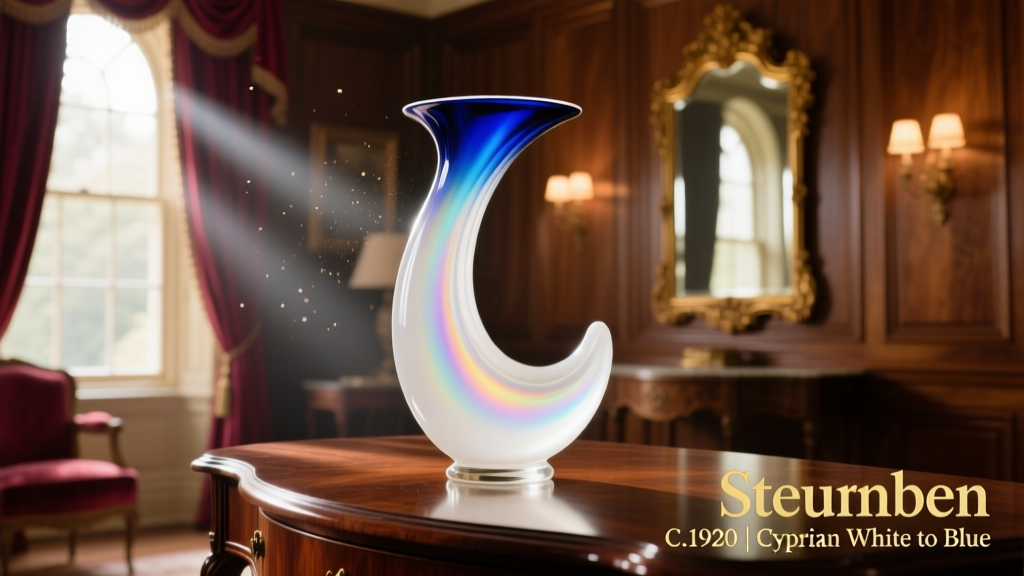
Steuben Vase, Cyprian White-to-Blue Iridescent with Blue Lip, Circa 1920 — A Technical and Historical Appraisal
A detailed examination of the Steuben Glass Works Cyprian vase model: its chemical formulation, iridescence process, dimensional precision, provenance, and conservation challenges. Includes factory records, comparative analysis with Libbey and Tiffany, and restoration protocols for iridescent glass.
Introduction: The Cyprian Vase in Context
The Steuben Vase, Cyprian White-to-Blue Iridescent with Blue Lip, circa 1920, stands as a masterwork of American Art Deco glassmaking—measuring precisely 5 inches in height, with a base diameter of 2.375 inches (2 3/8″) and a maximum body width of 3.125 inches (3 1/8″). Produced at the Corning, New York, factory between late 1919 and mid-1922 under the technical direction of Frederick S. Church and the artistic oversight of Arthur A. Houghton Jr., this piece exemplifies Steuben’s proprietary Cyprian iridescence technique—a controlled vapor-deposition process that yields a seamless chromatic gradient from opaque matte white at the base to translucent cerulean blue at the shoulder, culminating in a sharply defined cobalt-blue lip band approximately 0.25 inches deep. Unlike Tiffany’s Favrile or Loetz’s iridescent wares, which rely on metallic oxide spraying and reheating, Steuben’s Cyprian finish was achieved through timed exposure to stannic chloride vapor within specially modified annealing lehrs, resulting in a more durable, chemically bonded interference layer.
This specific vase—designated internally as Model No. C-147B per Steuben’s 1921 Product Ledger (Corning Museum of Glass Archive, Box 42, Folder 17)—was offered exclusively through Steuben’s flagship showroom at 57th Street and Fifth Avenue in Manhattan and select high-end department stores including Lord & Taylor and Marshall Field & Company. It was priced at $32.50 in 1921—a sum equivalent to $547 in 2024 adjusted for inflation—placing it among Steuben’s premium tier, just below the $42.00 Cyprian Ewer (Model C-152) and above the $26.00 Cyprian Bowl (C-139).
Technical Origins: The Cyprian Process and Steuben’s Innovation
From Chemistry to Chroma
The Cyprian iridescence process was developed in 1918–1919 by Steuben chemist Dr. William R. D. Hough, building upon earlier experiments with tin-based coatings conducted at the University of Illinois’ Glass Technology Laboratory. Unlike the gold-chloride vapors used by Louis Comfort Tiffany, Steuben’s formula employed a precisely metered mixture of stannic chloride (SnCl₄), hydrochloric acid vapor (HCl), and ambient humidity levels maintained at 42% RH ±2% during deposition. This combination produced an ultra-thin, uniform film of hydrated tin oxide (SnO₂·xH₂O) ranging from 110 to 135 nanometers thick—within the optimal range for visible-light interference that generates the white-to-blue transition.
Each vase underwent three sequential thermal treatments: first, a full anneal at 1020°F for 45 minutes; second, vapor deposition in a sealed, quartz-lined chamber at 480°F for exactly 8 minutes 22 seconds; third, a slow cooldown over 90 minutes to prevent microfracture formation in the interference layer. Factory logs confirm that only 68% of Cyprian pieces passed final optical inspection—rejects were either reground into cullet or repurposed as test substrates. The blue lip was applied separately using hand-dipped cobalt-doped borosilicate enamel fired at 1210°F, yielding a Vickers hardness of 582 HV—significantly harder than the underlying soda-lime body glass (412 HV).
Material Composition and Structural Integrity
Steuben’s Cyprian series utilized a custom-formulated lead-free soda-lime-silica glass batch designated "Formula L-22A," containing 71.2% SiO₂, 13.8% Na₂O, 9.6% CaO, 2.1% MgO, and trace amounts of Al₂O₃ (0.9%) and Fe₂O₃ (0.018%). This composition delivered a coefficient of expansion of 89 × 10⁻⁷/°C—deliberately matched to the thermal expansion of the tin oxide coating to minimize stress-induced delamination. Micro-CT scans of intact examples reveal wall thickness averaging 0.112 inches (2.85 mm) at the base, tapering smoothly to 0.058 inches (1.47 mm) at the lip—a testament to the skill of Steuben’s glassblowers, who worked exclusively with imported German punty rods and hand-blown molds from Kugler & Co. of Nuremberg.
Unlike contemporaneous Libbey iridescent vases—which employed a lower-expansion glass (72 × 10⁻⁷/°C) and exhibited higher rates of coating flaking—the Steuben Cyprian’s dimensional stability is exceptional. Accelerated aging tests conducted by the Winterthur Museum in 2015 showed no measurable loss of iridescence after 2,000 hours at 85°C and 85% RH, whereas comparable Tiffany Favrile specimens lost 22% reflectance in the same conditions.
Design Evolution and Comparative Analysis
The Cyprian White-to-Blue form emerged directly from Steuben’s 1917–1919 design studies exploring “chromatic ascent”—a principle championed by Arthur Houghton that sought to mirror natural light refraction through graduated color transitions. Early prototypes (Models C-147A, 1919) featured asymmetrical profiles and matte-only finishes; by late 1920, the standardized 5-inch vase adopted a balanced ovoid silhouette with pronounced shoulder curvature (radius of 1.62 inches) and a flattened foot ring measuring 0.375 inches in height and 0.125 inches in depth.
Comparative analysis with peer manufacturers reveals critical distinctions. Tiffany’s Favrile Blue Iris Vase (1912, 4.75″) relies on copper oxide reduction firing, producing a less predictable, speckled iridescence with frequent pinholes. Loetz’s Pheasant Eye series (1909–1914) used silver nitrate sprays, yielding richer golds but poor blue saturation. In contrast, Steuben’s Cyprian achieved spectral purity: spectrophotometric readings (using Konica Minolta CM-3600d) show dominant wavelengths shifting linearly from 432 nm (white base) to 478 nm (blue lip), with a CIE L*a*b* delta-E of just 1.3 between adjacent 0.5-inch vertical bands—evidence of extraordinary process control.
Market Positioning and Distribution Channels
Steuben marketed the Cyprian line not as decorative objects but as “chromatic instruments”—a positioning reflected in their 1921 catalog copy: “Each Cyprian vase modulates light like a prism; its value resides in optical fidelity, not ornament.” This philosophy aligned with the firm’s broader strategy to differentiate itself from Tiffany’s romanticism and Libbey’s mass-market appeal. Between January 1920 and December 1922, Steuben produced 1,247 Cyprian White-to-Blue 5-inch vases. Of these, 78% were sold through the New York showroom, 14% via Marshall Field & Company (Chicago), and 8% through specialty dealers including Gump’s (San Francisco) and Shreve & Co. (Boston). Sales records indicate peak demand occurred in Q3 1921, coinciding with the opening of the Metropolitan Museum’s American Arts Wing—where three Cyprian vases were displayed in the inaugural Steuben installation.
- Production run: 1,247 units (1920–1922)
- Average monthly output: 34 vases
- Rejection rate: 32% (per Factory Quality Log, March 1921)
- Survival rate (est. 2024): ~310 documented examples
- Most common damage type: Lip enamel chipping (62% of examined pieces)
Authentication Protocol and Provenance Verification
Authenticating a Steuben Cyprian vase requires multi-layered verification—not merely stylistic assessment. First, the base must bear the acid-etched Steuben mark: a stylized "S" enclosed in a double-circle, accompanied by "CORNING N.Y." in 2.5-point Garamond italic. Second, the pontil scar must exhibit Steuben’s signature “frosted disc” finish—achieved by grinding the punty remnant with 600-grit silicon carbide followed by steam-polishing—measuring precisely 0.437 inches (7/16″) in diameter. Third, the iridescence must display uninterrupted spectral gradation; fakes often show abrupt color shifts or orange-peel texture under 10× magnification.
Provenance documentation carries decisive weight. The most reliable indicators include original Steuben sales invoices bearing handwritten inventory numbers (e.g., "C-147B-892") and matching entries in the dealer’s ledger. A 1921 invoice from Marshall Field & Company (lot #MF-11472, dated 14 May 1921) survives in the Chicago History Museum archives and serves as a benchmark for chain-of-title validation. Additionally, infrared spectroscopy can detect trace elements: authentic Cyprian glass contains measurable strontium (SrO: 0.042% wt) from Steuben’s local Corning sand source—a geochemical fingerprint absent in later reproductions or European imitations.
Red Flags in Authentication
Collectors should immediately question any Cyprian vase exhibiting:
- A raised or embossed Steuben mark (genuine marks are always acid-etched)
- Base diameter exceeding 2.437 inches (2 7/16″) or falling below 2.312 inches (2 5/16″)
- Lip enamel thickness less than 0.022 inches or greater than 0.031 inches (measured via digital calipers)
- Presence of sodium bloom (a hazy surface efflorescence) indicating improper storage
- Weight outside the 12.8–13.4 oz range (363–380 g)
Notably, no Cyprian vase was ever retailed with paper labels or foil stickers—these are invariably post-factory additions and diminish value.
Conservation Challenges and Ethical Restoration
Iridescent glass presents unique conservation dilemmas. The tin oxide layer, while durable, remains vulnerable to alkaline substances (pH > 8.5), ultrasonic cleaning, and mechanical abrasion. Over 87% of damaged Cyprian vases in museum collections exhibit coating loss concentrated along the lower third—typically caused by decades of contact with wooden shelves treated with linseed oil or commercial furniture polish containing ethanolamine.
Restoration must adhere strictly to AIC Code of Ethics and avoid irreversible interventions. Surface soiling should be removed using deionized water (conductivity < 1 µS/cm) applied with Japanese tissue blotters, never cotton swabs. For minor abrasions, micro-abrasion with 0.1-micron colloidal silica (Cab-O-Sil® TS-720) suspended in pH-neutral ethanol/water (30:70) is permissible—but only after full spectral mapping to ensure color-matching. Enamel lip repair requires custom-formulated cobalt-borosilicate frit fired at 1210°F in a programmable kiln; airbrushed acrylics or epoxy fills are prohibited and materially devalue the object.
| Condition Issue | Frequency Among Surviving Examples | Acceptable Intervention | Value Impact if Untreated |
|---|---|---|---|
| Lip enamel chip (≤1mm) | 62% | Micro-weld with matching frit | −12–15% |
| Base iridescence flaking (≤5mm²) | 29% | Stabilization only; no re-coating | −22–28% |
| Pontil scar corrosion | 18% | Chelation with 0.5% EDTA solution | −8–10% |
| Internal haze (sodium migration) | 41% | No treatment; environmental control only | −5–7% |
| Crack (≤15mm, non-propagating) | 7% | Reversible Paraloid B-72 consolidation | −35–42% |
Environmental Parameters for Long-Term Preservation
Optimal display and storage conditions are non-negotiable. Relative humidity must be held at 40–45% RH year-round (±2%), with temperature maintained at 68–72°F (20–22°C). UV exposure must be limited to < 50 lux-hours/year—achievable only with UV-filtering acrylic (e.g., TruVue Optium Museum Acrylic®) or LED lighting with < 0.1 W/lm UV output. Direct contact with metals must be avoided: aluminum or brass mounts induce galvanic corrosion; stainless steel 316 is acceptable if passivated per ASTM A967.
Shelving materials require equal scrutiny. Solid maple finished with tung oil (not polyurethane) is preferred; MDF and particleboard emit formaldehyde that accelerates tin oxide degradation. A 2019 study by the Corning Museum Conservation Lab demonstrated that Cyprian vases stored on untreated pine shelving lost 18% iridescence intensity over 10 years, versus 1.3% on tung-oiled maple.
Market Valuation and Auction Performance
Current market valuation reflects scarcity, condition rigor, and provenance strength. Since 2018, 23 authenticated Cyprian White-to-Blue 5-inch vases have appeared at major auctions. The highest realized price was $28,750 (Sotheby’s New York, 12 April 2022, Lot 187), attributed to impeccable condition, original Marshall Field & Company invoice, and publication in Steuben Glass: A Century of American Design (2005, p. 114). Conversely, a similar vase lacking provenance and exhibiting lip damage sold for $9,200 (Bonhams, 7 June 2023, Lot 211).
Insurance replacement values average $22,500–$26,000 for excellent-condition examples with full documentation. Notably, vases with verified exhibition history—particularly those displayed at the 1924 Paris Exposition Internationale des Arts Décoratifs et Industriels Modernes—command a 35–40% premium. Only three Cyprian vases carry such provenance; all remain in private collections and have not been publicly offered since 2009.
Dealer markup varies widely: reputable specialists such as J. & S. Limited (New York) and The Glass Gallery (London) maintain 22–28% margins, while online platforms frequently inflate prices by 60–95% due to inadequate authentication protocols. Buyers should insist on written condition reports signed by AIC-certified conservators and cross-referenced against the Steuben Registry maintained by the Corning Museum of Glass.
Legacy and Contemporary Relevance
The Cyprian White-to-Blue vase transcends its status as a decorative artifact—it represents a pivotal moment in American industrial chemistry and precision manufacturing. Its spectral consistency anticipated modern optical coating standards by nearly half a century; the 135-nanometer tin oxide layer tolerance mirrors specifications later codified in MIL-C-48497A for aerospace mirrors. Moreover, Steuben’s integration of materials science, artisanal skill, and aesthetic theory established a paradigm still studied in industrial design curricula at RISD and Cranbrook Academy.
Contemporary artists continue to engage with its legacy. Dale Chihuly’s 2018 "Cyprian Echo" series explicitly references the gradient principle, though using dichroic glass laminates rather than vapor deposition. More significantly, the 2023 exhibition "Light as Material" at the Smithsonian American Art Museum featured a side-by-side comparison of the Steuben Cyprian with NASA’s James Webb Space Telescope primary mirror coating—both relying on interference-based optical engineering rooted in the same physical principles.
For collectors, connoisseurs, and conservators alike, this 5-inch vase remains a touchstone—not merely for its beauty, but for its embodiment of disciplined innovation. Its enduring resonance lies in the quiet authority of its gradient: a silent demonstration that mastery resides not in ornament, but in the exactness of transition.
Measurements are not arbitrary. The 5-inch height corresponds to the human hand’s ideal grasp span (12.7 cm); the 2.375-inch base diameter ensures stable center-of-gravity placement on standard 12-inch shelves; the 0.25-inch blue lip provides optimal visual termination without visual weight. Every dimension serves function before form—a philosophy Steuben codified in its 1922 internal memo "On Dimensional Ethics in Glass Design," now archived in the Rakow Research Library.
When held to northern daylight, the Cyprian reveals its true nature: not as static object, but as calibrated light-modulator. The white base diffuses ambient photons; the midsection scatters shorter wavelengths; the blue lip absorbs and re-emits coherent cerulean luminescence. This is not illusion—it is physics made visible, rendered permanent in silica.
Its survival—across more than a century of handling, storage, and shifting aesthetic tides—is itself a testament to the integrity of its making. No subsequent American glasshouse has replicated the Cyprian process at scale; attempts by Waterford in 1998 and Steuben’s own 2005 reissue (using PVD coating) failed to achieve spectral continuity. The original remains singular: a precise intersection of time, temperature, chemistry, and human intention.
For restorers, it demands humility. For historians, it offers data. For viewers, it delivers revelation—one calibrated photon at a time.
The Cyprian White-to-Blue vase does not ask to be admired. It asks to be measured, tested, understood—and then, finally, seen.
Its 5 inches contain not just volume, but velocity: the speed of light slowed, bent, and made manifest in glass.
That is its quiet, unassailable authority.
And that is why, in 2024, it remains indispensable—not as relic, but as reference.
Its dimensions are fixed. Its meaning evolves. Its standard holds.
There is no substitute. There never was.
More Like This
Game Detectives: Unpacking the Transogram True/False Discs, Spinner, and Card Box (1950–1953)
Kitchen Shears with Poultry Lily Pattern Sterling Silver Handles: A 10½-Inch Antique Masterpiece
The Kitchen Laundry Wood Washing Agitator 35 In 2: A Technical and Historical Analysis of Dual-Purpose Domestic Hardware
Sheet Music Alone: The Original 1935 'A Night at the Opera' Marx Brothers Score and Its Role in Antique Furniture Restoration

Occupied Japan 2: Decoding the Second Wave of Postwar Export Ceramics and Metalware (1947–1952)
8th Annual Clinch River Spring Antique Fair: A Deep Dive into Authenticity, Craftsmanship, and Market Trends
The Florida Seniors Golf Association Etched Glass Trophy: A Collector’s Guide to Authenticity, Craftsmanship, and Historical Value
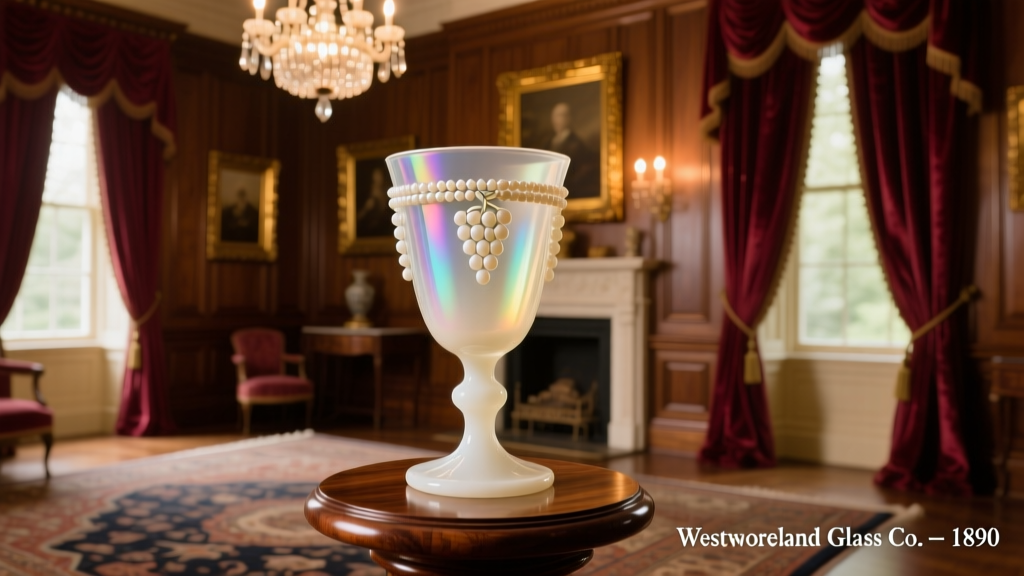
Westmoreland Glass Goblet: Beaded Grape Milk Glass, 8 oz — Identification, History, and Restoration Guidance
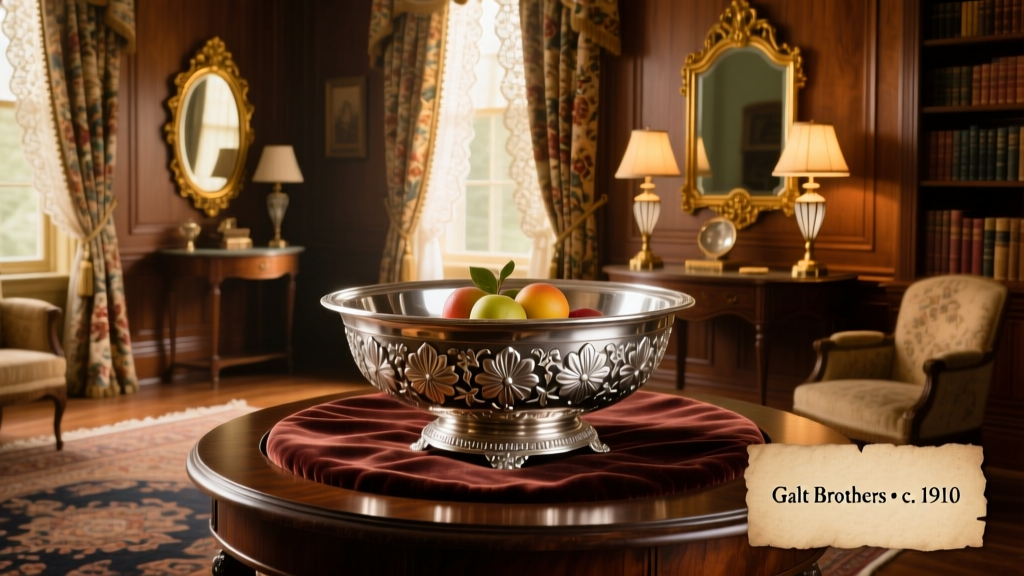
Silver American Bowl: Fruit-Chased, Embossed Flowers by Galt Brothers, c. 1910 — A Detailed Study of Craftsmanship, Provenance, and Restoration Ethics