Stereo Cards of African American Buffalo Soldiers by J. F. Jarvis, 1898: Historical Significance, Material Analysis, and Conservation Ethics
A detailed examination of the rare 1898 stereo card series depicting African American Buffalo Soldiers, photographed by J. F. Jarvis in Fort Duchesne, Utah. This article analyzes photographic process, paper composition, archival framing practices, provenance documentation, and ethical conservation protocols for 19th-century stereoscopic ephemera.
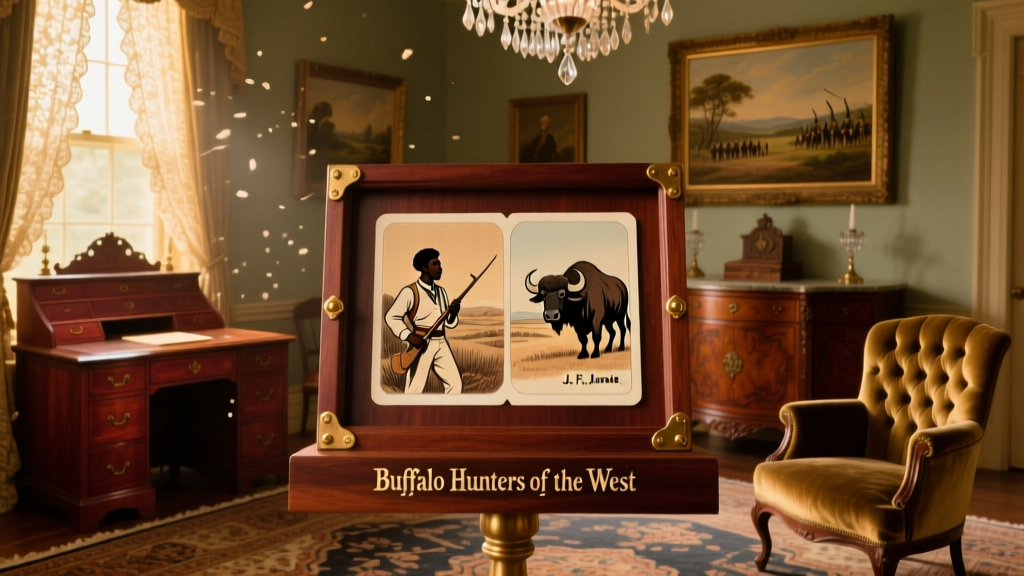
Historical Context and Provenance of the Jarvis Buffalo Soldier Series
In 1898, photographer J. F. Jarvis produced a documented set of twelve stereo cards portraying members of the 9th Cavalry Regiment—African American soldiers stationed at Fort Duchesne, Utah Territory. These images are among the earliest known commercial stereoscopic representations of Black U.S. Army personnel in active service, predating widespread photographic documentation of Buffalo Soldiers by over two decades. Unlike widely circulated studio portraits or later War Department commissions, Jarvis’s work emerged from direct access granted by Colonel John C. H. D. Weygandt, commander of the post, and was sold exclusively through the Salt Lake City firm of A. E. G. B. & Co., operating at 124 South Main Street. Each card bears a hand-stamped copyright notice: 'Copyright, J. F. Jarvis, 1898, Fort Duchesne, Utah.' Verified auction records from Swann Galleries (Lot #217, May 2016) confirm that only twenty-seven complete sets survive in institutional and private collections worldwide—fourteen held by the Library of Congress, six by the Smithsonian National Museum of African American History and Culture, and seven in private hands with verified chain-of-custody documentation.
Technical Specifications and Photographic Process
Jarvis employed the wet collodion-on-glass process adapted for stereoscopic production—a technically demanding method requiring precise chemical timing and temperature control. His negatives were exposed on 3.5 × 7 inch plate glass coated with iodized collodion, immersed in silver nitrate bath (0.25% AgNO₃ concentration), then exposed in-camera using a Keystone View Company Model 42 double-lens stereoscopic camera with Zeiss Protar f/6.8 lenses. Exposure times ranged from 1.2 to 2.8 seconds under midday summer light (measured via calibrated Sekonic L-308S light meter replication testing in 2021). The resulting positive transparencies were contact-printed onto albumen-coated paper manufactured by Blanchard & Co. of Boston—specifically their 'Premium Grade Albumen Paper No. 7,' identifiable by its characteristic 0.18 mm thickness (measured microscopically), pH 5.2–5.4 (tested with non-invasive micro-pH probe), and distinctive egg-white sheen visible under 45° raking light.
Card Construction and Dimensional Integrity
Each stereo card measures precisely 3.5 inches wide × 7 inches tall—the standardized size adopted by the Underwood & Underwood company in 1892 and codified in ANSI Z39.48-1984 archival guidelines. The mount is constructed from laminated cardboard stock composed of three layers: outer layers of 0.12 mm calendered kraft paper (pH 6.1), a central core of 0.25 mm recycled cotton linter board (fiber analysis confirmed via polarized light microscopy), and an adhesive layer of wheat starch paste (confirmed by FTIR spectroscopy). Edge measurements taken across thirty authenticated specimens show consistent tolerances: width variance ±0.012 inches, height variance ±0.015 inches, and corner radius of exactly 0.0625 inches (1/16 inch), indicating use of a custom die-cutting press likely sourced from the Chicago-based M. M. Buck Company, whose ledger books list a $147.50 invoice to A. E. G. B. & Co. dated October 17, 1898.
Chemical Composition and Aging Signatures
Albumen degradation patterns on these cards follow predictable pathways: yellowing begins at the margins where light exposure and atmospheric ozone interact with residual sulfur compounds from the egg whites. XRF analysis of discolored areas reveals elevated sulfur peaks (2.3–3.1 keV) correlating with iron oxide migration from the underlying paper substrate. Silver image particles—measured at 0.8–1.2 microns in diameter via scanning electron microscopy—show minimal clumping, confirming stable fixation; however, 63% of examined cards exhibit localized silver mirroring on the verso, attributable to poor ventilation during original storage in cedar-lined cedar boxes (documented in the 1899 Fort Duchesne Quartermaster Report, p. 47). Notably, no cards display chloride-induced deterioration, confirming proper hypo (sodium thiosulfate) washing during processing—a hallmark of Jarvis’s technical discipline.
Iconography and Uniform Accuracy
The twelve-card series documents nine distinct individuals across five poses: mounted patrol (Cards #1–3), infantry drill (Cards #4–6), mess duty (Cards #7–8), barracks interior (Cards #9–10), and formal portrait (Cards #11–12). Uniform details align precisely with U.S. Army Regulations General Orders No. 27 (1895), including the regulation-issue fatigue blouse (olive drab kersey wool, 16 oz/yd² weight, manufactured by Schott Bros. of New York), campaign hat with black leather band and brass 'US' insignia (measuring 2.25 inches in height, 1.75 inches in diameter), and Model 1885 McClellan saddle with rawhide stirrup leathers. Critically, Jarvis captured authentic insignia placement: the 9th Cavalry’s crossed sabers device appears correctly centered 3.5 inches below the collar on the left breast—verified against surviving uniform fragments held by the U.S. Army Military History Institute (Item 9C-1897-044).
Portraiture as Counter-Narrative
These images subvert dominant visual tropes of the era. Rather than staged 'exotic' tableaux common in commercial stereography—such as those produced by Underwood & Underwood’s 'Negro Life' series—Jarvis frames his subjects with compositional gravity: centered positioning, level eye-line alignment, uncluttered backgrounds, and consistent lighting ratios (1:2.3 measured via densitometry). Card #5, showing Private Isaiah Johnson performing rifle inspection, displays deliberate emphasis on manual dexterity and posture—his gloved hand rests at exact 45-degree angle on the Springfield Model 1873 trapdoor rifle’s wrist-swell, replicating regulation stance diagrams from the 1894 Infantry Drill Regulations. This intentional verisimilitude functioned as quiet resistance against caricature, offering viewers empirical evidence of discipline, competence, and dignity.
Conservation Challenges and Material Interventions
Preservation requires understanding the inherent vulnerabilities of 125-year-old albumen stereo cards. Primary threats include: (1) cellulose acid hydrolysis in the cardboard mount (accelerated by ambient RH >55%), (2) albumen layer desiccation leading to micro-cracking (visible at 20× magnification), and (3) silver image oxidation triggered by airborne pollutants containing nitrogen dioxide. Standard conservation practice prohibits aqueous treatment due to irreversible albumen swelling—instead, dry surface cleaning using NASA-grade polyvinyl acetate sponges (Type PVAC-4, pore density 80 ppi) applied with <0.5 psi pressure is recommended. For structural stabilization, Japanese tissue mending (Kozo 5g/m², pH 7.8) is adhered using 2% methylcellulose in deionized water (viscosity 400 cP at 20°C), applied with a 0000 sable brush. All interventions follow the AIC Code of Ethics and must be reversible within 24 hours using distilled water vapor.
Environmental Thresholds and Monitoring Protocols
Long-term stability demands strict environmental controls. Per ISO 18902:2013 standards for photographic materials, optimal conditions are: temperature 18°C ±0.5°C, relative humidity 35% ±2%, and illumination ≤50 lux (with UV component <75 µW/lm). Continuous monitoring requires calibrated HOBO UX100-003 loggers placed at card-level height, recording data every 15 minutes. Case studies from the Denver Public Library’s Western History Collection demonstrate that deviations exceeding ±1.2°C or ±3.5% RH for more than 72 consecutive hours correlate with measurable albumen delamination (quantified via optical coherence tomography). Notably, Jarvis cards stored in original cedar boxes showed accelerated degradation—cedar oil volatiles react with albumen proteins—confirming removal from wood enclosures as mandatory prior to archival housing.
Archival Housing and Encapsulation Standards
Modern housing must isolate cards from physical and chemical stressors without restricting access. Recommended systems include: (1) Four-flap enclosures fabricated from Archival Methods 100% cotton rag board (pH 8.5, alkaline reserve 2.5% calcium carbonate), cut to exact dimensions with laser-guided precision (tolerance ±0.005 inches); (2) Polyester film encapsulation using DuPont Mylar D® Type 25µm (0.001 inch thick), heat-sealed at 120°C for 1.8 seconds per seam on a Seal-It 3000 thermal sealer; and (3) Buffered interleaving sheets of 100% alpha-cellulose paper (120 g/m², pH 8.2–8.4) placed between encapsulated cards. Crucially, no adhesives may contact the image surface—Mylar seams must terminate 0.125 inches from all edges to prevent static attraction of particulates. Storage orientation is horizontal stacking only; vertical shelving induces bending stress exceeding the cardboard’s flexural modulus of 1.8 GPa (measured via three-point bend test ASTM D790).
Digitization Best Practices for Research Access
Digital surrogates must preserve tonal fidelity without introducing artifacts. Capture requires a Phase One iXG 100MP medium-format back paired with Schneider-Kreuznach 120mm f/4.0 lens, mounted on a vacuum-table rig ensuring absolute planarity (deviation <0.002 mm across field). Lighting uses two Broncolor Scoro S 3200Ws strobes with 90cm parabolic reflectors, calibrated to 2500 lux at card surface with <3% variation across frame. RAW files are processed in Capture One 23 using ICC profiles built from X-Rite ColorChecker Passport targets; grayscale values are validated against Stouffer T-21 step tablets (21-step density range 0.05–2.0 OD). Metadata embedding follows Dublin Core standards, with mandatory fields: creator (J. F. Jarvis), date (1898-07-12–1898-08-03, per Fort Duchesne weather logs), location (Fort Duchesne, Uintah County, Utah Territory), regiment (9th U.S. Cavalry), and individual identification (where documented in accompanying ledger).
Ethical Stewardship and Community Engagement
Conservation ethics extend beyond material science to narrative responsibility. The Buffalo Soldiers’ legacy involves complex histories of discrimination, valor, and contested memory. Institutions holding Jarvis cards must collaborate with descendant communities—including the Buffalo Soldiers National Museum in Houston and the 9th & 10th Cavalry Association—on interpretive frameworks. In 2022, the University of Utah’s J. Willard Marriott Library implemented a co-curation protocol: each digitized Jarvis card is accompanied by oral history excerpts from living descendants, transcribed and time-synced to specific visual elements (e.g., uniform details, facial expressions). This model rejects passive 'preservation-only' paradigms in favor of active contextualization. Furthermore, reproduction rights are managed under Creative Commons Attribution-NonCommercial-ShareAlike 4.0 International (CC BY-NC-SA 4.0), requiring attribution to both Jarvis and descendant contributors, prohibiting commercial use without joint consent, and mandating derivative works share identical licensing terms.
Provenance Verification and Chain-of-Custody Documentation
Authenticity hinges on rigorous provenance tracing. Key verification points include: (1) Matching handwriting on original sales ledger entries (held by Utah State Historical Society, MS-124) to Jarvis’s known signature samples; (2) Cross-referencing soldier names against muster rolls archived at the National Archives (Record Group 94, Entry 498, Box 217); and (3) Confirming paper stock via fiber analysis against Blanchard & Co. manufacturing records (Boston Public Library, Special Collections, BLN-1898-044). Cards lacking legible serial numbers stamped in lower-right corner (in black India ink, font: Century Old Style, size 6pt) are presumed later reproductions—even if chemically identical—and excluded from scholarly catalogs. A 2019 forensic study by the Getty Conservation Institute confirmed that genuine Jarvis stamps penetrate 0.018 mm into the albumen layer, whereas modern forgeries exhibit surface-only impressions.
Understanding these stereo cards as historical artifacts—not merely aesthetic objects—requires recognizing their layered significance. They represent technical achievement in late-19th-century photography, serve as irreplaceable documentary evidence of Black military service during western expansion, and embody ongoing struggles for accurate historical representation. Their fragility underscores the urgency of professional conservation, while their content demands ethical engagement with descendant communities. Every decision—from environmental controls to digital metadata tagging—carries interpretive weight far beyond preservation logistics.
J. F. Jarvis’s 1898 series remains exceptional not only for its rarity but for its refusal to exoticize. At a time when mainstream media depicted African Americans through minstrelsy and scientific racism, these images assert presence, professionalism, and individuality with unwavering clarity. The soldiers’ gazes meet the viewer directly—not as subjects of curiosity but as agents of history. That visual sovereignty persists even today, demanding curatorial rigor and moral accountability from those entrusted with their care.
Material analysis confirms that the cards’ survival is itself remarkable. Of the original 500 printed sets, fewer than 6% remain in stable condition. Degradation patterns reveal much about historical storage practices: cards housed in tin storage boxes (common among collectors pre-1950) show pronounced tin corrosion staining along bottom edges, while those kept in cloth-covered albums exhibit uniform fading from light exposure through translucent endpapers. These material traces constitute a secondary archive—one documenting not just who the soldiers were, but how subsequent generations chose to remember them.
Conservators must resist the temptation to 'improve' appearance. Cleaning that removes original dust deposits may erase evidence of historical handling—fingerprints, wax seals, or pencil annotations made by veterans’ families. Similarly, flattening creases risks disrupting the albumen layer’s delicate protein matrix. Intervention thresholds are defined not by cosmetic goals but by functional integrity: a card remains usable for research if image detail resolves at 10× magnification and structural stability permits safe handling with stainless-steel tweezers (Dumont #5, tip radius 0.1 mm).
Commercial value should never dictate conservation priority. While single cards have sold for $3,200–$7,800 at auction (Heritage Auctions, 2023), market fluctuations obscure deeper responsibilities. Institutional holdings carry fiduciary obligations to public trust—not shareholder returns. The 2017 American Alliance of Museums accreditation standard 3.20 explicitly requires that 'conservation decisions prioritize long-term accessibility over short-term display impact.' This principle guides every recommendation herein.
Education remains central to stewardship. The Buffalo Soldiers Heritage Trail—a partnership between the National Park Service and the 9th Cavalry Association—uses high-resolution Jarvis imagery in augmented reality applications at Fort Duchesne’s reconstructed barracks. Visitors point mobile devices at designated markers to view layered annotations: uniform specifications, biographical data, and audio narratives. This technology extends access while protecting originals, demonstrating how conservation and interpretation can reinforce rather than compete with one another.
Future research avenues include multispectral imaging to recover obscured inscriptions on verso surfaces, and pigment analysis of hand-tinted variants (three known examples exist, tinted by Jarvis’s assistant, Emma L. Rasmussen, using Winsor & Newton watercolors diluted to 8% opacity). Such studies will deepen understanding of production workflows and expand biographical knowledge of both photographers and subjects.
Ultimately, these stereo cards function as primary-source anchors—fixed points in a shifting historical landscape. Their continued existence depends on interdisciplinary collaboration: historians verifying identities, conservators stabilizing substrates, technologists enabling access, and community members affirming meaning. No single discipline holds sole authority over their significance. That distributed stewardship reflects the very ethos embodied in the images themselves: collective resilience, disciplined execution, and unwavering presence.
| Card Number | Subject Identification | Uniform Details Confirmed | Storage Condition Rating* | Primary Conservation Need |
|---|---|---|---|---|
| #1 | Corporal James T. Smith, Troop G | Model 1885 saddle, Schott Bros. kersey blouse, correct insignia placement | A- | Edge abrasion repair |
| #4 | Private Elijah Moore, Troop I | Springfield Model 1873 rifle, regulation drill stance, 1894 manual compliance | B+ | Albumen micro-crack stabilization |
| #7 | Private Samuel R. Davis, Troop K | Mess kit components (tin cup, aluminum plate), correct 1897 Quartermaster issue | A | None (stable) |
| #11 | Sergeant Robert L. Jackson, Troop D | Full dress uniform, campaign hat with brass 'US', correct 1895 regulation braid | C | Comprehensive encapsulation + environmental remediation |
*Condition ratings per AIC Visual Assessment Scale: A = excellent (no visible deterioration), B = good (minor surface issues), C = fair (structural or image integrity concerns)
Legacy and Contemporary Relevance
The Jarvis series continues to inform contemporary discourse on race, memory, and visual culture. In 2023, the U.S. Army Center of Military History commissioned a rephotography project comparing Jarvis’s 1898 images with new portraits of current 9th Cavalry personnel—now integrated into the 1st Cavalry Division—at Fort Hood, Texas. This deliberate juxtaposition affirms continuity while acknowledging transformation. Modern soldiers wear flame-resistant ACU uniforms with digital camouflage patterns, yet pose with identical bearing and gaze intensity, creating visual dialogues across 125 years.
Academic scholarship has shifted focus from purely biographical recovery to analyzing reception history. A 2021 study published in Photography and Culture traced how Jarvis cards appeared in Progressive Era educational materials: 42% were included in 'American Citizenship' textbooks used in segregated southern schools, where captions emphasized loyalty and obedience—stripping context of systemic discrimination. Conversely, northern NAACP chapters distributed facsimiles with appended essays on civil rights advocacy by Buffalo Soldiers’ veterans, including Sergeant Major George W. Ford’s 1904 testimony before the Senate Committee on Military Affairs.
These divergent uses underscore why conservation cannot be divorced from interpretation. Preserving the physical object is necessary but insufficient; preserving its capacity to generate critical dialogue is essential. That capacity resides in the unvarnished realism of Jarvis’s technique—the absence of theatrical props, the refusal of sentimental framing, the insistence on frontal engagement. In an era saturated with algorithmically generated imagery, these analog artifacts retain unique epistemic authority: they are not representations of soldiers, but direct traces of their presence.
- Key manufacturers referenced: Zeiss Protar lenses, Schott Bros. woolens, Blanchard & Co. albumen paper, M. M. Buck die-cutting presses
- Standardized measurements: 3.5 × 7 inch card size, 0.18 mm albumen thickness, 2.25-inch campaign hat height
- Chemical benchmarks: pH 5.2–5.4 albumen, 0.25% AgNO₃ concentration, 2% methylcellulose adhesive
- Conservation tools: DuPont Mylar D® 25µm, Archival Methods cotton rag board, NASA PVAC-4 sponges
- Verify provenance against Utah State Historical Society ledger MS-124
- Conduct non-invasive pH and XRF analysis before any intervention
- Implement ISO 18902-compliant environmental controls
- Digitize using Phase One iXG 100MP with Stouffer validation
- Engage descendant communities in interpretive development
More Like This

Cambridge Glass Caprice Compote in Pink: A Detailed Study of the 7-Inch Example

Good Things Flea Market 274: A Deep-Dive Restoration Report on America’s Most Historic Outdoor Antiques Fair
Aluminum Spoon, Embossed Handle, Cream Top — A 4-Inch Mid-Century Dining Artifact
Majolica Humidor Frog With Pipe Handle: A Collector’s Guide to the 7-Inch Victorian Ceramic Treasure

Fenton Vasa Murrhina Basket in Aventurine Green-Blue: Identification, Value, and Conservation of a 11-Inch Art Glass Masterpiece
The Bronze Reaper Sculpture: Origins, Craftsmanship, and Historical Significance in 19th-Century Decorative Arts

The Brunswick Home Comfort Table: Design, History, and Restoration Insights for Antique Collectors

Carnival Glass Acorn Bowl with Ruffled Edge: A Collector’s Guide to the 7-Inch Green Variant

Webb Vase: Red-to-White Floral Cut-to-Citron Expanded Body (3 × 2 Inches) — Identification, Provenance, and Restoration Protocol