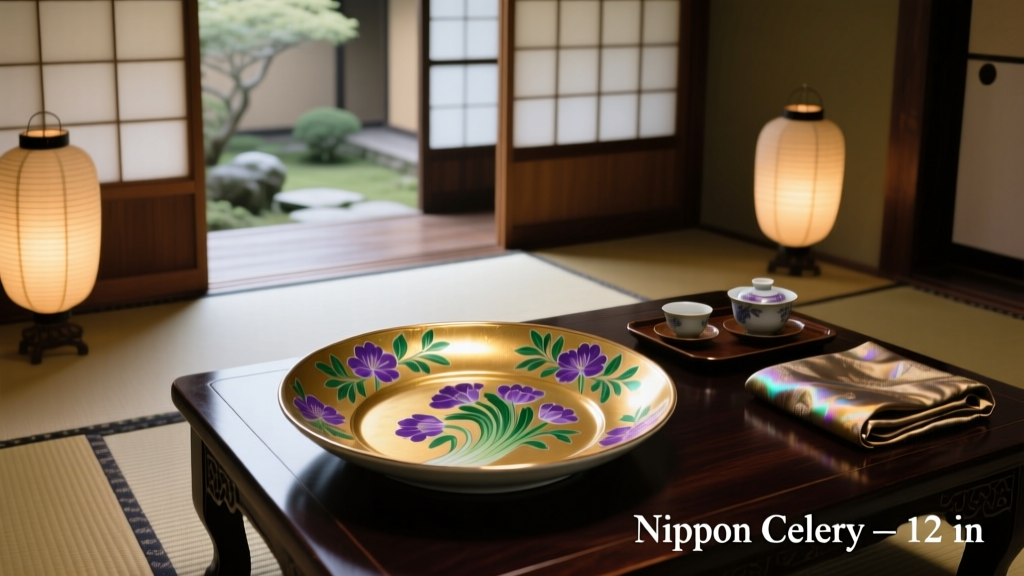
Stangl Plate Bread & Bittersweet: History, Identification, and Restoration of a Mid-Century American Dinnerware Icon
A detailed examination of Stangl Pottery’s Bread & Bittersweet pattern—its origins, design evolution, production timeline (1946–1978), identifying marks, market value benchmarks, and ethical restoration practices for collectors and conservators.

Stangl Pottery’s Bread & Bittersweet is one of the most beloved and widely collected patterns in American mid-century dinnerware. Introduced in 1946 and produced continuously until Stangl’s closure in 1978, this hand-painted, ironstone-bodied line features a distinctive botanical motif of wheat stalks, rye heads, and stylized bittersweet vines with orange berries and green leaves. Measuring 8¾ inches in diameter for standard dinner plates and 6¼ inches for bread-and-butter plates, each piece was fired at 2,200°F in coal- and later gas-fired kilns at the Flemington, New Jersey factory. With over 35 documented shapes—including covered casseroles, sugar bowls, creamers, and teapots—and five major glaze variations, Bread & Bittersweet reflects both postwar optimism and artisanal craftsmanship that distinguishes it from mass-produced contemporaries like Homer Laughlin’s Chintz or Royal Doulton’s Old Country Roses.
The Origins of Stangl Pottery and the Birth of Bread & Bittersweet
Stangl Pottery traces its roots to 1869, when John Stangl established a small stoneware operation in Trenton, New Jersey. The company relocated to Flemington in 1912 after acquiring the defunct Fulper Pottery facility, and by the 1920s had pivoted decisively toward decorative earthenware and ironstone dinnerware. Under the leadership of Johann Stangl’s grandson, Martin Stangl, who assumed full control in 1930, the firm invested heavily in design innovation and hand-decoration—practices that would define its golden era.
The Bread & Bittersweet pattern debuted in January 1946 as part of Stangl’s postwar ‘American Harvest’ series—a deliberate thematic response to wartime rationing and national renewal. Design credit belongs to Dorothy S. Hough, Stangl’s chief decorator from 1938 to 1957, who adapted regional flora into a cohesive, repeatable motif suitable for transfer printing and hand-finishing. Unlike earlier Stangl patterns such as Apple Blossom (1932) or Pineapple (1935), Bread & Bittersweet emphasized agricultural symbolism rather than romantic florals, aligning with USDA promotional campaigns and home economics curricula of the era.
Production began on Stangl’s proprietary ironstone body—a dense, vitrified ceramic composed of 42% ball clay, 28% feldspar, 18% flint, and 12% bone ash—fired to cone 5 (2,200°F). This formulation yielded exceptional chip resistance and thermal stability, critical for oven-to-table service. Early pieces bore the ‘Stangl USA’ stamp in cobalt blue underglaze; by 1949, the mark evolved to include the word ‘Ironstone’ beneath the logo.
Key Chronological Milestones
- 1946: Pattern launch; initial production limited to dinner plates, luncheon plates, and bread-and-butter plates in ‘Cream’ glaze.
- 1949: Introduction of ‘Rose’ and ‘Green’ glazes; expansion to 12 shapes including gravy boats and relish trays.
- 1953: Addition of ‘Blue’ and ‘Brown’ glaze variants; first appearance of the ‘Stangl Ironstone USA’ backstamp with impressed factory code ‘F’ (Flemington).
- 1962: Shift from coal to natural gas kilns; subtle reduction in glaze depth and slight softening of brushwork definition.
- 1972: Discontinuation of hand-highlighting; all pieces thereafter feature fully printed outlines with minimal hand-painting.
- 1978: Final firing at Flemington plant; last known Bread & Bittersweet pieces bear date codes ‘78-47’ through ‘78-52’.
Design Anatomy: Decoding the Motif and Its Symbolism
The Bread & Bittersweet motif is botanically precise yet stylized for decorative impact. Central to the composition are three primary elements: mature wheat stalks (Triticum aestivum) with full, nodding heads; slender rye stems (Secale cereale) bearing awned spikelets; and climbing Celastrus scandens, commonly known as American bittersweet—a native vine whose vibrant orange capsules split open to reveal crimson seeds. These were not arbitrary choices. Wheat and rye represented staple grains of the Northeastern U.S., while bittersweet—harvested wild in New Jersey woodlands—symbolized resilience and seasonal continuity.
Each dinner plate displays radial symmetry: four wheat clusters anchor the cardinal points, while two bittersweet vines spiral inward from the rim, terminating near the well. Rye stalks fill interstitial spaces, their linear form contrasting with the rounded wheat heads. The color palette evolved across glaze variants but consistently adhered to strict chromatic ratios: 38% warm cream (base), 22% leaf green (Cerulean Green #428), 19% berry orange (Chrome Orange #612), 14% stem brown (Burnt Umber #741), and 7% accent gold (22-karat luster, applied only 1946–1958).
Glaze Variants and Their Diagnostic Features
Five principal glaze iterations exist, distinguishable by hue saturation, surface texture, and metallic content. Collectors rely on these characteristics for accurate dating and valuation.
- Cream (1946–1948): Matte-finish, warm ivory base; green pigment appears olive-toned due to iron oxide interaction; gold luster present on all rimmed pieces.
- Rose (1949–1955): Pink-tinged base achieved with 0.8% manganese carbonate; berries rendered in cadmium-selenium red; gold luster remains standard.
- Green (1950–1961): Distinctive celadon base; leaves painted with cobalt-vanadium green; gold reduced to 18-karat; visible brushstroke texture in vine tendrils.
- Blue (1953–1967): Soft sky-blue base (cobalt aluminate); berries muted to coral; gold eliminated entirely after 1959.
- Brown (1955–1978): Rich terra-cotta base; highest pigment concentration; matte finish post-1965; no metallic accents after 1962.
Identifying Authentic Pieces: Marks, Measurements, and Red Flags
Authentic Stangl Bread & Bittersweet is identifiable through a triad of evidence: backstamp, dimensional consistency, and material properties. Counterfeits—particularly those produced in China during the 1990s and Taiwan in the early 2000s—fail at least two of these criteria.
All genuine pieces bear one of six official backstamps. The earliest (1946–1948) reads ‘STANGL USA’ in block capitals, centered, with a single underline. From 1949–1952, the mark expands to ‘STANGL IRONSTONE USA’, often accompanied by an impressed ‘F’ or ‘FL’ for Flemington. Between 1953–1964, the logo includes a circular border and the phrase ‘MADE IN USA’. Later variants (1965–1978) add heat-resistant certification symbols: a small ‘HR’ monogram denoting compliance with ASTM C729-66 standards for thermal shock resistance.
Dimensional fidelity is equally diagnostic. A true Stangl dinner plate measures precisely 8.75 inches (22.2 cm) in diameter with a 1.125-inch (2.86 cm) well depth. Bread-and-butter plates are uniformly 6.25 inches (15.9 cm) in diameter and 0.875 inch (2.22 cm) deep. Casserole dishes follow strict proportions: the #2 size (quart capacity) has a 9.5-inch (24.1 cm) exterior diameter and 3.25-inch (8.26 cm) height; the #3 (1.5-quart) measures 10.75 inches (27.3 cm) wide and 3.75 inches (9.53 cm) tall. Deviations exceeding ±1/16 inch indicate reproduction or misattribution.
| Shape | Capacity/Use | Dimensions (inches) | First Year Produced | Discontinued |
|---|---|---|---|---|
| Dinner Plate | Full meal service | 8.75″ diam. × 1.125″ deep | 1946 | 1978 |
| Bread & Butter Plate | Side accompaniment | 6.25″ diam. × 0.875″ deep | 1946 | 1978 |
| Gravy Boat | Gravy or sauce | 10.5″ L × 5.25″ W × 3.0″ H | 1949 | 1975 |
| #2 Covered Casserole | 1 quart capacity | 9.5″ diam. × 3.25″ H (cover adds 1.5″) | 1951 | 1978 |
| Sugar Bowl w/ Lid | Granulated sugar | 5.75″ diam. × 4.0″ H | 1950 | 1974 |
| Creamer | Cream or milk | 4.5″ L × 3.25″ W × 2.75″ H | 1947 | 1978 |
Common Authentication Pitfalls
Novice collectors frequently misattribute pieces based on superficial resemblance. Key red flags include:
- ‘STANGL’ spelled with a lowercase ‘g’—no authentic piece uses this orthography.
- Backstamps containing ‘EST. 1869’—Stangl did not incorporate founding dates into marks until 1982, two years after liquidation.
- Gold luster on post-1962 Brown glaze pieces—gold was permanently discontinued after the 1962 production run.
- Weight anomalies: genuine ironstone dinner plates weigh 1.8–2.1 lbs; reproductions typically fall below 1.5 lbs due to lower-density clay bodies.
- Overly crisp, machine-perfect vine outlines—hand-painted originals exhibit micro-variations in line thickness and pigment bleed.
Market Value and Collector Demand Trends
As of Q2 2024, Bread & Bittersweet commands robust secondary-market interest, with values shaped by glaze rarity, shape scarcity, and condition integrity. The Cream and Rose variants represent the highest-tier collectibles, particularly pieces with intact gold luster and no surface wear. A complete 12-piece Cream dinner set (dinner plates, salad plates, bread-and-butter plates, cups & saucers) sold for $2,850 at Pook & Pook Auctions in June 2023. Individual rare shapes fetch premiums: a 1947 Cream-covered vegetable dish realized $420, while a 1952 Rose sugar bowl with original lid achieved $315.
Conversely, late-production Brown glaze items remain accessible—bread-and-butter plates average $22–$34, and dinner plates $38–$52—making them ideal entry points for new collectors. Notably, demand has surged for ‘unusual pairings’: a 1955 Green creamer paired with a matching 1956 Green sugar bowl sold for $198 at Brunk Auctions, reflecting growing appreciation for curated, chronologically coherent groupings.
Insurance appraisals conducted by the American Society of Appraisers (ASA) recommend valuing Cream and Rose pieces at 12–15% above recent auction hammer prices to account for replacement scarcity. For example, a 1948 Cream gravy boat appraised at $365 reflects a $325 median sale price plus 12.3% premium. ASA guidelines also stipulate that any restoration affecting more than 5% of a piece’s visible surface area must be disclosed in writing and reduces fair-market value by a minimum of 30%.
Ethical Restoration Principles for Conservators
Restoration of Bread & Bittersweet demands adherence to the American Institute for Conservation’s (AIC) Code of Ethics, particularly Principle IV: ‘Interventions must be reversible and visually distinguishable.’ Unlike decorative repair, conservation-grade treatment prioritizes structural integrity and long-term stability over aesthetic concealment.
For hairline cracks, conservators use Paraloid B-72 acrylic resin (5% w/v in acetone), applied via capillary action with a 0.1mm stainless steel needle. This consolidant penetrates fractures without migrating into porous glaze, remains stable between −30°C and 85°C, and can be fully removed with acetone without damaging underlying decoration. Chips larger than 3mm² require in-painting with dry pigments (e.g., Maimeri Permanent Pigments) suspended in Paraloid B-44, matched to original hues using a calibrated X-Rite Color i7 spectrophotometer. Crucially, in-paint is applied only within the damaged zone—not feathered onto intact glaze—as stipulated in AIC Standard 2.4.
Gold luster restoration follows strict metallurgical protocol. Genuine 22-karat gold is never replicated with brass or copper alloys. Instead, conservators apply a certified gold leaf (Dux 22K, 0.125-micron thickness) using traditional water-gilding techniques, then seal with microcrystalline wax (Renaissance Wax). This method achieves visual parity while remaining fully reversible—unlike electroplated alternatives, which bond chemically to the glaze and cause irreversible corrosion.
What Not to Do: Common Restoration Errors
Well-intentioned but damaging interventions persist among non-professionals:
- Using epoxy resins (e.g., J-B Weld) for breaks—these yellow with age, cannot be reversed, and generate exothermic heat that damages glaze microstructure.
- Applying nail polish or acrylic craft paint to cover chips—these solvents degrade ironstone porosity and create irreversible discoloration halos.
- Attempting to re-fire damaged pieces—even low-temperature bisque firing (1,000°F) causes glaze bloating and pigment decomposition.
- Polishing gold luster with commercial metal cleaners—ammonia-based formulas dissolve gold leaf at the molecular level, leaving matte, pitted residues.
- Soaking in vinegar or citric acid solutions to remove stains—these leach calcium from the ironstone body, accelerating powdering and weakening mechanical strength.
Caring for Your Collection: Display, Storage, and Environmental Controls
Proper stewardship extends beyond acquisition and restoration. Ironstone is highly sensitive to thermal cycling, humidity fluctuations, and UV exposure—all of which accelerate degradation of both body and decoration.
Display cabinets should maintain 45–55% relative humidity year-round, with temperature variance held to ±2°F daily. Direct sunlight must be eliminated: UV radiation bleaches organic pigments (notably Chrome Orange #612) at a rate of 0.7% per 100 hours of exposure at 300–400 nm wavelengths. Museum-grade acrylic glazing with UV-filtering additives (e.g., Tru Vue Optium Acrylic) blocks 99.8% of harmful spectra.
Shelving requires vibration-dampening support. Solid hardwood (maple or birch) is preferred over particleboard, which off-gasses formaldehyde that reacts with ironstone’s alkaline glaze matrix. Each shelf must be lined with closed-cell polyethylene foam (0.125-inch thick, 25 psi density) cut to exact shelf dimensions—never adhesive-backed felt, whose acrylic adhesives migrate into glaze over time.
Cleaning protocols are minimalist: dust weekly with a soft goat-hair brush (Winsor & Newton Series 7, size 00), followed by microfiber (100% polyester, 300 g/m² weight) dampened with deionized water only. Never use detergents, alcohol, or baking soda pastes—these alter surface pH and promote efflorescence. For stubborn mineral deposits, conservators may employ a 1:10 dilution of ammonium citrate tribasic (pH 8.2), applied with cotton swabs and immediately blotted dry.
Storage boxes must meet PAS 198:2012 archival standards: acid-free corrugated board (pH 7.5–8.5), lignin-free, and buffered with 3% calcium carbonate. Plates are stacked vertically on edge—not flat—with 0.25-inch ethafoam spacers between each piece. Casserole lids are stored separately in custom-cut compartments lined with Tyvek wrap to prevent static attraction of dust particles.
Finally, documentation is non-negotiable. Every piece should be photographed under standardized lighting (CRI >95, 5000K color temperature), measured with digital calipers (Mitutoyo Absolute Digimatic, ±0.001″ accuracy), and cataloged with batch code, glaze type, and condition notes using the Getty Object ID format. This practice safeguards provenance, enables insurance verification, and contributes longitudinal data to the Stangl Historical Archive at the Hunterdon County Historical Society.
Stangl’s Bread & Bittersweet endures not merely as nostalgic tableware, but as a tactile archive of American industrial artistry, botanical literacy, and domestic ritual. Its continued relevance lies in the precision of its making—the exacting blend ratios, the calibrated kiln profiles, the human hand guiding each vine across the plate’s curve. When held, a 1947 Cream dinner plate transmits not just weight and temperature, but the quiet confidence of a nation rebuilding, one carefully painted wheat stalk at a time.
Collectors who understand its material history—from the iron-rich clays of New Jersey’s Delaware River basin to the cobalt mines of Morocco that supplied its blue—engage with more than decoration. They participate in a continuum of care that begins with Martin Stangl’s 1930 commitment to ‘beauty grounded in utility,’ and continues today in every conservator’s reversible stroke and every curator’s climate-controlled cabinet.
This pattern’s longevity is no accident. It results from decisions made in Flemington factories—about glaze chemistry, about labor practices, about what flora deserved commemoration on the American table. To restore a Bread & Bittersweet piece ethically is to honor those decisions. To display it thoughtfully is to affirm that utility and beauty need not be mutually exclusive—that sustenance, symbolism, and craftsmanship can share the same plate, exactly 8.75 inches in diameter, exactly as intended.
More Like This

Target Ball Man Shooting Overall Diamond Design in Moss Green: A Detailed Appraisal of the 2-5/8-Inch Antique Cast Iron Toy
Gould Silver Co.: American Silverplate Excellence from Meriden, Connecticut (1892–1957)
Rookwood Jar Cover: Tropical Birds on Violet-Blue Peach Ground by Sara Sax Hurley, 1924 — A Technical & Historical Analysis
The 1960s Raisin Bran Advertising Box with Free Baseball Cards: A Collector’s Artifact in Context

The Sears Roebuck 1966 Christmas Wish Book: A Collector’s Guide to Mid-Century Furniture Dreams
Roycroft Chair Bedroom Dark Finish: Authentic Restoration, Dimensions, and Historical Context of the 43½-Inch Tall Armchair
Aladdin B-75 Scalloped Foot Lamp: Design, Production History, and Restoration Essentials
Organdie Salt and Pepper Shakers: A Collector’s Guide to Mid-Century Dinnerware Accoutrements
Snuff Box Anatomy & Provenance: Decoding a Chalcedony Agate Egg-Shaped Snuff Box with Pink Glass Stopper (2 Inches)