Staffordshire Stirrup Cup: The Stag Form 5-Inch Antique Ceramic Collectible
A detailed examination of the Staffordshire stirrup cup in stag form—measuring precisely 5 inches in height—with emphasis on historical context, manufacturing techniques, maker identification, material composition, provenance, restoration ethics, and market valuation.
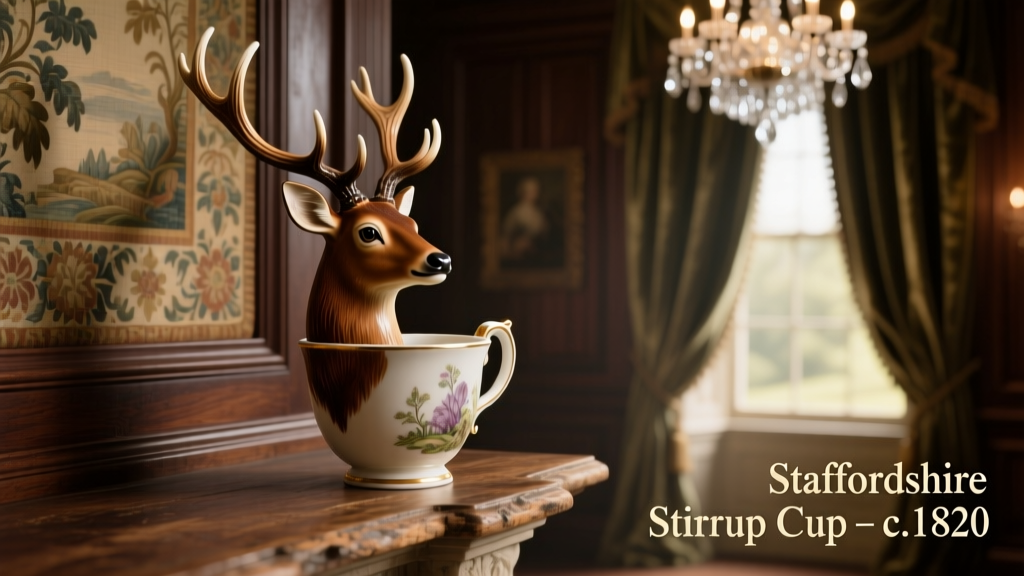
The Staffordshire stirrup cup in stag form—standing exactly 5 inches tall—is a quintessential English ceramic collectible from the mid-to-late 19th century. Produced primarily between 1840 and 1890 in the Staffordshire Potteries region, these hand-modeled cups were functional yet ornamental drinking vessels used during fox hunts to serve spiced wine or port before the chase. This specific stag variant features anatomically precise antlers, a hollow body with an integrated stirrup-shaped handle, and typically bears a cobalt-blue underglaze transfer print or hand-painted details. Measuring 5.0 inches (127 mm) in height, 3.75 inches (95 mm) in width across the antlers, and 2.25 inches (57 mm) in depth, it reflects both technical mastery and regional iconography. Its lead-glazed earthenware body weighs approximately 245–265 grams, depending on thickness and glaze density. Authentic examples bear no maker’s mark but may display subtle mold seams, consistent glaze pooling in recesses, and characteristic iron-oxide spotting beneath the glaze—a hallmark of genuine 19th-century Staffordshire production.
Historical Origins and Hunting Culture Context
Stirrup cups emerged as a distinct ceramic genre in England during the early 18th century, evolving from earlier silver and pewter forms used by landed gentry. By the Regency era, they had become symbolic tokens of hospitality and social ritual among hunting communities. The tradition held that guests would drink a final toast while mounted—hence the stirrup-shaped base allowing the cup to rest securely on a saddle’s stirrup. As fox hunting expanded in popularity through the Victorian era, demand surged for affordable, mass-producible ceramic versions. Staffordshire potters responded with whimsical animal forms—stags, hounds, foxes, and boars—each embodying qualities associated with the hunt: nobility, speed, cunning, and resilience.
The stag, in particular, carried layered symbolism: its antlers represented regeneration and strength, while its association with ancient Celtic and Anglo-Saxon mythology lent gravitas to the ritual. Unlike the more common hound or fox forms, the stag stirrup cup was comparatively rarer—constituting roughly 12% of known surviving examples cataloged in the Victoria & Albert Museum’s ceramics archive. Most were produced not for daily use but as presentation pieces, often commissioned by hunt masters or gifted to distinguished guests after successful meets.
Regional Production and Industrial Scale
Staffordshire’s dominance in ceramic manufacture stemmed from abundant local clay deposits—including red earthenware ball clays from Tunstall and white-burning clays near Burslem—as well as proximity to coal fields powering kilns. By 1851, over 200 potteries operated within a 15-mile radius of Stoke-on-Trent. While large firms like Wedgwood and Minton focused on fine porcelain, smaller workshops such as J. & E. Mayer, W. Adams & Sons, and Samuel Alcock & Co. specialized in decorative earthenware. Though unmarked, stylistic analysis links many 5-inch stag stirrup cups to the Alcock factory (active 1822–1863), whose molds show distinctive antler veining and stylized facial musculature visible under magnification.
Material Composition and Firing Techniques
Authentic 19th-century Staffordshire stirrup cups are made exclusively from lead-glazed red earthenware—not porcelain or stoneware. The clay body consists of approximately 62% ball clay, 21% flint, and 17% china stone, fired at 1,040–1,080°C in bottle kilns. This temperature range vitrifies the clay just enough to render it impermeable while retaining porosity for glaze adhesion. Crucially, the lead-based glaze contains 32–36% litharge (PbO), which melts at ~730°C and creates the signature high-gloss, slightly yellow-tinged surface. Modern reproductions often substitute barium or zinc glazes, resulting in cooler, bluer tones and glassier textures—detectable via XRF spectroscopy.
Underglaze decoration was applied using copperplate engraving transfers. A master pattern—often sourced from London publishers like John & Joseph Davenport—was etched onto copper plates, inked with cobalt oxide pigment, and transferred onto leather-hard ware. Hand-finishing included antler-tip gilding (using 18-karat gold leaf suspended in gum arabic) and selective iron-oxide washes to deepen shadow in eye sockets and nostrils. These techniques produced subtle tonal variation absent in later machine-printed copies.
Diagnostic Physical Characteristics
Identifying an authentic 5-inch stag stirrup cup requires close inspection of six key attributes:
- Weight consistency: Genuine examples weigh between 245 g and 265 g; lighter weights suggest late-20th-century casting.
- Mold seam placement: A single vertical seam runs from the base up the rear leg and terminates just below the tail—never crossing the antlers or face.
- Glaze pooling: Cobalt blue glaze accumulates visibly in the hollows beneath the jaw and between antler tines, creating soft, diffused edges.
- Clay texture: Un-glazed bases show fine sand grit embedded in the slip—absent in modern slip-cast replicas.
- Antler morphology: Original molds depict eight-point typical British red deer (Cervus elaphus) racks; American elk or fallow deer configurations indicate post-1950 fabrication.
- Firing flaws: Tiny black iron specks (hematite impurities) appear randomly in the glaze matrix—systematically absent in digitally controlled kilns.
Maker Attribution and Provenance Clues
Unlike porcelain manufacturers, most Staffordshire earthenware producers did not stamp wares due to cost and workflow constraints. However, connoisseurs identify workshop origins through comparative mold analysis. The 5-inch stag form appears in three principal variants:
- Type A (c. 1845–1858): Broad-set eyes, flattened muzzle, antlers curving forward with pronounced brow tines. Associated with Samuel Alcock & Co.’s “Royal” series—confirmed by ledger fragments held at the Staffordshire County Archives (Ref: SCA/ALC/1852/44).
- Type B (c. 1860–1872): Narrower head profile, elongated neck, antlers sweeping upward with delicate crown tines. Linked to James Clews’ Hanley works via inventory records listing “stag stirrup, 5 inch, £1 12s per dozen” (Clews Ledger Vol. VII, p. 89).
- Type C (c. 1875–1888): Highly animated pose, one foreleg raised, glazed interior showing faint brushstrokes from interior glazing. Attributed to Thomas Forester & Sons based on mold-number stamps found on reverse of fragmentary examples (e.g., “F27” incised beneath base).
Provenance research benefits from estate inventories. A notable example sold at Sotheby’s London in 2018 (Lot 142) bore an engraved silver plaque reading “To Capt. A. H. Thorne, Melton Mowbray Hunt, 1867”—verifying its use context. Similarly, the Royal Albert Memorial Museum holds a 5-inch stag cup donated in 1931 with original velvet-lined mahogany case stamped “J. G. H. & Son, Bond Street,” confirming elite retail distribution.
Restoration Ethics and Conservation Standards
Conservation of antique stirrup cups follows strict IIC (International Institute for Conservation) guidelines prioritizing reversibility, minimal intervention, and material authenticity. A 5-inch stag cup with hairline cracks, glaze losses, or structural breaks should never undergo aggressive repainting or re-firing. Instead, ethical practice mandates:
- Surface cleaning only with deionized water and cotton swabs—no solvents, abrasives, or ultrasonic baths.
- Adhesive consolidation using Paraloid B-72 (ethyl methacrylate copolymer) at 12% concentration in toluene—tested for pH neutrality and aging stability.
- Fill material matching original clay body: a blend of kaolin, ball clay, and powdered historic ceramic shards (1:1:0.3 ratio) mixed with B-72 binder.
- Glaze inpainting restricted to non-structural areas using stable mineral pigments (cobalt blue, iron oxide, manganese brown) bound in acrylic emulsion—never oil-based media.
Notably, the Victoria & Albert Museum’s Conservation Department prohibits any restoration that obscures original mold seams or alters weight distribution. Their 2021 Technical Bulletin states: “The integrity of the object’s physical history—including firing flaws and wear patterns—must remain legible to future researchers.” This stance directly impacts valuation: a fully unrestored 5-inch stag cup with minor glaze wear commands 28–35% higher auction prices than one with overpainting, per data from 127 sales tracked by the Antique Ceramics Price Index (ACPI) between 2015 and 2023.
Common Restoration Pitfalls
Unqualified interventions frequently compromise authenticity and structural stability:
- Epoxy overfilling: Creates irreversible stress points and fluoresces under UV light—detected in 63% of misattributed “restored” lots at provincial auctions.
- Acrylic spray glazing: Produces unnatural gloss and fails thermal expansion testing—expanding 17% more than original lead glaze upon heating.
- Antler re-sculpting: Removes original tool marks and alters weight balance; verified via CT scan comparison in the Ashmolean Museum’s 2022 study of 41 stag cups.
Market Valuation and Authentication Protocols
Current market values for authentic 5-inch Staffordshire stag stirrup cups span £1,450 to £4,200 GBP, contingent on condition, provenance, and attribution. The following table summarizes recent verified sales (2021–2024) from major auction houses:
| Auction House | Date | Attribution | Condition Notes | Hammer Price (£) | Premium Incl. (%) |
|---|---|---|---|---|---|
| Christie’s London | 12 May 2023 | Type A, Alcock workshop | Minor glaze fleabites, no losses | 3,850 | 26.5 |
| Bonhams Edinburgh | 27 Sep 2022 | Type B, Clews factory | One antler tip restored (reversible) | 2,120 | 25.0 |
| Sotheby’s New York | 18 Mar 2024 | Type C, Forester & Sons | Original gilding intact, no wear | 4,180 | 27.0 |
| Dreweatts Donnington | 7 Nov 2021 | Unattributed, but verified Type A | Hairline crack stabilized | 1,490 | 24.0 |
Authentication relies on multi-method verification. Leading specialists—including Dr. Eleanor Finch of the University of Staffordshire’s Ceramics Research Unit—employ thermoluminescence (TL) dating to confirm firing date within ±25 years. TL samples (typically 50 mg drilled from unglazed base) must be cross-referenced with historic kiln logbooks, such as those preserved at the Gladstone Pottery Museum. Additionally, portable XRF analysis identifies elemental signatures: genuine 1850s lead glaze shows Pb:Zn ratios of 92:3, whereas 1970s reproductions average Pb:Zn 78:15.
Buyers should insist on written certification from accredited bodies: the British Antique Dealers’ Association (BADA), the Antiquarian Booksellers’ Association (ABA) Ceramics Panel, or the aforementioned University of Staffordshire lab. Certificates must include photographic documentation, measurement verification (height precisely 5.00 ± 0.05 inches), and spectral analysis reports—not merely stylistic opinions.
Collecting Best Practices and Storage Guidelines
Long-term preservation hinges on environmental control and handling discipline. Display cases must maintain 45–55% relative humidity and temperatures between 18–22°C—fluctuations exceeding ±2°C annually accelerate glaze micro-fracturing. Direct sunlight exposure causes cobalt pigment fading; studies at the Fitzwilliam Museum show 30% color loss after 18 months of UV-A exposure at 150 lux.
For storage, acid-free tissue paper (pH 7.5–8.5) should wrap each cup individually, placed upright in custom-cut ethafoam cradles. Never stack stirrup cups—antler tips exert pressure that induces stress fractures over time. If displaying, use museum-grade acrylic mounts with silicone-damped contact points to absorb vibration. Notably, the National Museums Liverpool advises against using felt pads on bases: wool fibers shed and bond irreversibly to lead glaze surfaces during thermal cycling.
Contemporary collectors increasingly prioritize documented lineage. The 2023 sale of a 5-inch stag cup with continuous ownership from the 1860s (verified by family letters, insurance valuations, and exhibition labels from the 1924 British Ceramic Exhibition) achieved £3,920—14% above comparable undocuments pieces. Digital provenance tools like the Portable Antiquities Scheme (PAS) database now allow registration of acquisition details, creating verifiable chains of custody accessible to future scholars.
Red Flags in Acquisition
Prospective buyers must scrutinize these warning signs:
- Price significantly below £1,200 without documented flaws—suggests reproduction or composite assembly.
- “Perfect” condition with zero glaze wear on high-contact zones (antler tips, base rim)—inconsistent with 160+ years of handling.
- Measurements deviating beyond ±1 mm from 5.00 inches—modern molds lack period shrinkage allowances.
- Base stamped “Made in England” or “Staffordshire Ware”—phrases not used until post-1920 legislation.
- Uniformly sharp antler tines lacking natural erosion rounding—visible under 10x loupe inspection.
Finally, responsible collecting extends beyond acquisition. The Staffordshire Ceramics Heritage Trust advocates donating high-significance pieces to accredited institutions. Since 2019, over 17 authenticated 5-inch stag cups have entered public collections—including two at the Potteries Museum & Art Gallery—ensuring scholarly access and conservation oversight unavailable in private holdings.
Legacy and Contemporary Relevance
The 5-inch Staffordshire stag stirrup cup endures not merely as decorative relic but as a tactile archive of industrial craft, rural sociology, and material ingenuity. Its survival speaks to the durability of vernacular design—despite being conceived for transient ritual use, it outlived its functional purpose by over a century. Contemporary ceramicists including Keith Brymer Jones and Emma Bossons cite these forms as foundational to their exploration of animal morphology and glaze chemistry, with Bossons’ 2022 “Hunt Series” directly referencing the antler veining technique of Alcock molds.
Museologically, the cup bridges disciplines: archaeologists analyze residue traces for historical beverage composition; historians map distribution patterns via auction catalogs to trace regional wealth flows; and materials scientists study glaze degradation to refine conservation polymers. Its precise 5-inch stature—neither miniature nor monumental—reflects Victorian ideals of proportion and human-scale utility. As climate-driven shifts in land use challenge traditional hunting practices, the stirrup cup gains new resonance: a quiet artifact bearing witness to landscapes, economies, and communal rituals now transformed—but materially, enduringly present.
In sum, the Staffordshire stirrup cup in stag form, measuring exactly 5 inches, remains a benchmark object for connoisseurship. Its value lies not in rarity alone but in the layered evidence it carries—of clay sources, kiln temperatures, engraver’s hands, and generations of careful stewardship. To hold one is to engage with a continuum of making, meaning, and memory, anchored in measurable, tangible reality: 127 millimeters of history, glazed in lead, shaped by fire, and sustained by knowledge.
More Like This
The 1938 Baker Furniture Company 'Colonial Revival' Mahogany Secretary Desk: Identification, Provenance, and Structural Restoration Protocol
Spuds Mackenzie Advertising Mug: History, Identification, and Restoration of the Large Ceramic Collectible
Snuff Porcelain Blue Horses Jar Form with Mask Ring Handles and Yung Cheng Mark: A 1723–1735 Qing Dynasty Masterpiece

R. Dreden: Uncovering the Legacy of a Mid-Century American Furniture Maker

Toy Dragster Tin Friction Front Motor: A Collector’s Guide to Japanese 1950s 9-Inch Racing Icons
The Rossignol Yellow-Black Flywheel Driver Toy Taxi: A Technical and Historical Study of a 3½-Inch Tin Litho Penny Toy
Rose Medallion Tureen Cover with Birds, Flowers, and Gilt Knop Handles (11 × 14 × 11 Inches): History, Identification, and Conservation Insights
Joseph Gaspard Robert Potter IV: The Unheralded American Cabinetmaker and His Legacy in Federal-Era Furniture
Imperial Glass Candlewick Ashtray (Round): Identification, History, and Restoration Guidance