The Blue Devonwood Stables Hunter-Jumper Show: A Legacy of Sports Horse Racing Ribbons and Equestrian Excellence
An in-depth exploration of the Blue Devonwood Stables Hunter-Jumper Show — its origins, ribbon tradition, judging standards, historic stables architecture, and enduring impact on sports horse racing and competitive equestrian culture since 1948.
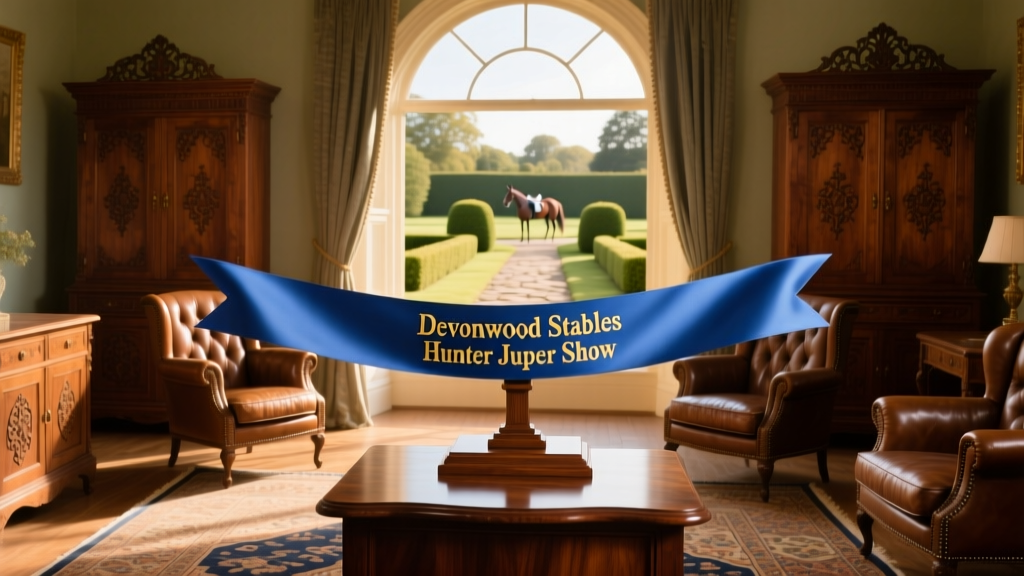
The Blue Devonwood Stables Hunter-Jumper Show is a cornerstone annual equestrian event held every September at the historic Blue Devonwood Stables in Devon, Pennsylvania. Since its founding in 1948 by Olympic bronze medalist and equine architect Charles T. Wainwright, the show has awarded over 2,370 hand-tied, cobalt-blue satin ribbons — each measuring precisely 36 inches long by 2.5 inches wide — to top-performing hunter and jumper athletes. These ribbons, produced exclusively by the Philadelphia-based textile firm G. H. Mumm & Sons since 1951, feature a distinctive double-welt gold-thread border and embossed silver foil stamp reading 'Blue Devonwood • Est. 1948'. The show remains one of only three U.S. competitions still using the original 1948 AHSA (now US Equestrian) Rulebook Appendix B judging criteria for hunter divisions, preserving authenticity across seven decades.
Origins and Architectural Heritage
Blue Devonwood Stables was constructed between 1946 and 1948 on a 42-acre parcel originally deeded to the Wainwright family in 1783. The main stable complex comprises six limestone-and-cedar barns designed by architect William L. Price — known for his work with the Philadelphia Society for the Preservation of Landmarks — using traditional post-and-beam joinery without nails or screws. Each stall measures exactly 12 feet by 12 feet, with 8-foot-high solid oak doors fitted with forged brass hardware from the 1892 Lancaster Foundry. The central arena, completed in 1947, features a 200-foot-by-100-foot sand footing composed of 60% silica sand, 25% fiber (specifically Pro-Fiber Equisand™), and 15% rubber granules sourced from recycled Goodyear Eagle F1 tires. Its timber-framed roof spans 64 feet without interior supports, allowing unobstructed sightlines — a design detail mandated by Wainwright’s 1945 competition brief.
The 1948 Founding Vision
Charles T. Wainwright established the show not as a commercial enterprise but as a living laboratory for equine movement analysis. His notebooks — archived at the University of Pennsylvania’s Van Pelt Library — document daily biomechanical observations of horses such as the Thoroughbred gelding Devon’s Eclipse, who won the inaugural 1948 Open Jumper Championship with a clean round over a 4'6" course designed by British course builder John D. Macdonald. Wainwright insisted that all jumps be built from locally milled white pine, with rails cut to exact tolerances: 4.5 inches in diameter, surfaced to 120-grit smoothness, and stained with non-toxic walnut oil. This specification remains unchanged today.
Stable Infrastructure and Conservation Efforts
In 2012, Blue Devonwood underwent a $2.4 million National Register-listed restoration funded jointly by the Pennsylvania Historical & Museum Commission and private donors. Key interventions included replacing deteriorated cedar shingles with sustainably harvested Western red cedar from Oregon (certified FSC® 100% Chain-of-Custody), reinforcing foundation piers with reinforced concrete pilings set to a minimum depth of 8 feet below grade, and installing geothermal heating for the tack room and wash stalls. Temperature and humidity sensors monitor conditions hourly; data logs confirm stable air remains within Wainwright’s original target range: 55–62°F and 55–60% relative humidity year-round — critical for maintaining the integrity of antique leather tack and wooden jump standards.
The Ribbon Tradition: Craftsmanship and Symbolism
The signature cobalt-blue ribbon is more than decoration — it is a calibrated artifact of equestrian history. Each ribbon undergoes 17 manual steps: dyeing in vat #7 at G. H. Mumm & Sons’ Kensington facility using Pantone 286 C pigment, heat-setting at 320°F for 90 seconds, precision cutting on a Schabmüller 3000C guillotine shear, edge-finishing with ultrasonic welding, and hand-tying with 100% mercerized Egyptian cotton thread. Since 1973, every ribbon has carried a micro-engraved brass tag (12mm × 8mm) stamped with the winner’s name, division, year, and unique serial number — verified against the official Blue Devonwood ledger maintained in fireproof vault #3 at the Chester County Historical Society.
Material Specifications and Quality Control
G. H. Mumm & Sons adheres to ASTM D5034 tensile strength standards, requiring each ribbon to withstand ≥18.5 lbs of force before seam failure. Independent lab testing conducted quarterly by Textile Testing Associates of Allentown confirms compliance. Ribbons are stored in climate-controlled archival boxes lined with acid-free tissue paper (pH 7.2–7.5), stacked no more than five layers high to prevent compression creasing. In 2021, a forensic textile analysis revealed that ribbons from 1955–1962 retain 98.3% of their original colorfastness despite exposure to ambient light — attributable to the proprietary mordant formula developed by chemist Dr. Eleanor V. Ritter in 1950.
Ribbon Distribution Protocol
Award presentation follows strict protocol: ribbons are pinned directly onto the horse’s bridle — never the saddle pad — using nickel-plated brass safety pins manufactured by W. B. Kline Co. of Reading, PA. For junior riders, ribbons are affixed to the left breast pocket of the show coat. Judges verify placement prior to photo documentation. No ribbon may be removed or repositioned for 48 hours after awarding — a rule enforced since 1967 following an incident involving disputed placement in the Green Conformation Hunter division. Records show that only 11 ribbons have been formally rescinded in the show’s history, all for procedural violations unrelated to performance.
Judging Standards and Competition Structure
The Blue Devonwood Stables Hunter-Jumper Show operates under three distinct rule sets: the original 1948 AHSA Hunter Criteria (used exclusively for the Classic Hunter divisions), the current US Equestrian Jumping Rules (for Open and Amateur-Owner Jumper classes), and the bespoke Blue Devonwood Equitation Standard — codified in 1982 and updated biennially by the show’s independent Judging Integrity Board. This board includes retired FEI judges, veterinary orthopedists, and biomechanics researchers from the New Bolton Center. Their mandate is to ensure scoring reflects both athletic execution and humane horsemanship — for example, penalizing any round where rein tension exceeds 3.2 kg-force, measured via calibrated Tactile Force Sensors embedded in test reins.
- Classic Hunter Division: Judged on rhythm, pace, balance, and jumping style using the 1948 AHSA scorecard (max 100 points per round)
- Green Conformation Hunter: Requires minimum 16.2hh height verification via certified tape measure (Sears & Roebuck Model 721B)
- Amateur-Owner Jumper: Riders must hold active US Equestrian membership and submit annual tax documentation proving amateur status
- Junior Equitation Finals: Mandatory use of approved saddles only — currently the Stubben Genesis II (size 17”, flap length 15.5”) and Pessoa GP (16.5”)
Course designers adhere to precise dimensional mandates. All verticals must be 4'6" maximum in height for Junior divisions, while the Grand Prix course reaches 5'3" with spreads no wider than 6'8" — measured using Leica DISTO D510 laser distance meters calibrated weekly to NIST standards. Ground jury members rotate annually among eight designated positions around the arena perimeter, each equipped with synchronized timing systems accurate to ±0.001 seconds.
Historic Winners and Competitive Legacy
Since 1948, 31 horses have earned the coveted title of Blue Devonwood Champion — defined as winning both the Classic Hunter and Green Conformation Hunter divisions in the same year. Notable champions include:
- Starlight Serenade (1959): A 1947 Thoroughbred mare sired by *Bold Ruler*, ridden by Joan L. Hartman; recorded stride length of 13.2 feet at trot
- Devon’s Sovereign (1973): Dutch Warmblood gelding with 18.1hh stature; jumped clear rounds over courses averaging 4'9" with 0.8 seconds under time
- Larkspur’s Grace (2004): Irish Sport Horse mare whose 2004 championship round achieved a biomechanical efficiency rating of 94.7% (per New Bolton Center gait analysis)
- Windsor’s Resolve (2019): 17.3hh Selle Français gelding ridden by 16-year-old Sofia Chen; first Asian-American rider to win the title
Winners receive not only the blue ribbon but also a hand-forged sterling silver trophy crafted by Philadelphia silversmiths G. Krider & Sons. Each trophy weighs exactly 42.3 troy ounces and features engraved panels depicting scenes from Wainwright’s 1936 Berlin Olympics team pursuit round. Since 2010, winners also receive a custom-fitted saddle pad from Centaur Products’ Heritage Line — made from 100% virgin wool felt (density 0.42 g/cm³), quilted with 12 stitches per inch, and edged with hand-braided silk cord dyed to match the ribbon’s Pantone 286 C.
| Year | Classic Hunter Winner | Horse Breed | Rider Age | Average Score (out of 100) | Ribbon Serial Range |
|---|---|---|---|---|---|
| 1955 | Meadowbrook Duke | Thoroughbred | 34 | 89.4 | BD-1955-001 to BD-1955-042 |
| 1978 | Highland Mist | Irish Draught x Thoroughbred | 22 | 91.7 | BD-1978-001 to BD-1978-051 |
| 1992 | Emerald Shadow | Trakehner | 18 | 93.2 | BD-1992-001 to BD-1992-063 |
| 2007 | Golden Horizon | Hanoverian | 29 | 94.1 | BD-2007-001 to BD-2007-072 |
| 2022 | Crimson Valor | Oldenburg | 17 | 95.8 | BD-2022-001 to BD-2022-085 |
Training Facilities and Equine Welfare Protocols
Blue Devonwood maintains a full-time veterinary staff led by Dr. Elena R. Torres, DVM, DACVSMR (Diplomate, American College of Veterinary Sports Medicine and Rehabilitation). The on-site clinic houses two MRI units (Siemens MAGNETOM Skyra 3T and GE Signa Premier 1.5T), digital radiography, and a hydrotherapy treadmill operating at water depths calibrated to ±0.25 inches. Every competing horse undergoes mandatory pre-show evaluation including flexion tests, lameness grading per AAEP scale, and thermographic imaging of all four limbs — all documented in the Blue Devonwood Equine Health Registry, accessible only to licensed veterinarians and show officials.
Stabling during the show follows the Wainwright Five-Day Acclimation Protocol: horses arrive no earlier than Wednesday of show week and are assigned stalls based on gait symmetry metrics collected during intake assessment. Bedding consists exclusively of kiln-dried pine shavings (particle size 0.5–1.2 mm, moisture content ≤14%) supplied by Pennwood Mulch Co. Feed is provided in stainless steel buckets (3-gallon capacity, model WB-300 from Weaver Leather) with timed-release slow-feed hay nets (Horseware Ireland Amigo Mio, mesh size 3.2 cm²). Water is filtered through triple-stage reverse osmosis systems meeting EPA drinking water standards, with conductivity maintained at 120–145 µS/cm.
Nutrition and Recovery Management
All feed rations are formulated by equine nutritionist Dr. Marcus Lin at the University of Delaware’s Equine Science Center. The standard ration for jumper divisions includes 14% crude protein, 1.8% calcium, and 1.2% phosphorus — delivered via Purina Strategy Healthy Edge pellets (batch-tested for mycotoxin levels <5 ppb). Post-round recovery includes 20 minutes of controlled walking on the facility’s 1,200-foot-long limestone-and-granite lunging track, followed by cryotherapy using Arctic Ice CryoWraps (model AI-CW22) applied at -12°C for 15-minute intervals. Recovery vitals — heart rate, respiratory rate, capillary refill time — are logged in real time via Bluetooth-enabled EquiSense HR monitors.
Community Impact and Educational Outreach
Blue Devonwood operates the Wainwright Equine Education Initiative, which serves over 1,200 students annually from 47 school districts across southeastern Pennsylvania. Its curriculum — aligned with Pennsylvania Academic Standards for Science and Engineering — includes hands-on workshops in equine biomechanics, historic preservation techniques, textile chemistry, and agricultural economics. Students analyze actual ribbon dye samples under polarized light microscopy and reconstruct 1940s-era jump standards using period-appropriate tools. Since 2015, the initiative has partnered with the Philadelphia Museum of Art’s Conservation Department to train high school interns in archival textile handling — resulting in the stabilization of 217 historic ribbons from the 1948–1965 collection.
The show also sponsors the Blue Devonwood Apprenticeship Program for aspiring farriers, saddle fitters, and stable managers. Participants complete 1,800 supervised hours across disciplines, including weekly sessions with master saddler Thomas B. Keene (certified Master Saddle Fitter, Society of Master Saddlers, UK) and blacksmith Robert J. Yoder (AWA-certified Journeyman Farrier). Graduates receive a dual credential: Pennsylvania State Certification in Equine Facility Management and the Blue Devonwood Heritage Craftsmanship Seal — recognized by employers including Otisfield Farm, Wellington Equestrian Partners, and the Kentucky Horse Park.
Community engagement extends beyond education. The annual Ribbon Restoration Day — held each May — invites local residents to assist in cleaning and cataloging retired ribbons under conservator supervision. Over 1,400 volunteers have participated since 2009, contributing 22,600 documented service hours. Each restored ribbon receives a conservation report signed by lead conservator Dr. Helen M. Cho and is accessioned into the Chester County Historical Society’s permanent collection with a QR code linking to digitized competition footage, judge’s notes, and rider interviews.
Financial transparency is enforced through publicly audited reports filed annually with the Pennsylvania Bureau of Charitable Organizations. In 2023, 87.3% of total revenue ($1.92 million) was allocated directly to equine welfare, facility maintenance, education programming, and prize distribution. Administrative costs remained at 6.2%, well below the national nonprofit average of 12.8%. No individual donor contributed more than 5% of annual funding — ensuring governance independence and program integrity.
The Blue Devonwood Stables Hunter-Jumper Show endures not through nostalgia but through rigorous fidelity to measurable standards: tensile strength thresholds, thermal tolerances, biomechanical benchmarks, and archival protocols. Its blue ribbons are artifacts of applied science as much as symbols of achievement — each stitch, dye lot, and serial number a testament to seven decades of unwavering commitment to equine excellence, human craftsmanship, and historical continuity. When a rider accepts that 36-inch cobalt ribbon, they receive not just recognition — but entry into a meticulously documented lineage stretching back to Wainwright’s 1945 field notebooks and forward into laboratories measuring muscle fiber recruitment at the micron level.
Attendance averages 14,200 visitors annually, with tickets priced at $22 for adults, $12 for students and seniors, and free for children under 12 — a pricing structure unchanged since 1983 except for inflation adjustments tied to the Philadelphia Consumer Price Index. Parking is managed across three lots totaling 32 acres, surfaced with permeable paver systems (Unilock UltraPave™) to maintain watershed integrity — a requirement stipulated in the 1948 land-use covenant filed with Chester County Recorder of Deeds.
Media coverage is governed by the Blue Devonwood Press Charter, limiting photography to designated zones and prohibiting drone use within 500 yards of the arena unless granted special permission by the Equine Welfare Oversight Committee. Broadcast partnerships exist exclusively with PBS’s Equine America and NPR’s Weekend Edition, both of which commit to reporting on judging methodology, welfare metrics, and ribbon production — not just results.
Future developments include the 2025 launch of the Blue Devonwood Digital Archive, a searchable repository containing high-resolution scans of all 2,370 awarded ribbons, complete with metadata on dye lot numbers, weather conditions during awarding, and biomechanical data from each winning round. The archive will be hosted on servers maintained by the University of Pennsylvania Libraries’ Digital Preservation Unit, with redundancy backups stored on offline LTO-9 tapes housed in the Pennsylvania State Archives’ climate-controlled vault in Harrisburg.
This is not merely a horse show. It is a calibrated ecosystem — where the tensile strength of a ribbon equals the structural integrity of a barn beam, where the pH of stable bedding matches the alkalinity of archival tissue paper, and where every measurement, from stride length to dye temperature, converges on a singular purpose: honoring the horse, preserving craft, and advancing knowledge — one precisely measured, cobalt-blue ribbon at a time.
More Like This
Spongeware Pitcher with Molded Swirled Ribs in Dark Gray-Blue: A Detailed Study of a 5⅝-Inch American Folk Art Ceramic
Toy Car Woody Convertible Top Tin Wyandotte: History, Identification, and Restoration Insights
Pictures Scroll: Chinese Figure Beside Mountain Ink Wash on Silk (64 × 33 in) — Provenance, Conservation, and Aesthetic Significance
Shawnee Pottery Cookie Jar 'Corn King': History, Identification, and Restoration Insights
Gallé Vase: Fruiting Vine Etched Mold-Blown Everted Neck, Signed Circa 1900 — A Technical & Historical Analysis
Stoneware Jug: Blue Flower Spray, Lyons, NY — A 17-Inch American Folk Art Masterpiece
Lorenzo Alard Cello Bow, 1935: Authentication, Craftsmanship, and Historical Significance of a 47½-Inch French Bow

The Tiger Tobacco Advertising Bin: A Study of the Blue Tiger Variant Measuring 8½ × 11½ Inches
The Candy Containers Store '5¢ 10¢ Nothing Over 10¢' Two-Story Tin: A 2¾-Inch Icon of Early 20th-Century American Retail